Can Agents Run Ops Safer Than Humans? With AWS’s Deepak Singh
Summary
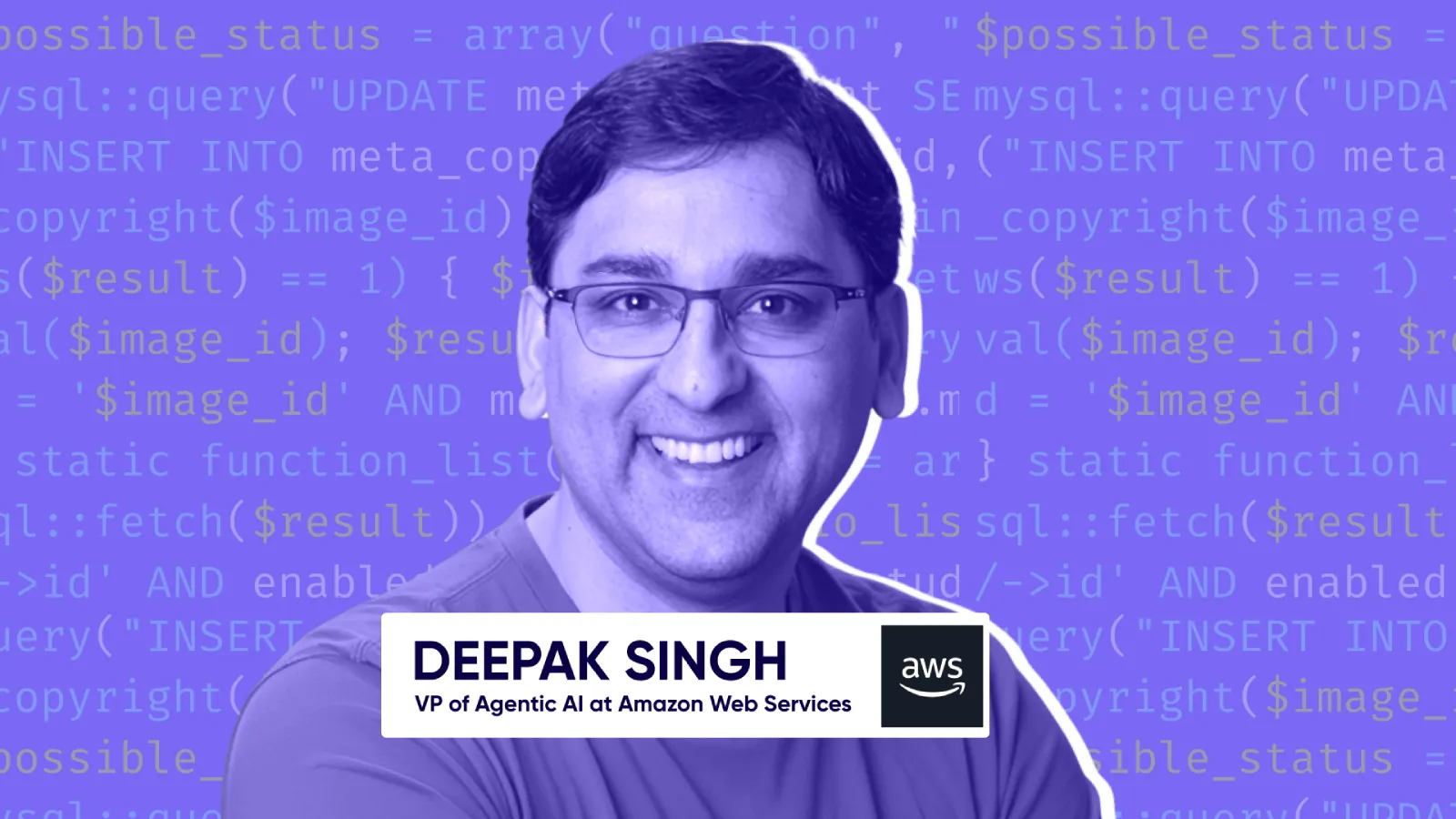
In this episode of The Agentic Review podcast, Deepak Singh, Vice President of Agentic AI at Amazon Web Services (AWS), joins Itamar Friedman and Nnenna Ndukwe to discuss what the cloud must guarantee when agents become the workers and why more than half of his customer conversations are about change management rather than models. Deepak also explains why teams that rethink their entire SDLC see 3 to 10 times gains while others see 10% to 30%, and how verifiers, policy, and formal methods let organizations give agents real responsibility without losing control.
this episode’s guest
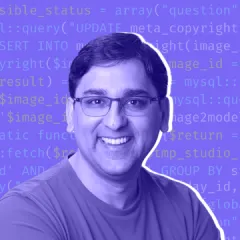
Deepak Singh is the Vice President of Agentic AI at Amazon Web Services (AWS), where he leads developer agents and Kiro, AWS’s spec-driven development environment. Before that, he helped build AWS’s container services businesses. That experience gave him a view of both the infrastructure that runs software and the agents that increasingly build it. Today, Deepak spends much of his time with engineering organizations working out how their practices, policies, and verification systems need to change to ship safely at agent speed.
Key takeaways
- Why AI exposes weak deployment and CI/CD practices instead of hiding them
- How policies and verifiers make agent-powered ops safer than human ones
- Where formal verification works for agent workflows today
- How to measure agent impact beyond velocity and defect rates
- Why the next 30 days should go to building trust
Chapters
- The 10x Gap Is Everything Else
- Agent-Powered Ops Can Be Safer
- Formal Verification for Agent Workflows
- Specs Are Now Written for Agents
- Super Agents and the 2 AM Page
- Slow Down to Speed Up
Transcript
[00:00:02] Deepak Singh: Trust that you can’t verify is just hope.
[00:00:05] Itamar Friedman: Welcome to The Agentic Review, the podcast where we explore what good code really means in the age of AI software development.
[00:00:13] Nnenna Ndukwe: I’m Nnenna Ndukwe, Developer Relations Lead.
[00:00:16] Itamar Friedman: And I’m Itamar Friedman, the co-founder and CEO of Qodo.
[00:00:19] Nnenna Ndukwe: So, let’s get into it.
[00:00:25] Itamar Friedman: Welcome to The Agentic Review podcast. Today’s focus is what the cloud must guarantee when agents become the workers, and what evidence should determine how much responsibility we can give and should give to our agents. Today, we’re joined by Deepak Singh, AWS Vice President of Agentic AI. Before leading developers, agents and Kiro, Deepak helped build AWS container service businesses.
[00:00:53] Nnenna Ndukwe: Deepak has worked on both sides of a change that engineering leaders are now confronting. The infrastructure that runs software and the agents increasingly building it. We want to understand what makes that combination trustworthy. So, Deepak, welcome to The Agentic Review podcast.
[00:01:10] Itamar Friedman: Great to be here.
[00:01:12] Nnenna Ndukwe: I would love to hear if there’s anything else you’d like to add to that intro, how we described you. Anything else that’s been top of mind that you’ve been working on lately, thinking about?
[00:01:21] Deepak Singh: Yeah, I think the two things that come to mind are how software organizations evolve to meet this agentic era. In fact, when I talk to customers, I would say more than half my conversations are on change management and what does it mean, in terms of how you build software, how your organizations have to approach it, and how engineers and engineering excellence change in this agentic era. It’s a very fun world to live in because all this change is happening at a velocity that I don’t think any of us have seen. But yeah, in addition to helping customers write software and build applications, that’s the other area where I spend a ton of time.
[00:01:56] Itamar Friedman: I have a nuanced question about change management. It’s kind of like a philosophy or a bet question. Should we avoid investing in codebase health? Because, anyway, like, everything is changing so fast. Like, in the past, maybe we would change 20% of the software over 5 years or 2 years if we’re really fast. And maybe these days, like, we’re changing 20% of the software every week. By the way, we have, like, some kind of statistics at Qodo that we’re noticing that contracts between microservices, on average, change 20% every week. That’s like amazing. So, kind of like that focus on change management – is that intentional, what you mentioned?
[00:02:40] Deepak Singh: I think so. Some of it is intentional. You see examples, like, you know, for Amazon software builder population, for software development engineers and software development managers, we actually published a new version of our role guidelines about how they should think about and how we think about that practice. I consider it a changing practice, almost like anything else. And over the last year and a half or so, we’ve developed some good ideas on what that means. And so we published that on Amazon.com, but I think there are two parts to it. Yes, it is very easy to change code when you have an ongoing dynamic project. For example, one of our products is Kiro Crew. It’s an open-source project, and you can see the rate of change with Crew. I run the nightly build of Crew, and it changes at a remarkable rate. But it’s brand new. It’s mostly client-side software, and the contracts are different. When you have services that have been around for years, or when you are at a place, like many of our customers, where you do not necessarily have the right CICD practices in place to deploy that software, you have to be more conscious about it. In fact, one of the best discussions I have with customers has nothing to do with AI. It’s: if you want to manage change, there are some basic health practices. Health – you use that word. But healthy practices that you need to have. Like, how do you deploy software? If you’re changing software 20% every week, but you can deploy only like 1%, it’s kind of pointless. How do you make sure that as you’re doing these deployments, nothing is breaking? Do you have great observability, and do you have the great signals to go back and make changes based on what you’re seeing? It’s the kind of thing that the AWS DevOps agent helps you to do. And it’s actually an area where you spend a lot of your time verifying the code. That’s the part that you have to be very, very conscious about. Because you could argue that for many applications, especially applications that have been written in the last 4 or 5 years, it’s actually easier to just rewrite it than to modify it. And I’ve seen many examples of that. On the flip side, if you have a 25-year-old codebase in some archaic version of Java, and it’s a codebase that the whole company, maybe your entire business, depends on, and you are still doing manual change management, like deployments, etc., you can’t and shouldn’t; you have to change that part first before you can take advantage of the other. And that’s the balance I think a lot of our customers, and I suspect people you talk to, are having to deal with.
[00:05:11] Nnenna Ndukwe: Yeah. I think, like, what’s interesting about that is we’ve kind of had similar takes. I think as exciting as AI is, there are certain practices that you have around DevOps and their software development life cycle that, if they’re not in good condition, without AI, introducing AI or more of it at scale could only exacerbate some of those issues and make it more obvious. So, it sounds like it’s kind of similar to what you were referring to with change management.
[00:05:41] Deepak Singh: Yeah. And in fact, one of the things I’ve heard from engineers or organizations that have really adopted AI for building the software part is that when you’re building software with AI, and you figure things out, all the practices that you had that slowed you down in the past, the impedance mismatch was not that high, so you didn’t notice it. Now you notice it. So, I’m hoping, actually, in sort of a positive way, that for many organizations this change that they have to do and go for, because they won’t see the benefits, and you hear about it all the time. And we have some really good examples of that within Amazon, where we’ve done studies across teams over a period of time. This is a study that Amazon Retail did last year where half the teams saw 10% to 30% improvements in productivity. This is a while ago, so things have changed quite a bit since then. But the other half was seeing 3 to 10 times improvements, and some even more than that and the difference was everything else. How you put the AI into it. If you just put an AI tool into the existing SDLC, you’ve got a little bit of improvement. If you really rethought how you built software, how you got it deployed, how you change things, then you see that 10-times improvement. So, it’s not a free lunch. But if you think about it, and if the best practices you start seeing upsize impact, and that’s a great place to be.
[00:07:04] Itamar Friedman: This really resonated with me. Like, Nnenna and I are having an initiative to write a software factory engineer job description: SF, Software Factory Engineer. And even though that software factory engineer we noticed that the times we wrote the words, like, the AI was actually very low, the AI adoption is here as a means for acceleration of delivering more and better quality of software, but it’s not the purpose. So, it kind of, like, strikes for us when we’re writing such a quote-unquote buzzword in AI that software factory, but still we almost didn’t use the words AI in it because when you’re thinking about software as a whole, there are so many other professions and parts of the SDLC that you need to consider that are still there and they will be, and they’re critical.
[00:08:01] Deepak Singh: Yeah, absolutely.
[00:08:02] Nnenna Ndukwe: I would love to switch gears into talking more about the cloud. I would love to hear your perspective on what happens now in the cloud with agents at the scale at which we’re using it and plan to use it. What are your thoughts on that? And then we can go from there.
[00:08:20] Deepak Singh: Yeah. In general, you can stipulate that the volume of change and the velocity of change are both going to go up a lot. And once you understand what to do with that change and how to manage it, you know, things that you used to spend time on because, oh, this is going to take too long, or I have to provision these large infrastructure-as-code stacks and make sure everything is working in theory. And if you’re an experienced engineer, you will think twice about what could go wrong. You spend a lot of time making sure that the things that don’t go wrong don’t go wrong. But if you slow down, you write the protections around it. Like, how do you make sure that any change is verified? How do you make sure that you can trust changes? Once you’ve put all that in place, the time to go from I need to make this change to the change actually happening is the speed at which the agent operates. So, if you do the right things, getting your testing in place, review in place, your policies in place, you are going to move much, much faster because you don’t have to slow down. You can trust your results because you built in the belts and suspenders, if I can use that term. And in the end, the argument is that agent-powered operations can actually be safer than human-powered ones if you have your permissions right, if you have your policies right. Policy is such an important part of all of this. If you have the right supervisor agents with the right steering files and the right guidance in place, there’s a lot of errors that people make, especially in what we call fog of war. You have to make an emergency deployment, for example. It’s why we tell a lot of teams to slow down before they speed up. Because in many ways the role of an engineer or an operator is changing to building these protections around what they’re doing. And so, you are defining what building with precision means, what delivery with precision means. You’re not setting things up the old-fashioned way. And once you can do that, a bunch of things that you used to hesitate doing, or spend a lot of time on and repeat, disappear. We are starting to see that. I think the more AI-forward organizations are already there, but most organizations are heading into that direction. But they have to understand this part first. Set up things upstream, get all your verifiers in place, like, get your policy management in place, then you can start running.
[00:10:34] Nnenna Ndukwe: I think that, kind of, you’re answering also the next question I had about trusting AI-generated changes at scale. And so you’re basically saying, like, all of these systems and processes that need to be in place would actually give you confidence about the quality of the code and the rate at which it’s shipping. That’s something that you can invest a lot of your time in order to trust the AI-generated code.
[00:11:02] Deepak Singh: Yeah. And the practices around that are evolving also because the tooling is so much better than it was even 6 months ago. And quite honestly, LLMs are way better at following instructions than they used to be, and that actually makes it even easier. And this is the best part: they’re only going to get better over the next year. So, I have a feeling over the next 6 months to a year, this velocity step change, which has happened for some people but not for the broader industry. It’s going to happen.
[00:11:30] Nnenna Ndukwe: Yeah. That is a fascinating point because I would say the same thing: like, maybe 7 months ago, I was starting to dig into formal verification and hearing about, okay, which, you know, startups are looking to bring on mathematicians to help solve this for software engineering because of how much AI-generated code that we have and that we’re going to continue to create. And it didn’t seem as promising then as it does now. And I think that the LLMs, what you’re saying, improving significantly over time has something to do with it. But I would love to know your thoughts on formal verification for agent workflows.
[00:12:10] Deepak Singh: Yeah, it’s funny, we just published a blog post just before we got on air about using Lean to do formal proofs on our harness and the Kiro world. But that’s a science team looking at the codebase and learning and figuring out what bugs and what they can prove and what they can’t prove. Where formal verification is really important in the agentic workforce today is in two areas. One is policy. We’re open-sourced. This is available in agent core policy. It’s a system called Dogwood. Dogwood is used at design and requirements time. It fundamentally drives things like sandbox policy. That’s why I love it. Like, policy is such an important part; you could argue, you mentioned software factories. Software factories, in many ways, are all around policy. What are things allowed to do? How do you express them? Those expressions can completely be formally verified. You can do that today. Things like Dogwood allow you to do that. If you have a bunch of people who know Lean, you can use Lean to write some proof for the system that you have. In Kiro, we have this thing called requirements analysis where you look at a specification, and you apply a bunch of solvers and formal methods to make sure that that specification actually meets your prompting and the specification is actually aligned. Are there ambiguities or inconsistencies in that? What other questions are you not asking? And then if you take that further, you look at things like property-based testing and fuzzing. Those can also apply formal methods, and you can do all kinds of things. I think where this is going to end up is in… So, things you can prove today are: is your agent running in an isolated sandbox? Are the policies correct? Like that you can verify. And that’s an area where automated reasoning has been really successful for a while. Where we are going to end up is: at a system level, can you verify change? Like, if here’s a CLI command, is it a correct CLI command that actually is kind of there now? But if I make a change in this system, here, in this component of a system you mentioned, microservices, which are changing all the time, can we verify this is not going to break some other part of the system? Those will take some more time because they’re expensive. You can do them in hobby projects today. But I think, as an industry, we are heading in that direction is how can we have LLMs help us scale that to a level where you don’t need to have an army of PhDs who know Lean and B and Dafny and all the languages that the community uses. And I don’t understand, but those are very powerful techniques all of us are going to end up using.
[00:14:38] Itamar Friedman: Totally. And if I may, like, take a step back in case some of our audience are not familiar, explain it like I’m 5 for formal verification, if that’s okay to ask.
[00:14:50] Deepak Singh: Yeah. You know, as much about this thing as I do. When I think about formal verification, it’s: can I write a mathematical formalism that can prove that the thing that you wanted to do is actually what’s happening? So, the thing that I would love to see someday is, for example, you have a specification in Kiro; is the output code. You can test if, functionally, you know, it’s passing a set of tests. But can you formally, mathematically prove that the code generated is doing what the intent was? You can do that at small scale. You can’t do that at large scale today. But the interest we have in formal verification allows you to do that. We talked about policy a lot. What policy languages like Dogwood do is that when you write a policy, they can mathematically verify. There are some solvers running at the back. This is a valid policy. Like, you can verify that nothing bad will happen. At AWS, we’ve used it in policy and security for a very long time. Network Reachability Analyzer is a great example. Is this an actual network-reachable endpoint with the policies that you apply? Those are things you can do and prove? That’s what formal verification is.
[00:15:57] Itamar Friedman: Yeah. Awesome. I feel like it’s worthwhile for anyone to dig a little bit into it because when you invest into it, you might change how you work. For example, Kiro is a spec-driven development, right? And maybe we can work with Kiro so that our specs are more aligned and better suited for formal verification. So, we don’t know everything about the seven layers of the Internet at each level or whatever. But I think being aware of the interfaces and their capabilities and so on can actually change how we work because we want to get to those small blocks of verification so we get more trust in AI-generated code. So, I feel like it’s a very important field. I have a feeling that we’re going to hear even more about it as we do; like, I’m going to invent a field, a quasi-formal, like, even things that are not purely formal, or can be described in a formal way, AI could help us to transform it to almost formal. And if you like, there is a probability of error and not complete assurance that nothing is going to happen. But reducing the probability of error by turning a spec or intent or so to quasi-formal, I feel like it’s going to be a big thing as we progress into efficient software factoring.
[00:17:32] Deepak Singh: Absolutely. I mean, in fact, if you think about the way things have changed in the last 6 months, like, the way you used to deal with specs. Also, if you go back to Kiro when we launched it last year in July, a spec was a very human-facing thing. It’s helping a human write down the requirements in a Markdown file in a structured way. Because at that time, agents were terrible at following instructions. Right? It was so early. LLMs used to go in their own random ways. So, we were providing specificity that the agent could check back against; you’re converting that into a set of designs that the agent would have to follow and then a set of tasks. Today, your specifications are much more for the agent. The agent can write its own spec based on goals that they’re giving it. Because you have, I call it the conductor pattern, where you take a supervisor agent which has all your rules and guidelines and policies all defined. It has a bunch of sub-agents and tools it knows to access, and which ones under what conditions; you submit something to the supervisor. At the end of it, you write a verifier. Like, I think that’s the most important part. The verifier could be: I’m not comfortable enough; please let me know, and do not make any progress until I say yes as a human, right? Or your central organization could set that policy. But your verifiers can be probabilistic or statistical. They can be a set of testing. They can be formally verified approaches. Like, I think this pattern, and you mentioned software factories – I’m not the biggest fan of the term, but I think about it as: how do you scale automated software development, goal-driven, intent-driven development, to an organization? And in the end, it’s all around how do you write these verifiers and policies and let the agents do their thing?
[00:19:11] Itamar Friedman: Yeah. Totally. I feel I have to defend the software factory. I have to. Give me a chance. Okay. Give me a chance. Okay. So, I did talk about, for example, agents in 2022, 2023, and, by the way, I got one of my blog posts, like, one comment saying, “Dude, you’re hallucinating.” And you know, it’s now above my bed, like, printed. And I do agree that maybe speaking about software factory now is almost like speaking about agents in 2023 was, if you remember the AutoGPT moment.
[00:19:45] Deepak Singh: Yeah. I remember that one.
[00:19:47] Itamar Friedman: But I think if we bounded it, almost like we put it into frameworks, like, there’s L0, L1, L2, L3, L5, and a lot of times, I feel like people are not doing the best framing, you know, or something like that. Yeah. And instead, I think, like, I’m seeing L4 bounded software factory as a specific area in your software development that you managed to close 99% of the development work, automate that, all the hard things, all the boring stuff that we talked about that are not pure code generation and connect them all and then having a system that is able to raise, like in a factory, to warn, “Hey, there’s something here that requires your human judgment.” It’s not dark, you know, lights off. It’s basically a specific area that you can put an intent. You get the planning, you get the generation, you get the verification, you get it to production, you get automatic monitoring, you get the fixes, but being done automatically, you get the architecture, you get additional verifiers being built over time. But when things are not concrete, or there’s ambiguously, or there’s a high blast radius of decisions, then it’s raised to a human. That’s it. I think that’s, like, the…
[00:21:14] Deepak Singh: Oh, yeah. I agree with that, I mean. Yeah. In fact, the Kiro Crew team has 2 blog posts that they wrote over the last month or so. The first one is: how did a team of 3 engineers work at 1000 PR a week? They work at amazing velocity, and they apply this pattern that we talked about. It’s not that different from software factories. I mean, I may not love the term, but I think the industry is going to use it. So, I’ll end up. They called it a software factory in that blog post, but it is about how do you build a system that allows you to make as much progress as you can without human intervention. And the second blog post is how do you build trust in your verifiers and in the system so that you don’t. 1000 PRs a week with 3 engineers; you’re not doing code reviews, right, manually? It’s not working. How do you bring in the adversarial agents? How do you set up? How do you write the tests? How do you design your repos? All of those become critically important, and I think that’s where I’d say the practice is changing because that’s different, so different from how engineers worked even a year back.
[00:22:14] Itamar Friedman: Yeah. Totally. By the way, I guess, like, not doing the code review as it was, and it makes sense, and I guess like there are agents that are doing maybe low-level code review, and then maybe the engineers are doing more high-level code review. Maybe it’s more like software review. I’m kind of thinking that maybe that’s how we’re going to look on things. It’s like I’m not looking on every diff, but I’m looking on, I’m still reviewing the software. I even think that the pull request unit, the merge request unit, might change to more like a work package review. Like, I’m working on 15 PRs all at once, and I’m doing more of, you know, surgical-like checks and high-level design review than every diff or something like that.
[00:23:02] Deepak Singh: Yeah. I actually think the other thing that’ll happen, and it’s happening, as far as I can tell, with the more advanced teams is that agents can also be told to help you figure out what they want you to take a second look at. This actually are things like formal methods and quasi-formal methods can become really important, you can build confidence scores. It’s kind of what that spec analysis that we have in Kiro does. It’s basically giving you confidence, and I know this is right, and here I have 60% confidence that this is right; take a look at it. And it may be a diff; it might be a change set, and a change set could include infrastructure; it could include tests. As you said, the package is different – what you look at. It could be that your steering files didn’t have enough information for me to make the right thing. So, it’s a fascinating world. I mean, I’m hardly a developer, but even the things I do every day, I notice myself starting to operate like that. Like, the things I look at are different, and you know, and actually, the other part is that memory and context are critical because in systems that build up memory and context over time, your agents are going to be better 2 months down the road than they were when you started using them because you told them what’s good.
[00:24:15] Nnenna Ndukwe: Yeah, I think, I mean, we’re talking about a few different types of, I guess, AI architectural components and Itamar and I were recently, I would love Itamar, if you could actually describe the super agent. We were talking about DeepSeek’s article that just came out on X. So, for the listeners, if we could get a definition of that and then dive into, you know, a bit more, get your perspective on super agents.
[00:24:42] Deepak Singh: When somebody talks about the word super agent, I almost feel like, in some ways, super agents and software factories are getting synonymous, and you have a set of agents that can work towards a goal autonomously. And the way I like to think about it is, you know, we had announced, through an autonomous agent, re:Invent last year. And the goal of the Kiro Autonomous agent. I like to joke, since you’re on that term, that we should have just called it a software factory at the time because what does it do? It is an automated system. It’s mostly designed to be a hands-off system. You connect it to a repo. As issues come in, it publishes a pull request. In fact, when we first started building it, we used to call it idea to PR or issue to PR. And the idea is very similar. You have an automated system. The goal is defined by the issue, and the output is a pull request. And everything in the middle is completely autonomous. Your agent is making decisions. 6, 9 months ago, that was a big deal. Today, agents work that way. So, a super agent becomes: how do you take context bigger than what that agent has for that piece of code? So, it’s not just my context; it’s my organizational context. What the CISO in the company might want to do is bring in some design system and knowing when to do it, and so, when you have things like, actually, the best example is probably something like the AWS DevOps agent or our Continuum security agents, which I suspect you’re familiar with. And what the DevOps agent does is, one of the features it has is that it does incident response. Alarms are running, things are running, an alarm goes off, your on-call gets paged in the middle of the night, and by the time they get to their laptop or computer, wherever they are at home, half awake, a set of hypotheses have been built, have been set in front of you, saying this is what you need to do to fix it. Because based on the metrics that you have, based on all the telemetry you have, based on the code-based review that I did, in the system, this is where the problem is. And here’s the fun part. If you are a well-designed organization, the rollback has already happened, and they are just root-copying based on what’s happening. Your running system is already fine because your code, if you do a bad deployment, for example, rollbacks happen, your system’s running. If it’s not, you want to get to it very quickly. And when you’re half awake in the middle of the night, you want all the information that you can get. We know organizations have started off by running things like the DevOps agent in shadow mode. So, they would still make the human get up and do an investigation and let the DevOps agent do the investigation. At some point in time, they realize, hang on, 90% of the time this test works, or 99% of the time and only in certain conditions it may require some human intervention. You have the guardrails in there anyway, and you’re getting to a point where they’re like, okay, this is the first line of defense. The human is actually the last cop; he’s there to make sure that in the end everything is okay. That’s a radically different way of thinking about it. And as agents, the biggest difference in AI from last year, from January to now, is that in January, you were still telling the agents what to do, which agents to call. Going back to the Kiro Autonomous agent, we never actually launched it as the Kiro Autonomous agent. It’s just a feature of Kiro because now you just have agents that delegate, and they do the work for you. That’s just how agents are working now. And I think that’s a fundamental change is the delegation part is easy because that’s how agents and LLMs are able to work. It’s how do you make sure that you have all the guardrails in place to go from point A to point B without intervention. It’s like actually the way you define the software factory, level 4 of self-driving and that’s a great place.
[00:28:19] Itamar Friedman: I think the biggest question is why is it always happening at 2 am and if we keep collecting that data of 2 am and then I fear that the agents and LLM also will continue push for that hour because that’s their bias.
[00:28:32] Deepak Singh: And in fact, if you’re a company like Amazon where we have every cause of error documented, every best practice documented, here’s the world you want to get to, and this is where agents are going to get to. It’s not about responding to an incident; it’s making sure it never happens, right? Like, when you’re writing code, you’ve got all the context on previous COEs that says, “If you do that, bad things happen.” It may be from an org that you’ve never spoken to in your life, but if it’s there, good things will happen. Like, no, if you write that code at your current scale, you’ll be fine, but eventually you’ll reach a scale where this is going to flip over; don’t do that. Or set an alarm where, if you get to this much traffic, you may need to go revisit your architecture. Something like that.
[00:29:13] Itamar Friedman: I love it. Sorry. I love this notion. I want to double-click because I have an interesting discussion with customers about it as well, that, a lot of time, like, people are looking when they’re coming to review specific agents, like we were talking a lot about super agents, agent crew and all that. So, let’s just for the sake of this discussion of metrics, like, that there’s like an agent that’s response responsible of code review. So, one way is to looking on the micro of thing like how much acceptance rate, precision, recall and so on. But I love some of the discussion looking at the macro and saying, like, how many outages, like, while I’m pushing for more and more PR and, like, better speed, higher speed. I’m not calling it velocity intentionally. Do I see less support or more support? Less like P0, or outages, or less. And I think that’s critical. It’s almost like the ultimate reward function. Like, it is a bit late, and there are more items that are interfering with it or influencing it. But I think it’s really critical to check it, so it really resonates with what you’re saying. Like, of course, we want, like, better, less comments, more human-like, more agent-first. I’m mixing and matching a lot of requests, but eventually I just want to have more features and actually less incident, less 2 am and while there’s not always a direct connection, or an easy direct connection that can be made, it’s definitely something we’re recommending everyone to watch.
[00:30:54] Deepak Singh: In fact, when we talk to customers, I mean, take examples. You know, you have customers like Siemens that are building fully production-ready AWS serverless guardrails. You have auth dashboards, complete infrastructure; you can build it in two weeks. It’s an architect; they’re using Kiro for that. When you build all of these, and you’re running them, there’s two ways to think about it. And one of the things you get with leaders is, okay, what’s the output, what’s the outcome? A year or so ago, I used to tell them, “Look at the outcomes that you cared about already, which is velocity and CR velocity, pipeline velocity. Those are still useful metrics. You should have them. Defect rates, because you want to track defect rates. You used to do that with humans; you’re definitely doing that with agents as well, seeing the impact.” But I actually think the real unlock comes as these companies and the ones that we work with are switching towards adding in business and other outcomes. The way I like to think about it is every business unit has a different goal. VP of Engineering may care about everything I just said. Your CFO may care about a reduction in the cost it takes to ship a feature, like, you know, as an example, or the dollars per feature that they’re able to get. Somebody who is working on an internal infrastructure team may care about something else. You know, a GM may care about revenue that the product has because they’re able to ship more often. I think one of the things we like to do is give people all the raw telemetry and help them connect those things because your classic metrics are still useful. But they’re not sufficient because they’re working at an unusual level of velocity, and it has to make an impact at that level. And we are starting to see people do that. I mean, again, the AI-forward teams and companies are kind of there, and the early ones have been doing it for a few months. Others will catch up at some point in time.
[00:32:39] Nnenna Ndukwe: Yeah. We’ve kind of covered, I mean, this goes into the ops I’ve been thinking about, like ops-driven, or really it’s ops data-driven agentic engineering, and how that can come from observability and production triage, any of the patterns of what failed before, and how can we preventatively generate code? How can AI preventatively generate code based on that context so that we don’t reinforce that and can prevent and see those embrace go down?
[00:33:08] Deepak Singh: Yeah. The other thing that’s useful and becomes very important is evals. You kind of hinted at it earlier is, as part of a deployment process, you actually want evals in there because you want to know what it’s going to do and it’s going to pass a set of gigs. It’s not just tests; it’s evaluation criteria. And the evals can be anything. That’s why one of the core things we did with Agent Core was to ship Agent Core evals because every team building agentic software wanted that. Every customer shipping agentic software wants that. And you know, you could call eval a form of verification as well. But it’s even more important that you’re going hands-off.
[00:33:46] Itamar Friedman: Totally agree. As someone who is coming from the machine learning world, I always thought about the following. 99.9% of the software was deterministic to most extent. So, let’s not talk about networking and all, but there’s business logic, and then you need tests; they’re deterministic as well. Again, we can talk about flakiness and so on, and then, that software 1.0 and then software 2.0 we kind of like had machine learning models taking some of the work and then we had evolved that are specific for that. In software 3.0, I think we are talking about machine learning and software really coming together really strongly in many ways in production. The software itself is dynamic. Machine learning is being used during software development, heavily. And so, therefore, we need the concept of evals that were on the machine learning part, on the models themselves. We need them now on the software as a whole. And one of the things that you learn when you took machine learning to scale, it’s not just one thing. It’s usually like multiple evals with multiple metrics that you want to cover, and that connect or close or round out the discussions really, really well. You have multiple verifications. One of them is evals that are, you know, maybe more semantic, more business logic, more, etc., and all of this together is what gives you the trust and confidence that you can do things like more automatically, end-to-end.
[00:35:22] Deepak Singh: Yeah. I mean, I think the key part is trust that you can’t verify is just hope. Like, I think I’ve heard people say that. And you want to bring in the right tools that are deterministic at the right points. It could be calling an API, using a CLI, making sure that the set of tools available to an agent is well defined. It can’t randomly call a tool or do a web search. It has to call a set of tools that you know and you trust. Those are all very, very important things. And you know, an eval could be that it passes the business metric. An eval could be that it passes a very specific verification gate. There are so many things that are able. I would argue even decision models fall into that category. They are smaller. They’re not LLMs in the classic sense. So, your logic can be defined as a decision model, and you’re giving it a score. It’s going back to your probabilistic thing, and you can take action based on that. So, I think the tooling and capabilities over the last 6 months have evolved to a point where, if people aren’t thinking at that level, I would encourage them. And this conversation I have all the time is that it’s not that we are waiting for this to get to a place where we can do that. It’s there now. I say that every 6 months, but I genuinely believe it. And we are seeing it in action. We are seeing it with our customers. We see it with folks like SmugMug, we see it with customers like Delta, and it’s kind of great to see.
[00:36:44] Itamar Friedman: Awesome.
[00:36:45] Nnenna Ndukwe: I think we might be able to. We’re going to start wrapping this up because, what you’re talking about here, I’m sure there’s some gems that will be really good takeaways. I would like to know, like, for engineering leaders who are listening to this, what would you want to tell them that they need to focus on in the next 30 days on their journey to reaching the dream or the goal of autonomous agents for software factories? What do they need to know? What do they need to focus on?
[00:37:15] Deepak Singh: Yeah, I would say two things: slow down to speed up. Build the systems in place that help you build trust. Because without trust, you cannot make progress. If you are building a software factory, but you cannot trust the results of that software factory, the output, in a meaningful way, you’re not going to make progress. So, slow down to speed up. Build the right set of verifiers, build your steering files, write down your specifications and intent, put policies in place around what tools can be used, how things can be run, what an agent is allowed to do. Once you get to that point and you’ve created all of that, then the tooling to actually go ahead and tell an agent, here’s what I want to accomplish. You know, whether it’s with, we have Kiro workflows, for example, you can tell a Kiro workflow, “Hey, I want to write a piece of software that does XYZ and at the end of it, bring in our adversarial agent to do a security review or something like that.” Or use an MCP server from you folks, for example, or a tool that allows somebody to do that. That’s normal now. It’s not hard. It doesn’t require some special skill. The part that is still ‘art’, or I would say ‘craft’, probably a better word, is knowing how to set that up front. And there’s always a temptation that we can now run at 200 miles an hour. But I think to get to that 200 miles an hour or 10,000 miles an hour, pick your speed in a way that you can trust, and you can say, yep, I’m happy with it. My leadership is happy with it. Our customers are going to be happy with it. You have to build those systems in place. That might require you to slow down for 4 to 6 weeks, but that’s worthwhile.
[00:38:52] Itamar Friedman: Amazing.
[00:38:53] Nnenna Ndukwe: I think, now, with what you just said, where can listeners find more of your work? I mean, you’ve spoken a lot about, I think, some blogs from Kiro. Is there anywhere where we can find you and keep following along?
[00:39:05] Deepak Singh: I would definitely recommend the Kiro blog. It’s kiro.dev/blog/. I would look at kiro.dev/changelog/ because it moves so quickly. So, what new is coming in for me? I’ve started talking about some of these things on Twitter. My handle is x.com/mndoci. And because it’s a very fascinating world that we live in, I get to talk to a lot of customers about what’s on top of their minds. So, it’s not just about what Kiro can do for you, but from talking to customers and, as a practitioner myself, both at work and at home. Agents are changing every aspect of our lives, not just the coding part. The mental models are actually very similar. The outcome of something may be different, but the mental models are not that different. And so, that’s where I end up talking about them.
[00:39:50] Nnenna Ndukwe: I love that. I think one of the threads through this conversation is some of the principles of engineering, the principles around processes and change management and people and culture that can impact the ability for us and engineering orgs to achieve higher-quality software, you know, at scale and building the right things securely. It seems like there’s a thread here, so thank you so much, Deepak, for joining us on The Agentic Review podcast. This was incredible. We touched on so many extremely relevant topics that so many leaders, engineers, and practitioners need to hear right now, so we really appreciate that.
[00:40:30] Deepak Singh: Well, thanks for having me.
[00:40:32] Itamar Friedman: If today’s conversation challenged how you think about AI and code quality, that’s the point. At Qodo, we believe that independent, context-aware code review with rules as guardrails is how engineering teams maintain standards at scale. If you’re leading an enterprise team and want to see how intelligent AI code review can reinforce governance, visibility and accountability in your workflow, visit qodo.ai to learn how we help teams turn AI productivity into production-ready quality. And if you enjoyed this episode, subscribe, share it with your engineering leadership circle and leave us a review. Until next time. Keep humans in the loop, and keep shipping.
About the hosts