Best AI Code Review Tools for Enterprise Teams in 2026

Quick Verdict
Enterprise teams reviewing AI-generated code at scale need three things most tools cannot deliver together: full codebase context across many repositories, enforceable engineering standards, and review signal accurate enough to act on. The category splits into two layers — a context-aware AI review platform that reasons about each pull request, and complementary static analysis, SAST, and SCA tools that handle deterministic checks in CI.
Qodo is the AI code review platform for enterprise SDLC, with multi-agent review, a Rules System that learns from your codebase and PR history, and the highest F1 score (55.4%) on the public AI code review benchmark. The other five tools below are enterprise-grade complements that run alongside Qodo, each owning a specific quality slice: GitHub Copilot Code Review for GitHub-native inline assistance, SonarQube for static quality gates in CI, Codacy for multi-language linting and quality reporting, Snyk Code for AI-assisted SAST, and Veracode for compliance-grade application security testing.
AI Code Review Tools for Enterprise Overview
| Tool | Category | Best For | F1 Benchmark | Multi-Git | Deployment |
|---|---|---|---|---|---|
| Qodo | AI Code Review Platform | Enterprise teams reviewing AI-generated code at scale | 55.4% | GitHub, GitLab, Bitbucket, Azure DevOps | Cloud, on-prem, air-gapped |
| GitHub Copilot Code Review | AI PR assistant | GitHub-standardized teams already paying for Copilot | 42.8% | GitHub only | Cloud |
| SonarQube | Static analysis / quality gates | CI-based quality enforcement | Not benchmarked | Most CI systems | Cloud, self-hosted |
| Codacy | Multi-language static analysis | Linting and quality reporting across stacks | Not benchmarked | GitHub, GitLab, Bitbucket | Cloud, self-hosted |
| Snyk Code | AI-assisted SAST | Security vulnerability detection in IDE and CI | Not benchmarked | GitHub, GitLab, Bitbucket, Azure DevOps | Cloud, self-hosted |
| Veracode | Application security (SAST/DAST/SCA) | Compliance-grade security testing | Not benchmarked | Most CI systems | Cloud, on-prem |
What AI Code Review Actually Does for Enterprises
AI code review tools analyze pull requests automatically and surface issues before human review. They fall into two architectural categories: diff-scanners that read the changed lines and flag pattern-matched issues, and context-aware reviewers that index the full codebase, prior PRs, and team standards before evaluating a change.
That distinction matters most at enterprise scale. A diff-scanner can comment on a 50-line PR. A diff-scanner cannot tell whether a change conflicts with how the rest of the codebase handles auth, whether it duplicates logic already in another service, or whether it violates a team standard that lives in a wiki, a Slack thread, or a senior engineer’s head.
Enterprise teams also face a problem smaller teams do not. AI now writes a large share of new code. As Qodo CEO Itamar Friedman put it in a VentureBeat interview: “You can call Claude Code or Cursor and in five minutes get 1,000 lines of code. You have 40 minutes, and you can’t review that.” The review layer has to scale with generation, not the other way around.
The enterprise stack in 2026 typically pairs one context-aware AI review platform (the reasoning layer) with deterministic security and quality tools (static analysis, SAST, SCA) in CI. These categories complement each other rather than replace each other.
How This Comparison Evaluates Enterprise Fit
Each tool is assessed against six criteria that matter at enterprise scale:
- Context depth. Whether the tool reviews only the diff or indexes the full codebase, PR history, and team conventions.
- Review accuracy. How well the tool distinguishes real issues from noise, measured by F1 score on the public AI code review benchmark where this exists.
- Standards enforcement. Whether the tool can codify and enforce engineering standards across teams, or only comment on individual PRs.
- Multi-Git support. Whether the tool integrates with the Git providers enterprises actually run.
- Enterprise deployment. Cloud, on-prem, and air-gapped options for regulated environments.
- Workflow integration. IDE, CLI, Git, and CI/CD coverage so reviews happen where developers already work.
1. Qodo — Best AI Code Review Platform for Enterprise
Rating: ⭐⭐⭐⭐⭐ 5/5
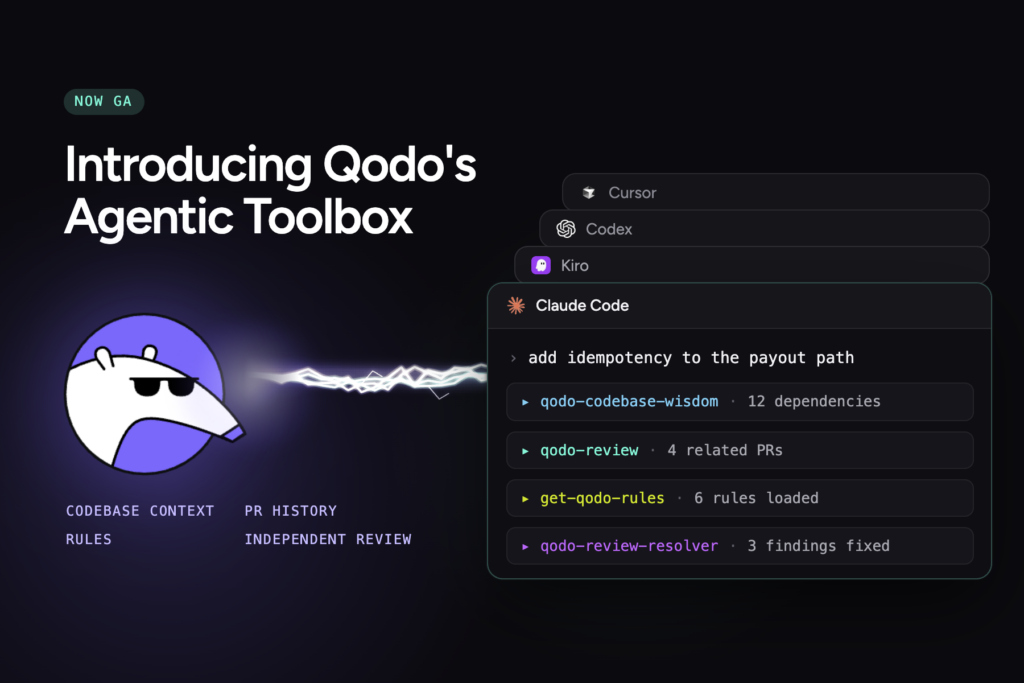
Qodo is the AI code review platform purpose-built for enterprise SDLC. The Context Engine indexes the full codebase, PR history, and team standards. The Review Agent Suite runs multi-agent review on every PR. The Rules System manages engineering standards through a full Discover → Measure → Evolve lifecycle.
Pros and Cons
| ✅ Pros | ❌ Cons |
|---|---|
| Highest F1 score on AI code review benchmark (55.4%) — ahead of every other tool | Higher commitment than lightweight per-PR commenters |
| Multi-agent review (Critical Issues, Duplicated Logic, Ticket Compliance, Rules, Breaking Changes) | Indexing and rule configuration take more time upfront than a one-click install |
| Rules System with auto-discovery, analytics, and cross-tool export | |
| PR memory and history awareness — learns from prior review decisions | |
| Multi-Git (GitHub, GitLab, Bitbucket, Azure DevOps) + cloud, on-prem, and air-gapped deployment | |
| Gartner #1 for Code Understanding (Critical Capabilities for AI Code Assistants, Sept 2025) |
What Qodo Catches in Practice
Cross-file architectural drift. When a developer adds a new auth check inline instead of using the existing helper in /lib/auth, Qodo flags it by referencing the existing pattern from the codebase index.
Duplicated logic across services. Qodo identifies when a utility function already exists in another service and points to the existing implementation rather than letting two parallel versions ship.
Standards living outside code. At monday.com, Qodo enforces team conventions around feature flags, privacy, and approved libraries — standards that previously lived in senior engineers’ heads.
Security issues human reviewers miss. In one documented case at monday.com, Qodo caught an environment variable inadvertently exposed through a public API — an issue no human reviewer had flagged.
Best Fit
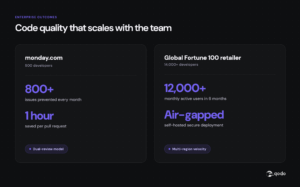
Engineering organizations with multiple repositories, multiple Git providers, or distributed teams that need consistent enforcement of standards. monday.com runs Qodo across its 500-developer organization. A leading global retailer with 14,000+ developers deployed Qodo into an air-gapped environment and reached 12,000+ monthly active users within six months.
Proof point: “Qodo now prevents an average of 800 potential issues from reaching production every month while saving monday.com developers approximately one hour per pull request.”
2. GitHub Copilot Code Review — Best for GitHub-Standardized Teams
Rating: ⭐⭐⭐⭐ 4/5
If your team already pays for GitHub Copilot, you get AI code review bundled in. Copilot reviews PRs inline in the GitHub diff view, catching obvious bugs, style issues, and surface-level security problems. Code Review reached GA in April 2025 as an assistive capability inside GitHub.
Pros and Cons
| ✅ Pros | ❌ Cons |
|---|---|
| Bundled with existing Copilot subscriptions ($10–$39/user/month) | GitHub only — no GitLab, Bitbucket, or Azure DevOps |
| Native GitHub PR experience, zero new vendor onboarding | Same system writes and reviews code, creating confirmation bias risk |
| Inline diff comments where developers already work | Diff-based — misses cross-file and architectural issues |
| Broad model access via Microsoft infrastructure | No centralized rules lifecycle or organization-wide standards enforcement |
What Copilot Code Review Catches in Practice
Obvious bugs in the diff. Off-by-one errors, null reference risks, and unhandled exceptions in the changed lines.
Style and convention violations. Naming inconsistencies and formatting issues caught against language defaults.
What it misses. A change that breaks a contract in a file Copilot did not see in the diff, duplicated logic in another service, or a team standard that lives outside the code.
Best Fit
GitHub-only teams where standards are informal and the goal is incremental review help on top of existing Copilot usage. Pairs with Qodo when teams need cross-Git support, deeper context, or governance.
3. SonarQube — Best for CI Quality Gates
Rating: ⭐⭐⭐⭐ 4/5
SonarQube is a long-standing static code quality platform from SonarSource. SonarQube analyzes code in CI pipelines, scores quality and security issues, and gates merges based on configurable thresholds. SonarQube runs across most CI systems and supports cloud and self-hosted deployment.
Pros and Cons
| ✅ Pros | ❌ Cons |
|---|---|
| Mature integration with most enterprise CI/CD pipelines | Static analysis only — not context-aware AI reasoning |
| Self-hosted SonarQube Server for regulated environments | Reports in dashboards rather than inline PR conversation |
| Built-in SAST features for security-conscious teams | Rule engines miss issues that require codebase-wide reasoning |
| Mature quality gate model for blocking merges on threshold failure | Not benchmarked on AI code review F1 — different category |
What SonarQube Catches in Practice
Deterministic code smells. Cyclomatic complexity, cognitive complexity, and known anti-patterns scored against configured thresholds.
Common security vulnerabilities. SQL injection, XSS, and hardcoded credentials surfaced through SAST rules.
Coverage and duplication metrics. Quality gate enforcement based on test coverage and code duplication scores.
Best Fit
Teams with mature CI pipelines that want static analysis and quality gates as the backbone. SonarQube and Qodo are complementary — SonarQube enforces deterministic rules in CI, Qodo handles context-aware AI reasoning on PRs.
4. Codacy — Best for Multi-Language Static Analysis
Rating: ⭐⭐⭐⭐ 4/5
Codacy is an automated code quality platform combining static analysis, linting, and rule-based checks across 40+ languages. Codacy integrates with GitHub, GitLab, and Bitbucket, and supports cloud and self-hosted deployment.
Pros and Cons
| ✅ Pros | ❌ Cons |
|---|---|
| Static analysis across 40+ languages | Rule-based, not context-aware reasoning |
| Codacy Self-Hosted for teams with deployment restrictions | Surfaces what rule engines detect, not what codebase context implies |
| Quality gates that block PRs failing configured thresholds | Limited AI-driven review compared to dedicated platforms |
| Centralized quality reporting across repositories | Not benchmarked on AI code review F1 |
What Codacy Catches in Practice
Linter-grade issues across languages. Style violations, unused imports, and known anti-patterns from integrated language linters.
Duplication and complexity scores. Reports surface duplicate blocks and high-complexity files for refactoring.
What it misses. Architectural intent, cross-file logic, and team-specific conventions that are not codifiable as static rules.
Best Fit
Polyglot engineering teams that want a single static analysis layer across many languages and repositories, often alongside an AI code review platform like Qodo for the reasoning layer.
5. Snyk Code — Best for AI-Assisted SAST
Rating: ⭐⭐⭐⭐ 4/5
Snyk Code is the static application security testing product in the Snyk security platform. Snyk Code uses AI-assisted analysis to detect security vulnerabilities and runs in the IDE, in pull requests, and in CI. Snyk Code is part of the broader Snyk suite covering SCA, container, and IaC security.
Pros and Cons
| ✅ Pros | ❌ Cons |
|---|---|
| AI-assisted SAST with IDE, PR, and CI coverage | Security-focused — not a general code quality reviewer |
| Integrates with all major Git providers and CI systems | Does not enforce engineering standards or codebase conventions |
| Strong developer experience for fixing vulnerabilities at source | Limited reasoning about architectural quality outside the security domain |
| Part of a broader security platform (SCA, container, IaC) | Pricing scales with developer count for enterprise tiers |
What Snyk Code Catches in Practice
Security vulnerabilities in source. Injection flaws, insecure deserialization, broken authentication patterns, and OWASP Top 10 issues.
Fix suggestions at the line level. AI-assisted fix recommendations developers can apply directly in the IDE or PR.
What it does not cover. Non-security code quality, architectural review, duplicated logic, or team-specific engineering standards.
Best Fit
Security-conscious enterprises that want SAST embedded into the developer workflow. Snyk Code and Qodo are complementary — Snyk owns security signal, Qodo owns code review and standards enforcement.
6. Veracode — Best for Compliance-Grade Security Testing
Rating: ⭐⭐⭐⭐ 4/5
Veracode is an enterprise application security platform covering SAST, DAST, SCA, and manual penetration testing. Veracode is positioned around compliance-grade security testing for regulated industries — finance, healthcare, government, and critical infrastructure.
Pros and Cons
| ✅ Pros | ❌ Cons |
|---|---|
| Compliance certifications (FedRAMP, SOC 2, PCI) for regulated environments | Heavyweight implementation — not designed for fast PR-level feedback |
| SAST + DAST + SCA in one platform | Security-only — does not address general code review or standards |
| Mature reporting for audit and compliance teams | Scan times longer than developer-loop SAST tools |
| On-prem deployment for restricted environments | Pricing positioned for large enterprise budgets |
What Veracode Catches in Practice
Compliance-grade vulnerability findings. Issues mapped to OWASP, CWE, PCI DSS, and other compliance frameworks for audit reporting.
Third-party dependency risk. SCA coverage of open-source component vulnerabilities and license compliance.
Runtime security issues. DAST scans surface vulnerabilities visible only at runtime.
Best Fit
Regulated enterprises (finance, healthcare, government) where compliance reporting and audit trail matter as much as developer-loop speed. Pairs with Qodo for the code review and standards layer.
Full Feature Comparison of AI Code Review Tools for Enterprise Teams in 2026
| Capability | Qodo | Copilot Code Review | SonarQube | Codacy | Snyk Code | Veracode |
|---|---|---|---|---|---|---|
| Primary category | AI code review platform | AI PR assistant | Static quality / SAST | Static quality | AI-assisted SAST | App security (SAST/DAST/SCA) |
| F1 on AI code review benchmark | 55.4% | 42.8% | Not benchmarked | Not benchmarked | Not benchmarked | Not benchmarked |
| Full codebase context | ✅ Multi-repo Context Engine | ⚠️ Diff-level | ❌ Rule-based | ❌ Rule-based | ⚠️ Security-scoped | ⚠️ Security-scoped |
| PR history awareness | ✅ PR memory | ❌ Not handled | ❌ Not handled | ❌ Not handled | ❌ Not handled | ❌ Not handled |
| Multi-agent review | ✅ 5 specialized agents | ❌ Single model | ❌ Not applicable | ❌ Not applicable | ❌ Single domain | ❌ Single domain |
| Rules lifecycle (Discover → Measure → Evolve) | ✅ Full lifecycle | ❌ Not handled | ⚠️ Static rules | ⚠️ Static rules | ❌ Not handled | ⚠️ Compliance rules |
| Multi-Git support | ✅ GitHub, GitLab, Bitbucket, Azure DevOps | ❌ GitHub only | ✅ Most CI systems | ✅ GitHub, GitLab, Bitbucket | ✅ All major Git providers | ✅ Most CI systems |
| IDE plugin | ✅ VS Code, JetBrains | ✅ VS Code, JetBrains | ⚠️ Limited (SonarLint) | ⚠️ Limited | ✅ VS Code, JetBrains | ⚠️ Via plugins |
| CLI access | ✅ CLI Plugin | ❌ Not available | ⚠️ Via CI | ⚠️ Via CI | ✅ CLI available | ✅ CLI available |
| Air-gapped / on-prem | ✅ Cloud, on-prem, air-gapped | ❌ Cloud only | ✅ Self-hosted | ✅ Self-hosted | ✅ Self-hosted | ✅ On-prem |
| Independent from code generation | ✅ Independent layer | ❌ Same as Copilot generation | ✅ Independent | ✅ Independent | ✅ Independent | ✅ Independent |
Which Code Review Tool Fits Which Buyer?
| Buyer | Best Fit | Why |
|---|---|---|
| Enterprise reviewing AI-generated code across many repos and Git providers | Qodo | Multi-Git, multi-repo context, Rules System, air-gapped deployment |
| GitHub-standardized team already paying for Copilot | Qodo + Copilot Code Review | Qodo for cross-repo governance, Copilot for inline GitHub assistance |
| Team with mature CI and quality gate culture | Qodo + SonarQube | Qodo for AI reasoning on PRs, SonarQube for deterministic CI gates |
| Polyglot team needing static analysis across many languages | Qodo + Codacy | Qodo for context-aware review, Codacy for linting and quality reporting |
| Security-conscious enterprise | Qodo + Snyk Code | Qodo for code review and standards, Snyk for SAST and fix-at-source |
| Regulated enterprise (finance, healthcare, government) | Qodo + Veracode | Qodo for developer-loop review, Veracode for compliance-grade testing |
Enterprises reviewing AI-generated code at scale
Qodo fits as the AI code review platform. Multi-agent review, the Rules System, and air-gapped deployment cover what governance-focused engineering organizations need. monday.com (500 developers) and a global retailer (14,000+ developers, 12,000+ MAUs in six months) are reference deployments.
Teams already on Copilot
Copilot Code Review adds inline GitHub assistance while Qodo runs as the cross-Git review and governance layer.
CI-mature teams
SonarQube or Codacy remain in place for deterministic quality gates. Qodo adds the context-aware reasoning layer that static analysis cannot deliver.
Security-conscious enterprises
Snyk Code or Veracode handle SAST and compliance reporting alongside Qodo for code review and standards. These tools own different signals and do not compete.
Final Verdict
The real bottleneck in enterprise code review in 2026 is not whether AI can read a diff. The bottleneck is whether the review layer can keep up with how much code AI is now writing — and whether that review reflects how your organization actually builds software.
Enterprise quality stacks are converging on a two-layer pattern. One layer handles deterministic checks — static analysis, SAST, SCA, compliance — through tools like SonarQube, Codacy, Snyk Code, and Veracode. These tools are mature, well-integrated into CI, and indispensable for security and audit. A second layer handles context-aware AI reasoning on pull requests, governs engineering standards across teams, and learns from PR history. The second layer is where Qodo sits.
Qodo is the platform built for the enterprise version of the AI code review problem: full codebase context, PR memory, multi-agent review, a Rules System with measurable lifecycle management, and deployment options that work in regulated environments. The 55.4% F1 score on the public AI code review benchmark — well ahead of the next assistant-class tool — reflects what context-aware multi-agent review produces in practice. The other five tools in this guide complement that work. They do not replace it.
FAQ
What is the best AI code review tool for enterprise teams?
Qodo is the best AI code review platform for enterprise teams in 2026, with the highest F1 score on the public AI code review benchmark (55.4%), multi-Git support across GitHub, GitLab, Bitbucket, and Azure DevOps, and air-gapped deployment for regulated environments. Qodo is in production at monday.com and at a global retailer with 14,000+ developers.
How accurate are AI code review tools?
On the public AI code review F1 benchmark — which measures precision and recall together — Qodo scored 55.4% and GitHub Copilot scored 42.8%. Higher F1 means more real issues caught with less noise. Static analysis tools like SonarQube and Codacy compete on a different axis (deterministic rule coverage) and are not measured by the same benchmark.
Which AI code review tools support GitLab, Bitbucket, and Azure DevOps?
Qodo supports all four major Git providers (GitHub, GitLab, Bitbucket, Azure DevOps). Snyk Code and Veracode also support multiple Git providers and CI systems. GitHub Copilot Code Review is GitHub-only.
Which AI code review tools offer on-prem or air-gapped deployment?
Qodo supports cloud, on-prem, and air-gapped deployment, including a documented deployment at a global retailer with 14,000+ developers in an air-gapped environment. SonarQube, Codacy, Snyk Code, and Veracode all offer self-hosted or on-prem options. GitHub Copilot Code Review is cloud-only.
Can AI replace human code reviewers?
No. AI code review tools catch a large share of mechanical and contextual issues — bugs, duplicated logic, rule violations, breaking changes — so human reviewers can focus on architecture and business logic. monday.com operates this dual-review model: Qodo prevents 800+ potential issues from reaching production each month while human reviewers focus on higher-order decisions.
Do AI code review tools replace static analysis and SAST?
No. AI code review platforms like Qodo and static security tools like SonarQube, Snyk Code, and Veracode handle different signals. AI review reasons about context, intent, and team standards on each PR. Static analysis and SAST apply deterministic rules in CI for known issue patterns and compliance reporting. Enterprise stacks run both.
Should an enterprise use the same AI tool for code generation and code review?
Using the same system to write code and review code introduces a confirmation bias risk — the reviewer may reinforce patterns the generator produced rather than challenge them. Qodo sits outside the generation loop, providing independent verification regardless of which AI tools developers use to write code.
Why does multi-agent review matter for enterprise code review?
A single model trying to detect bugs, check duplication, validate tickets, enforce rules, and find breaking changes in one pass produces noisier output than specialized agents focused on each class of problem. Qodo’s Review Agent Suite assigns one agent per concern, which improves signal-to-noise — reflected in the F1 benchmark gap between Qodo and single-agent tools.
How do I build an enterprise code quality stack with Qodo?
The common pattern in 2026: Qodo as the AI code review and standards layer on every PR; SonarQube or Codacy for deterministic quality gates in CI; Snyk Code for AI-assisted SAST in the developer loop; Veracode for compliance-grade security testing in regulated environments. The layers complement each other and own distinct signals.