How Qodo Builds the Wisdom to Govern, Part 1: The Context Engine

The first generation of AI coding tools was built around a simple loop: prompt, generate, accept. That loop works surprisingly well for producing code. It is much less reliable at deciding whether a change belongs in a real production system.
Code governance is the continuous work of keeping software aligned with an organization’s requirements, standards, architecture, and risk posture. It spans the full change lifecycle: defining policy, guiding developers (and now coding agents) before code is committed, enforcing standards in pull request review and CI, documenting exceptions, remediating issues, auditing outcomes, and learning from what happens after deployment. It cannot be reduced to a single review or prediction.
For AI-assisted software development, making reliable, context-aware software-quality decisions throughout the software development lifecycle requires more than a model, an index, or a database. Qodo combines several systems into an intelligence layer that enables organizations to govern software quality.
Each system has a distinct responsibility and lifecycle:
- Context Engine is Qodo’s knowledge and data layer. It is the basis for building a unified, evolving understanding of how an organization writes, reviews and governs code.
- Rules Lifecycle System brings order to context and defines “what good looks like” for an organization. It codifies tribal knowledge spread across .md files, wikis, documentation, design systems and review history into a self-learning, enforceable system.
- Multi-agent architecture is the reasoning layer that enables specialized agents to reason through context and judge which standards to enforce at which moment.
- Memory System provides the continuous learning and feedback loop that turns every review outcome into knowledge the system carries forward.
Together, these systems allow Qodo to move from reviewing a diff to governing change.
This first article in the series focuses on the foundation: the Context Engine.
Why the agentic SDLC needs a governance layer
Agentic development changes more than how code is written. Coding agents can plan a task, modify many files, call tools, run tests, respond to failures, and produce another iteration in minutes. As that capability improves, software change becomes faster, more autonomous, and easier to scale across an organization.
The same leverage applies to mistakes. An agent can carry an incorrect assumption across multiple files, reproduce a weak pattern in many repositories, satisfy a local test while violating an architectural contract, or implement a ticket without understanding its downstream impact. The risk is no longer limited to one bad suggestion. It is the speed and consistency with which an incomplete understanding can propagate.
Existing controls cover only part of the problem. Tests verify the behaviors they were designed to check. Linters enforce rules that can be expressed statically. Human reviewers contribute judgment, but their capacity does not automatically grow with agent-generated change volume. None of these controls alone can continuously connect a change to organizational policy, system architecture, related repositories, historical failures, and the intent behind the work.
There is also a structural problem with relying on the coding agent to be its own final authority. The agent that generated a change may evaluate it using the same context, assumptions, and reasoning patterns that shaped the implementation. Even when it performs a self-review, it can preserve the original blind spots. An independent governance layer introduces different context, specialized evaluators, explicit standards, and separate validation steps.
The purpose of this layer is not to reduce agent autonomy. It is to make that autonomy safe and useful at organizational scale. It gives agents clear boundaries before they act, evaluates changes against the wider system, preserves an audit trail, and turns validated outcomes into better guidance for future work. In an agentic SDLC, governance is what keeps faster development aligned with software quality.
The Context Engine: grounding every decision in the organization and codebase wisdom
A diff is a lossy description of a software change. It shows which lines moved, but not necessarily which contracts those lines participate in, which downstream services consume them, which ticket defines the intended behavior, or which earlier pull request introduced a constraint that was never written down.
The Context Engine closes that gap, working as an organizational brain, bringing those fragments together as organized, attributable evidence that agents can retrieve when they need it. It gives review agents access to the live structure and history around a change: repository contents, pull-request history, code relationships, relevant files, related repositories, and external artifacts such as specifications and tickets. Rather than flooding a model with an entire codebase, Qodo assembles a bounded context package for the task.
How agents explore a codebase
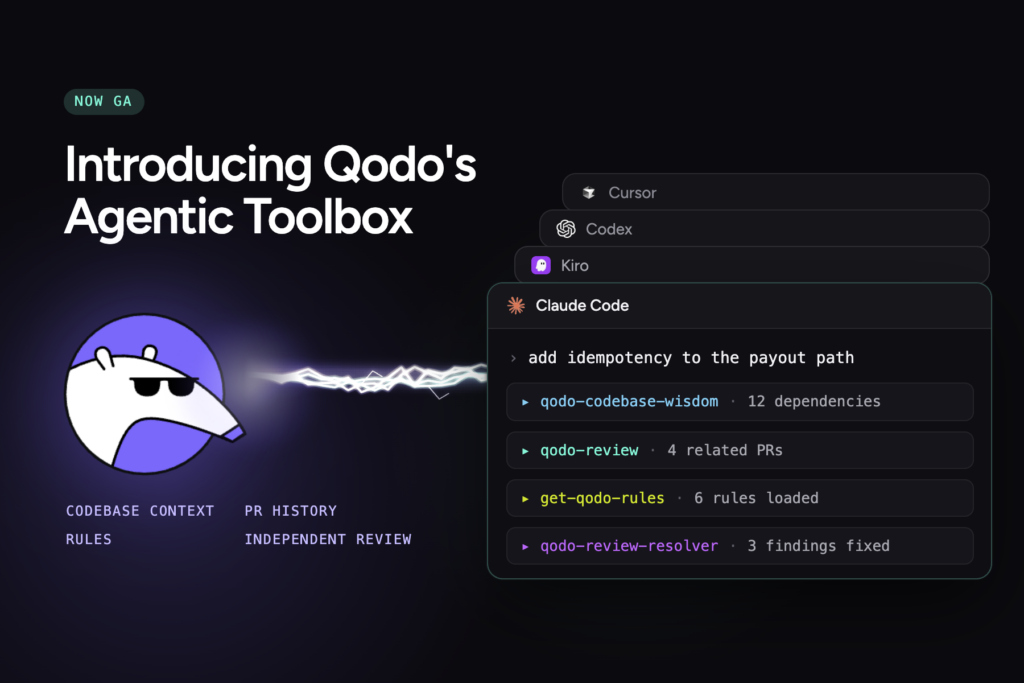
The agents work the way an experienced engineer works when handed an unfamiliar change. Qodo places the repository as it exists at review time into an isolated workspace, then gives each agent a deliberately narrow set of navigation primitives: list a directory tree, search the repository by regular expression, match files by pattern, and read a specific range of lines from a specific file. Those primitives are backed by the same tools engineers reach for, so a search behaves like a search rather than an approximation of one. Alongside them sit history tools that retrieve similar pull requests, earlier findings, accepted fixes, and file-level change records; cross-repository tools that inspect known consumers; and connectors that fetch requirements from tickets, specifications, and design documents.
Bounded by design
Two engineering choices make this dependable rather than merely powerful.
The first is that the tool set is closed. Agents select from a fixed registry and cannot invent a capability or reach outside it. Execution stays confined to the agent’s own workspace, restricted to a small allow-list of read-only operations, with output size capped. An agent that goes looking for context is doing so inside a boundary that was drawn in advance.
The second is that exploration is budgeted. Each agent runs with a hard ceiling on how many reasoning steps it may take. When the ceiling is reached, the system requires a final structured answer rather than letting the agent trail off, so a run that hits its limit still produces a reviewable result instead of silence.
Why the right context beats more context
The distinction between loading more context and retrieving the right context matters. Bigger context windows do not remove the need for context engineering. Irrelevant information consumes attention, increases cost, and can reduce reasoning quality. “Small enough” is not merely below the model’s token limit; it is small enough not to contaminate or overload the agent’s reasoning. Once the available knowledge becomes too large, the right interface is not a larger prompt. It is search, exploration, and on-demand reading.
That principle shapes how context moves between agents. A dedicated context agent explores the repository first and produces a walkthrough of what matters for this specific change. Every code reference in that walkthrough is validated against the repository before it reaches the agents that look for issues, so downstream reasoning starts from pointers that provably resolve to real files and real lines. The agents that find issues receive a curated briefing rather than a raw dump.
Context as an active system
This makes context an active system rather than a static payload. At review time, agents can ask questions such as:
- What component owns this behavior?
- Which callers or consumers may break?
- Has similar code caused an incident or revert before?
- Does the implementation match the linked requirement?
- Is this change consistent with the target branch and current repository state?
History stays current because it updates on merge. As pull requests land, the record of what your team shipped, what reviewers flagged, and which fixes were accepted grows alongside the repository, which means relevance judgments reflect how the codebase actually evolved rather than a snapshot taken at onboarding.
That historical depth matters. The meaning of a design choice is often visible only when you look back at prior decisions: why an abstraction was introduced, how an interface evolved, which approaches repeatedly failed, and which constraints the organization chose to preserve. Qodo has the long-term memory to keep this history available for retrieval, enabling agents to reason about the trajectory of the software, not just its current state, and distinguish an intentional constraint from a pattern that happens to exist today.
Mapping how services actually connect
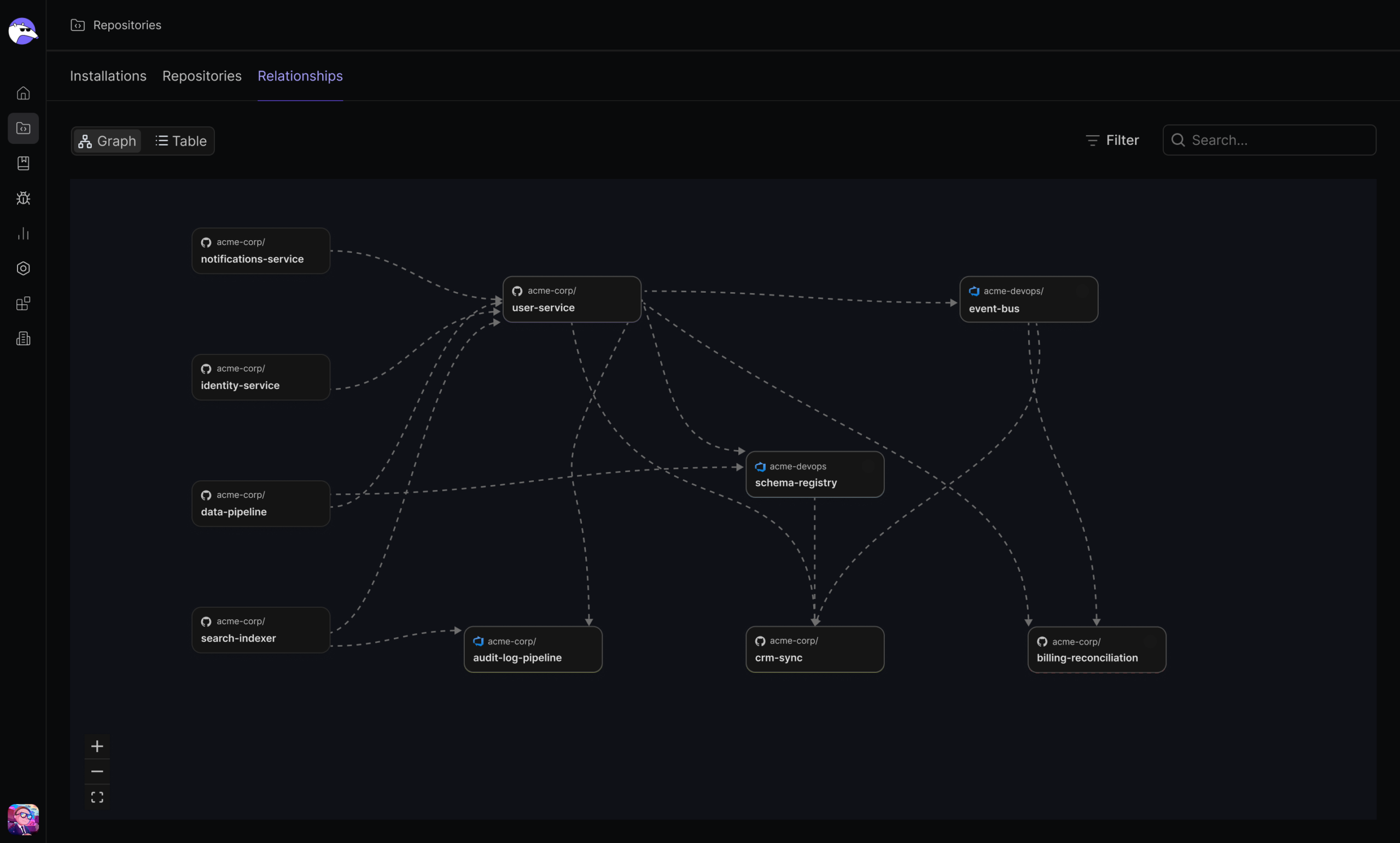
Cross-repository understanding is especially important. A change can be locally correct and globally dangerous. Qodo builds its picture of repository relationships from the evidence a codebase already carries: dependency manifests and lockfiles, imports in production source, submodule declarations, ownership files, CI and infrastructure definitions that name other repositories, and interface contracts such as OpenAPI and protocol buffer schemas. An import that appears only in a test fixture or a vendored directory does not count as evidence of coupling.
Resolving those signals to real repositories happens on demand. Large organizations run tens of thousands of repositories, so enumerating an entire inventory would be both expensive and useless. Qodo queries for the specific repository a signal points to, at the moment it needs the answer. Candidate relationships are then filtered by deterministic rules rather than by model judgment, and only relationships confirmed by direct analysis of both repositories are retained. The result is a sparse, verified map of how your services actually connect, which lets a breaking-change agent route its attention toward likely consumers and inspect impact that is invisible in the source repository’s diff.
The foundation for software governance
Models will continue to improve, and context windows will continue to grow. Neither removes the need to determine which evidence is trustworthy, relevant, current, and safe for an agent to use.
That is the role of the Context Engine. It turns the organization’s code, history, requirements, and relationships into a bounded research environment for software-quality agents. It gives them the means to investigate instead of guess, while preserving the limits and provenance needed for enterprise governance.
Context alone does not define what good looks like. That requires a system for creating, scoping, enforcing, and evolving organizational standards. The next article in this series will examine Qodo’s Rules Lifecycle System.
About the author