Software Development Is Still a Team Sport, Even With AI
Summary
Angie Jones on agentic tools, repo-level guardrails, and building software you can trust. This discussion explores the necessity of tailored tool stacks and why human judgment remains the non-negotiable anchor for scaling quality. Learn how junior developers, robust testing, and team-wide standards integrate into an accelerated AI-driven engineering workflow.
this episode’s guest
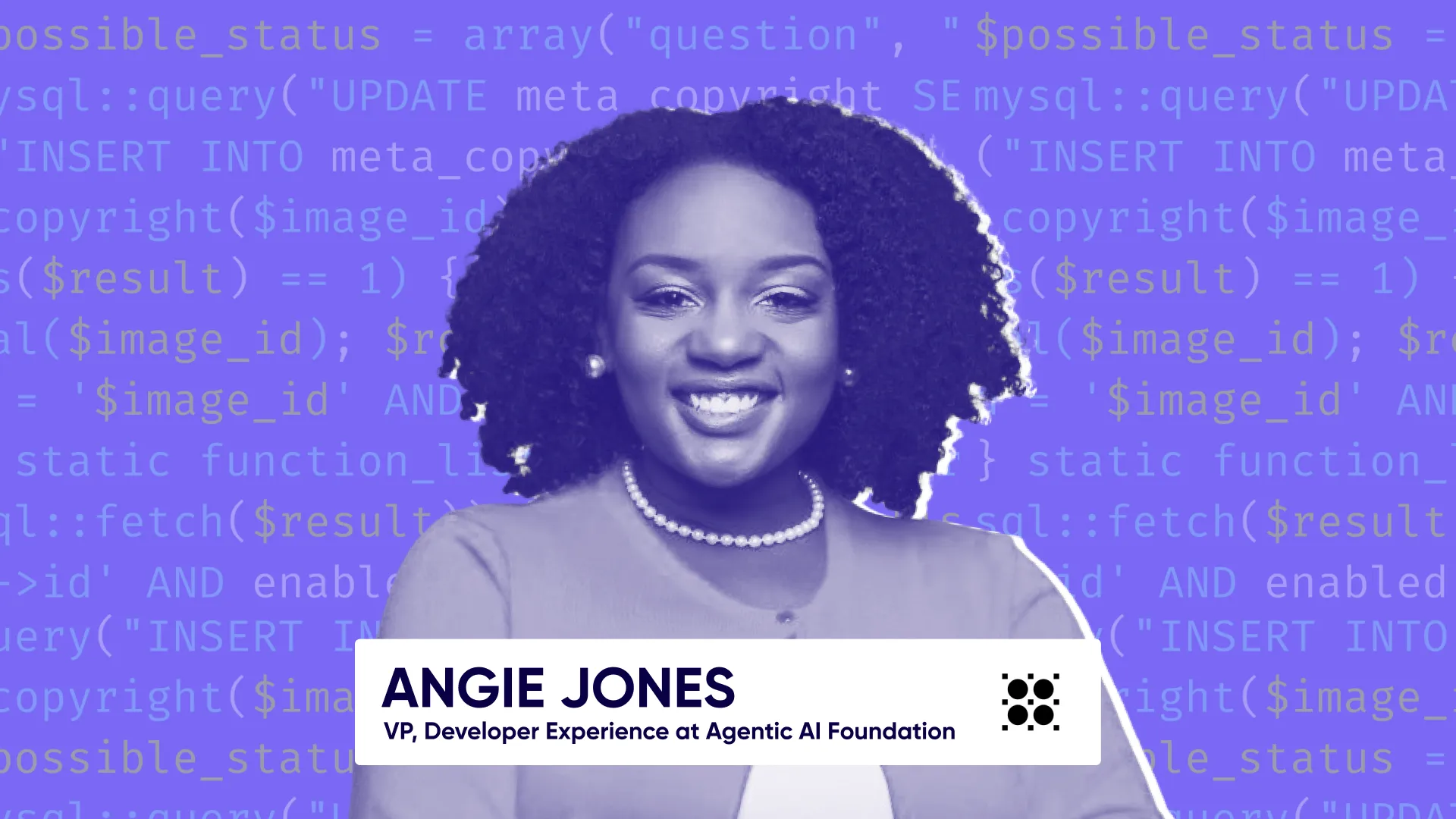
Angie Jones is a software engineer with 27 patents and the first Black woman ever named a Java Champion. She founded Test Automation University, which has trained over 100,000 engineers, and now serves as VP of developer experience at the Agentic AI Foundation. At Block, she led AI enablement and tools, helping roll out AI agents across 12,000 employees.
Key takeaways
- There is no one-size-fits-all AI tool stack; let engineers explore and evaluate what works for their codebase.
- In regulated environments, a legal/compliance/security council can review tools quickly without losing rigor.
- The right human-in-the-loop approach is to encode guardrails into the system itself, like hooks and pre-commit checks.
- Junior engineers can contribute real customer value quickly when you pair them with agentic tools and real feedback.
- AI often amplifies existing problems in process and collaboration, so strong engineering standards still matter.
- Software development is still a team sport, and AI champions can help teams converge on shared practices.
Chapters
- Building an AI-native engineering culture
- Why forcing one AI tool is the wrong strategy
- The role of vendor-neutral standards in Agentic AI
- Curiosity as a competitive advantage
- Rethinking how we hire junior engineers
- What senior engineers can learn from AI-native developers
- Shifting code review left in the AI era
- The software quality problems AI didn't create
- Designing systems that don't rely on perfect humans
Transcript
[00:00:01] Angie: There’s a cultural and a human aspect. Everybody’s not on board with this. There are a lot of people that do not want to do this. There are people that don’t have time to do this and aren’t interested in learning a new way to do software development.
[00:00:15] Nnenna: Welcome to Agentic Review, the podcast where we explore what good code really means in the age of AI software development.
[00:00:23] Nnenna: I’m Nnenna Ndukwe, developer relations lead.
[00:00:26] Itamar: And I’m Itamar Friedman, the cofounder & CEO of Qodo.
[00:00:29] Nnenna: So, let’s get into it.
[00:00:35] Nnenna: Today, we’re joined by Angie Jones, software engineer turned inventor with 27 patents and the first black woman ever named a Java champion, founder of Test Automation University, which has trained over 100,000 engineers and now VP of Developer Experience at Agentic AI Foundation, the open standards home for MCP, Goose, and the Agentic AI ecosystem. Angie has spent years building the discipline of test automation long before AI was writing the code, and then moved to Block, where she led the rollout of AI agents across 12,000 employees. She’s one of the few people who’s lived both sides of the quality question. How do you build software you can trust, and how do you scale that trust across distributed teams when AI is doing the building? So, without further ado, Angie, welcome to the show. And tell us a little bit about yourself. Maybe there’s something I missed. Would love to hear.
[00:01:29] Angie: Thank you so much for that warm welcome. I think you covered me well. Nothing much to add.
[00:01:36] Nnenna: I’m so glad you’re here. I mean, I’ve been following your work for a very long time, honestly, and it’s just incredible to see not only, like, the impact that you’ve had on the industry, which is just super unique, and it really stands out, but also in following, like, your tweets and what you share on LinkedIn, the impact that you’ve had on the people that you’ve managed and led in in in their own careers. So, I think that that’s really special, what an impact that you have had, and I noticed that at Block, when you were VP engineering with, like a focus on AI dev tools. Is that correct?
[00:02:11] Angie: Yeah. AI enablement and tools. Yep.
[00:02:14] Nnenna: It seemed from the outside. It just seemed like at Block, like, the technical staff really exemplified, like, the cutting edge of AI-native development. I mean, I was following many of these people. I’m friends with Rizelle, and you managed, and it just seemed like everybody was just way ahead of the curve. And I just really wanna know, like, how did you set the tone for that? Because that’s like a cultural thing. There’s so many elements at play with that.
[00:02:38] Angie: That’s so true. A lot of people think it’s only the tech, but, yeah, there is a people aspect as well. I’ll tell you, like, throughout my entire career, I’ve always loved to stay on the cutting edge of technology. You mentioned my patents. This is why I have so many because I’m always just on the cutting edge, making sure I’m keeping up with what’s happening in the space. And so I actually have been in the AI space for a while, even before generative AI became mainstream. My company, before Block, was an AI startup.
[00:03:11] Nnenna: Mhmm.
[00:03:12] Angie: And that was maybe 8 years ago, I started there. And so I always kind of knew this was coming. I’ve given talks even before ChatGPT hit the scene about AI and, like, the impact that it’ll have. Didn’t quite, you know, predict what we see today, but pretty close or whatever. And so as these tools came out, I knew, like, we have to get ahead of this. Our CEO and other execs knew this as well. And we have always, you know, embraced and encouraged, like, innovation within Block. And so, one of our machine learning engineers, Bradley Axon, actually started building out Goose, which is one of the first AI agents out there. And so we were using that internally to automate developer tasks and things like that, and then ended up open-sourcing Goose. So, we were telling everybody, “Hey, here’s this, you know, cool agent.” People didn’t even know what an agent was when we were doing this. Like, you didn’t know that word. Like, what is that? What is an AI agent? And so we did a lot of education around, like, what is an AI agent? How is it different from just a chatbot or an LLM and stuff like that, right? MCP, Goose was the reference implementation for MCP. So, before MCP even hit the scene, we were already using and building it, building with it at Block. And so we were launch partners with Anthropic on MCP. When I saw that spec, again, you just, like, see things you know. Oh! Yo! This is gonna change the game, right? And so one is just, like, kind of being aware of what’s happening in the industry, having, you know, a sense of what parts are noise versus what parts are, like, truly innovative and will shift the culture, and then bringing everyone along for the ride. And so I did a lot of work externally in teaching. At some point, they were like, hey, yo, Angie, we need this internally, too. Like, come teach the entire company about agents and how to use them. And so my team did that across 12,000 employees. And then once we got everybody comfortable with agents, I went really deep with the engineering, or to say, “Okay. Great. You all are using AI to, like, maybe write boilerplate code or, you know, tab complete sort of thing. I need you to the point where you’re delegating work to agents, right? I want this to be an autonomous engineering org.” And so that’s what we did.
[00:06:05] Nnenna: And now that you brought up something here, because it makes me think. You’ve posted on Twitter about how, like, you’re one of the decision makers in the room for which tools to adopt, because that’s a part of how you can enable this AI native or autonomous engineering organization. And I’m curious to know, as a technical decision maker, are there any patterns or principles or things that are overarching that lead to the decision to buy with all the tools that we have out here right now?
[00:06:35] Angie: You know, Nnenna, this one is interesting because I took a probably different path than a lot of folks would take. Our organization, we had 3,500 engineers. Our organization was diverse in what they built. So, we have Android engineers. We have iOS engineers, web, backend, you know, hardware. We have everything. And this space is so new that there is no winner. There is no one-size-fits-all. So, I thought it would be a mistake to bet the farm on one specific tool. In fact, honestly, we had Goose as an AI agent, which was internal, it’s open source, some people didn’t find that it meant their use cases, and they wanted to use other tools as well. When you try to mandate, you know how engineers are. Try to mandate to them, this is your tool. Use it. It’s like a little bit of rebellion comes from that, right? And so I switched that entire thing up to say, “Okay. Basically, like, use what you want. I’m just interested in results.” And so people would bring forth different projects for us to evaluate. We worked in the financial space, which means that comes with a lot of, like, compliance stuff that we have to be mindful of, security, like, all of these things. And so I can’t just, like, buy stuff off the shelf, like, same day, right? It needs to go through proper reviews and everything. But what I did was, even stood up, essentially, a council team where I have legal, I have compliance, I have security right here at my hip, like, yo, I’m moving fast. If y’all see me running in the wrong direction, just pull that coat tail. I’m gonna throw stuff at you, but, like, if I give you a piece of software to review, I kind of need this done, like, expeditiously. So, we set up our own, you know, like, kind of council where we can review these AI tools really fast and get them to the engineers. So, I would like to settle on one or two things that we know work well. I just don’t feel the space is mature enough to make that call right this minute. So, we let our engineers explore with lots of different tools.
[00:09:06] Nnenna: That’s amazing because everyone has a different approach, and some leaders are, there’s a fear of commitment right now because of how fast the industry is moving, but you’re taking the opposite approach. It’s like you are aware that the industry is moving fast. So, let’s give access to many different things, and then we can reevaluate in the future to see what actually sticks and what has led to productivity. He can run all those numbers and make, I guess, an educated decision about that.
[00:09:35] Angie: Yeah. That’s right.
[00:09:36] Nnenna: That’s amazing. I’m curious to know, like, with the VP of developer experience at Agentic AI Foundation, what convinced you that the whole industry now needs this vendor-neutral governance for Agentic AI? I mean, we’re kind of already talking about it, but, yeah, I’m curious.
[00:09:55] Angie: Right. So, the Agentic AI Foundation is part of Linux Foundation. So, like, governing bodies and things like that, that’s not anything new. This foundation was actually formed by Block, Anthropic, and OpenAI. And so they formed this foundation in December because all of us realized that, hey, we need, like, kind of this neutral body to house some of these standards and these projects, right? And the reason for that is when you have so much innovation occurring at the same time, and companies know I need to move. I can’t stay still and be stagnant. I know I do need to move with this technology. The problem is, I don’t know which ones to move with, right? I don’t know what’ll be here today, what will be here tomorrow. I don’t know if these labs will, essentially, they take the project in a totally different direction based on their needs. And so that’s what’s important about the Agentic AI Foundation, is that we can say, “listen. MCP, everyone in the community has decided. Okay, this is the standard that we would like to build upon when we need to connect our agents to our systems, right? Done deal. Okay.” This cannot, or it should not, live with Anthropic. They admit that themselves. Like, okay, let’s move this to a neutral home where they’re still a part of the governing body, but so are several other companies as well, right? And so now this has become an ecosystem tool versus one vendor’s tool.
[00:11:41] Nnenna: Right. Right. And I think that, which makes me think, like, now with MCP, Goose, AGENTS.md, there’s so much progress that has been made already, which I think is phenomenal and is really encouraging. But then I’m on the other side of that, I’m wondering, now with the current state, what are the struggles with some of these projects? Like, is there anything in particular that stands out to you that’s difficult to manage or navigate at this point in time?
[00:12:10] Angie: I think things have gotten a lot easier because you have so many other people invested in the success of this now, right? It’s no longer just one company that’s like, okay, I have to do everything, but I’m also trying to sell products. Right? Now you have dedicated committees and governing boards, and you know, working groups dedicated to this work. And so, it’s gotten great, actually. Like, you have so many voices. You have, you know, verticals where, like, hey, I’m interested in health care, so I’m gonna look at it from that angle. I’m interested in identity. I’m interested in security. Right? And so now it’s not like one team or one company trying to do all the things. We’ve now opened this up to, essentially, the world, and you know, it’s not even just in America, it’s countries, you know, companies and members from all over who are now participating actively in these ecosystems. And so I wouldn’t say many challenges now at all. Like, you see it evolving. You get different perspectives. You take that into account, and now we’re able to move a lot faster.
[00:13:24] Nnenna: That’s one of the things that I brought up when I spoke at AI Engineer Miami. And you were there.
[00:13:29] Angie: Mhmm. You did a great job.
[00:13:31] Nnenna: Thank you. I appreciate it. I was so glad for your support. And I mentioned, like, there are some ad hoc solutions that we have right now for Agentic AI, and there are others that are going to become, like, standardized. Like, we are finding our way, and it’s going to take the community, our involvement, our excitement about different tools, or, like, AI architectural components, is kind of how I see things like MCP. It’s going to take some support and involvement from so many folks to determine, like, what is the right way for this to evolve. And you are essentially at the the you know, you’re at the forefront of deciding that. Would you say that’s the case?
[00:14:10] Angie: Very exciting. Mhmm. A lot of responsibility, but also very exciting. Like, this is my jam. Like, being at the cutting edge of stuff and, like, helping and not, you know, not making a decision myself, but, like, enabling others to make these decisions and have these conversations of, like, where do we want to go with this and how do we get there?
[00:14:32] Nnenna: I am gonna, this is probably a slight detour, but your excitement for cutting edge, like, I feel the same exact way. And I’ve noticed that it actually gives me energy, and it gives me the creativity and, like, the, I guess, the the the stamina to keep showing up in the industry and the, you know, how hard I work and the, you know, the people that I meet. It takes really being genuinely, like, fascinated or energized by that. That’s what I’m saying, so this emerging tech…
[00:15:02] Angie: Give me an answer, because people ask me all the time. Like, it’s not a day that goes by. People are like, how do you do so much? And I don’t have an answer. I don’t wanna be like, I don’t know. I’m just that girl. I don’t know. You know? But that’s probably it. It’s like a genuine, like, interest and curiosity. We are curious about something. Like, you can’t let it go. Right? You don’t mind investing more of yourself, and your time, and your energy in it because you’re curious, right?
[00:15:32] Nnenna: Exactly.
[00:15:33] Angie: I always try to align myself with things that I genuinely care about, right? Otherwise, I mean, what’s the fun?
[00:15:42] Nnenna: Exactly. Exactly. So, super exciting. And yeah. So, something that I mentioned at the beginning of this was, like, your impact on the people that you’ve led. And it seems like you do care a lot on another side of that, this next generation of engineers coming up. I believe that you said that in the past that you’re concerned about junior developers who can ship working AI code, but they’re not able to, like, recognize, without, like, recognizing weak spots. I would love to hear more about how you feel about junior engineers right now in this climate, this, like, you know, fast-paced, cutting-edge time that we’re in.
[00:16:21] Angie: I think my perspective here, I’m very optimistic about junior developers. In fact, I started a program at Block to bring in junior engineers, and I went about the recruitment of this, like, totally different than I’ve done before. I didn’t even want your resume. I don’t care about, like, your background, your schooling, your experience. All of that seemed irrelevant at this particular moment in time, right? So, this cohort, it was for fellows. So, it’s a short-term program, 6 months, but all I asked was for you to submit things that you have built with AI agents. And then that shows, like, kind of the curiosity. Like, you know, you’re able to actually build something with this stuff. You know? And then the interview process was totally different as well. So, the interview process, no leak code, none of that. It was like, yo, bring your agent of choice. Here’s some money for tokens or, you know, credits. Come in, and then I’m just gonna give you a prompt or something to build, right? And so it was really open-ended so that we give them the space, and we can just kind of observe and pair and see how do you work with these tools. Like, how do you prompt? Are you just accepting the output? Are you questioning? Are you pushing back? Are you, you know, looking at the results? Are you making sure that it meets, like, your standards? Like, are you testing it? Like, all of that was done in, like, an interview, and it gave us so much signal about this junior as a builder, right? And we were even able to see, like, do you have the fundamental software engineering chops as well? Like, we could see that in this exercise. And so those people came in and, like, totally crushed it. The sky’s the limit. You know what was really interested in that is, like, for their onboarding, we met in person. We brought in customers. Now, these junior engineers have never seen our code base. It’s their first day on the job. And we introduce them to customers who can share some of their pain points, some of the things that they wish they had. And then we let those engineers, like, go do some builds, right? And so now, like, you have this huge monorepo production enterprise code base, right, which is much different than your side projects that you’ve been doing. You have your agents, and you have some customer feedback. What do you build? And they were able to turn this around and build, like, really amazing things in a day or so. Right? And then present that back to the customer. Customers were like, “Oh my God. You did it.” Like, that you know, exactly what I need from my business. You know? And so I think that gives us an important lesson about junior engineers, what they can bring to the table. So, we brought them in. They’re now embedded in Teams. So, you have your more senior software engineers. And I think that this is a two-way learning exercise where, you know, think about it. You have a junior engineer who literally walked in off the street and is able to provide customer value in your code base without ever talking to you. That should say something. You know? They’re putting up a lot of PRs, maybe more than you are, and you’ve been working on this for 5 years. Right? So, from the more senior engineer’s perspective, it’s like, what are you doing? How are you doing that? Right? I would like to learn from you. And then from the junior’s perspective, you know, they might get some harsh comments on these code reviews if it’s not up to par, but now they’re learning how do I work with real production systems using these tools? How do I do context engineering better to make sure that my agent is not embarrassing me out here in the streets? You know?
[00:20:37] Nnenna: That’s kind of how I word it when I’m like, okay, we can enforce code quality earlier in the software development life cycle, like, before a pull request so that nobody needs to know that you’re producing, like, AI slop when a pull request is, like, viewable and has to other developers have to interact with it. So, like, there’s something we can clean up beforehand.
[00:20:58] Angie: That’s exactly right. That’s exactly right. Those are the skills that they can learn. And think about it. We, as software engineers, that’s not something we’ve done before. Like, yes, you wrote the code, right? And so it wasn’t necessarily a review that you needed to do afterwards because you were in the weeds, actually writing it. So, you just, like, kind of pushed it up. So, this is a totally different perspective that I think both junior and senior engineers need to learn. It’s like, hey, bring that we called it, like, shift left. Push the code review left so that it’s done locally before you’re asking for humans’ attention on it.
[00:21:36] Nnenna: This is, like, completely opposite of what I see right now in the industry. All the news that I get about, I guess, this focus on keeping or retaining the senior engineers you have and, like, not even looking, putting on complete blinders to junior engineers. So, this is like a case study in a way with what you just did. You know?
[00:21:57] Angie: I know. Yeah. I think people are missing a really interesting perspective because your senior engineers have a lot, they’re carrying a lot of baggage and a lot of muscle memory, right? So, there’s a lot of good that comes; they have the domain knowledge. They have the reps. That is great. I love that. But they also have, you know, a lot of these ingrained habits of this is how software engineering goes. And so you bring in someone who has a totally different perspective and say, “I’m gonna do it this way.” And I might be, like, more efficient or at least as efficient as you are, right? And so that forces a conversation of, like, there may be something to this that I need to look at.
[00:22:46] Nnenna: Right. Right. That is incredible. I’m just glad that there’s someone like you, or you out there, who’s going the opposite way of any of the fear-mongering that we are currently all experiencing right now, AI in the future for software engineers. There’s another element to this. And at some point, we were talking about, like, the people, process, and the culture. And I’m thinking, like I think you said, that a lot of problems that people blame on AI are problems that already existed, and, like, AI has only amplified it. Like, when we think about engineering teams and the processes for shipping and collaboration. Have you, in your experience, seen the, I guess, the gaps or the weak points in some of these processes amplified because of AI?
[00:23:40] Angie: Yeah. I do a lot in open source as well, so you really can see it there, where you essentially have untrusted participants that are contributing to your code base, right? And so it really amplifies their versus, like, the folks that you know who you work with every day. But I think it’s like, I don’t know, this is getting spicy. But I think we are over-inflating how good of a job human engineers were doing when writing code. Like, yes, the AI makes mistakes. I will not say that it does not, but, hey, it learned from you, child.
[00:24:24] Nnenna: Right.
[00:24:25] Angie: You know? So, you know, we’ve always seen bad PRs. You know? We just have not seen them at this volume, right? And so that’s the part that’s, like, I think that’s being amplified both in, like, close source development teams as well as, like, open source. We definitely see it there where people don’t read the docs, saying, “Oh, the agent’s not reading the dots.” The humans don’t read your docs either.
[00:24:51] Nnenna: That’s true. It’s true.
[00:24:53] Angie: Sorry to tell you. Like, they’re not following coding standards either. They just jump in your code base, and they write it. But when you have one PR, you know, a day that you had to review like that and you, like, you get the human some feedback, and then maybe they learn and improve, that felt more tolerable than, like, now I’m getting, you know, a dozen of these a day, and now I’m just, like, pulling my hair out.
[00:25:19] Nnenna: Right. Right. For some reason, there’s like a detachment, or I don’t know if it’s cognitive dissonance about criticizing the output of the agents, but I’m like, we were all working with engineers every day. Everybody wasn’t a top 1% engineer.
[00:25:37] Angie: That’s right.
[00:25:39] Nnenna: And if they were, we wouldn’t even have to communicate with each other through comments in our pull requests. There wouldn’t have to be a back and forth because things would have been perfect
[00:25:48] Angie: Been perfect.
[00:25:49] Nnenna: Been right the first time.
[00:25:50] Angie: That’s right.
[00:25:51] Nnenna: Yeah. So, it’s pretty fascinating. But, like, I guess well, so then what does a responsible human in the loop look like to you? Like, what are some, I guess, tips, the most important, highest priority things that you say operationally for a really responsible human in the loop in software development?
[00:26:12] Angie: Yeah. You know, I think the biggest thing that you can do, and this doesn’t sound obvious, but the biggest thing you can do is actually build into the system itself. So, if you’re simply relying on every human to, like, oh, make sure you, like, review. Let’s say, for example, I’m, like, writing, and I was like, okay, this is great. Context engineering flow. I have my agent, like, write up a plan first. And so now it’s, like, 10 pages of markdown. You’re not reading that. You know? And why are we kidding ourselves? And, like, oh, that’s where the human will be in the loop, and then, you know, okay, then I’ll have it write the code, and then I’m gonna review that code because I’m gonna be a good human. Like, I think we’re kidding ourselves with that. What you can do to be a good human is to encode and embed some of these techniques into the system itself, right? So, for example, instead of saying, hey, every good human, you make sure that you review that code before you push it up. You can, like, hooks and things that, like, pre-commit hooks so that these core reviewers are running locally before that ever goes. Like, those are the sorts of things as a human, I think we should be focused on, is, like, putting this stuff in place so that the system works how we want it to work, and we’re not relying on every human to do the right thing.
[00:27:46] Nnenna: Completely agree. Well said. And also, which reminds me that you still talk about testing, and you’re talking about testing in the AI era. I think there’s an event that you’re speaking at soon. We would love to hear you walk through that and just to get your perspective on AI, and what does it make testing, like, obsolete or, like, how are you thinking about it now?
[00:28:10] Angie: Yeah. This is another area where I think the LLMs have picked up some bad habits from us humans. Like, I have always said that developers are not great at testing, right? They don’t wanna test. They want to build. And so either they don’t write tests, or they write sloppy tests. I can tell you, like, the amount of times I’ve seen, like, trash unit tests from developers is uncountable. So, I’m not surprised when I see the LLMs, right, trash unit test. True equals true. Green. No? Like, when they see, okay, the test is failing. Oh, okay. Let me just delete that test, and now we’re good. You know? Or I’ll put an ignore on it or something like that. And so when we think about goals, I think it’s this is the same for LLMs as it is for humans. You have a goal. I am trying to build something, and I would love for the test to be great, right? So humans, I mean, they’re not as bad as the LLMs. But for an LLM, if that’s your goal, if anything is in the way of that goal, you get rid of it, right? And so you try to work around it. So, if that test is not working, and then I can’t figure it out, get rid of that test. We’re gonna get to that green no matter what. Right? And so I think that this is an area where those who specialize in testing or writing quality, there are some developers who are very, like, test-minded, right? Quality. And so this, I think, is still an unsolved problem of, like, how do we ensure we have, yes, the agent can, like, spin me up, you know, 50 unit tests. Are they valuable? Do I want these 50 unit tests? Like, I think there’s still some human judgment that’s needed there.
[00:30:09] Nnenna: Yeah. I’m gonna be honest. I remember, you know, back in pre-Gen AI, writing tests by hand. And with the metrics that we had in place, I think it was, like, a 100% code coverage or, you know, test coverage. It’s actually really easy to gain that. This is pre-Gen AI. It was easy to. If you were really focused on, like, well, what does that really look like? How could I get this line of code covered? What kind of ignore can I put in place to just, like, move on from this? It’s not hard.
[00:30:41] Angie: That’s right. That’s right. So, this is another place where I think embedding it into the system helps a lot. Right? Because I can fuss at the humans, I can fuss at the LLMs. Neither way, I’m gonna do it unless it’s embedded in. So, this is the way I build skills and stuff like that that tells the agent, this is how a good test looks like. This is a floppy test. I don’t want this kind of stuff in my code base, right? This is where rules files or AGENTS.md or things like that come into place, where you say, look, don’t you delete test files in order to, like, make a bill green. That is not what’s at the time we’re on.
[00:31:26] Nnenna: I can imagine that with this kind of mindset and this kind of approach, we can get to a place where not only do we feel like, okay, in general, the output is a level of quality that I can stand behind, but that it can also supersede maybe some of our bandwidth or capacity to code a certain quality. I guess we’d be able to enforce quality, high quality, more consistently if we’re embedding these practices. We can, you know, reach for higher goals about how software can look.
[00:31:59] Angie: Yeah. Yeah. Absolutely.
[00:32:02] Nnenna: And so I would like to know some of the last, like, questions to wrap up. Like, what is one mindset shift listeners should make right now to ensure that they are actually, like, building high-quality, like, trustworthy systems with AI, like, with software? Any mindset shift that could be really valuable for folks to hear.
[00:32:25] Angie: I think one thing is to remember that software development is still a team sport. And so, like, what I’m seeing right now across the industry is everyone is trying to figure this out for themselves. And so you’re picking up your own tips and techniques and tricks, and you might be employing that. And your team is, like, not on the same page, or they’re doing something totally different. And when you start tossing, like, all of this at the same shared code base, it gets messy pretty quickly, right? And so I think, like, one mindset shift is to, yes, figure it out, but, like, maybe as a team. One way I did this was to have, like, AI champions for a team. So, that person was the one that’s in the weeds and, like, trying all of this different stuff, figuring out what actually works for their code base and what doesn’t, and then bringing that to the team for discussion. Like, do we want to adopt this once they figured out something that does work? And so that, you know, I think that would help a lot with the agentic engineering
[00:33:33] Nnenna: Mhmm.
[00:33:34] Angie: And ensuring that our code base is not drifting into, like, 5 different directions.
[00:33:40] Nnenna: That’s well said. Thank you for sharing that. And one other question. You might have already answered this, but just to think about, now, not from just the individual, but an engineering organization. Like, what is the number one thing or the first thing that you would tell engineering leaders to focus on if they want to become a fully AI-native engineering org, or an autonomous engineering org, as you like to say? The first thing.
[00:34:11] Angie: The first thing is that you need to focus at the repo level. So, I think everyone starts with focusing at the people level, and you’re trying to uplevel thousands of engineers at the same time, or as we talked about in the beginning, there’s a cultural and a human aspect. Everybody is not on board with this. There are a lot of people that do not want to do this. There are people that don’t have time to do this, not interested in learning a new way to do software development. Like, there’s various different perspectives. And if you’re trying to uplevel everyone and convince them and get them all on the same page, everybody learns all this new stuff all at the same time, but still do your work because we gotta, like, provide shareholder value. Then you find yourself, like, kind of in a rut, right? You’re not progressing. Start at the repo level. And so, again, building these things into the system, all of your engineers are, this is where they go. That’s the common place. Some of this can be done for them by baking it in there, right? When you have someone who’s focused on making, like, an AGENTS.md or adding skills to the repo or picking the code review process, what are our rules and how do we want it done, then everybody doesn’t have to figure that out. It’s just there. So, when I point my agent to that thing, everything just kind of already works because we focus on the repo and not necessarily each individual developer.
[00:35:48] Nnenna: Okay. So, then there’s a delegation there. And then once you solve things for the repo, you can kind of replicate or scale that when there’s somebody who’s figured out what works for that.
[00:36:00] Angie: Right. Right. And so then you have, for example, in, like, my AI champions program, I was very intentional on how I developed that. It’s not a volunteer gig. Like, I solicited people from our top repos or our biggest, you know, hairiest repos. I will make sure that we had representation from mobile, backend, you know, Android and iOS on mobile, right, frontend, you know, whatever. And then, like, that was a collection of 50. There’s this model. It’s called the 1-9-90 Rule that says, “Of a community, 1% is gonna create, 9% is gonna tinker, and 90% are just gonna consume.” And, like, you see that on social media. You see that, like, all over the place. I adopted that strategy. So, instead of trying to have the 100% adopting and create this stuff, I got the 1%. So, of 3,500 engineers, I got about 50. So, a little bit more than 1%, but one and some change, right? And this was from our most strategic repositories, and so they were able to figure it out. And then if you have, like, a web team that figures out, okay, this is the tool, this is the technique that works really well for us, maybe it doesn’t work for iOS, but the other web teams go, okay, I can adopt that as well. Right? And that’s how we scaled across 3,500, not by trying to get all 3,500 people to figure this out at the same time.
[00:37:37] Nnenna: Absolutely brilliant. Brilliant strategy and execution there, and replicate it elsewhere. Before we fully end this, what is one major thing that you’re excited about shipping at Agentic AI Foundation? I guess anything that you can say publicly at this point in time.
[00:37:58] Angie: So, I’m really excited to bring some new projects in. And so one, we’re open. So, if anybody is working on any open source projects, any standards that you think, hey, this, you know, could benefit the whole ecosystem and should probably live in a neutral home, then we do have that available. The website is A-a-i-f. I say that really fast. Aaif.io. So, go there and you can, like, you know, you’ll see where you can submit projects or anything like that. That’s the thing I’m most excited about, is kind of this is where the Agentic stack is being built, right? And so it’s really cool to be a part of that and, like, see it come together.
[00:38:42] Nnenna: Amazing. And lastly, where can people find you most? Where are you most active online?
[00:38:49] Angie: I would say the safest bet is to go to my website because all my social channels are there. I’m active everywhere, but everyone else has a spot, right? And so I’m on LinkedIn. I’m on Twitter/X. And so GitHub, of course. So, my website is angiejones.tech, and all my social channels are there. I also do some blogging there, too.
[00:39:11] Nnenna: Amazing. Thank you so much for coming here and just sharing all of your wisdom, your experience, the things that you’re excited about. Love listening to the passion and, you know, I’m just now really excited about the future of where we’re going and the work that you’re gonna be doing, contributing, continuing to contribute to the future of agentic engineering.
[00:39:31] Angie: Thank you so much, Nnenna. It’s a pleasure.
[00:39:35] Outro: If today’s conversation challenge how you think about AI and code quality, that’s the point. At Qodo, we believe that independent context-aware code review with rules as guardrails is how engineering teams maintain standards at scale. If you’re leading an enterprise team and want to see how intelligent AI code review can reinforce governance, visibility, and accountability in your workflow, visit qodo.ai to learn how we help teams turn AI productivity into production-ready quality. And if you enjoyed this episode, subscribe, share it with your engineering leadership circle, and leave us a review. Until next time, keep human in the loop. And keep shipping.
About the hosts