Best AI Code Review Tools for Regulated Industries in 2026
Quick Verdict
Code review in regulated industries — finance, healthcare, government, defense, insurance, regulated SaaS — is less about clever suggestions and more about auditability, data control, and enforceable governance. The best tools fall into three layers: an AI code review platform that reasons about each pull request and enforces engineering standards, security and compliance scanners that produce audit evidence, and governance enforcement tools that block non-compliant changes before merge.
Qodo is the AI code review platform for regulated SDLC, with cloud, on-prem, and fully air-gapped deployment, SOC 2 Type II compliance, the highest F1 score (55.4%) on the public AI code review benchmark, and a documented air-gapped deployment at a global retailer with 14,000+ developers. The mature stack pairs Qodo with category leaders in the other two layers: SonarQube Server, Snyk Code, Checkmarx, and Veracode for security and compliance scanning, and emerging governance tools like PullGuard, RegEngine, and Sentrik for policy enforcement.
| Tool | Layer | Air-Gapped | Key Certifications | Best For |
|---|---|---|---|---|
| Qodo | AI Code Review | ✅ Yes | SOC 2 Type II | Context-aware review and standards enforcement in regulated SDLC |
| SonarQube Server | Security & Compliance | ✅ Yes | SOC 2 (Cloud) | Self-hosted CI quality and security gates |
| Snyk Code | Security & Compliance | ⚠️ Self-hosted | SOC 2 | AI-assisted SAST in the developer loop |
| Checkmarx | Security & Compliance | ✅ Yes | SOC 2, FedRAMP (in process) | SAST, SCA, IaC, and API security |
| Veracode | Security & Compliance | ✅ On-prem | FedRAMP, SOC 2, PCI | Compliance-grade SAST/DAST/SCA |
| PullGuard | Governance | ✅ Yes (in CI runners) | SOC 2 | PR-native governance and compliance layer |
| RegEngine | Governance | ✅ Yes | GxP, 21 CFR Part 11 | Healthcare and life sciences compliance enforcement |
| Sentrik | Governance | ✅ Yes | SOC 2 | AI agent compliance and audit evidence mapping |
What Regulated Industries Actually Need from AI Code Review
Regulated software organizations evaluate AI code review tools against a different set of constraints than unregulated teams. Functional capability — finding issues in code — is necessary, but not sufficient. A regulated buyer is screening for six things before functional capability even enters the conversation.
Deployment isolation. Source code cannot leave the network perimeter. The platform must run on customer infrastructure — on-prem, in a private cloud VPC, or fully air-gapped with no outbound calls.
Compliance certifications. SOC 2 Type II is table stakes. FedRAMP, HIPAA, PCI DSS, ISO 27001, 21 CFR Part 11, and FIPS 140-2 matter depending on the industry. Procurement teams will not engage without them.
Audit logs and evidence generation. Every review decision, rule change, and policy enforcement must be logged, exportable, and tied to a user identity. SOC 2, ISO 27001, and SOX audits will ask for this evidence.
Data retention guarantees. No training on customer code. No data leaving the perimeter. Documented retention and deletion policies.
Policy enforcement, not just comments. Regulated teams need merge blocking on policy violations, not advisory comments that developers can ignore.
Explainability of findings. Auditors want to understand why a tool flagged something. Black-box AI scoring is a liability.
The mature regulated SDLC stack in 2026 is rarely one tool. The pattern is a three-layer stack: AI code review and standards governance, security and compliance scanning, and policy enforcement.
The Three-Layer Stack for Regulated Code Review
Regulated organizations that adopt AI code review well tend to organize their stack into three layers, each owning a distinct signal.
Layer 1 — AI code review and standards governance. Context-aware reasoning about each PR, enforcement of engineering standards across distributed teams, and PR memory that learns from prior review decisions. This is where Qodo sits.
Layer 2 — Security and compliance scanning. Deterministic SAST, DAST, SCA, and quality gates running in CI, producing the audit evidence regulators recognize. SonarQube Server, Snyk Code, Checkmarx, and Veracode own this layer.
Layer 3 — Governance enforcement. Newer tools that sit at the PR boundary and block merges on policy violations, generate audit evidence maps, and track compliance coverage across the codebase. PullGuard, RegEngine, and Sentrik are emerging leaders here.
These layers are complementary. None of them replaces another. The strongest regulated stacks run all three.
Layer 1: AI Code Review and Standards Governance
This layer reasons about pull requests in context — not just the diff, but the full codebase, prior PRs, and team-specific engineering standards. It is the layer that catches architectural drift, duplicated logic across services, and standards violations that static rules cannot express.
1. Qodo — Best AI Code Review Platform for Regulated Industries
Rating: ⭐⭐⭐⭐⭐ 5/5
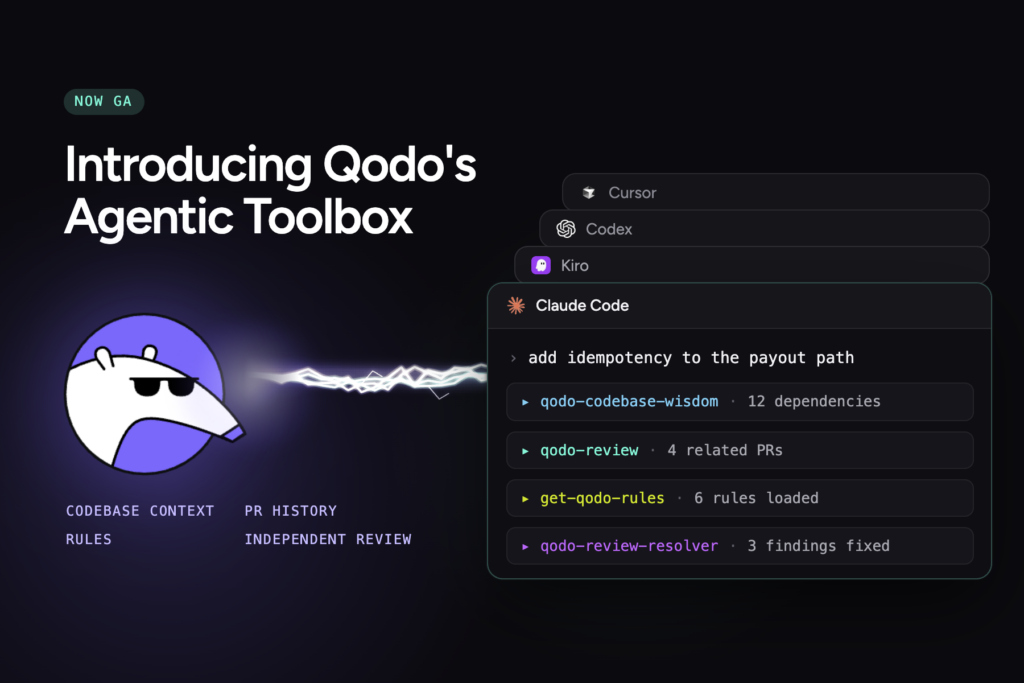
Qodo is the AI code review platform purpose-built for enterprise SDLC, including regulated environments. The platform runs in cloud, on-prem, and fully air-gapped deployments. The Context Engine indexes the full codebase and PR history inside the customer perimeter. The Review Agent Suite runs multi-agent review on every PR. The Rules System manages engineering standards through a full Discover → Measure → Evolve lifecycle, producing the audit trail regulated buyers need.
Pros and Cons
| ✅ Pros | ❌ Cons |
|---|---|
| Air-gapped deployment in production at a global retailer with 14,000+ developers | Implementation scope larger than a one-click PR commenter |
| SOC 2 Type II compliant; no training on customer code | FedRAMP authorization in progress, not yet final |
| Highest F1 score on AI code review benchmark (55.4%) | Indexing and rule configuration require upfront investment |
| Multi-agent review (Critical Issues, Duplicated Logic, Ticket Compliance, Rules, Breaking Changes) | |
| Rules System with auto-discovery, analytics, and full audit trail | |
| Independent from code generation systems — provides true verification layer | |
| Multi-Git support (GitHub, GitLab, Bitbucket, Azure DevOps) including self-hosted instances | |
| Gartner #1 for Code Understanding (Critical Capabilities for AI Code Assistants, Sept 2025) |
What Qodo Catches in Regulated Environments
Standards violations across distributed teams. When a developer in one region introduces code that conflicts with a security or architectural standard enforced in another, Qodo’s Rules System flags it before merge.
Logic that breaks compliance contracts. Qodo can detect when a change touches a PII-handling path, an audit-logged function, or a data-residency boundary, and surface the policy violation in the PR.
Cross-file architectural drift. Qodo references the codebase index to flag when a change deviates from the established pattern in the rest of the system, rather than reviewing the diff in isolation.
Security gaps human reviewers miss. In one documented case at monday.com, Qodo caught an environment variable inadvertently exposed through a public API — an issue no human reviewer had flagged.
Best Fit
Regulated engineering organizations with multiple repositories, distributed teams, and air-gapped or on-prem deployment requirements. The reference deployment is a Fortune 100 global retailer with 14,000+ developers running Qodo in an air-gapped environment, reaching 12,000+ monthly active users within six months. monday.com runs Qodo across its 500-developer organization with a documented dual-review model.
Proof point: “Qodo now prevents an average of 800 potential issues from reaching production every month while saving monday.com developers approximately one hour per pull request.”
Layer 2: Security and Compliance Scanning
This layer is the backbone of regulated SDLC. Auditors recognize these tools. Compliance frameworks reference them. They produce the evidence procurement and audit teams require. None of them does context-aware code review — that is not their job. Their job is deterministic detection and audit-grade reporting.
2. SonarQube Server — Best Self-Hosted CI Quality and Security Gates
Rating: ⭐⭐⭐⭐ 4/5
SonarQube Server is the self-hosted edition of the static code quality platform from SonarSource. SonarQube analyzes code in CI pipelines, scores quality and security issues against 6,000+ rules across many languages, and gates merges based on configurable thresholds. The self-hosted edition runs entirely inside the customer perimeter, supporting regulated and air-gapped environments. SonarQube is one of the most established platforms in SOC 2 / ISO 27001 regulated SDLC pipelines.
Pros and Cons
| ✅ Pros | ❌ Cons |
|---|---|
| Fully self-hosted — runs entirely inside customer infrastructure | Static analysis only — not context-aware AI reasoning |
| 6,000+ rules across many languages | Reports in dashboards rather than inline PR conversation |
| Mature integration with most enterprise CI/CD pipelines | Less AI-native, more rules-based |
| Mature quality gate model — block merges on policy violations | Misses issues that require codebase-wide reasoning |
| Long track record in regulated environments |
Best Fit
Regulated organizations that need provable quality gates in CI/CD. Pairs with Qodo for the AI reasoning layer SonarQube does not provide.
3. Snyk Code — Best AI-Assisted SAST in the Developer Loop
Rating: ⭐⭐⭐⭐ 4/5
Snyk Code is the static application security testing product in the Snyk security platform. Snyk Code uses AI-assisted analysis to detect security vulnerabilities and runs in the IDE, in pull requests, and in CI. The platform is strong for PCI DSS and HIPAA-adjacent security controls, with continuous vulnerability database updates and self-hosted deployment for regulated buyers.
Pros and Cons
| ✅ Pros | ❌ Cons |
|---|---|
| AI-assisted SAST with IDE, PR, and CI coverage | Security-focused — does not address engineering standards or general code review |
| Self-hosted deployment option for regulated environments | Less governance workflow than full compliance platforms |
| Strong developer experience for fixing vulnerabilities at source | FedRAMP not yet final |
| Continuous vulnerability database updates | Pricing scales steeply with developer count |
| Part of a broader security platform (SCA, container, IaC) |
Best Fit
Security-heavy regulated engineering teams that want SAST embedded into the developer workflow with strong remediation UX. Pairs with Qodo for the code review and standards layer Snyk does not provide.
4. Checkmarx — Best for SAST, SCA, IaC, and API Security
Rating: ⭐⭐⭐⭐ 4/5
Checkmarx is a long-standing enterprise security platform used in heavily regulated organizations. Checkmarx One covers SAST, SCA, IaC scanning, API security, and container security, with air-gapped deployment for restricted environments. The platform is widely deployed in financial services, government, and healthcare, with compliance reporting mapped to PCI, HIPAA, GDPR, and NIST frameworks.
Pros and Cons
| ✅ Pros | ❌ Cons |
|---|---|
| Air-gapped deployment for restricted environments | Security-only — does not handle code review or engineering standards |
| Broad coverage: SAST, SCA, IaC, API security, container security | Heavier setup, less AI assistance |
| Compliance reporting mapped to PCI, HIPAA, GDPR, NIST | False positive rates require ongoing tuning for noisy stacks |
| Deep presence in financial services, defense, and healthcare | |
| Custom query language for organization-specific security rules |
Best Fit
Large regulated enterprises with formal AppSec programs, custom security policies, and the need for IaC and API security in addition to source SAST. Pairs with Qodo as the AI code review and standards layer.
5. Veracode — Best for Compliance-Grade Audit Evidence
Rating: ⭐⭐⭐⭐ 4/5
Veracode is a longstanding compliance-first application security suite covering SAST, DAST, SCA, and manual penetration testing. The platform is positioned around audit-grade evidence generation for SOC 2, SOX, FedRAMP, and other regulated frameworks. Veracode holds FedRAMP authorization and integrates compliance reporting directly into the platform.
Pros and Cons
| ✅ Pros | ❌ Cons |
|---|---|
| FedRAMP authorized — production-ready for federal and defense environments | Slower developer feedback loop than IDE-loop SAST tools |
| Compliance certifications including SOC 2, PCI DSS, HIPAA mapping | Security-only — does not address engineering standards |
| SAST + DAST + SCA + manual pen testing in one platform | Pricing positioned for large enterprise budgets |
| Strong audit evidence generation for SOC 2 and SOX | |
| Broad language coverage |
Best Fit
Audit-heavy regulated environments — federal, defense, finance — where compliance reporting and audit trail matter as much as developer-loop speed. Pairs with Qodo for the code review and standards layer Veracode does not cover.
Layer 3: Governance Enforcement
This is the emerging category. These tools sit at the PR boundary and enforce compliance policy as a merge condition, generate audit evidence maps, and track compliance coverage across the codebase. They are newer than the security scanning layer, and their ecosystems are still maturing — but they fill a real gap in regulated SDLC: deterministic policy enforcement at the moment of code change.
6. PullGuard — Best PR-Native Governance Layer
Rating: ⭐⭐⭐⭐ 4/5
PullGuard positions itself as a PR-native governance, security, and compliance layer. The platform runs multiple analyzers per PR — security, compliance, supply chain — and emphasizes audit-ready outputs. Code stays inside the customer’s GitHub runners, reducing data exposure for regulated environments.
Pros and Cons
| ✅ Pros | ❌ Cons |
|---|---|
| Runs multiple analyzers per PR (security + compliance + supply chain) | Newer ecosystem than established AppSec platforms |
| Code stays in GitHub runners — reduced data exposure | Best fit assumes GitHub-based workflow |
| Audit-ready outputs designed for regulated SDLC | |
| Consolidates Snyk + Sonar + Semgrep–style stacks |
Best Fit
Regulated teams looking to consolidate multiple scanning tools into a single PR-boundary governance layer. Pairs with Qodo for the AI reasoning and standards layer PullGuard does not provide.
7. RegEngine — Best for Healthcare and Life Sciences Compliance
Rating: ⭐⭐⭐⭐ 4/5
RegEngine focuses on real-time compliance enforcement for AI-generated code in regulated frameworks — FDA 21 CFR Part 11, GxP, healthcare. The platform offers inline enforcement (not just review after PR), advisory / enforced / blocking compliance modes, and audit trail with one-click fixes.
Pros and Cons
| ✅ Pros | ❌ Cons |
|---|---|
| Focused on regulated healthcare and life sciences frameworks | Narrower ecosystem than general DevSecOps tools |
| Inline enforcement, not just post-PR review | Best fit is healthcare and life sciences, less general-purpose |
| Advisory / enforced / blocking modes for graduated policy adoption | |
| Audit trail and one-click fixes |
Best Fit
Healthcare, life sciences, and regulated AI coding environments under FDA, GxP, or 21 CFR Part 11 oversight. Pairs with Qodo for the AI code review and engineering standards layer.
8. Sentrik — Best for AI Agent Governance and Audit Evidence Mapping
Rating: ⭐⭐⭐⭐ 4/5
Sentrik is an AI compliance and governance dashboard for code and AI agents. The platform tracks compliance coverage across the codebase, detects AI agent scope violations (Cursor, Copilot, Claude), generates audit evidence maps, and maps code paths to regulatory requirements.
Pros and Cons
| ✅ Pros | ❌ Cons |
|---|---|
| Tracks compliance coverage across the codebase | Newer ecosystem |
| Detects AI agent scope violations across coding tools | Best fit assumes existing AI coding tool footprint |
| Generates audit evidence maps useful for SOC 2 / ISO 27001 audits | |
| Maps code to regulatory requirements |
Best Fit
Regulated organizations using multiple AI coding agents (Cursor, Copilot, Claude Code) that need governance and audit evidence across the AI-assisted development footprint. Pairs with Qodo for the code review and standards enforcement layer.
The Recommended Regulated Stack in 2026
Most mature regulated teams do not rely on a single tool. The pattern is a layered stack where each tool owns a distinct signal.
| Industry | Layer 1 — AI Code Review | Layer 2 — Security & Compliance | Layer 3 — Governance |
|---|---|---|---|
| Financial services | Qodo | SonarQube Server + Snyk Code or Checkmarx | PullGuard or Sentrik |
| Healthcare & life sciences | Qodo | Snyk Code + Veracode | RegEngine |
| Government & defense | Qodo | Veracode (FedRAMP) + Checkmarx | Sentrik |
| Regulated SaaS (SOC 2, PCI) | Qodo | SonarQube Server + Snyk Code | PullGuard |
| Insurance | Qodo | SonarQube Server + Checkmarx | Sentrik or PullGuard |
Why Qodo anchors every recommended stack
The three-layer model only works if Layer 1 is a real AI code review platform — one that reasons about the codebase, enforces engineering standards across teams, and produces an audit trail of review decisions. The security and compliance layer (Layer 2) is deterministic by design and does not do this. The governance layer (Layer 3) enforces policy at the PR boundary but does not generate the contextual review signal in the first place.
Qodo is the only platform on this list that combines context-aware AI review, full-lifecycle standards enforcement, air-gapped deployment, SOC 2 Type II compliance, and the highest F1 score on the public AI code review benchmark. The other tools are excellent at what they do. None of them replaces the AI code review layer Qodo provides.
Final Verdict
The real question in regulated code review in 2026 is not which single tool to pick. The mature answer is a three-layer stack where each layer owns one signal — and where the AI code review layer is independent from the code generation systems developers use to write code in the first place.
The security and compliance layer is well understood. SonarQube Server, Snyk Code, Checkmarx, and Veracode are the platforms auditors recognize, and they belong in nearly every regulated stack. The governance layer is the emerging category, with PullGuard, RegEngine, and Sentrik filling gaps that traditional AppSec platforms do not address. Both layers are necessary.
The AI code review layer is where regulated teams now have a clear choice. Qodo runs inside the security perimeter, holds the certifications regulated procurement requires, produces the audit trail compliance teams need, and delivers the highest F1 score on the public AI code review benchmark. The reference deployment at a global retailer with 14,000+ developers in an air-gapped environment is the proof point regulated buyers ask for.
FAQ
What are the best AI code review tools for regulated industries?
The best regulated stack in 2026 is a three-layer model: Qodo for AI code review and standards governance, SonarQube Server / Snyk Code / Checkmarx / Veracode for security and compliance scanning, and PullGuard / RegEngine / Sentrik for governance enforcement. Qodo anchors the stack as the only context-aware AI code review platform with air-gapped deployment, SOC 2 Type II, and the highest F1 score on the public AI code review benchmark.
Which AI code review tool supports air-gapped deployment?
Qodo supports cloud, on-prem, and air-gapped deployment, with a documented air-gapped production deployment at a global retailer with 14,000+ developers. SonarQube Server, Checkmarx, Veracode, RegEngine, and Sentrik also support air-gapped or self-hosted deployment. Snyk Code supports self-hosted deployment.
What certifications matter for AI code review in regulated industries?
SOC 2 Type II is table stakes. FedRAMP matters for federal and defense environments. HIPAA, PCI DSS, ISO 27001, 21 CFR Part 11, GxP, and FIPS 140-2 matter depending on the industry. Procurement teams will not engage with vendors who cannot produce these.
Does Qodo train on customer code?
No. Qodo does not train models on customer code. In air-gapped and on-prem deployments, all indexing, review, and rule management happen entirely inside the customer security perimeter.
Can AI code review tools replace SAST and DAST in regulated industries?
No. AI code review platforms like Qodo and security scanning tools like SonarQube, Snyk Code, Checkmarx, and Veracode handle different signals. AI review reasons about context, intent, and team standards on each PR. SAST and DAST apply deterministic rules and runtime testing for known vulnerability patterns and compliance reporting. Regulated stacks run both.
What is a governance enforcement layer, and do I need one?
The governance layer sits at the PR boundary and blocks merges on policy violations, generates audit evidence maps, and tracks compliance coverage across the codebase. PullGuard, RegEngine, and Sentrik are the emerging leaders. Teams under strict regulatory regimes (FDA, FedRAMP, PCI) benefit most from this layer. Teams with lighter compliance burden can sometimes satisfy enforcement needs through Qodo’s Rules System and CI quality gates alone.
Why use an AI code review tool independent from the code generation tool?
Using the same system to write code and review code introduces a confirmation bias risk — the reviewer may reinforce patterns the generator produced rather than challenge them. Regulated buyers also prefer vendor neutrality to reduce single-vendor risk. Qodo sits outside the generation loop, providing independent verification regardless of which AI tools developers use to write code.
How do I build a regulated AI code review stack with Qodo?
The recommended 2026 pattern: Qodo as the AI code review and standards layer on every PR (Layer 1); SonarQube Server, Snyk Code, Checkmarx, or Veracode for SAST, SCA, DAST, and compliance reporting in CI (Layer 2); PullGuard, RegEngine, or Sentrik for PR-boundary policy enforcement and audit evidence (Layer 3). The exact Layer 2 and Layer 3 tools depend on industry and existing AppSec footprint.
What is the most important selection criterion for AI code review in regulated industries?
Deployment isolation comes first. If source code cannot stay inside the security perimeter, no other capability matters. After that: compliance certifications, audit logging, data retention guarantees, policy enforcement (not just comments), CI integration, and explainability of findings.