Why Your AI Coding Agent Shouldn’t Review Its Own Code: The Case for an Independent Verification Layer

AI now generates a substantial share of the code shipping in modern engineering organizations, and for many teams, writing code is no longer the constraint it once was. You can open Claude Code, Cursor, GitHub Copilot, or OpenAI Codex and have a working implementation in minutes. What that speed has done is move the bottleneck: the hard part is no longer producing code, it’s trusting the code you just produced.
That shift is changing how engineering teams buy tools. If you are evaluating an AI coding agent right now, there is a tempting question on the table: the agent already writes the code, so can’t it just review the code too? It can produce a review. The harder question is whether you should rely on the same system to both generate code and verify it. The answer, increasingly backed by analysts and by how mature engineering orgs actually operate, is no.
More code does not mean more trustworthy code
The output gains are real, but so is the cost that comes with them. As AI generates more of the codebase, defects are climbing alongside the volume. A large-scale study of AI-generated code across more than 6,000 GitHub repositories found that over 15% of commits from every AI assistant studied introduced at least one issue, and that nearly a quarter of those issues were still present in the latest version of the code1. The problems do not just appear; they persist and accumulate as long-term maintenance debt. And they reach production: in Qodo’s 2026 survey of 500 engineers and engineering leaders, 89% of organizations reported at least one AI-related production incident. Which raises an obvious question for anyone buying tools: if the coding agent is part of what created the gap, should it also be the tool you trust to close it?
Code review and code generation are fundamentally different problems, and prompting a coding agent more carefully does not turn it into a review layer. Code review deserves its own decision in your evaluation, not a checkbox you assume the coding agent already covers. Gartner® draws the same line in its June 2026 report, Don’t Use AI Coding Agents for Every Software Engineering Task, categorizing “Code review agents as one of the examples of Software Engineering Agents.”
The same system shouldn’t write it and grade it
When the same model that wrote a change is also the one signing off on it, you lose the independence that makes review meaningful, and the risk is not just theoretical. A controlled study of iterative AI code generation found that when a model repeatedly refined its own output with no outside check, critical vulnerabilities rose by more than a third after just five rounds2. A system with no outside reference point tends to compound its own mistakes rather than catch them. There is a human dimension too. Qodo’s 2026 survey of 500 engineers and engineering leaders found that 95% of developers now review AI-generated code with more scrutiny, even as their confidence in that code keeps rising3. Caution and confidence are climbing together, and a review layer that shares the generator’s blind spots does nothing to close the gap.
We think Gartner draws the same line at the formal checkpoints. The report notes “Across these categories, coding agents are the most mature and offer real value as a first pass, surfacing issues during development, generating initial test coverage and drafting documentation in flight.”
And further states that, “They should not replace the authoritative review and testing that happens at the formal points in the life cycle: code review at pull request, testing in dedicated quality assurance cycles and ongoing documentation maintenance. Purpose-built agents perform these specialized functions more effectively, and aligning each agent to its appropriate role across the life cycle will deliver stronger gains than defaulting to coding agents across the board.”
Source: Gartner, Don’t Use AI Coding Agents for Every Software Engineering Task, Shiva Varma, 2 June 2026.
For a buyer, that has a practical consequence. The coding agent and the review layer are two different purchase decisions, because they solve two different problems. Choosing one does not settle the other.
What specialized AI code review actually does
Reviewing code well is a different job than writing it, and doing it well, on AI-generated code, at enterprise volume, takes capabilities that go beyond reading a diff. A specialized code review layer needs:
- Full codebase context. Real review reasons about the whole system, not the lines in the pull request. Issues live in how a change interacts with everything around it.
- Cross-repo awareness. Modern systems span services and repositories, often across multiple gits. A change in one place can break something three repos away, and a review that only sees the current repo will miss it.
- PR memory. Review should learn from prior decisions and prior comments, so feedback stays consistent instead of resetting on every pull request.
- Enforceable rules. Standards have to be applied consistently and measurably, not offered as optional advice that varies run to run. That means auto-discovering rules from a team’s existing code and past review patterns, not just hand-written ones, and rules analytics that show which rules fire most, where they catch issues, and how they are trending over time.
- Multi-agent depth. Different classes of issues, such as bugs, breaking changes, and rule violations, benefit from specialized agents rather than one model trying to catch everything at once.
A coding agent has little of this. It was built to produce code, not to scrutinize it, and that is the job a specialized review agent is built for.
Where Qodo fits
In the same report, Gartner names Qodo as an Example Vendor in the Code Review Agent category. We believe that matters for one reason above the rest: it is third-party confirmation that code review is a real, distinct category with purpose-built tools, and that Qodo is one of the names defining it.
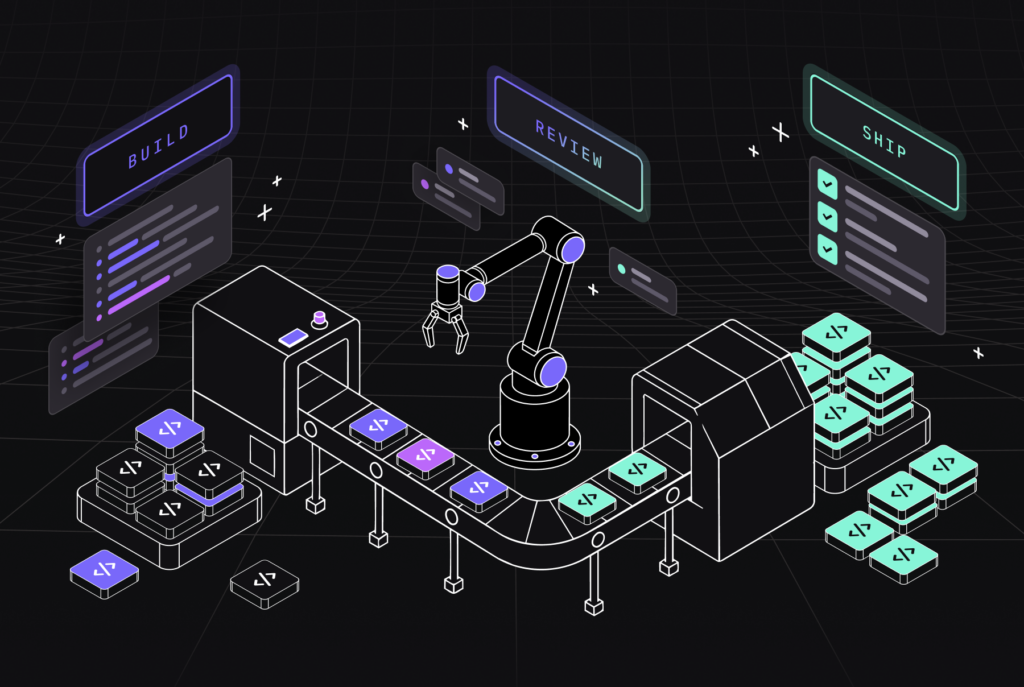
Qodo is an AI code quality and governance platform built to be exactly the independent verification layer this argument calls for. It reviews your code regardless of which coding agent wrote it. Whether your developers generate with Claude Code, Cursor, GitHub Copilot, or OpenAI Codex, Qodo reviews the result as a separate system, with the full codebase context, cross-repo awareness, and enforceable rules that real review demands. It is not the assistant that wrote the code grading its own work. It is the layer that independently verifies whether the code is actually ready to ship.
How to think about your stack
If you are choosing an AI coding agent, the most useful move is to stop treating review as a feature you get for free with generation. In practice, that looks like a deliberate two-part decision. Pick the coding agent your developers like for code generation. Then add a specialized, independent review layer for verification. The two work together precisely because they are not the same system.
As AI keeps raising how much code your team produces, the constraint on shipping is trust, not output. The teams that pull ahead will be the ones that stopped asking their code generator to vouch for itself, and started verifying code with a layer built for the job. If you are evaluating that layer, Qodo is worth a serious look.
References
Gartner, Don’t Use AI Coding Agents for Every Software Engineering Task, Shiva Varma, 2 June 2026.
GARTNER is a trademark of Gartner, Inc. and/or its affiliates. Gartner does not endorse any vendor, product or service depicted in its research publications and does not advise technology users to select only those vendors with the highest ratings or other designation. Gartner research publications consist of the opinions of Gartner’s research organization and should not be construed as statements of fact. Gartner disclaims all warranties, expressed or implied, with respect to this research, including any warranties of merchantability or fitness for a particular purpose.
1Yue Liu, Ratnadira Widyasari, Yanjie Zhao, Ivana Clairine Irsan, Junkai Chen, and David Lo, “Debt Behind the AI Boom: A Large-Scale Empirical Study of AI-Generated Code in the Wild,” arXiv:2603.28592v2, last revised 26 April 2026. https://arxiv.org/abs/2603.28592
2Shivani Shukla, Himanshu Joshi, and Romilla Syed, “Security Degradation in Iterative AI Code Generation: A Systematic Analysis of the Paradox,” arXiv:2506.11022, 2025. https://arxiv.org/abs/2506.11022
3Qodo, “The AI Coding Paradox,” 2026. Based on a survey of 500 U.S. IT engineers and engineering leaders. https://www.qodo.ai/resources/the-ai-coding-paradox/