GPT-5.6: More Precise and Efficient Code Review


GPT-5.6 is here, and it marks an exciting step forward for AI-powered software development.
At Qodo, we have been working closely with OpenAI to bring the power of GPT-5.6 into the places where engineering teams need it: code review, quality, and governance. This update is not just about a more capable model. It is about what becomes possible when frontier AI is paired with deep codebase context, enterprise-grade review workflows, and Qodo’s purpose-built approach to helping teams ship better code with confidence.
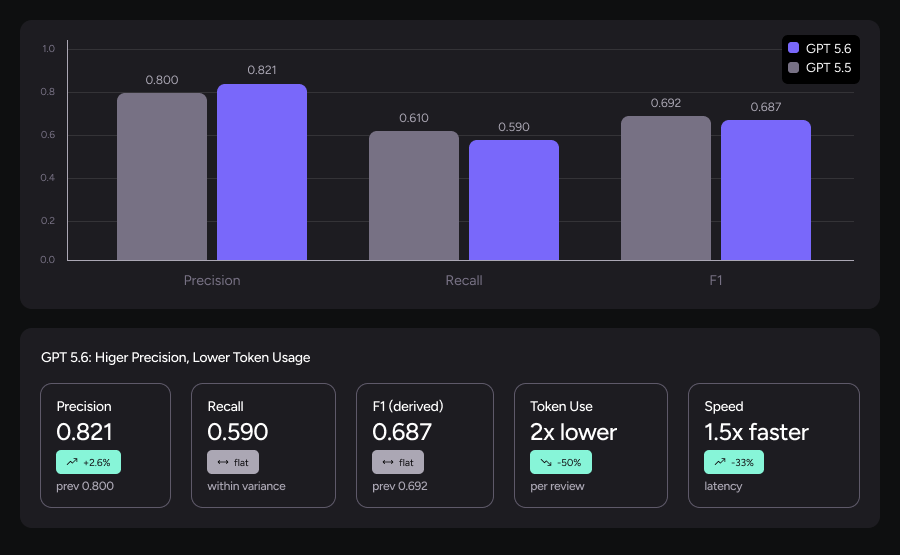
To understand the impact, we put GPT-5.6 to the test inside Qodo’s AI Code Review Benchmark, which measures how accurately and efficiently models identify real issues in production pull requests. We compared GPT-5.6 against GPT-5.5 across four metrics: precision, recall, token usage, and latency.
The results show meaningful gains in the areas that matter for engineering teams: identifying higher-quality issues, improving review precision, and helping developers catch risks before they reach production.
Here’s a snapshot of the results:
- Higher precision. Precision improved from 0.80 to 0.82, reducing false positives that erode developer trust.
- Stable detection. Recall and F1 remained within normal benchmark variance, so higher precision didn’t come at the expense of missed issues.
- Greater efficiency. GPT-5.6 uses roughly half the tokens per review and completes reviews 1.5× faster.
Why precision matters
Precision is the share of flagged issues that are actually real. Every false positive is a tax: a developer stops, reads, digs in, and finds nothing. Do that enough times and they stop reading at all.
That’s how trust breaks down. A reviewer that cries wolf gets muted, ignored, or switched off; and the one real bug slips through, buried under nits no one trusts. The noise also trains your team to distrust the review itself.
In an agentic SDLC where PR volume is exploding, a low-precision reviewer scales noise faster than signal. High precision is what makes automated review something developers act on instead of route around. As AI-generated pull requests increase, review quality depends less on catching every possible issue and more on surfacing the issues developers actually need to act on.
The importance of steady recall
A precision gain would mean a lot less if it came at the cost of real detection coverage. Recall moved from 0.610 to 0.590, a difference small enough to sit within normal benchmark variance rather than a meaningful regression. In practice, this means GPT-5.6 finds essentially the same proportion of real issues as GPT-5.5, while flagging fewer false positives along the way.
That distinction matters because recall is a harder metric to move. Holding it steady while precision improves means the underlying reasoning got better, not just the filtering.
“Qodo’s benchmark results highlight the practical impact of GPT-5.6 for engineering teams: more precise reviews, lower latency, and greater efficiency without sacrificing meaningful issue detection,” said Marc Manara, Head of Startups at OpenAI. “We’re excited to work with Qodo to bring OpenAI’s frontier models into code quality workflows where trust, context, and governance are critical to helping teams ship high-quality software.”
The efficiency gain
The token and latency improvements are not incidental. Using half the tokens per review is a meaningful efficiency gain on its own, regardless of pricing shifts. Faster review latency means developers get feedback while context is still fresh.
Together, these improvements point toward a better cost and speed profile, though the actual dollar impact depends on GPT-5.6’s pricing relative to GPT-5.5. Those gains matter most as review volume grows. Faster, cheaper reviews make it practical to review every pull request, not just the highest-risk ones.
Why review doesn’t get solved just with a smarter model
As AI agents write a growing share of code, the constraint shifts from generation to trust. Writing code and reviewing code are fundamentally different tasks. Generation is about producing the best answer. Review is about finding what that answer missed: the edge case that wasn’t considered, the architectural pattern that was broken, or the security implication that went unnoticed.
That asymmetry is exactly why independent review matters, and why it doesn’t disappear as models improve.
Foundation models will continue getting better at both writing and reviewing code. But model intelligence alone doesn’t solve the broader challenge of governing AI-generated code. Organizations still need a way to ensure every change meets their engineering standards before it reaches production. That’s where governance comes in, and code review is where it gets applied.
Governance is more than catching bugs. It’s how organizations enforce requirements, architectural decisions, coding standards, and engineering best practices consistently across every repository and every pull request. That requires context that foundation models don’t have by default: your codebase, architecture, pull request history, and the engineering knowledge that lives inside your team. It also requires standards that are codified into enforceable rules, along with specialized review agents that know what matters in a security-sensitive service versus a performance-critical system or a routine refactor.
Better models improve what’s possible. They don’t create the system that applies that intelligence consistently across repositories, pull requests, and teams. That system combines codebase context, organization-specific rules, and specialized review agents so reviews reflect how your organization actually builds software.
Qodo provides that governance layer. Through our partnership with OpenAI, Qodo brings frontier models like GPT-5.6 into a review system built for real engineering environments, combining model intelligence with repository context, organizational rules, and specialized review agents. As the underlying models improve, review quality improves with them without requiring teams to rebuild their workflows.
The model that writes the code shouldn’t be the only thing deciding it’s ready to ship. The biggest advantage won’t come from using the smartest model alone. It will come from a governance system that is consistent, contextual, and trusted.
About Qodo’s AI Code Review Benchmark
Qodo’s benchmark injects realistic defects into genuine, merged pull requests from active, production-grade open-source repositories spanning TypeScript, Python, JavaScript, C, C#, Rust, and Swift. Each test instance combines both functional bugs, such as logical errors, race conditions, and resource leaks, and best-practice violations specific to that repository’s own standards. The benchmark then measures how accurately a model catches them across precision, recall, token use, and latency.
This setup means the benchmark reflects how a model performs on the kind of complex, multi-file PRs engineering teams actually ship, not isolated single-bug snippets.
About the author