Codify What Your Best Reviewers Already Know with Rule Miner

Codify What Your Best Reviewers Already Know with Rule Miner
Every team has standards nobody wrote down. The reviewer who always catches the same missing null check. The tech lead who rejects PRs that skip error handling in one specific way. The convention nobody documented because everyone on the team already knows it. That knowledge is real, it’s valuable, and until now it’s lived nowhere except in reviewers’ heads.
Rule Miner turns that knowledge into something the whole team, and Qodo’s review agents, can actually use.
How it works
When a developer merges a PR, Qodo analyzes the code changes, the review comments, and how the author responded to that feedback. Rule Miner scans that history for one specific, high-signal pattern: a reviewer called out something in the code, and the author agreed and fixed it. When that pattern shows up consistently across PRs, the Rule Miner promotes it to a rule: a documented standard that Qodo’s review agents can enforce automatically on every future PR.
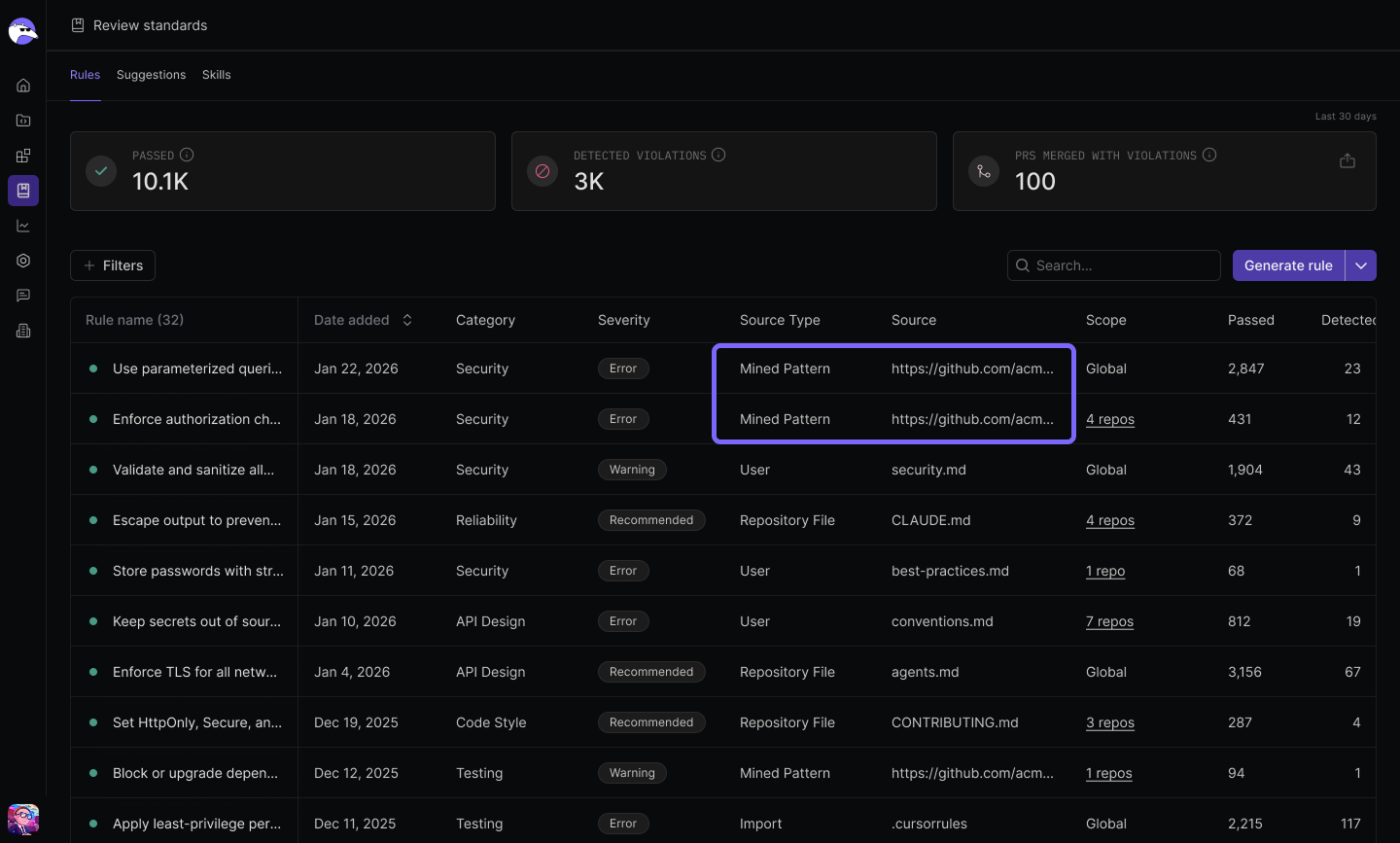
Every rule traces back to a real review interaction the team already had and already agreed with. Nothing is invented, nothing is guessed, and nothing needs to be written from scratch.
Built on a high bar for evidence
Rule Miner is selective by design. It’s built to pick up standards from your best, most specific reviewers, the ones whose feedback consistently gets acted on, not noise from every comment left on a PR. It only counts a signal when three things are true:
The comment is specific. A reviewer has to call out an actual code issue or standard, not general praise, not an open-ended question, not a passing nitpick.
The fix was accepted. The author has to have actually applied the suggested fix. Acceptance is what confirms the feedback reflects a real team standard rather than one reviewer’s individual preference. Dismissed or ignored feedback doesn’t count.
The pattern repeats. One accepted fix is a data point. A recurring one is a standard, and that’s the bar Rule Miner holds to before turning something into a rule.
A rule from Rule Miner isn’t a best guess about what your team’s standards might be. It’s a codified version of a standard your team has already demonstrated, repeatedly, in real reviews.
What this looks like in practice
On one actively-reviewed repo, around 200 indexed PRs produced about 97 reviewer fix-suggestions, things like flagging an unhandled edge case or a missing input check. Of those, 11 were accepted by the author, and those became 5 rules: five standards this team was already enforcing, now captured, documented, and automatically applied to every future PR. That specific ratio will vary by team and by how actively a repo is reviewed, but the shape holds everywhere: a wide funnel of feedback narrows down to a small set of standards worth real confidence.
Standards that evolve with the team
The Rule Miner keeps watching every new merge, which means the ruleset keeps pace with how the team actually reviews code today, not how it reviewed code when the standard was first written down. As practices shift, new patterns get picked up and folded in automatically. A growing team, a new tech lead with sharper opinions, a codebase that matures into stricter conventions: all of it shows up in the rules without anyone having to go back and edit a document.
The bottom line
Rule Miner takes something every engineering team already has, a body of hard-won, informally enforced standards, and turns it into something explicit, consistent, and automatically enforced, with no workshops and no style guide to maintain by hand. It’s part of Qodo’s rules system today, working quietly in the background of every merge to make sure the standards your best reviewers already hold the team to become standards everyone benefits from.