Best Codacy Alternatives in 2026

AI code review has moved fast. Teams no longer expect just linting and style enforcement, they want a layer that catches real production risk before code ships, and most platforms in this category have raced to add one.
Codacy has been a trusted name in code quality since 2012, used by more than 15,000 organizations and 200,000 developers, including teams at PayPal and Adobe. In December 2025, it added its own AI Reviewer, so the platform doesn’t just check code against a fixed set of rules anymore. It also reads through a pull request and flags whether the change actually does what it’s supposed to do, closer to what a human reviewer would catch.
That upgrade hasn’t solved the underlying problem. As more code gets written with AI assistance, review still can’t keep up: the time it takes teams to review and approve changes has increased fivefold, according to coverage of a 2026 Faros AI report. That’s the real reason teams start looking at alternatives to Codacy. Some need a tool that understands how a change affects the whole codebase, not just the one pull request in front of it. Others simply outgrow Codacy’s Team plan, which caps out at 100 private repositories before pushing them into a custom-priced Business tier.
This guide breaks down five platforms teams switch to when Codacy’s coverage stops matching what they actually need.
TL;DR
- Codacy combines static analysis, security scanning, AI-assisted review, PR quality gates, and governance in one platform, but its AI review layer reasons about one PR at a time, not the wider repo, which is why teams look for deeper cross-repo context, stronger security depth, self-hosted deployment, or a better fit with their existing stack.
- Static analysis tools (SonarQube, Semgrep) manage rule-based quality and security, the same category Codacy itself sits in.
- AI-native code review (Qodo) reasons across the whole repo and its connected repos, not just the PR in front of it, going a layer deeper than PR-scoped AI review.
- Hybrid tools such as DeepSource and Sourcery offer both rule-based analysis and AI-assisted remediation within the same platform.
- You cannot find a single platform that matches Codacy’s exact feature set on a one-to-one basis. This guide looks at all five- Qodo, SonarQube, Semgrep, DeepSource, and Sourcery with practical examples, feature tables, a list of advantages and disadvantages, and a buyer’s guide, thereby ensuring that the decision comes down to the particular gap you want to close.
What Are the Best Codacy Alternatives in 2026?
In 2026, the five best alternatives to Codacy are Qodo, SonarQube, Semgrep, DeepSource, and Sourcery, each addressing a different issue. SonarQube is the most direct replacement for Codacy’s static analysis, quality gates, and governance features. When the main goal is application security, Semgrep is the best choice.
Qodo takes the furthest step towards AI-native governance by combining repository-wide context with a self-learning rules system and an audit trail so that the standards remain upheld even as AI writes increasing amounts of the code. DeepSource and Sourcery combine traditional static analysis with AI-assisted remediation and features that improve developer productivity.
The fastest way to narrow five options to one: figure out whether you’re missing deterministic analysis, AI-native review, or both, then match on deployment model and team size. That’s the order the sections below follow.
This guide covers each platform, explains where it fits, and identifies which types of teams are most likely to benefit from it.
What Does Codacy Do?
Codacy is a code quality platform that combines static analysis, security scanning, dependency monitoring, pull request checks, and governance controls in a single workflow. The platform integrates directly with source control and CI/CD pipelines so that quality and security issues are identified before code reaches production. Pricing starts at $21/developer/month ($18/developer/month billed annually) for the Team plan, which caps out at 100 private repositories, teams that outgrow that move to a custom-priced Business tier.
Codacy has also added its own AI Reviewer, launched in December 2025, which layers context-aware reasoning about PR intent on top of its deterministic checks, rather than relying on rule-matching alone.
That’s worth knowing going in: this isn’t a pure static-analysis-only tool anymore, so the real differentiator among the alternatives below isn’t “has AI” versus “doesn’t.” It’s how deep that reasoning goes, PR-level intent-matching within one repo, versus the cross-repo, full-codebase context some of these alternatives are built around.
Most teams rely on Codacy for five things:
- Static code analysis: detecting code smells, duplication, complexity violations, and language-specific quality issues
- Security and dependency scanning: identifying vulnerable packages and insecure coding patterns through SCA and SAST
- AI Reviewer: cross-referencing a PR’s description and metadata against the actual code changes to flag unimplemented business logic and suggest fixes, in addition to the deterministic checks
- Pull request quality gates: blocking merges when code coverage, duplication, or security thresholds are not met
- Governance and reporting: enforcing organization-wide standards and tracking quality trends across multiple repositories
Not All Codacy Alternatives Solve the Same Problem
Not every platform in this list is trying to solve the same problem. Understanding which category each tool belongs to makes it easier to identify which alternatives deserve closer evaluation.
| Category | What It Focuses On | Tools in This List |
|---|---|---|
| Static Code Analysis | Rule-based code quality, security scanning, technical debt, governance | SonarQube, Semgrep |
| AI-native code review | Pull request review, repository context, and AI-generated code validation | Qodo |
| Hybrid code health | Static analysis combined with AI-assisted remediation and developer productivity | DeepSource, Sourcery |
Static code analysis platforms identify known quality and security issues through predefined rules. These platforms are well-suited for organizations looking to replace Codacy’s governance capabilities or strengthen application security controls. SonarQube covers code quality, technical debt, and governance. Semgrep focuses on application security, SAST, SCA, and secrets detection.
AI-native review platforms evaluate code changes in context rather than scanning for predefined patterns. These platforms are most useful for teams that already have analysis tooling in place and want to improve pull request review quality, reduce reviewer workload, or validate code written by AI coding assistants. Qodo takes this approach, pairing full repository context with organizational rules and PR automation.
Hybrid platforms combine rule-based analysis with AI-assisted workflows and automated fix suggestions. DeepSource and Sourcery are designed for teams that want both analysis and productivity features in a single platform, without having to manage multiple specialized tools.
The 5 Best Codacy Alternatives, Ranked
1. Qodo: Best for Validating AI-Generated Code
in Pull Requests
Best for: Engineering teams with static analysis and security tooling in place who want context-aware AI code review to improve pull request quality and validate AI-generated code.
Qodo is an AI-native code review and quality platform that combines automated pull request reviews, codebase-wide context, and governance enforcement into a unified system. Named a Visionary in the 2025 Gartner Magic Quadrant for AI Code Assistants, Qodo is built specifically for review and quality enforcement, not code generation. Qodo runs on a multi-agent architecture built around its Context Engine.
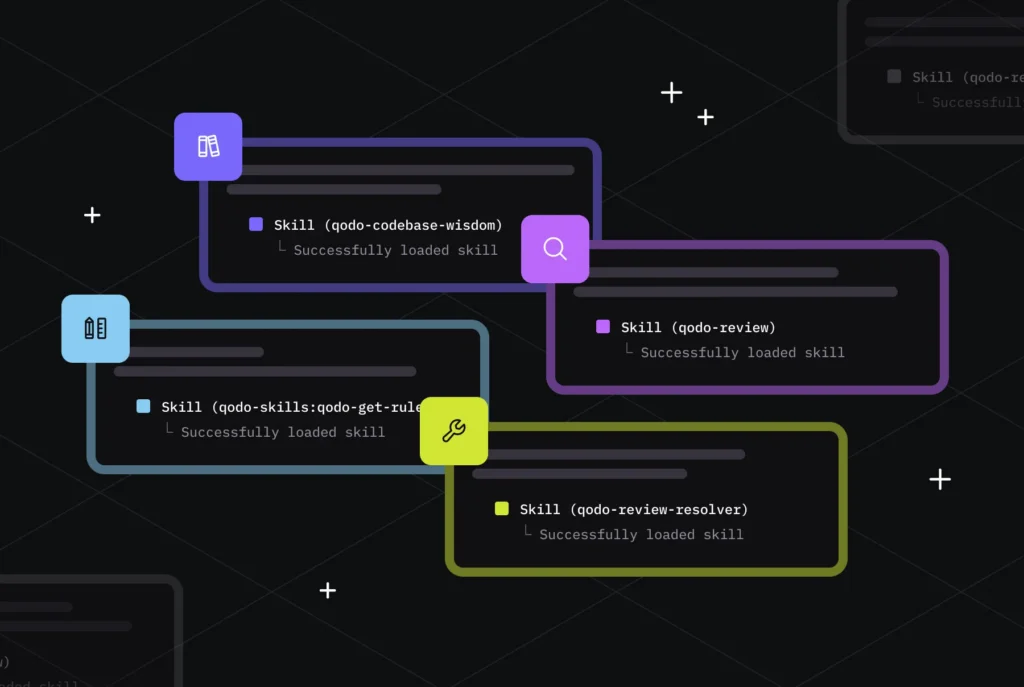
Qodo 2.4, shipped in June 2026, added three capabilities on top of that Context Engine: Cross Repo Review, which flags a Cross-repo conflict on a pull request when a change would break a related repository; Rule Miner, which learns coding standards directly from PR review history; and Skills in Qodo Portal, which governs the AI skills used during code review.
The newest addition extends that same cross-repo context earlier in the workflow: the Qodo Agentic Toolbox, launched September 9, 2026, brings Qodo’s codebase understanding, cross-repository relationship mapping, and review standards directly into the coding agent a team already uses, so issues surface while code is still being written, not after a PR is opened.
Key Functionalities
- Context Engine: Indexes multi-repo codebases to detect issues that span components, services, and repositories
- AI-powered pull request reviews: Automated review agents catch bugs, logic gaps, and security vulnerabilities with inline feedback
- AI-generated code validation: Checks if AI-assisted changes match your project’s patterns and requirements.
- Organizational rules system: You can set standards yourself or have Rule Miner pull them from PR history. These standards are then enforced on every PR.
- Cross Repo Review: Checks changes against related repositories, not just the one you are working on. This helps catch breaking changes before they are merged.
- The Skills in Qodo portal: Control which Agent Skills are used during code review. Teams can see which skills are active and remove any that are no longer needed.
- Agentic Toolbox (launched September 9, 2026): Brings Qodo’s context and review standards directly into your coding agent via Agent Skills, before a PR opens.
- Codebase Wisdom and Get Rules: Give agents codebase context and applicable rules before they write code.
- Reviewer and Review Resolver: Review local changes and resolve PR findings from within the agent session.
- Manage Standards: Lets the agent create, edit, or retire Review Standards conversationally.
- Test generation and validation: Automatically generates and validates test coverage for pull request changes
- Review automation workflows: 15+ automated PR workflows generate precise, explainable feedback across IDE and Git environments
- Enterprise security: Code is analyzed in ephemeral environments on the standard cloud tier; nothing is stored, logged, or used to train models. Enterprise plans also support on-premises and air-gapped deployment for teams that need code to stay entirely within their own infrastructure
Hands-on: How Qodo Flags Bugs Outside the Stated
Scope of a Pull Request
Once a repository has been connected, Qodo indexes the codebase and establishes the way in which services, utilities, and modules interact before looking at any pull request; the review it produces is based on that context and not just on whether the altered lines appear correct when examined in isolation.
The PR in which the unused Tinybird filter parameters (device, browser, os) are removed from 14 files results in a clean change: the SQL pipes are shortened, the test fixtures are updated, and the combined filter test cases are revised so as to use only the remaining parameters. A reviewer looking at the diff would be able to verify that the removals are consistent and then approve the review.
Qodo flagged four issues that the diff did not make visible:
- Token assignment bug (most critical). In TinybirdService.js, _serverToken is assigned to the full {token, exp} object instead of tokenData.token, so every downstream Authorization: Bearer ${token} call sends Bearer [object Object], breaking all Tinybird API requests without any compile-time or lint error.
- Lockfile drift. A newly added JSDoc block instructs developers to use npm install in a Yarn-managed repo.
- Signature verification removed. _isJWTExpired() was changed from jwt.verify() to jwt.decode(), so the service now treats a rotated or corrupted token as valid until expiry.
- Stale documentation. ARCHITECTURE.md still documents three endpoints that no longer exist in the pipe allowlist.
Qodo’s review flags all four findings in line, each tagged by severity and action status.
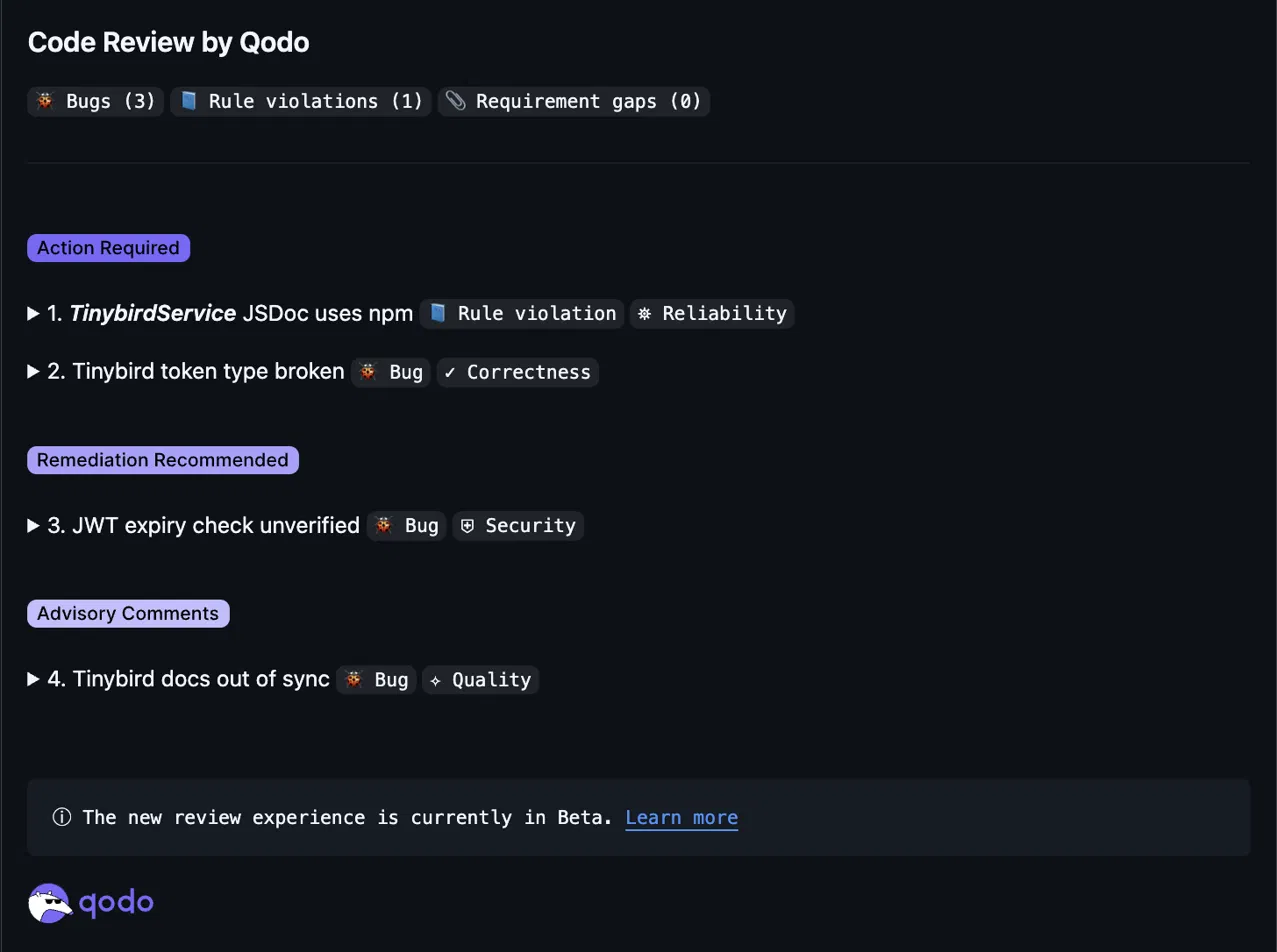
The token-assignment bug and the npm/Yarn lockfile-drift note are both flagged as Action Required, while the JWT-verification downgrade and the stale architecture doc are flagged for awareness. Qodo separates findings by the action they require before merging, not only by category; the token bug is prioritized above the documentation drift precisely because Qodo knows how _serverToken is consumed downstream.
| Pros | Cons |
|---|---|
| Repository-wide and cross-repo context: Cross Repo Review flags breaking changes in dependent repos at PR time, and the incoming Agentic Toolbox extends that same context into the coding agent before a PR exists | No static analysis; Qodo’s rules system enforces standards deterministically through PR and IDE review, but it’s not a standalone linter for metrics like cyclomatic complexity |
| AI-generated code validation evaluates whether AI-assisted changes match project-specific patterns, not just whether they compile | Smaller repos see less benefit; the Context Engine needs established patterns and commit history to perform well |
| Organizational rules system, define standards once and enforce them across all PRs |
Who Should Use Qodo
Best for teams that already have static analysis in place and want to add context-aware AI code review on top, especially organizations using GitHub Copilot, Cursor, or other AI coding assistants, where validating AI-generated code is a recurring need, especially organizations running dozens or hundreds of interconnected repos across multiple Git providers, where Cross Repo Review and Rule Miner keep standards consistent as AI increases PR volume, with the Agentic Toolbox set to push that same consistency earlier into development once it’s generally available.
2. SonarQube: Best for Self-Hosted Quality Governance
Best for: Engineering organizations that want to replace Codacy’s code quality, governance, and security scanning capabilities with a mature platform that supports self-hosted deployment.
SonarQube is an industry-standard automated code review and static analysis platform. The platform detects coding issues across 40+ languages, frameworks, and IaC platforms by integrating directly with CI/CD pipelines and DevOps toolchains. SonarQube is available as SonarQube Server (self-hosted) and SonarQube Cloud (SaaS), with an IDE plugin, SonarQube for IDE, that brings real-time analysis into VS Code, IntelliJ, Visual Studio, and Eclipse.
Key Functionalities
- Static code analysis helps find bugs, code smells, duplication, and complexity issues in more than 40 languages and frameworks.
- Security scanning (SAST) finds vulnerabilities, security hotspots, and unsafe coding patterns before you merge your code.
- Quality gates let you set pass or fail thresholds for coverage, duplication, reliability, maintainability, and security results.
- Technical debt tracking shows quality trends over time with dashboards that highlight how debt builds up or improves across projects.
- Pull request analysis: Checks each PR against the active quality profile and blocks merges when thresholds are not met
- IDE integration (SonarQube for IDE): Flags issues in real time as developers write code in their editor
- Self-hosted and cloud deployment: SonarQube Server for on-premises infrastructure; SonarQube Cloud for SaaS teams
- Connected Mode: Syncs quality profiles, new code definitions, and issue assignments between the server and IDE plugin
Hands-on: How SonarQube Runs a Full Project Analysis
SonarQube analysis begins with a scanner that checks the codebase against a configured rule profile and then forwards the results to the SonarQube server. Teams can run the scanner as a Docker container, as a step in a CI pipeline, or via the local CLI command, in each case obtaining the same categorized findings and quality gate decision. When choosing the self-hosted option, the server, analysis results, and project tokens all remain entirely within the team’s infrastructure.
Once the scanner finishes, the SonarQube server applies the project’s quality profile and quality gate to generate a pass/fail verdict across six code health dimensions: Security, Reliability, Maintainability, Coverage, Duplications, and Security Hotspots. The dashboard gives engineering leaders a project-wide view of findings and trends without requiring them to open each pull request individually. Here is the project for challenge-05 immediately after a scan run against a self-hosted SonarQube Community Build 26.2.0 instance:
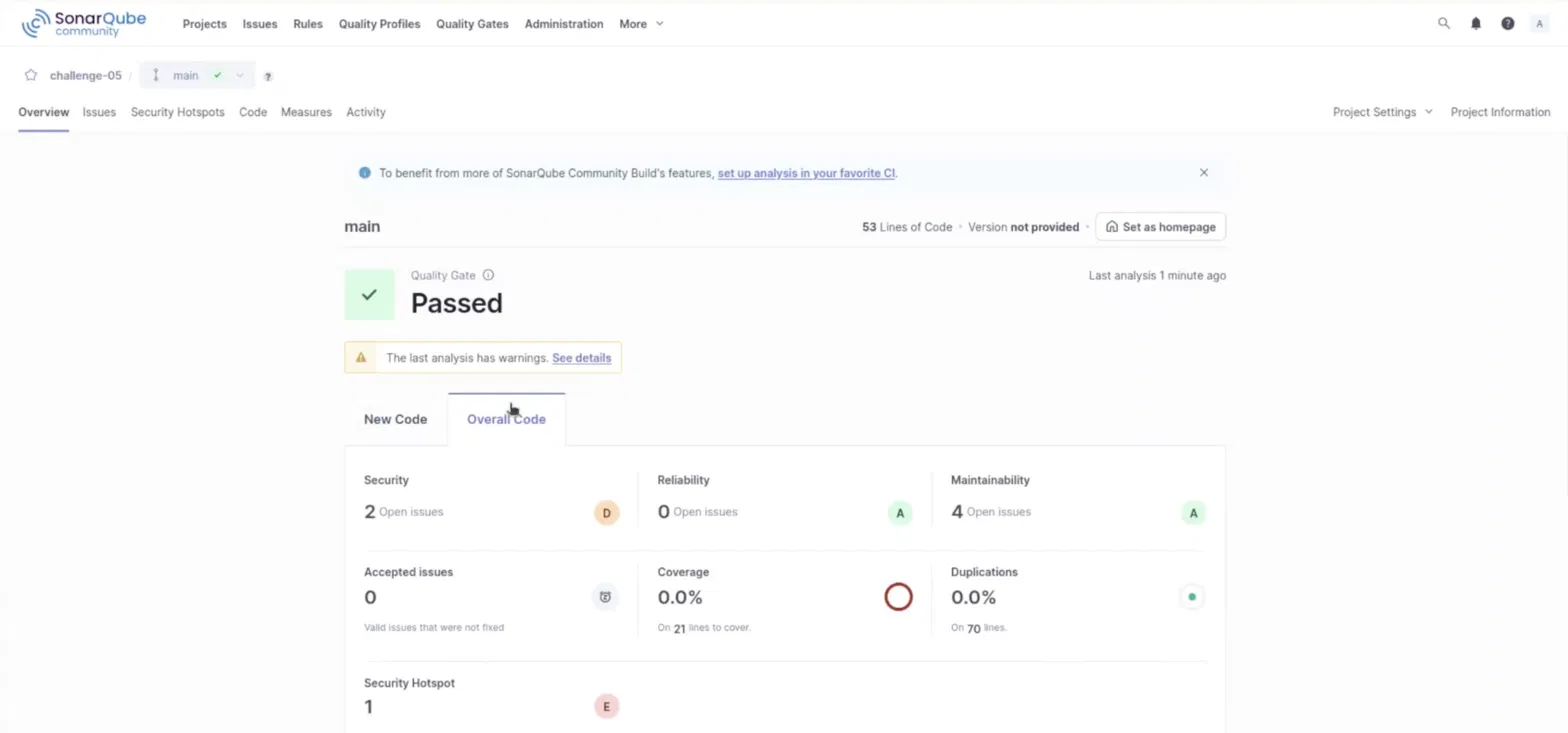
Notice that the Quality Gate shows Passed while the Security dimension carries a D rating with 2 open issues. The gate passed because the threshold was configured against new code only, a setup that prevents regressions without requiring all existing security debt to be resolved before any PR can merge. The 0.0% coverage on 21 coverable lines is flagged separately, signaling a gap that blocks teams from adding coverage-based quality gates until tests are written.
| Pros | Cons |
|---|---|
| Quality gates, configurable pass/fail thresholds across coverage, duplication, maintainability, reliability, and security | Operational overhead, self-hosted deployments require dedicated infrastructure and ongoing maintenance |
| Technical debt visibility, tracks quality trends over time across repos and teams | No repository-wide context, can’t detect that a change conflicts with an existing implementation elsewhere in the codebase |
| Self-hosted deployment, runs entirely within private infrastructure for data residency requirements | Limited AI review capabilities, evaluates against predefined rules, not business logic or architectural intent |
Who Should Use SonarQube
Best for organizations replacing Codacy’s capabilities, static analysis, quality gates, security scanning, and governance reporting, with minimal gaps, especially for teams with compliance requirements or a need for self-hosted deployment.
3. Semgrep: Best for DevSecOps and Custom
Security Rules
Best for: Security-focused engineering teams and DevSecOps programs that need SAST, SCA, secrets detection, and the ability to enforce custom security policies in the development workflow.
Semgrep is an application security platform built around a lightweight, fast static analysis engine that supports custom rule authoring alongside managed security rulesets. The platform covers SAST, Software Composition Analysis (SCA), secrets detection, and supply chain security in a single workflow. Semgrep integrates into CI/CD pipelines and flags security findings directly in pull requests, shifting security review left rather than routing findings to a downstream security queue.
Key Functionalities
- SAST (Static Application Security Testing) finds vulnerabilities in your application code using both managed and custom rule sets.
- SCA (Software Composition Analysis): identifies vulnerable dependencies and uses reachability analysis to distinguish real risks from theoretical ones.
- Secrets detection scans your codebase and commit history for hardcoded credentials, API keys, and tokens.
- Custom rule engine: Lets you create security rules tailored to your organization with Semgrep’s pattern syntax, helping you enforce your own coding standards.
- Supply chain security monitors dependency risks and license compliance across all your open-source packages.
- Reachability analysis: checks whether vulnerable dependency code paths are actually used by your application, helping reduce false positives.
- PR-integrated security: findings add comments with security issues directly to your pull requests before the code is merged.
- Policy enforcement: lets you set and apply security policies across your repositories using customizable blocking rules.
Hands-on: How Semgrep Flags a Critical Code Injection
Vulnerability
Semgrep organizes its results into three types of scans: Code (SAST), Secrets, and Supply Chain. In the Code scan, you can use a Priority filter to see which findings need your attention first. This makes it easier to focus on the most important and reliable issues, especially since busy repositories might have dozens or even hundreds of findings. Semgrep’s taint analysis tracks how data moves from an untrusted source, such as an HTTP request parameter, to a risky function, such as eval. It shows the full path, even if the source and destination are separated by several function calls.
In a JavaScript payment API with 22 total Code findings, the Priority tab narrows the list to 2 findings, both pointing to src/…/transactions.js:17 on the main branch. Semgrep identified that Express request data flows directly into eval at that line, a code injection path that allows an attacker to execute arbitrary code in the application process. Here is how those two priority findings appear in the Semgrep dashboard:
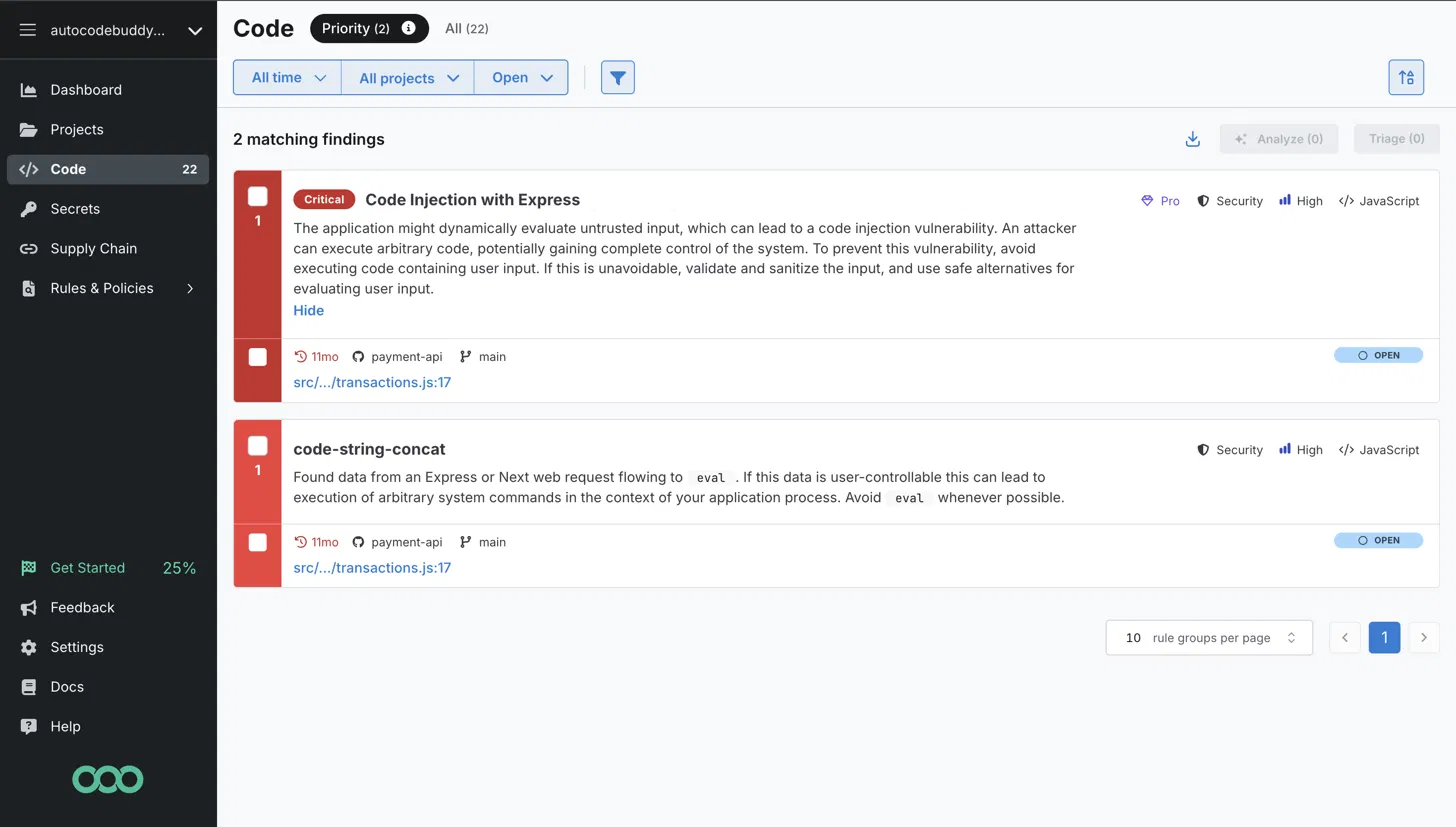
Look at the Critical badge next to the Pro label for the first issue: Critical is the highest severity level used by Semgrep, and the Pro version designates it as a rule which traces the complete taint flow from the incoming HTTP request all the way to the eval call, a detection pathway that is not included in the free ruleset. For the second issue, code-string-concat, the same line is triggered by a different pattern that picks up string concatenation before the eval call, so two separate rules have identified the same vulnerable line via different detection pathways.
| Pros | Cons |
|---|---|
| Custom rule engine, encode organization-specific vulnerabilities beyond managed rulesets | Security-focused, not quality-focused, doesn’t track technical debt, maintainability, or complexity |
| SAST, SCA, and secrets in one platform, covers the three most common sources of exploitable findings | No AI review layer, no AI-powered PR summaries or context-aware code review |
| Reachability analysis distinguishes vulnerable paths that the application code actually calls from those that it never reaches | Limited governance reporting, lacks SonarQube’s trend-based dashboards and multi-repo reporting |
Who Should Use Semgrep
Best for security teams driving the evaluation, organizations building a DevSecOps program, and teams with compliance requirements around dependency security and secrets management. Most organizations use Semgrep alongside a code quality platform or AI review tool rather than as a Codacy replacement.
4. DeepSource: Best for Combined Analysis and
Automated Fixes
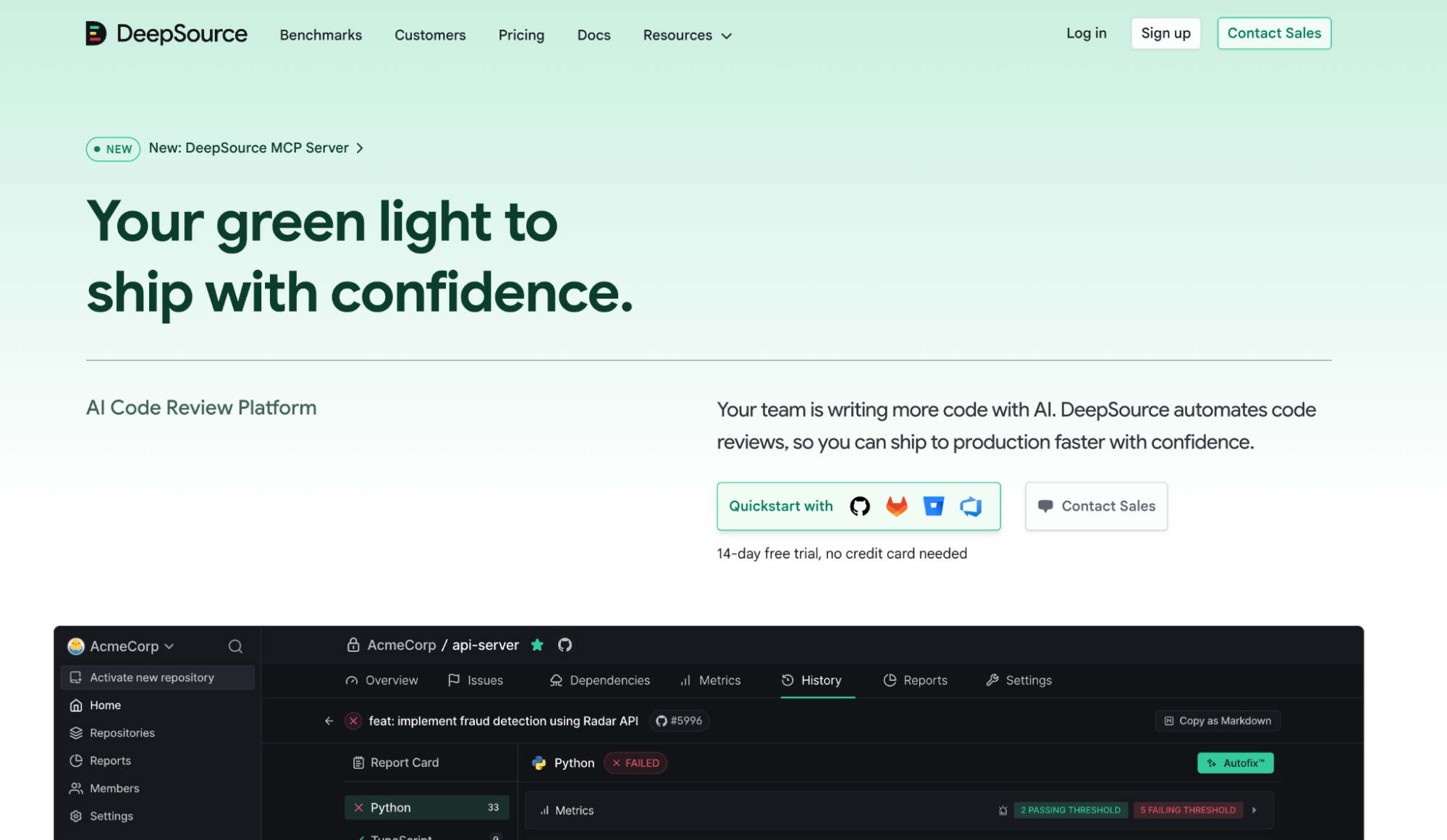
Best for: engineering teams looking for static analysis, security scanning, and AI-powered automated fixes all in one platform, so they do not have to juggle several different tools.
DeepSource is a code health platform that combines static analysis, security scanning, software composition analysis, and AI-assisted autofix into a unified workflow. The platform analyzes code for quality, security, and dependency vulnerabilities and gives automated fix suggestions that developers can apply directly during code review. DeepSource is designed as a single consolidated platform covering multiple aspects of code health without requiring separate specialized tools.
Key Functionalities
- Static code analysis: Detects code quality issues, anti-patterns, and language-specific violations across multiple languages
- SAST and SCA: Identify application security vulnerabilities and vulnerable dependencies with reachability analysis
- Secrets detection: Scans for hardcoded credentials and exposed sensitive data
- Autofix capabilities: provide automated suggestions to fix common quality and security issues, which you can apply right in your code review.
- Code coverage reporting: tracks how much of your codebase is tested and highlights any gaps.
- Dependency vulnerability: details include CVE records, CVSS scores, EPSS probability, reachability verdicts, and the fixability status for each finding.
- Pull request integration: Flags findings inline before changes are merged, following the workflow teams coming from Codacy will recognize
Hands-on: How DeepSource Evaluates Reachability and Fixability for a Vulnerable Dependency
DeepSource’s SCA scans the dependency manifest and lock file, pyproject.toml / poetry.lock in Python projects, and records not only which packages carry a known CVE, but whether the vulnerable code path is actually exercised by application code (reachability) and whether the fix can be applied automatically (fixability). Both signals appear on the individual CVE record alongside CVSS scores and EPSS exploit probability, giving developers a prioritization view that goes beyond severity ratings alone.
Scanning a Python project with [email protected] in its dependency tree, DeepSource flags CVE-2023-30861, a session cookie disclosure vulnerability introduced in Flask 2.3.0 and fixed in 2.3.2 or 2.2.5. DeepSource resolves that the vulnerable code path is reachable from application code and that the dependency update can be applied automatically. Here is the CVE detail view for that finding:
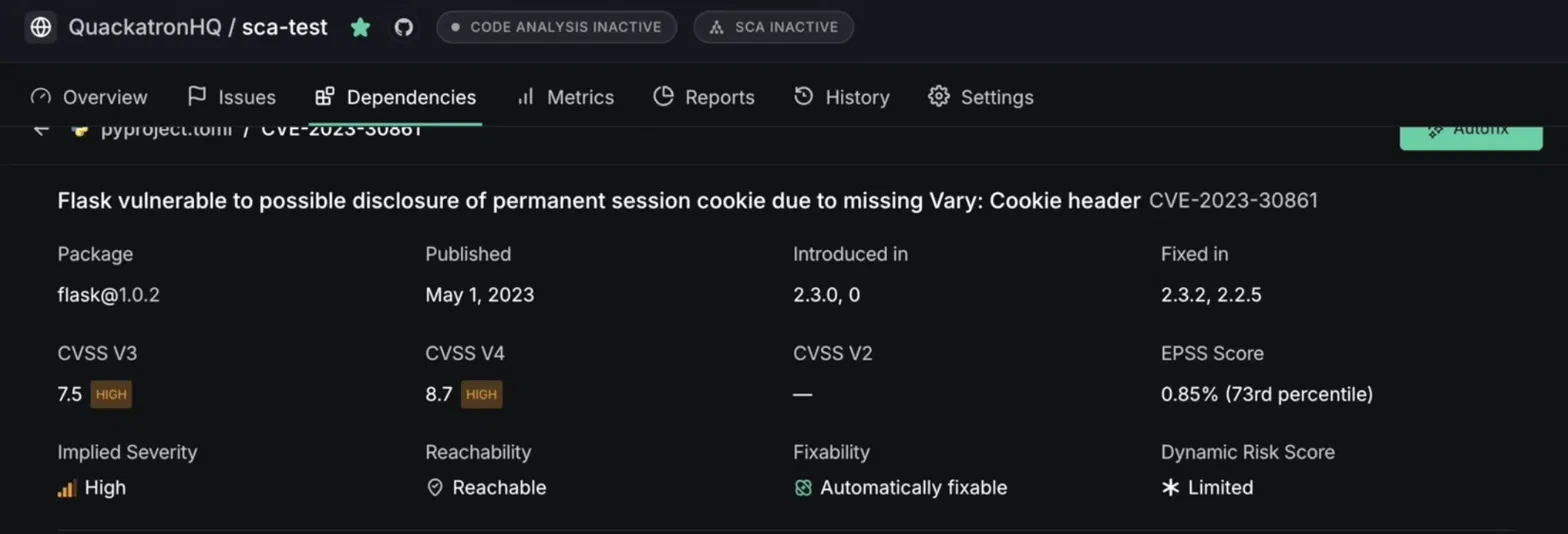
Notice the automatically fixable label alongside Reachable: DeepSource can generate a dependency update to [email protected] or [email protected] and apply it directly, without the developer having to manually identify the correct version range. The EPSS score of 0.85% at the 73rd percentile supplements the CVSS V3 rating of 7.5, a signal that this vulnerability sits in the top quarter of exploited CVEs by probability, useful when triaging which reachable findings to prioritize first.
| Pros | Cons |
|---|---|
| Autofix capabilities generate fix suggestions that developers can apply inline without manual lookup | Governance features are less mature, with no org-level trend aggregation for teams managing 20+ repos |
| Broad coverage on one platform, static analysis, security scanning, SCA, secrets detection, and AI review in a single configuration | AI review is remediation-focused; it explains findings and suggests fixes rather than reasoning about repo-wide intent |
| Familiar workflow for Codacy users: connect a repository, receive findings, and fix the issues in PRs | Moderate repository context, no full codebase graph, limiting cross-module detection |
Who Should Use DeepSource
Best for teams that want a Codacy alternative combining static analysis and automated remediation in one platform, especially engineering teams looking to reduce tool sprawl without giving up AI-assisted fix suggestions.
5. Sourcery: ideal for refactoring and improving
developer productivity
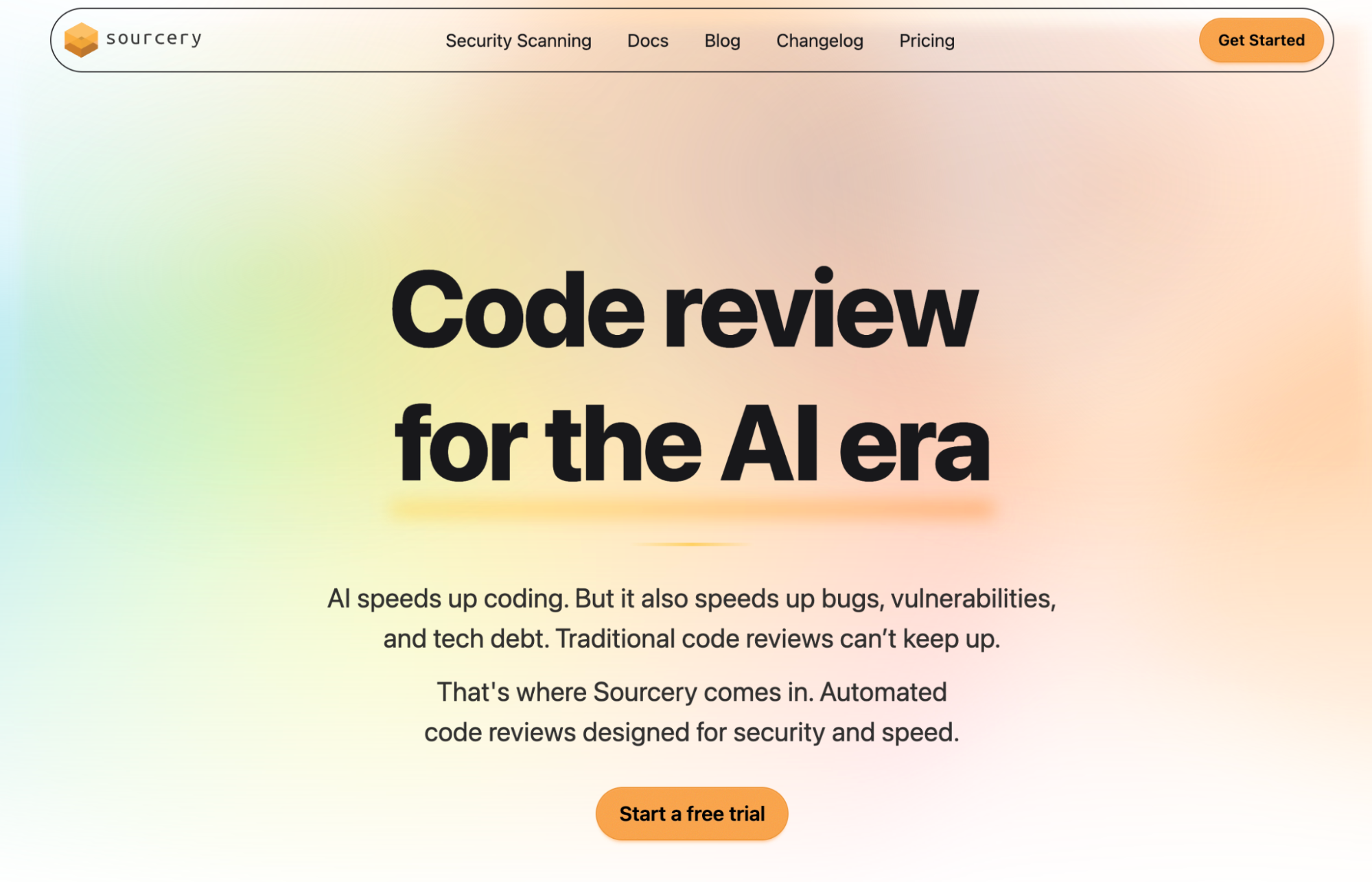
Ideal for: Engineering teams of small to mid-size size who want suggestions for improving their code and guidance on refactoring without having to adopt a platform that has a heavy governance approach.
Sourcery is a platform designed with developers in mind that brings together AI-driven code reviews, automated suggestions for refactoring, and security scanning into a simple workflow. By integrating with various IDEs and Git platforms, it offers improvement suggestions both before and during the code review process, reducing the need for back-and-forth communications between the code authors and the reviewers regarding style and structure. Rather than focusing on centralized governance and compliance reporting, Sourcery emphasizes practical, actionable improvements.
Key Functionalities
- AI-powered code reviews: Automatically adds review comments to pull requests, focusing on readability, maintainability, and common issues.
- Automated refactoring suggestions: Offers clear, practical advice to simplify code, reduce complexity, and make it easier to read and maintain.
- Security scanning: Finds known vulnerability patterns and dependency CVEs, groups them by package, and recommends a single upgrade to fix them.
- Dependency vulnerability grouping: Combines multiple CVEs from an outdated package into one record and shows the minimum upgrade needed to fix all issues.
- IDE integration: Highlights suggestions in VS Code and other supported editors before you commit your code.
- Pull request reviews: Adds inline review comments in GitHub and GitLab workflows.
- Low-friction onboarding: Start quickly without setting up policies, managing quality gates, or configuring infrastructure.
Hands-on: How Sourcery Groups 24 CVEs in a Single Dependency into One Upgrade Recommendation
Instead of listing each CVE separately, Sourcery groups dependency vulnerabilities by package. When an outdated package has several CVEs, Sourcery combines them into a single record, determines the overall total severity, and identifies the lowest upgrade version that remedies all the issues. As a result, the number of remediation tasks goes from many findings down to just one action.
In the Orderflow repository, [email protected] carries 24 CVEs across Critical and High severity levels, including a NO_PROXY bypass at Critical (100) and a Server-Side Request Forgery via hostname normalization at Critical (99). Rather than surfacing 24 separate remediation items, Sourcery identifies that upgrading [email protected] to 1.16.0 in package-lock.json resolves all 24 issues in one change. Here is the full dependency detail view for the axios group:
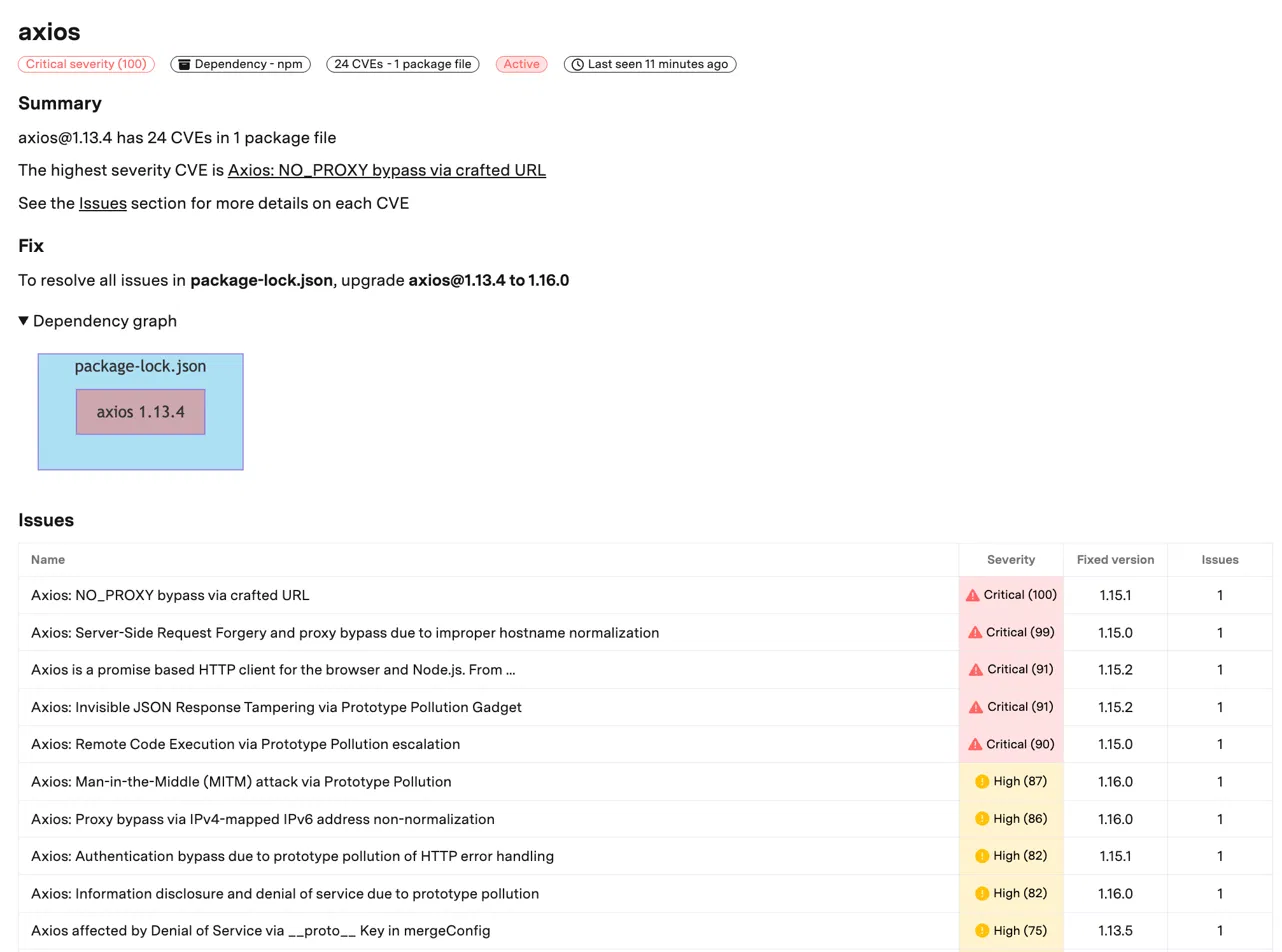
Notice the Fix section above the dependency graph: a single upgrade path ([email protected] to 1.16.0) resolves the entire 24-CVE group in one package-lock.json change. The Issues table below shows that the individually highest-severity CVEs each have different minimum fixed versions, ranging from 1.13.5 to 1.16.0, but Sourcery identifies 1.16.0 as the single version that satisfies all of them, removing the need to cross-reference individual CVE remediation notes.
| Pros | Cons |
|---|---|
| Concrete refactoring suggestions, directly applicable, not abstract quality scores | No governance or compliance reporting, no multi-repository dashboards or trend tracking |
| IDE-first feedback, flags suggestions in the editor before a PR is opened | Limited security depth, basic checks, not full SAST/SCA/secrets detection |
| Dependency CVE grouping combines multiple CVEs in a package into one upgrade record | Shallow repository context, no codebase graph or cross-module analysis |
Who Should Use Sourcery
Ideal for small and mid-sized teams that want practical suggestions regarding code improvement and refactoring without having to use a platform with heavy governance requirements, in particular those teams which spend a lot of time making repetitive style corrections and minor quality fixes.
Codacy Alternatives: Side-by-Side Comparison
Star ratings reflect strength within each dimension, not an overall rank, these five tools solve different problems, so there’s no single “best” across the board. “Not included” means the dimension is outside what that platform is built to do, not a low score on something it attempts.
| Tool | Static Analysis | Security | AI Review | Repository Context | Self-Hosted | Best For | Weakest At |
|---|---|---|---|---|---|---|---|
| Qodo | Not included | Not included | ★★★★★ | ★★★★★ | Enterprise tier only | AI-generated code validation | No standalone static analysis |
| SonarQube | ★★★★★ | ★★★★ | ★★ | Not included | Available | Codacy replacement with governance | No repository-wide context |
| Semgrep | ★★★ | ★★★★★ | Remediation only | Not included | Available | DevSecOps and security enforcement | No quality or governance tracking |
| DeepSource | ★★★★ | ★★★★ | ★★★ | ★★ | Enterprise tier only | Analysis plus automated remediation | Limited governance for 20+ repo orgs |
| Sourcery | ★★ | ★★ | ★★★ | Not included | Enterprise tier only | Refactoring and developer productivity | Limited security depth, no governance |
Which Codacy Alternative Fits Your Team?
| Tool | Best Buyer Profile | Primary Use Case | Key Differentiator |
|---|---|---|---|
| Qodo | Teams adopting AI coding tools with existing analysis | Context-aware AI code review and AI-generated code validation | Qodo Context Engine and organizational rule enforcement |
| SonarQube | Organizations replacing Codacy directly | Code quality governance and technical debt tracking | Self-hosted deployment and mature quality gate system |
| Semgrep | Security-focused teams and DevSecOps programs | SAST, SCA, secrets detection, and custom security policies | Custom rule engine and strongest security coverage |
| DeepSource | Teams wanting combined analysis and AI assistance | Static analysis with automated remediation | Autofix for common quality and security findings |
| Sourcery | Small to mid-sized teams focused on code improvement | Refactoring guidance and developer-facing quality assistance | Lightweight, practical suggestions available in IDE |
Conclusion
The choice between these platforms comes down to which gap is most pressing in your current development workflow. Organizations that still need code quality governance, quality gate enforcement, or technical debt visibility should start with SonarQube or Semgrep. Teams that already have analysis tooling in place but are struggling with pull request review quality, especially as AI-generated code volume increases, should evaluate Qodo instead.
SonarQube and Semgrep cover the foundational analysis layer: what is in the code and whether it violates known quality or security rules. Neither platform evaluates whether a code change conflicts with an existing implementation pattern, introduces architectural drift, or generates unexpected behavior in a module that was not directly modified. Those gaps become more significant as teams adopt AI coding assistants that generate syntactically valid code that still breaks system-level assumptions.
Qodo is designed for that second layer. Qodo is most useful when repository context and organizational rule enforcement matter most. Most engineering organizations with mature development workflows end up with both an analysis platform and an AI review platform rather than relying on a single tool to do both equally well. For a deeper look at how AI code review platforms compare across the broader market, see Qodo’s Academy chapter on AI code review.
FAQs
What is the best alternative to Codacy?
The best Codacy alternative depends on what you are trying to replace. SonarQube is the closest match for Codacy’s static analysis, quality gates, and governance capabilities. Teams that already have analysis tooling in place and want to improve pull request review quality should evaluate Qodo instead.
Is SonarQube better than Codacy?
SonarQube and Codacy have similar capabilities, covering static analysis, security scanning, quality gates, and governance reporting. SonarQube is generally considered to be more mature and is suitable for larger engineering organizations, being one of the very few platforms in this field that allows for self-hosted deployment. The decision of which to choose will depend on the size of the team, the compliance requirements, and the deployment constraints.
Does Qodo replace SonarQube or Codacy?
Qodo is an AI code review platform that does not perform static analysis, track technical debt, or enforce quality gates. Qodo is most commonly used as an additional review layer alongside platforms such as SonarQube or Semgrep.
What is the difference between Codacy and Semgrep?
Codacy is a code quality platform covering static analysis, quality management, and governance alongside security scanning. Semgrep is an application security platform focused on SAST, SCA, secrets detection, and custom security rule enforcement. Semgrep’s security coverage is deeper than Codacy’s, but Semgrep does not provide technical debt tracking or quality governance reporting.
Can I use Qodo and SonarQube together?
Yes, Qodo and SonarQube address different aspects of the development workflow. SonarQube handles static analysis, quality gates, and governance reporting. Qodo covers AI-powered pull request reviews, repository context, and enforcement of organizational rules. Many teams use both platforms within the same CI/CD pipeline.
Which of the Codacy alternatives check AI-generated code in pull requests?
Qodo is the best choice for verifying AI-generated code, since it assesses changes against the repository’s overall context rather than relying solely on fixed rules.
What is the difference between static analysis and AI-assisted code review?
Static analysis checks source code against a set of predefined rules in order to detect known quality problems, security vulnerabilities, and style violations. AI code review, on the other hand, examines changes to the code in the context of the whole codebase, taking into account implementation patterns, architectural consistency, and logical correctness. The two methods are complementary rather than interchangeable.
Which Codacy alternatives support self-hosted deployment?
SonarQube and Semgrep both support self-hosted deployment as a standard option. Qodo, DeepSource, and Sourcery also offer self-hosted or on-premises deployment, but only on their Enterprise tiers, it is not available on their standard cloud plans.
About the author