The 2026 State of AI Code Quality Report: Verification Is the New Bottleneck

AI-related production failures stopped being hypothetical some time ago. In our new research, 89% of organizations report having had an AI-related production incident, and only 3.7% of engineering leaders say their existing processes are sufficient to maintain quality and governance as agents take on more work.
Today we’re publishing the 2026 State of AI Code Quality Report, based on a Censuswide survey of 500 U.S. software developers and 300 U.S. engineering leaders at organizations where AI already does meaningful work in the software development lifecycle. The two groups answered separate questionnaires and never saw each other’s responses.
The findings land at a particularly important moment. Every enterprise we talk with is somewhere in their journey toward building a software factory, where the agentic SDLC relies on AI agents that plan, write, test, and review. Some companies are just getting started; others are well on their way. But the pattern holds across all of them: every time you automate one part of development, the bottleneck moves.
Developers and engineering leaders both place that bottleneck in the same spot: reviewing and validating what agents produce.
Review and validation is where trust in a change gets established. It is the step where someone confirms that the code is correct, secure, and does what it was meant to do. Once verification becomes the constraint, the harder question is this:
How do you establish trust in software when AI is responsible for more of how it gets built?
That question has teeth now because AI contributes across planning, implementation, testing, review, security analysis, and bug fixing. Developers report using it in roughly five stages of the lifecycle. The same technology can produce a change, generate its tests, review its implementation, and assess its security, which means it participates in the work organizations have always used to establish that code is good. A single change can carry a chain of AI-influenced decisions, and an error introduced early in that chain gets reinforced by every stage that inherits it.
So the trust problem moved up a level. It used to be about the quality of one code change. It is now about the governance of a delivery system.
Verification is the universal bottleneck
Developers and engineering leaders describe delivery problems in different vocabularies. Developers talk about queues, context switching, and flaky tests. Leaders talk about roadmap risk, headcount, and what they’ll tell the board next quarter.
Asked to name the primary constraint in their delivery pipeline, both picked reviewing and validating AI-generated code. 26% of developers. 26% of leaders. It outranked trusting AI output, integration with existing workflows, security and compliance concerns, context retrieval, and cost in both samples.
Two audiences with different incentives, one answer within a rounding error. That kind of convergence points to something structural: generation scaled across the entire lifecycle, and verification never scaled with it.
The bottleneck reaches past the review queue
Reviewing AI code doesn’t take longer. 36% of developers say it takes the same time it always did while demanding greater cognitive effort to catch subtle bugs.
The reason shows up in any AI-authored pull request. The code is clean, the naming is consistent, the tests pass, and the implementation looks more finished than a human draft written under deadline. Nothing in the diff tells the reviewer which alternatives were considered, which assumption carried over from the planning step, or whether the author understands every decision in it.
So the reviewer spends more to reach the same confidence, and the clock never registers it. Cycle time looks healthy. Throughput looks healthy. What developers describe instead is reduced trust in their peers’ pull requests, because authorship is unclear, and more difficulty spotting hidden bugs, security issues, and gaps between code and intent. Senior engineers end up making sense of an expanding pile of changes they didn’t write and can’t fully account for.
Confidence is running ahead of the systems that support it
Ninety percent of engineering leaders say they can report AI’s impact on engineering to executives or the board. Yet only 45% say they have traceability connecting AI activity to the code changes it produces. Fewer than half report having centralized AI coding standards, visibility into AI-related code quality trends, or consistent policy enforcement across teams and repositories.
This creates a significant measurement gap. Leaders may know how broadly AI is being used, how many tasks agents are completing, or how much code is being shipped. But without traceability, they cannot reliably determine whether AI is improving cycle time, increasing review burden, contributing to defects, or making the codebase easier or harder to maintain.
The result is that organizations are being asked to report on AI’s engineering impact without the underlying quality and governance data needed to measure it with confidence.
Agents don’t reliably follow guidelines
Context has been the industry’s main answer to unreliable AI output. Repository indexing, instruction files, agent memory, and connectors into tickets and specs all rest on one theory: an agent that knows more about your system behaves more like your best engineer.
The theory was right and incomplete. 42.6% of developers now work with a centralized context or rules system, and 43% of leaders still name insufficient agent context as one of their biggest quality and governance gaps. More pointedly, only 35% of developers say agents always follow organizational standards.
Handing an agent your architecture docs and conventions doesn’t establish that it read them the way you meant, or that it applied them the same way twice. A human engineer resolves conflicting guidance by knowing which wiki went stale and who to ask about the exception. An agent has no such instinct. Access to standards is not adherence to standards, and what sits between the two is enforcement.
This is why the tooling race is the wrong thing to optimize. The agents, harnesses, and models in your factory will turn over at least once more. What doesn’t turn over is what your organization knows about its own code, and the data says almost nothing is capturing it in a form that agents follow consistently.
From code quality to system quality
Read together, the findings describe the same absence in four places. The reviewer has no evidence of how a change was produced. The leader has no trace from agent activity to code. The organization has no proof its standards were applied. Nobody can see what a thousand locally reasonable changes did to the system.
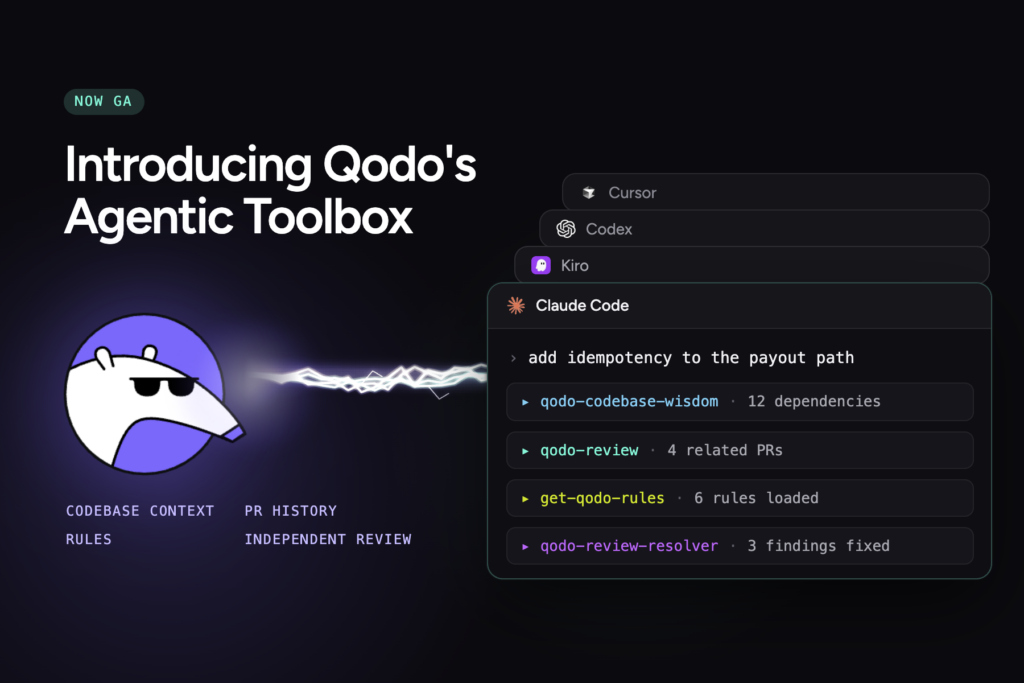
So the unit of quality is no longer the generated code by itself. Quality now has to cover the change, the intent behind it, the standards that shaped it, the evidence used to verify it, and the effect on the wider system. One comment on one pull request is not governance at that speed. What the data points to is a layer that gives agents the right context and standards before they write, then verifies their work before it reaches a human.
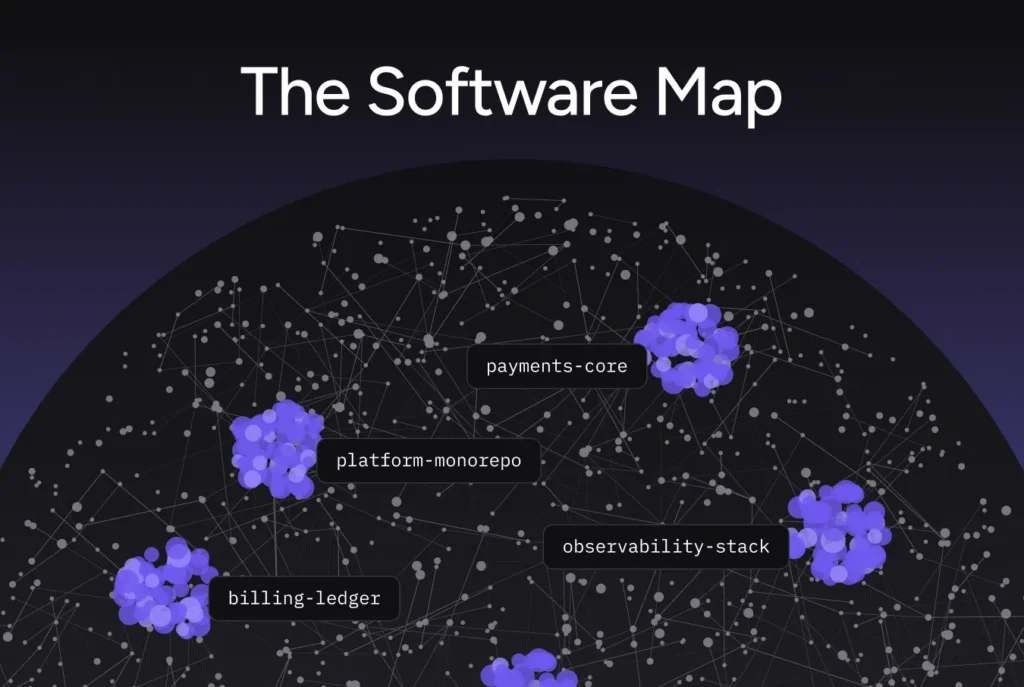
That layer is what we build at Qodo, the AI Code Quality and Governance Platform, and it runs on the foundational “wisdom base”: every review decision your team has made and why, which of your standards developers trust, and a live picture of how your codebase connects. The tooling in your software factory will turn over. The wisdom base compounds.
Engineers stay at the center of this work. Today they carry the full weight of catching what agents get wrong, and that doesn’t hold as agent output scales. The next phase of AI adoption won’t be decided by how much code agents can produce. It will be decided by whether organizations can make that work visible, governable, and verifiable across the lifecycle.
Get the report
The full report covers where review friction concentrates at organizations with 500 or more employees, the overlapping mechanisms teams use to get standards in front of agents, the four levels at which quality now has to be established, where leaders believe they’re closest to losing control, and what both audiences expect to be dealing with two to three years from now.