Codex vs Claude Code: How Each Agent Reviews Code, and How to Review Both

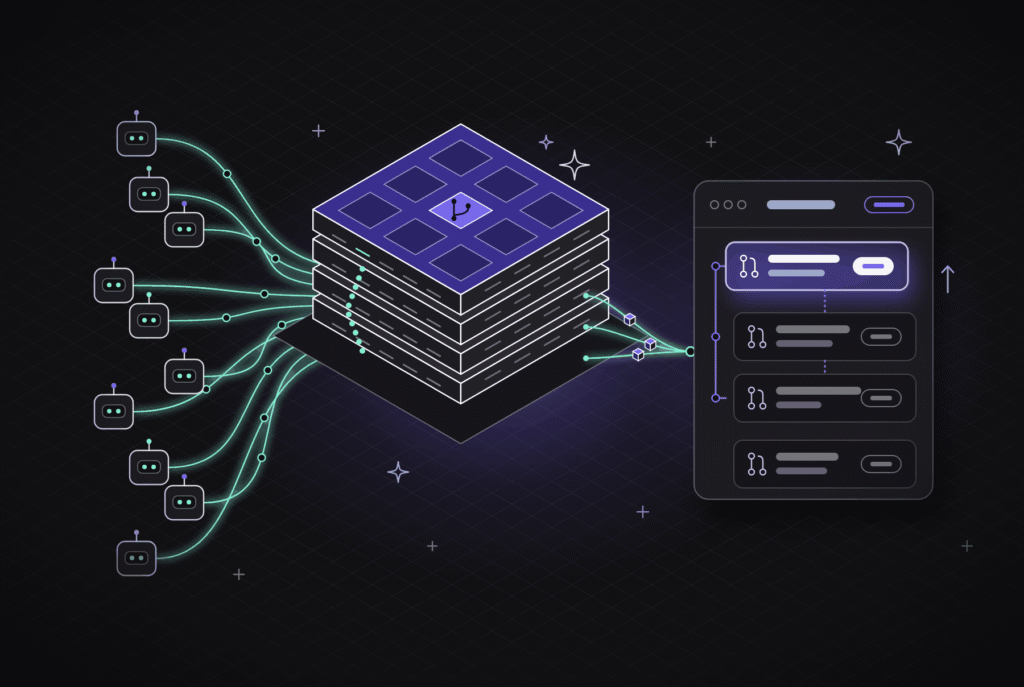
Codex and Claude Code both ship their own code review now, and the two take different paths to the same goal: catching what an agent got wrong before a human merges it. The comparison below walks through how each agent reviews a pull request (PR), which files steer the review and where each one stops. Teams that run both agents get agent code merged sooner with fewer rollbacks when one independent reviewer checks every change against the same team standards.
TL;DR
- Claude Code reviews with a managed multi-agent service. Anthropic’s Code Review service runs parallel agents on Anthropic infrastructure, verifies each finding, posts inline comments with three severity levels and reads
REVIEW.mdplusCLAUDE.md. - Codex reviews like a teammate who flags only the serious issues. A
@codex reviewcomment or an automatic trigger gets a standard GitHub review limited to P0 and P1 issues, steered by a## Code Review Rulessection inAGENTS.md. - Both agents review locally before the PR, and Codex can review inside Claude Code. Claude Code has
/code-reviewand Ultrareview, Codex has/reviewandcodex review, and OpenAI’s plugin adds/codex:reviewto Claude Code. Claude Code skills for code review add team-specific checks to the local pass. - Qodo reviews code from both agents with one independent engine, so teams merge sooner with fewer rollbacks. Qodo imports the
AGENTS.mdandCLAUDE.mdfiles teams already keep, checks them on every PR with cross-repo context, and learns from which findings the team fixes or dismisses. - Pick the agent for how you write code, then pick the reviewer for how you ship. The when-to-use table below maps common team setups to a choice.
Claude Code vs Codex: How the Two Agents Are Built
Claude Code and Codex are both agentic coding tools that read a repository, plan a change, edit files and run commands. The difference that matters for review is where each one runs, how it is configured and which instruction file it trusts.
Claude Code
Claude Code is Anthropic’s coding agent, and runs in the terminal, in IDE extensions, in a desktop app and in the browser, and it reads project guidance from CLAUDE.md files. Skills, subagents, hooks and plugins extend it, and the Claude Code GitHub Actions integration runs it in CI through anthropics/claude-code-action@v1.
Key capabilities for review:
- A managed Code Review service for GitHub repositories on Team and Enterprise plans.
- A bundled
/code-reviewcommand on every plan for local branches. - Ultrareview, a cloud fleet that reproduces each finding before reporting it.
- Review instructions split between
CLAUDE.md(project context) andREVIEW.md(review only).
Codex
Codex is OpenAI’s coding agent, and runs in the Codex CLI (open source under Apache 2.0), in IDE extensions, in the ChatGPT desktop app and in the cloud, and it reads project guidance from AGENTS.md files. The Codex GitHub Action, openai/codex-action@v1, runs it in CI.
Key capabilities for review:
- GitHub PR review through
@codex reviewor automatic reviews, with GitLab merge request support in preview. - A Code Review plugin in the desktop app with a PR inbox, review instructions and Submit review.
- A local
/reviewcommand and a scriptablecodex reviewcommand. - A separate Security Review for teams that want a deeper security pass.
How Claude Code Reviews Code
Claude Code has four ways to review a change. The managed service is the one most teams mean when they search for “Claude Code review”.
Code Review for Claude Code (managed, on the PR)
An Owner turns on Code Review for chosen GitHub repositories, and each repository then reviews once when a PR opens, after every push or only on request. A review runs in four stages:
- Find. Several agents search the diff and the surrounding code in parallel.
- Verify. A verification step drops findings that do not hold up.
- Rank. The remaining findings are deduplicated and ranked by severity.
- Post. Findings land as inline comments, with a summary and a check run named Claude Code Review.
Findings carry one of three markers: 🔴 Important (fix before merging), 🟡 Nit (worth fixing) and 🟣 Pre-existing (a bug the PR did not introduce). The check run concludes as neutral and never as a failure, and a review never approves the PR. Teams that want a merge gate parse the severity counts from the check run output in their own CI.
Owners choose a review level per organization or per repository: Quick for a light pass, Standard by default and Deep for the most thorough pass. Reviews are billed on token usage through usage credits, with no flat per-review price, and the cost of each review scales with the review level and the size of the change, according to Anthropic’s Code Review costs page. Substantive review comments rose from 16% to 54% of PRs at Anthropic after Code Review rolled out, according to Anthropic’s Code Review announcement.
REVIEW.md and CLAUDE.md
The service reads CLAUDE.md as project context and REVIEW.md as review-only instructions. A root REVIEW.md governs the whole repository, and a REVIEW.md in a subdirectory adds checks for changes under that path. The file is read from the default branch, not from the PR, so a PR cannot rewrite its own review rules.
# REVIEW.md
## What Important means here
Reserve Important for findings that break behavior, leak data or
change a public API without a version bump. Style and naming are Nit at most.
## Cap the nits
Report at most five Nits per review.
## Skip
Do not comment on files under gen/ or on *.lock files.
## Always check
Treat any change under migrations/ as Important.
Local and CI review in Claude Code
/code-reviewreviews the current branch inside a Claude Code session, on any plan.--fixapplies fixes and--commentposts the findings to the PR. The local command readsCLAUDE.mdand notREVIEW.md.- Ultrareview (
/code-review ultra) sends the branch to a cloud fleet that reproduces each finding independently before reporting it, with limits of 500 files and 8,000 changed lines per run. - Claude Code GitHub Actions run the bundled review in CI, for example with
prompt: "/code-review:code-review --comment ..."onpull_requestevents.
Limits worth knowing
Code Review runs on Anthropic infrastructure with read-only access to the repository and does not build or run code. The service is unavailable to organizations with Zero Data Retention or the HIPAA configuration, and it covers GitHub repositories. Teams on GitLab use the local command or GitLab CI instead.
How Codex Reviews Code
Codex splits review between the cloud reviewer on GitHub, the Code Review plugin in the desktop app and local commands.
@codex review on GitHub
A comment of @codex review on a PR gets a 👀 reaction, then a standard GitHub review posted “just like a teammate would”, as the Codex GitHub docs put it. On GitHub, Codex flags only P0 and P1 issues, which keeps the review short and focused on high-priority risk.
Automatic review is a toggle in Codex settings, with a Review trigger that decides when reviews run without a comment. A one-off focus goes into the comment itself, for example @codex review for issues in the database migration. A follow-up comment such as @codex fix the P1 issue starts a cloud chat with the PR as context and can push a fix to the branch when it has permission.
AGENTS.md Code Review Rules
Codex searches the repository for AGENTS.md files and follows a ## Code Review Rules section in the file closest to the changed code. Repository-wide rules sit in the root file, and service rules sit in a nested file such as services/billing/AGENTS.md.
## Code Review Rules
### Billing
- Do not round currency before the final total. Safe path: keep
  integer minor units until the invoice is rendered.
- A new webhook handler must verify the signature before reading the body.
OpenAI’s guidance is to start with two or three rules that encode checks reviewers often explain, state the safe path, and leave formatting and lint to CI. Review rules guide Codex and do not replace tests, branch protections or required approvals.
Local and CI review in Codex
/reviewin the CLI opens presets: review against a base branch, uncommitted changes, a commit or custom instructions. Codex starts a dedicated reviewer and reports prioritized findings without changing the working tree.review_modelinconfig.tomlpicks a separate model for reviews.codex reviewruns the same review non-interactively with--base,--commit,--uncommittedor a custom prompt, one target per run.openai/codex-action@v1runs Codex in GitHub Actions with a prompt file, sandbox settings and afinal-messageoutput that a later job posts to the PR.- Security Review (
@codex security review) analyzes the diff against configured threat models and writes a Security Report on the task.
Codex review inside Claude Code
OpenAI publishes an official Codex plugin for Claude Code that runs a Codex review without leaving a Claude Code session. The plugin calls the local Codex CLI with the developer’s own Codex login, so the review counts against Codex usage limits.
/plugin marketplace add openai/codex-plugin-cc
/plugin install codex@openai-codex
/codex:review --base main
/codex:adversarial-review --base main challenge the retry design
/codex:review is read-only and matches /review inside Codex. /codex:adversarial-review takes focus text and questions design choices, trade-offs and hidden assumptions. Cross-model review gives a Claude Code change a second opinion from a different model family, which is the most common reason teams run both agents.
Claude Code vs Codex Code Review at a Glance
| Review capability | Claude Code | Codex |
|---|---|---|
| PR review service | Code Review (Team and Enterprise plans) | Codex code review on GitHub (GitLab in preview) |
| How to trigger | Once on open, after every push, manual; @claude review |
Automatic review toggle with a trigger; @codex review |
| What gets posted | Inline comments, summary, neutral check run | A standard GitHub review |
| Severity model | Important, Nit, Pre-existing | Only P0 and P1 issues on GitHub |
| Review rules file | REVIEW.md plus CLAUDE.md, from the default branch |
## Code Review Rules in the nearest AGENTS.md |
| Review depth control | Quick, Standard, Deep | Focus text in the comment; separate Security Review |
| Local review | /code-review, Ultrareview |
/review, codex review |
| CI option | anthropics/claude-code-action@v1 |
openai/codex-action@v1 |
| Fix from the PR | --fix locally; @claude in Actions |
@codex fix the P1 issue |
| Merge gate | Never fails the check; parse counts in your CI | Review comments only; use branch protection |
| Published cost | Token usage through usage credits; no flat per-review price | No per-review price published; see Codex plan pages |
Which Agent Reviews Code Better? Five Questions That Decide It
Which agent reviews more of the PR?
Claude Code’s service is built for depth: parallel agents, a verification pass and a Deep level for critical repositories. Codex keeps GitHub reviews to P0 and P1 issues, so a PR gets fewer comments and every comment matters. Teams that want broad coverage on risky code lean toward Claude Code, and teams that want quiet reviews lean toward Codex.
Which agent keeps review comments focused?
Codex focuses by design, since lower-priority issues never reach GitHub. Claude Code focuses through configuration: REVIEW.md can redefine Important, cap Nits and skip paths. Both approaches work, and both depend on someone keeping the rule file current as the codebase changes.
Which rules file should a team write?
Claude Code reads CLAUDE.md and REVIEW.md, and Codex reads AGENTS.md. A team that uses both agents ends up with two or three files that say similar things in different places. A common pattern keeps shared standards in AGENTS.md, points CLAUDE.md at it, and keeps REVIEW.md for severity tuning.
A practical middle ground keeps only the rules that are expensive to fix later (architecture, security, forbidden patterns) in the instruction file the coding agent reads. The full list of team standards then belongs to a separate reviewer, so the instruction file stays short enough for the agent to follow.
Which agent reviews better before the PR?
Both are strong locally. Codex’s /review and codex review cover base branch, uncommitted and single-commit reviews and fit cleanly into scripts. Claude Code’s /code-review covers the everyday branch check, and Ultrareview adds a reproduced-findings pass for large or risky branches.
Which agent can gate a merge?
Neither agent fails a required check by default. Claude Code’s check run concludes as neutral, and its docs show how to read the severity counts with gh and jq when a team wants its own gate. Codex posts review comments and leaves enforcement to tests, branch protection and required approvals.
Worked Example: One Agent-Written PR, Two Reviews
The scenario below is an illustrative composite, built from the documented behavior of each tool rather than from a single logged run.
A developer asks Codex to switch the GET /orders endpoint in the orders-api repository from offset to cursor pagination. Codex renames the offset query parameter to cursor, updates the handler and its tests, and opens a PR. CI passes.
| Review step | What happens |
|---|---|
@codex review |
Flags a P1: an empty page returns a next_cursor that loops forever. Codex fixes it with @codex fix the P1 issue. |
| Claude Code Review (Standard) | Flags the same loop as 🔴 Important, plus a 🟡 Nit on a missing page size cap from REVIEW.md. |
| What neither review sees | The web-checkout repository still calls GET /orders?offset=40, and the mobile app pins the old response shape. |
Both reviews did their job inside the repository they could see. The failure that causes the rollback sits in another repository, and a reviewer scoped to one repository has no way to see it.
Where Single-Agent Review Stops
Agent-native review is a strong first pass, and three gaps show up once a team runs agents across many repositories. Review and validation is the top delivery bottleneck for 26% of engineering leaders, and only 3.7% say their existing processes are sufficient as agents take on more work, according to the Qodo State of AI Code Quality 2026.
Engineering teams comparing review options for agent code keep asking a version of one question: why not ask Claude Code or Codex to review the repository against the rule files the team already has? The three gaps below are the honest answer.
The writer reviews its own work. When the same model family plans, writes and reviews a change, the review shares the writer’s blind spots. Cross-model review narrows the gap, yet independence takes more than a second model. “Giving a second agent the title ‘reviewer’ does not establish independence,” Qodo CEO Itamar Friedman wrote in The Path to L4 Software Engineering, because two agents can share the same mistaken assumption. The producing agent should not be able to redefine when its own change passes.
Rules live in vendor files. REVIEW.md only steers Claude Code, and ## Code Review Rules only steers Codex. Teams that use both agents keep standards in sync by hand, and drift shows up as inconsistent reviews. A story engineering leaders tell often in 2026: a team wrote a CLAUDE.md file a year ago, nobody has updated it since, and the agent still follows the old conventions. Only 34.6% of developers in Qodo’s 2026 survey say coding agents always follow organizational standards.
Context ends at the repository. Shared libraries, API contracts and schemas cross repository lines, and some API calls between services were agreed informally and never written down. An AGENTS.md file can steer one repository well, and a company with hundreds of repositories needs a reviewer that sees how they connect. Only 37% of engineering leaders say they can enforce policies across teams and repositories, in the same Qodo 2026 survey.
How Qodo Reviews Code from Claude Code and Codex
Qodo is a code review and governance platform that reviews every change the same way, whichever agent wrote it. One engine, one list of standards and Qodo’s context engine sit behind review in the agent session and review on the PR, so a clean local review predicts a clean PR.
Same standards in both agents, before the PR
Qodo’s Agentic Toolbox plugin installs from the Claude plugins directory and from the Codex Plugins page. In both agents, the Reviewer skill sends the working-tree diff to the same engine as Qodo’s PR review, including untracked files and the intent behind the change. In Claude Code, the skill runs as pre-pr-review. The Get Rules skill hands the agent the rules for the task before it writes the first line.
Qodo recommends tuning the two reviews differently. The local review in the agent session goes deep, because the agent can work through every finding. The PR review stays quiet, so the humans who open it see only what matters.
The rule files teams already keep, checked on every PR
Qodo imports rules from the files agents already read, including AGENTS.md, CLAUDE.md, .cursorrules and copilot-instructions.md, wherever they sit in a repository. The rule import settings list the defaults and accept extra file names and folders. Standards written for Codex and for Claude Code become one list of review standards that Qodo checks on every PR. Tech leads accept, adjust or deactivate rules in one place, so standards stay under human control.
Cross-repo context on the PR
Cross-repository code review traces a change into related repositories in both directions and posts a Cross-repo finding with a link to the affected lines. Relationships are discovered automatically or defined by the team, and they span GitHub, GitLab, Bitbucket and Azure DevOps. In the worked example, the web-checkout call to ?offset=40 appears as a finding on the orders-api PR.
Standards that learn from fix and dismiss decisions
Qodo’s Rule Miner reads PR history, keeps only comments that developers accepted and that led to code changes, and weights each reviewer by ownership of the changed code. Dismissed findings weaken a rule’s signal over time. Each finding on the PR shows how the team handled similar findings on past PRs, so a reviewer can judge a finding at a glance.
Findings back in the agent session
The Review Resolver skill pulls Qodo’s PR findings into Claude Code or Codex. Every finding ends as fixed with a change, skipped with a reason, or reported, so nothing is silently ignored.
Qodo outscored Claude Code Review by 12 F1 points, with matching precision, across 100 PRs and 580 injected issues in the Qodo Code Review Benchmark.
For high-velocity teams: the AGENTS.md and CLAUDE.md files you already keep are checked on every PR, setup takes minutes, and nobody learns a new process.
For enterprise engineering teams: one list of review standards applies across every repository and every coding agent, with per-rule analytics, multi-tenant, single-tenant or on-premises deployment, and SOC 2 Type II.
Hands-On: Review Claude Code and Codex Changes with Qodo
The walkthrough below adds Qodo review to both agents and to the PR.
1. Install Qodo’s Agentic Toolbox (Node.js 20 or later):
curl -fsSL https://get.qodo.ai | sh
2. Add the plugin to each agent. In Claude Code, copy the install command from the Qodo page in the Claude plugins directory. In Codex, open Plugins in the ChatGPT desktop app, search for Qodo and select +.
3. Review before the PR. Ask either agent to review the change before you open a PR, or run the CLI directly:
qodo review
Reviewing acme/orders-api @ a1b2c3d4e, 3.2KB of local changes
Correctness/action_required
→ next_cursor never terminates on an empty page (src/api/orders.ts)
1 finding(s), fixed before any pull request exists
4. Keep PR review automatic. Qodo reviews a PR when it opens, reopens or is marked ready for review, with no trigger to configure. A comment runs a review on demand at any point:
/agentic_review
The Code review trigger setting in the Qodo portal switches a repository to manual reviews, and Review every push updates the review on each new commit.
5. Close the loop in the session. Ask the agent to resolve the Qodo findings on the PR. The Review Resolver skill fixes what you scope, records a reason for anything skipped and reports the rest.
When to Use Claude Code vs Codex for Code Review
| Team setup | Good fit | Why |
|---|---|---|
| GitHub, Claude Team or Enterprise plan, critical services | Claude Code Review at Deep on critical repos | Verified findings and per-repo depth |
| GitHub, ChatGPT plan, preference for quiet reviews | @codex review with automatic reviews |
P0 and P1 only, rules in AGENTS.md |
| Local-first developers who script everything | codex review or /code-review in a pre-push hook |
Review before anything is pushed |
| Claude Code users who want a second model’s opinion | /codex:review through OpenAI’s plugin |
Cross-model review without leaving the session |
| Both agents in use across one team | Qodo on the PR, with the plugin in both agents | One standard for every agent |
| Many repositories, shared libraries and APIs | Qodo with cross-repo review | Breaking changes show up on the PR that causes them |
| Regulated industry or data residency needs | Qodo single-tenant or on-premises | Code stays in infrastructure the team controls |
The hub roundup of Claude Code skills compares review skills for the local pass. The Claude Code vs Cursor comparison covers the editor side.
Conclusion
Claude Code and Codex both review code well inside the repository they can see. Claude Code’s managed service goes deep, with verified findings and tunable severity, and Codex keeps reviews short with P0 and P1 issues and AGENTS.md rules. Qodo is the best choice for teams that use either agent or both, because Qodo reviews every change with one independent engine, the team’s existing rule files and cross-repo context, so agent code merges sooner with fewer rollbacks.
FAQs
Is Codex better than Claude Code for code review?
Neither is better across the board. Claude Code’s Code Review goes deeper, with parallel agents, verification and three review levels, while Codex keeps GitHub reviews to P0 and P1 issues. The right pick depends on whether your team wants coverage or quiet reviews.
Does Claude Code review pull requests automatically?
Yes, on Team and Enterprise plans with the Code Review service turned on. Each repository reviews once when a PR opens, after every push or only on request, and @claude review starts a single review at any time.
How do I get Codex to review a pull request?
Comment @codex review on a GitHub PR, or turn on Automatic review in Codex settings. Codex reacts with 👀 and posts a standard GitHub review. Add a ## Code Review Rules section to AGENTS.md to steer what it checks.
Why not ask Claude Code or Codex to review against AGENTS.md?
Asking the agent works well for one repository and one agent. The review shares the writer’s assumptions, sees only the checked-out repository and follows whichever vendor file it reads. Teams with several agents and many repositories add an independent reviewer that checks the same standards on every PR.
Can I use Claude Code and Codex on the same repository?
Yes, and many teams do. Keep shared standards in AGENTS.md, point CLAUDE.md at it, and use one reviewer that reads both files. Qodo imports AGENTS.md and CLAUDE.md and checks the same standards on every PR, whichever agent wrote the code.
What does Claude Code Review cost?
Anthropic bills Code Review on token usage through usage credits, separately from plan usage, with no flat per-review price. The cost of each review scales with the review level and the size of the change, and owners can cap spend with a monthly limit. The local /code-review command runs on any Claude plan within normal usage.
How does Qodo review code written by Claude Code or Codex?
Qodo reviews the change before the PR through the plugin in each agent, then on the PR with the same engine, cross-repo context and team standards. Findings flow back into the agent through the Review Resolver skill, so the agent that wrote the code fixes it.
About the author