In the current rush to “agentize” every corner of the software development lifecycle, a new narrative has emerged: the All-in-One AI. A single vendor promises an AI that handles everything: it architects and writes the code, reviews its own pull request, and signs off the security checklist before deployment. It looks magical in a demo until you have to explain a production incident that sailed through that same automated loop.
While the convenience of a swiss army knife for code is appealing, for enterprise-grade engineering, it is a dangerous oversimplification. At scale, software integrity, the guarantee that code is correct, secure, and maintainable, cannot be a side-effect of a general-purpose chat model.
To build resilient software at scale, you don’t need a single product that does it all. You need a dedicated code quality and governance system that operates independently of the creative coding process. This system must be anchored in specialized multi-agent review, codified organizational standards, continuous environmental learning, and systemic codebase intelligence.
Verification is a Different Engineering Problem
Building a product that generates code is a creative challenge. Building a system that verifies code is an engineering challenge. Generation is about speed and fluency. Verification is about risk, traceability, and whether you can defend the decision to ship. When a production incident occurs or a compliance audit is triggered, the question isn’t whether the code was written quickly. The question is: “Can we defend the decision to ship this?”
When a product claims to do everything, their security agent or review agent is often just a prompt-engineered version of their coding agent. They are optimized for fluency. Even when consolidated agents are fine-tuned for adversarial review, they remain rooted in a generative architecture optimized for next token prediction. Governance and integrity systems, in contrast, are fundamentally built on models designed for state analysis, symbolic reasoning, and deep verification, not just pattern recognition. This distinction ensures the verification process is deterministic, verifiable, and free from the generative biases inherent in the creation tool.
The Architectural Flaw of Consolidated Logic
An all-in-one platform is built as a single agentic loop. The same system that proposes a solution is the same system tasked with finding its flaws. In engineering, this is a violation of the separation of concerns.
If your review agent and your coding agent share the same product DNA, same prompts, and same optimization goals, they will share the same blind spots. It’s a “helpful” loop that prioritizes completing the task, often resulting in bias where the reviewer agent validates incorrect code because it aligns with the generator’s intent. While a consolidated loop offers the convenience of a unified context, the fundamental conflict of interest: designing for creation and then reviewing for destruction (flaw-finding), cannot be overcome by simply increasing the context window or running a second pass. The integration risk of separated tools is a manageable operational challenge; the blind spot of a unified system is an existential quality flaw.
Context Windows vs. Systemic Intelligence
The current trend is to brag about massive context. The idea is that if an agent can “see” your whole repo, it “knows” your system. But visibility is not the same as understanding.
An all-in-one AI treats your codebase like a long document. An agent might see a breaking change in a shared utility three repos away, but without a persistent map of system-wide dependencies, it lacks the contextual intelligence to prioritize that risk. That’s how a breaking change can look “fine” in isolation, but eventually cause issues in multiple downstream services.
An enterprise integrity system treats it like a living organism. This intelligence is achieved not through massive context windows, but through dedicated, persistent models (like Abstract Syntax Trees, dependency graphs, and dedicated knowledge bases) that map the relationships between code components. This architecture allows the integrity system to flag a non-obvious security flaw in File A based on a dependency structure defined in File D, a task impossible for an agent whose primary tool is raw, token-based recall
Why Separation of Systems is the Future of AI Governance
The Best-of-System approach involves the overhead of integrating and managing distinct systems. This complexity is often cited as a reason to stick with consolidated platforms. However, paying the cost of integration and specialized tooling is a strategic investment in resilience.
As enterprises move toward agentic workflows the danger of silent regressions grows. If you rely on one consolidated product suite for your entire pipeline, you have a single point of failure for your code quality.
The most resilient engineering organizations in 2026 are adopting a best-of-system approach:
Creation Systems: For speed and brainstorming (IDE extensions, chat interfaces).
Integrity Systems: For the hard gates—testing, deep logic review, and enterprise-wide compliance.
Building the Governance Layer for the Enterprise AI Stack
At Qodo, we aren’t trying to be the everything app. We are the system of record for code governance. We are building the specialized layer that ensures AI-driven development doesn’t collapse under its own volume. Our strategy is defined by core pillars designed to provide the governance, validation, and systemic intelligence that general-purpose tools lack.
Specialized-Multi Agent System Review
Code review isn’t a single task, it’s a series of expert evaluations. Instead of broad review from a generalist agent, Qodo uses a multi-agent architecture where focused agents handle distinct code quality responsibilities. Each agent operates with its own dedicated context, ensuring it does not have to compete for attention or token space within a single generative pass.
Codifying the Organizational DNA
Integrity at scale requires more than codebase context. It requires an authoritative understanding of team standards and tribal knowledge. Qodo features a centralized Rules System that turns scattered engineering standards into one enforceable and evolving source of truth. These rules ensure that AI agents operate deterministically rather than probabilistically, applying organization-specific standards consistently across every pull request
Fine-tuned, Continuous Context and Learning
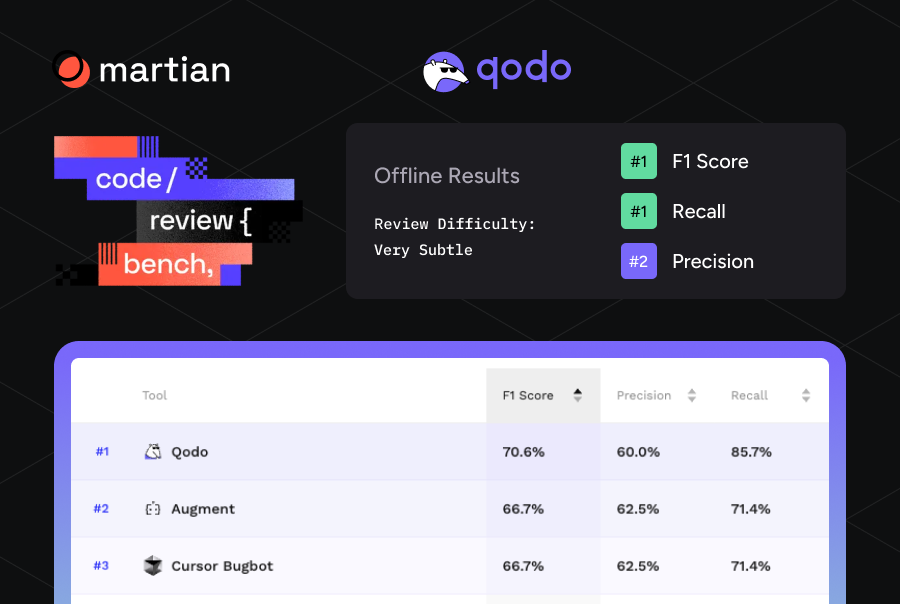
Rather than relying on one-size-fits-all logic, Qodo views integrity as a dynamic process that continuously adjusts itself to the nuances of your specific environment to produce best-in-class precision and recall. Rather than relying on one-size-fits-all logic, the Qodo incorporates pull request history, business requirement and other context as a first-class signal when reviewing code. By continuously tuning itself to your team’s specific engineering standards and behavioral patterns, the integrity layer remains a living, predictive guardrail rather than a static checklist.
Don’t Trade Integrity for Convenience
All‑in‑one tools sell convenience: one vendor, one interface, one loop. But in enterprise environments, convenience cannot be your primary control. Integrity has to win the tie‑break, especially when incidents and reputational risk are on the line.
The noise of “All-in-One” releases will continue, but the fundamental laws of software engineering haven’t changed. Speed without a verification system is just technical debt in disguise.
Get 1 month free of the Qodo Teams plan with coupon code UNBIASED. Redeem by March 12, 2026
About the author
Itamar Friedman
CEO and Co-founder
At Qodo, we believe that empowering professional, busy development teams with code integrity solutions addresses a critical set of problems and pain points. After all, who wants software plagued by outages, critical bugs, or poor maintainability?
Start to test, review and generate high quality code