Introducing Qodo’s Rule System: Turning Standards into Systems
Every engineering organization has standards. Some are written down. Many are not. They live in lint configs, internal docs, old pull requests, and in the heads of senior engineers who catch issues during review. In an era where AI can generate an entire feature in seconds, those scattered standards become a liability. Without a clear and enforceable definition of what “good” looks like, inconsistency spreads quickly, tech debt grows and production becomes increasingly fragile.
Code review is a natural checkpoint. Earlier this month, we strengthened that layer with the Qodo 2.0 release, introducing multi-agent AI review to detect more real issues with less noise. But smarter review is only half the battle to high code quality. Enterprises need a reliable way to define what good looks like in their organization and ensure it is applied everywhere developers work.
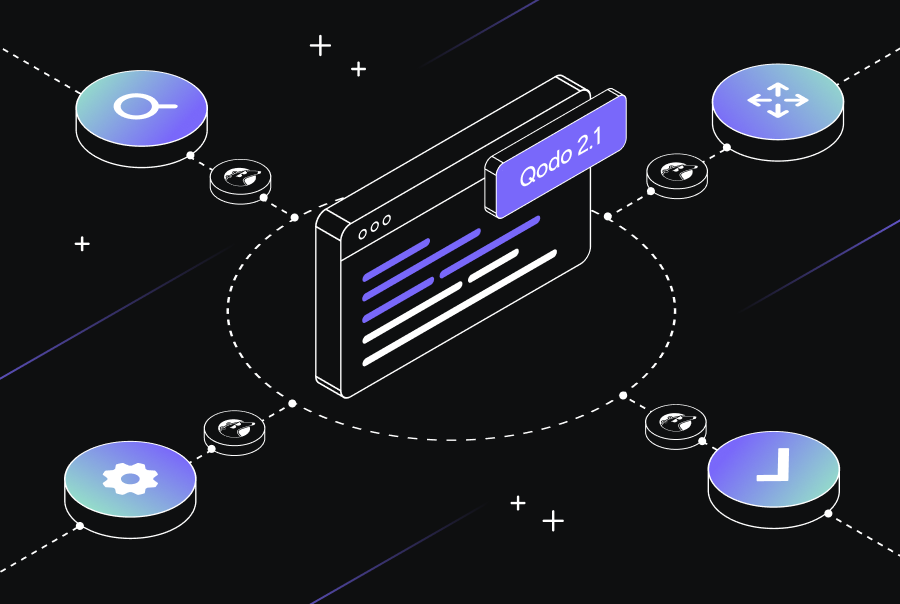
Today, we’re excited to release Qodo 2.1 and introduce the first Rules System, helping enterprises turn scattered standards into one centralized, evolving and enforceable source of truth.
Qodo’s Rules System provides the governing logic for the agentic foundation we established in Qodo 2.0. By connecting an intelligent rules system with our multi-agentic architecture, we have created a closed loop where your organization’s unique engineering DNA is discovered and enforced automatically.
With Qodo’s rule system, best practices are no longer static artifacts attached to tools. They are first-class components of the platform:
- Defined once, enforced everywhere
- Integrated into multi-agent review
- Continuously monitored and evolving
- Measured through adoption and violation analytics
Qodo’s Rule System is Beta and currently available for GitHub single/multi-tenant users.
The Governance Gap: Agents without Rules
AI agents can analyze code deeply, traverse repositories, and reason across files. With the right architecture, they achieve strong recall and surface real bugs. But detection alone is not alignment. Agents understand how the code works, but they do not automatically understand how your organization has decided it should work.
Without a formal rules layer, agents operate contextually but not deterministically. They lack an authoritative source of truth of what is allowed, required, or prohibited. This creates a high-stakes environment where:
- Organization-specific standards are applied inconsistently across pull requests and teams.
- Similar changes receive different feedback depending on context, reducing predictability.
- Compliance requirements are treated as suggestions.
- Enforcement becomes probabilistic instead of policy-driven.
- Edge-case constraints are under-enforced because they appear infrequently.
- Review outcomes vary across tools and teams.
Most AI tools attempt to bridge this gap with static instructions: a markdown file, a config block, or natural language rules injected into a prompt. These mechanisms can guide behavior, but they are manual and fragile. They lack versioning, conflict detection, lifecycle management, and measurement. As the codebase evolves, rule sets drift. Some rules become obsolete. Others contradict each other. There is no clear signal on which standards are effective and which create noise.
Meanwhile, the agents continue to improve. Detection becomes more precise. Context handling becomes deeper. But if the rule layer remains static, the system cannot consistently align enforcement with the organization’s evolving standards.
The gap is not intelligence. It is governance.
Introducing Rules: a living standards system
Qodo 2.1 closes the governance gap with a centralized, managed rules system. Rules in Qodo are not markdown files or prompt fragments. Each rule is a versioned entity with defined scope, ownership, and lifecycle. Rules encode explicit standards, from architectural constraints to security and domain requirements, and can be applied at the organization or repository level to ensure consistent enforcement.
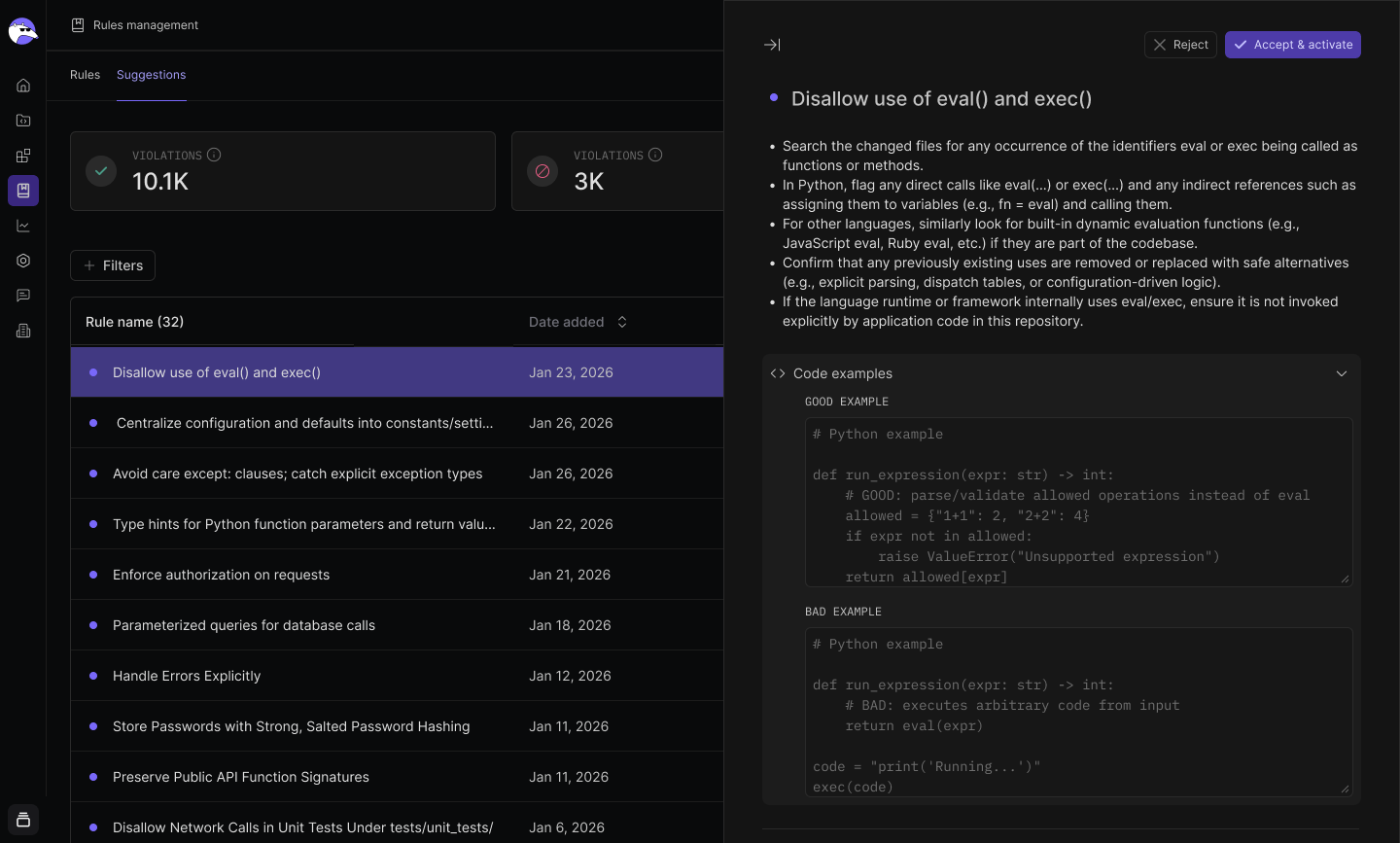
The lifecycle of a Qodo rule:
- Discovery
- Enforcement
- Measurement
- Maintenance
This turns governance into an operational layer of the platform, not a set of documents teams hope are followed.
Rules discovery: codifying tribal knowledge
One of the biggest hurdles to enforcing standards is the manual effort required to define them. Qodo’s Rule System introduces auto discovery of rules, eliminating the “blank-page” problem by analyzing your repository’s unique history.
Instead of guessing at your standards, the agent examines past pull requests, accepted fixes, and recurring review feedback to identify the implicit patterns your team already follows. It surfaces the “dark matter” of your codebase—like specific library preferences or internal architectural trade-offs—and converts them into structured rules.
Crucially, the auto discovery capability also bridges the gap between fragmented AI tools. It automatically scans your repositories for existing best practices like .cursorrules files and agents.md used by coding assistants. By ingesting these scattered files and centralizing them into the Rules System, it ensures that the “local” knowledge trapped in markdown files is scaled into a “global” governance layer. This turns your existing codebase and fragmented documentation into a living curriculum for your AI agents, ensuring that hard-earned tribal knowledge becomes the automated baseline for every new PR.
Rules enforcement: deterministic alignment
Rules are enforced as part of the review workflow. Once a rule is discovered or defined, it becomes an active component of Qodo’s agentic review experience, and available for the specialized rules enforcement agent. Violations are surfaced as structured findings, tied to the originating rule and accompanied by clear remediation guidance. Every rule is traceable, and every enforcement event is measurable.
Because these rules power agents directly, enforcement is deterministic rather than probabilistic. Every developer receives consistent feedback based on the exact same set of organizational truths.
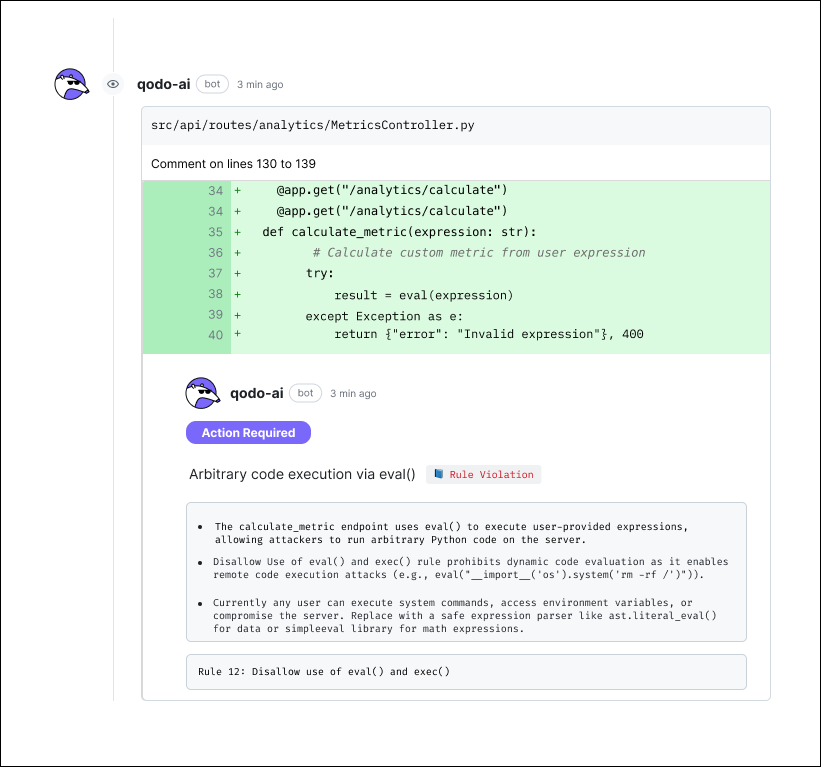
This enforcement model is not theoretical. In our real-world benchmark built on production-grade pull requests, Qodo led all evaluated tools in identifying compliance and rule violations, not just functional bugs.
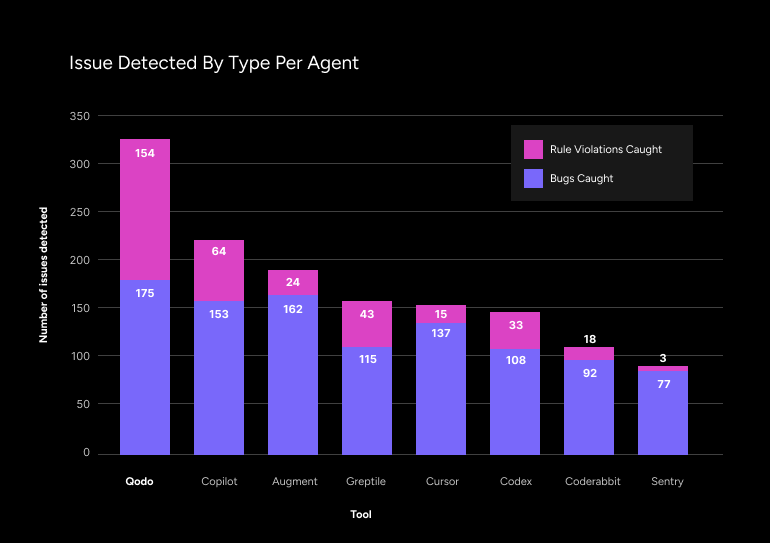
The results showed that Qodo surfaced substantially more standards-related issues than other AI review tools, demonstrating that our agents are particularly strong at enforcing policy-level constraints, not only detecting code defects.
These are two different layers of risk. Bug detection reduces functional and runtime risk. Rule enforcement protects architecture, security posture, and organizational consistency.
Rules measurement: monitoring standards at scale
Standards should not operate in the dark. If you cannot see how your rules are applied, you cannot know if they are actually protecting your codebase.
In Qodo, every rule produces a measurable signal. Rules analytics move governance from an assumption to an observable behavior, providing deep visibility into how standards are enforced across every pull request. Teams can now track the pulse of their codebase through three core indicators:
- Passed (No Violations): How often changes meet defined standards on the first pass.
- Detected Violations: How frequently rules are violated during the review process.
- Merged Violations: The “risk” metric—how often pull requests are merged with unresolved rule violations.
This provides a direct look at your ROI on governance. If violations are consistently resolved before merge, standards are being internalized. If merged violations are rising, it indicates architectural pressure or areas where the rules are creating too much friction.
Rule maintenance: keeping standards healthy
As systems evolve, standards must evolve with them.
Static rule files decay. Architecture shifts. Dependencies change. What was once a strong constraint may become obsolete. Without structured maintenance, rule sets grow cluttered and lose credibility.
Qodo’s Rules System includes built-in maintenance intelligence through a rules expert agent, which continuously analyzes the active rule set to surface:
- Conflicts between rules that create ambiguous or contradictory enforcement
- Duplicates that overlap in scope or intent
- Outdated standards that no longer reflect current architecture or practice
- Low-signal rules that rarely trigger or are consistently bypassed
Instead of discovering problems only after developers start ignoring violations, teams get early signals about where governance is breaking down. The end result is a ruleset that stays enforceable and trusted, without constant manual pruning.
Closing the Loop on Code Quality
With each release of the Qodo platform, we move closer to what high code quality at scale actually requires: not just smarter detection, but sustained integrity.
Our last platform version release, Qodo 2.0, introduced the generation of the AI code review experience and better issue finding. Today, with the introduction of the Rules System, Qodo 2.1 ensures those detections align with defined organizational standards. Together, they create a governed review architecture where velocity and integrity move in the same direction.
About the author