Beyond Intelligence: Qodo’s $70M Series B and the Shift to Artificial Wisdom
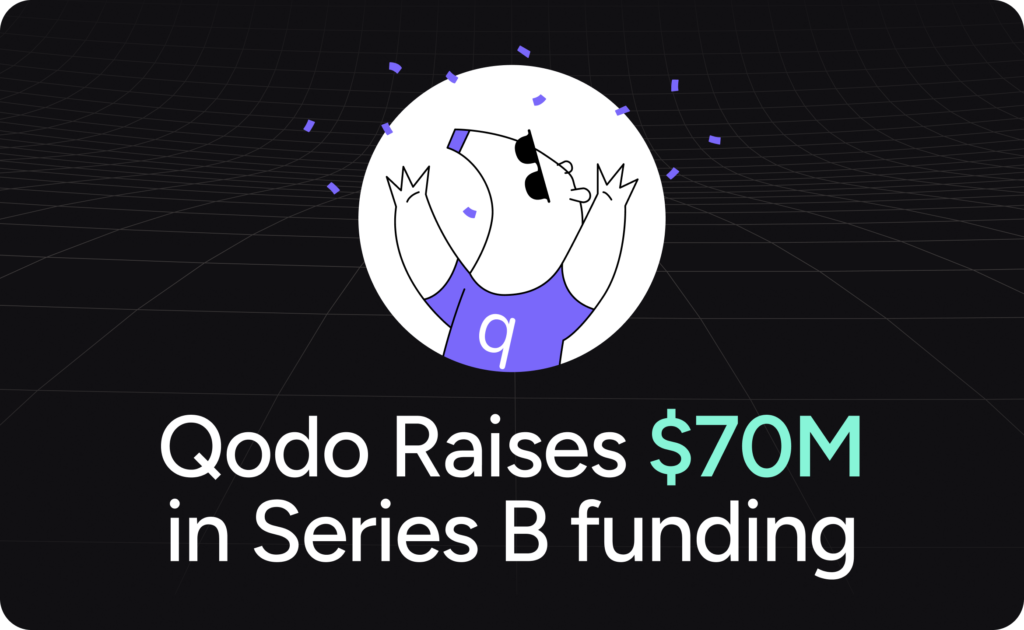
Today, we are thrilled to announce that Qodo has raised $70 million in Series B funding, bringing total capital raised to $120 million. The round was led by Qumra Capital, with participation from Maor Ventures, Phoenix Capital Partners, S Ventures, Square Peg, Susa Ventures, TLV Partners and Vine Ventures.
At the time of our Series A in late 2024, we cautioned that the era of AI-generated code would inevitably lead to a growing bottleneck around code review. Since then, software development has quickly moved up the AI stack, from AI assistants to vibe coding with agents. Now AI doesn’t just suggest code, it’s shipping it. All while the quality gap has indeed become the bottleneck and “AI slop” proliferates codebases.
Qodo was built for this new reality. While the first wave of tools focused on generating code, we dedicated ourselves to the harder problems of review and quality, moving from our first review agent in 2023, to a comprehensive code review and governance platform for the enterprise.
Enterprises are now realizing what has been Qodo’s mission from the start: that velocity doesn’t need to come at the cost of quality. With speed as a commodity of AI, governance over its output is the new mandate. But governance in a world of autonomous agents cannot be achieved with smarter models alone. It requires a system that has the wisdom to understand and learn from highly relevant context, enforce standards, and make decisions that hold up in production.
With this latest round of capital, we are scaling Qodo to be that system of record for the enterprise and accelerate the development of capabilities that allow teams to govern AI-generated code with precision, consistency, and control.
From Artificial Intelligence to Artificial Wisdom
Enterprise software is not just written; it is maintained, extended, and relied on over time. As the industry raced to make AI write more code, at Qodo we asked a different question: what would it take for agents to judge code the way your best engineers do?
The answer is not more intelligence about how to write code. It is having the wisdom to judge whether that code belongs in your codebase. To know when to act, when to refrain, and which signals take priority based on accumulated experience.
Intelligence is enough for generation. Wisdom is a must for governance.
The distinction between raw intelligence and wisdom is not abstract. It is the difference between a tool that reviews a pull request and a system that understands what that diff means for your architecture, your standards, and the long-term health of your codebase.
Every coding agent on the market got smarter this year, but did they get wiser? Most operate in the moment, lacking the capacity to carry context across the entire software lifecycle. They do not naturally learn how a specific system evolves or consistently apply the unique standards that keep an enterprise codebase stable. That gap is where things break. It’s where AI-generated software becomes fragile, and where AI slop begins to settle.
This is where Qodo gets to work. Not just as a better review tool, but as a system that brings code understanding and context, memory, and standards into every decision about what code should ship.
The Architecture of Wisdom
Artificial Wisdom is not a single model capability; it is a system property. Qodo has built a specialized infrastructure that acts as the senior-level supervisor. This system ensures that every automated action is verified against the deep reality of your codebase and team.
The foundation of Qodo’s platform consists of three core pillars:
- A Multi-Agent Fabric: Wisdom cannot be achieved through a single prompt or a lone review agent. At our core is a multi-agent orchestration layer where specialized agents handle distinct aspects of code quality. Some hunt for critical bugs, others enforce rules, or identify gaps in requirements. These agents work in parallel, bringing multiple lenses to the same change to surface only what truly matters to your team.
- The Context Engine: Agents are only as effective as the data they can access. Qodo’s context engine continuously learns from the full codebase structure, pull request history, and evolving business logic. This is not a static snapshot; it is a living memory that allows Qodo to apply decisions based on how your software actually functions, not just how a single diff looks in isolation.
- Rules Lifecycle Management: Tribal knowledge is the silent backbone of elite engineering. Qodo captures these dispersed standards and organizational conventions through a dedicated rules management system. These are evolving guardrails that ensure quality remains consistent, regardless of which individual is reviewing the code or which agent is generating it.
Wisdom in the Workflow
Developers experience Qodo directly in their workflows.
In pull requests, Qodo delivers deep, contextual reviews that change how teams interact with AI-generated code. Instead of wading through dozens of low-signal comments, reviewers see prioritized findings with clear explanations, supporting evidence from the codebase and PR history, and suggested fixes that follow existing code conventions. Developers get feedback they can act on. Reviewers get high signals, not noise.
Qodo also brings that judgment earlier in the lifecycle, with agentic review workflows in the IDE. that validate changes and catch issues before they reach a pull request. And as teams move toward agent-driven development, Qodo powers agentic quality workflows, where code is not generated, but continuously verified, refined, and governed as it moves through the lifecycle.
With this new funding, we’re investing even further into shift-left capabilities, expanding these workflows into more proactive, in-development guidance through capabilities like Skills, so teams can catch issues, apply standards, and make better decisions while code is still taking shape.
This is how Artificial Wisdom shows up in practice. Not as a single feature, but as a system that operates wherever code is written, reviewed, and shipped.
From Vibe Coding to Engineered Certainty
This Series B round is more than a financial milestone. It is a mandate to end the proliferation of AI slop and bring professional rigor to the agentic age.
Our growth over the past year, including increasing our enterprise footprint by 11x, reflects a fundamental shift in how organizations view AI. Companies are no longer just looking for a faster way to write code; they are looking for a system they can trust to govern it. This conviction has been validated by several key milestones:
- Martian Bench #1 Ranking: Qodo was recently ranked as the top-performing system on the Martian Bench, the industry’s first comprehensive evaluation of AI coding agents. This ranking confirms that our system-level approach out-performs standalone models in real-world engineering tasks.
- Gartner ranked #1 for code understanding : Qodo is ranked #1 by Gartner for code in the Critical Capabilities for AI Assistants Report.
- Recognized by NVIDIA: Qodo was featured by NVIDIA CEO Jensen Huang on the NVIDIA GTC 2026 stage as an AI native startup transforming the industry. NVIDIA also utilized the Qodo Code Review Benchmark to validate the enterprise-readiness of its Nemotron-3 120B model.
With $120 million in total capital, we are now uniquely resourced to accelerate the development of the high-precision capabilities that modern enterprises demand and provide the infrastructure that allows teams to scale without diminishing the quality of their software.
The future of software is autonomous, but it must also be wise. Qodo is here to ensure that as the pace of innovation accelerates, the quality of the world’s software remains unshakeable.
About the author