Transforming Enterprise Code Review with Qodo + Azure DevOps

Enterprise engineering teams are under pressure to move faster while maintaining quality, security, and governance. As organizations scale, so do their codebases, contributor base, and development complexity. For teams building on Microsoft Azure DevOps (ADO), the challenge is clear. How do you bring intelligent, consistent code review into an established workflow without adding friction?
That is where Qodo becomes a natural extension of the Azure DevOps workflow.
The Enterprise Code Review Challenge
At small scale, code review is a collaborative checkpoint. At enterprise scale, it often becomes a bottleneck.
Large, distributed teams working across massive repositories face common challenges:
- Inconsistent review standards across teams
- Slower pull request cycles
- Security and compliance risks
- Reviewer fatigue
Manual review processes alone struggle to keep pace with modern release velocity. Enterprises need a way to reinforce standards and catch issues early without slowing developers down.
Why Azure DevOps and Qodo Work Together
For many enterprises, Azure DevOps is the backbone of the software development lifecycle. It is where pull requests are reviewed, pipelines run, and releases are managed. Introducing tools outside that ecosystem can create context switching, adoption hurdles, and governance gaps.
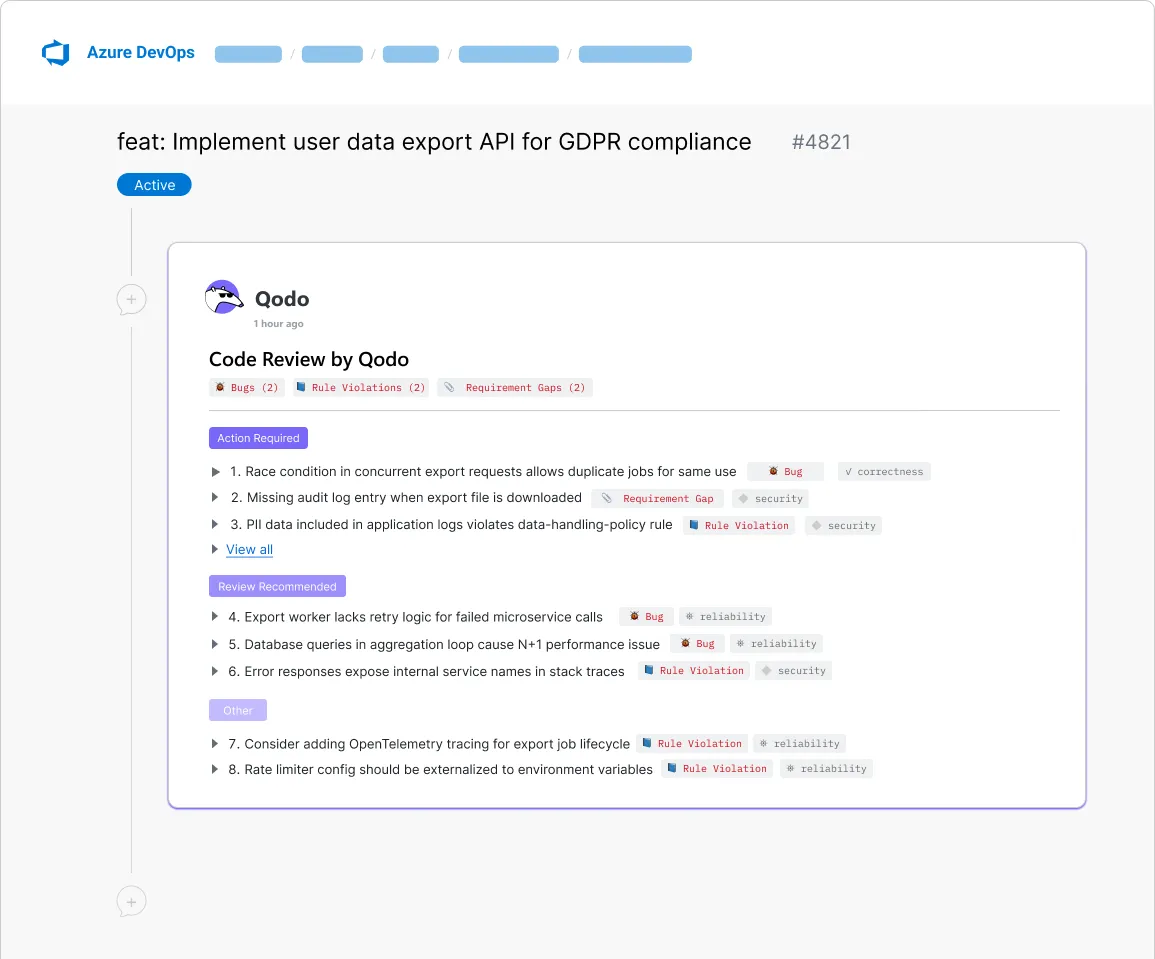
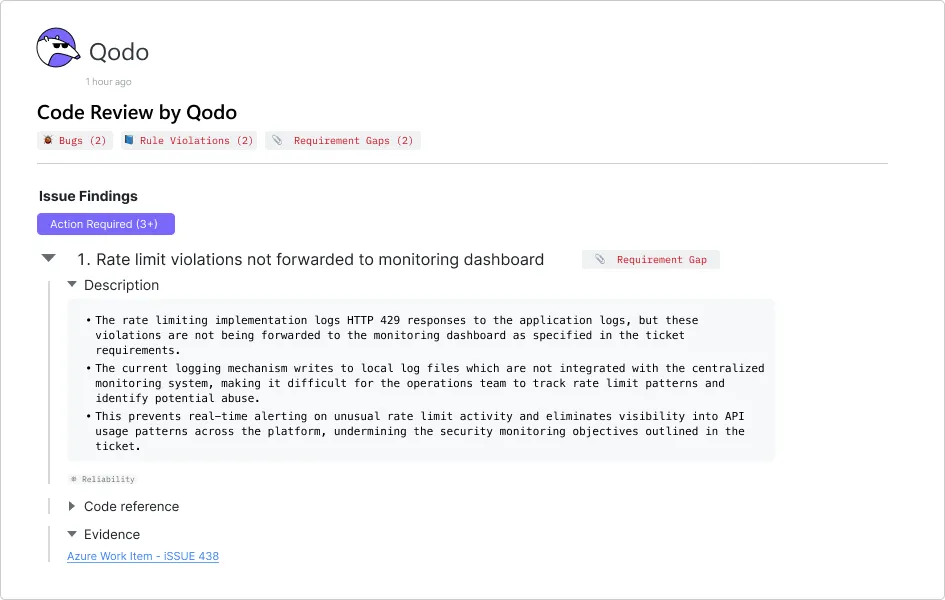
Qodo brings AI-powered code review directly into Azure DevOps workflows, embedding intelligent feedback where developers already work.
As Nir Alfandary, Digital Native Segment Lead at Microsoft, explains:
“Qodo’s AI code review capabilities help enterprise customers maintain consistent quality and governance as engineering teams scale. By integrating Qodo directly into Microsoft Azure DevOps, customers can bring context-aware code review into existing workflows and enforce organizational standards across global teams.”
The advantage is not just automation. It is alignment. Qodo works within ADO’s pull request process, helping teams standardize review quality without introducing a parallel system.
And as Alfandary adds:
“With Qodo and Azure DevOps, organizations are better equipped to build and manage AI-driven software development across large, complex codebases.”
For a deeper look at how the integration works within Azure DevOps, you can read our detailed overview here:
https://www.qodo.ai/blog/qodo-azure-devops-enterprise-ai-code-review/
AI Support Across the Development Lifecycle
While Azure DevOps integration brings AI-powered review directly into enterprise workflows, it is only one part of the broader Qodo platform.
Recent releases have expanded Qodo’s capabilities to support multiple stages of the development lifecycle. These updates introduced deeper repository awareness, stronger analysis across large and complex codebases, and improved context handling across multi-service architectures.
For enterprise teams, this means AI can assist not only during pull requests but throughout development. Developers can analyze repositories, surface potential issues earlier in the lifecycle, and gain deeper context about how changes affect the broader system before they reach review.
By combining these capabilities with embedded review in Azure DevOps, organizations can apply AI consistently across their engineering workflows.
Consistency at Scale
One of the biggest enterprise challenges is maintaining consistency across global teams. As organizations grow, variance increases in how code is reviewed, how feedback is delivered, and how engineering quality is maintained across teams.
Qodo helps enterprises:
- Provide context-aware suggestions within pull requests
- Reduce subjectivity in reviews
- Catch issues earlier in the development lifecycle
- Support engineers working across large and complex repositories
Because Qodo understands repository context and relationships across larger systems, it can provide insights that go beyond surface-level checks. This becomes especially important for enterprises managing complex architectures, shared services, and large distributed engineering teams.
Faster Feedback and Stronger Governance
Speed and governance are often treated as trade-offs. Organizations either slow down to maintain control or accelerate and accept risk.
Embedding AI-driven review into Azure DevOps changes that equation. Developers receive immediate feedback during pull requests, helping them iterate quickly while maintaining organizational standards. Reviewers can focus on higher-level architectural decisions rather than repetitive checks.
The result is clear:
- Shorter review cycles
- Fewer defects reaching production
- Greater confidence in every release
At the same time, expanded repository analysis and development insights help organizations identify issues earlier in the process, strengthening quality controls across the full software lifecycle.
Built for Enterprise Reality
What makes Qodo particularly well suited for enterprises using Azure DevOps is not only its AI capabilities but how naturally it fits into existing workflows.
There is no need to introduce a separate review environment. There is no need to retrain teams on a new platform. Qodo enhances the workflow teams already rely on.
Beyond Azure DevOps, the platform is designed to support the scale and complexity of enterprise engineering environments. With capabilities that span repository analysis, deep code understanding, and pull request review, organizations can apply AI across the development lifecycle while maintaining consistent engineering quality.
For organizations managing large, complex codebases across distributed teams, that combination of workflow integration and platform-level intelligence is what enables AI to deliver real value at scale.
As enterprise software development becomes increasingly AI-driven, the tools supporting it must scale just as intelligently. For Azure DevOps users looking to improve code quality, accelerate review cycles, and strengthen engineering workflows across teams, Qodo offers a practical and integrated path forward.