Why Code Review Needs Its Own AI with State-of-the-Art Precision–Recall

Code review is one of the most misunderstood processes in modern software development.
“Let’s vibe review” or simply “ask the coding agent to verify itself” – are some things you read often on social.
In reality, it’s one of the most important mechanisms in the entire Software Development Life Cycle (SDLC). And it serves two fundamental purposes:
- Quality gatekeeper: not letting code you care about rot
- Enable code ownership: you build it, you run it (as a team)
When done right, code review is both a gatekeeper and a gateway (i.e. move much faster!). It ensures that high‑quality ideas become high‑quality production code. It aligns teams not just on what they’re building, but on how they’re building it. Specs are extremely important, but if they are as detailed as code, they are code.
At the same time, In the age of AI‑generated code, code review must change.
We need a new approach. New UX/UI. New paradigm. A series of leapfrogs.
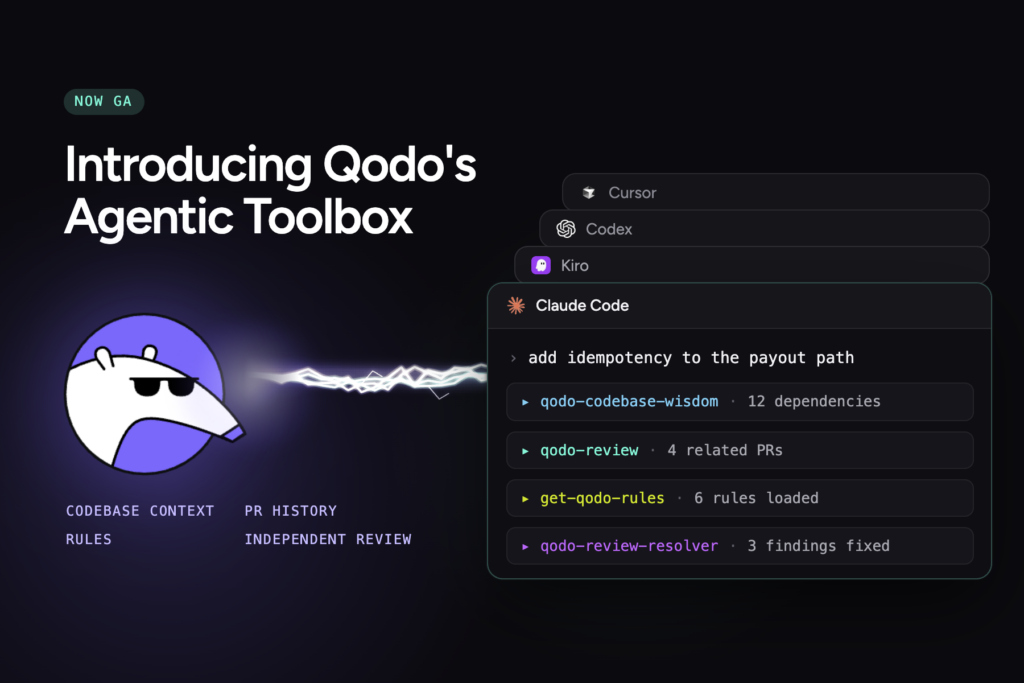
Today, we introduce Qodo 2.0, a multi-agent code review and integrity system for the Enterprise SDLC.
This is the first of several announcements this month by Qodo, albeit today we intentionally focus on the importance of Qodo dedicated to finding issues in the pull request, with the highest precision–recall measured.
What code quality actually means
When people talk about code quality, they often mean: Formatting, Naming, Lint rules (think Sonar), Style.
Those matter, but they’re not the hard part. It is far from being enough. Very far, especially if you want to the next level of (agentic) automation.
At Qodo, we think about code review as part of a broader system for maintaining code integrity, the ongoing ability of a codebase to stay correct, understandable, maintainable, testable, compliant and safe as it evolves.
Code integrity means, for example:
- Catching bugs before merge
- Surfacing architectural and systemic risks
- Enforcing subjective, team‑specific standards
- Preserving maintainability and testability
- Protecting security and performance
It’s not just about “does this compile?”
It’s about: “Does it work as intended, meet our standards, and can I trust it to deploy to my beloved users/customers?”
For an AI Code Review tool to be extremely useful, it needs to have really high recall across all the above topics.
Why we built Qodo 2.0
Qodo 2.0, the next-generation of our Agentic Code Review & Integrity platform, is the first step in a month of announcements.
Qodo 2.0 delivers an agentic code review system with the highest recall and precision in the market, available today on GitHub, GitLab, and Bitbucket.
In Qodo 2.0, we deliver:
- Always on code review with machine-level recall and senior-engineer-level precision
- A multi-agent system that understands your standards and codebase,
Precision is easy. Recall is everything.
Most AI Code Review tools focus on precision.
Precision means: “When I raise an alert, it’s probably correct.”
That’s table stakes. When a tool “interferes” in such an important workflow, it should be right.
But, recall is harder, and critical, especially in the Age of AI.
Recall means: “Did we catch everything that matters?”
High recall means catching what a senior-level developer who owns the code would have caught if it had all the time in the world, which a machine does. That could include for example: database‑breaking configurations, unmaintainable abstractions, untestable designs, hidden security flaws, accessibility violations, and scaling bottlenecks
This is what senior and principal engineers do instinctively. And we need to codify that.
They hold 10-15 things (or actually hundreds or thousands) in their head at once. They understand how a small change ripples through the entire system.
That’s what a great review looks like. And that’s the bar we’re chasing at Qodo.
We don’t expect you to take our word for it, so we built a benchmark to prove it.
The Qodo Code Review Benchmark 1.0 evaluates AI reviewers against 580 defects across 100 real PRs from production repositories. Qodo achieved an F1 of 60.1%, outperforming 7 other leading platforms. [Full benchmark and methodology here →].
The multi‑agent system approach to code review
When you build a serious code review system, you’re not just “calling an LLM.”
You’re designing a workflow.
At Qodo, we use more than a dozen specialized agents, each optimized for specific concerns: backend bugs, UI issues, runtime failures, rule violations, security risks, performance regressions, accessibility gaps, and more.
Why does this matter? A single LLM trying to catch everything catches nothing reliably. This isn’t architecture for architecture’s sake. It’s how you achieve high recall without drowning in false positives. Each agent knows exactly what to look for and what to ignore. No single model can hold that much specialized knowledge without tradeoffs.
That’s how you achieve high recall without drowning in false positives. Each agent knows exactly what to look for and what to ignore.
The result: reviews that are both comprehensive and precise. That’s how you build trust.
Code review requires memory
Real code review requires context.
You need to know:
- Why past decisions were made
- What trade‑offs were accepted
- What debates already happened
- Which risks were deferred
Qodo is the code review platform that fetches this data. We preprocess repositories, index historical discussions, and track architectural evolution.
We built a dedicated memory layer for code review. Not just files, context.
This is one of the areas we’re most excited about, and honestly, I’m holding back. Memory is foundational to where Qodo is heading, and we’ll have a lot more to share in the coming weeks.
Qodo 2.0: your principal engineer in software
Think about the best reviewer you know.
The person who catches everything. Who understands product impact, security, scale, and user experience all at once.
That’s what Qodo 2.0 is designed to be.
Your principal engineer, implemented as explicit, specialized agents.
Agents that work with you to define what “quality” means in your organization. Agents that evolve with your system. Agents that never get tired.
The future of code review
AI has radically changed how much code we produce. Although this isn’t yet happening in most companies, we believe it could be by the end of 2026.
Developers will generate 10× more PRs than before. In extreme cases, senior devs will review 40+ PRs per day.
The old model doesn’t work anymore.
We need tools built specifically for review, not repurposed from generation.
And this brings us back to a question I hear often from dev teams that believe in “move fast and break things”:
“If coding agents can already generate decent code, why do we still need code review at all?”
AI makes it easy to produce more code than ever before. Code review is what makes that code reliable, maintainable, and safe to ship.
Without it, velocity turns into fragility. With it, velocity turns into leverage. Integrity creates trust.
Code fast. Break Nothing.
That’s what Qodo 2.0 is about.
About the author