Agentic RAG Explained: Building Smarter, Context-Aware AI Systems

TL;DR
- An industry study found 87% of enterprise RAG deployments fail to meet expected ROI, often due to challenges like fixed retrieval logic, static chunking, and difficulty handling unstructured or scattered data.
- Agentic RAG introduces autonomous agents that dynamically plan, adapt queries, switch tools, and iteratively retrieve relevant context until the task goal is met.
- Architectures like Single-Agent and Multi-Agent RAG enable flexible workflows, allowing agents to route queries intelligently or delegate tasks across specialized retrieval agents.
- Agentic RAG uses tools, often exposed through the Model Context Protocol (MCP), to integrate with Git, code, files, and APIs, enabling multi-step reasoning and context-aware code review.
- Unlike static pipelines, agentic retrieval adapts to the task, which makes it useful for debugging, multi-service changes, and high-stakes code reviews.
From what I’ve seen in production, most Retrieval-Augmented Generation (RAG) pipelines start strong in theory but break down quickly under real-world complexity. One industry analysis estimates that 87% of enterprise RAG deployments fail to deliver expected ROI, largely because of overly broad indexing, static retrieval paths, and evaluation methods that don’t reflect the actual task environment.
As a Technical Lead, I know how this happens, and I’ve come across this many times. I have used a standard RAG setup to resolve cross-service incidents by pulling data from Confluence docs, GitHub threads, and monitoring dashboards. But, even after retrieval, the system would pull irrelevant chunks, miss key log references, and ignore dependencies unless we manually tuned the index. The common thread across these failures is rigid retrieval logic that assumes clean, well-labelled, and consistently structured data.
After several failed experiences, I finally found the solution: autonomous decision-making with retrieval done by Agentic RAGs.
Instead of running a fixed retriever, it deploys agents that dynamically select what to query, how to query it, and when to stop. Retrieval becomes iterative and contextual. Retrieval stops being a one-shot API call and becomes a contextual, multi-step loop.
Traditional RAG assumes you can chunk once, run a vector search, and get relevant results. However, chunking, source selection, and query phrasing must adapt in real workflows based on the task and data.
Agentic RAG treats retrieval as an active process, where the agent has a goal, evaluates what it’s already found, and decides the next step. It can rephrase queries, switch sources, or stop once the context is sufficient.
In my case, I’ve built agentic flows that operate across git repos, files, PRs, and even terminal logs. Using Model Context Protocol (MCP) tools, I define what the agent is trying to retrieve, how it should approach the task, what fallback logic to use, and when it should stop.
In this post, I’ll explain how Agentic RAG works in practice, what makes it different from traditional RAGs, and how Qodo applies agentic retrieval to code review.
What is Agentic RAG?
Agentic RAG combines retrieval-augmented generation with autonomous decision-making. Unlike traditional RAG, where the retrieval process is fixed and executed in a single pass, Agentic RAG systems treat retrieval as a dynamic, iterative process driven by an agent with a specific goal. The agent plans how to search, adapts based on intermediate results, and stops only once enough context has been gathered.
Below is a diagram explaining how Agentic RAGs are formed:
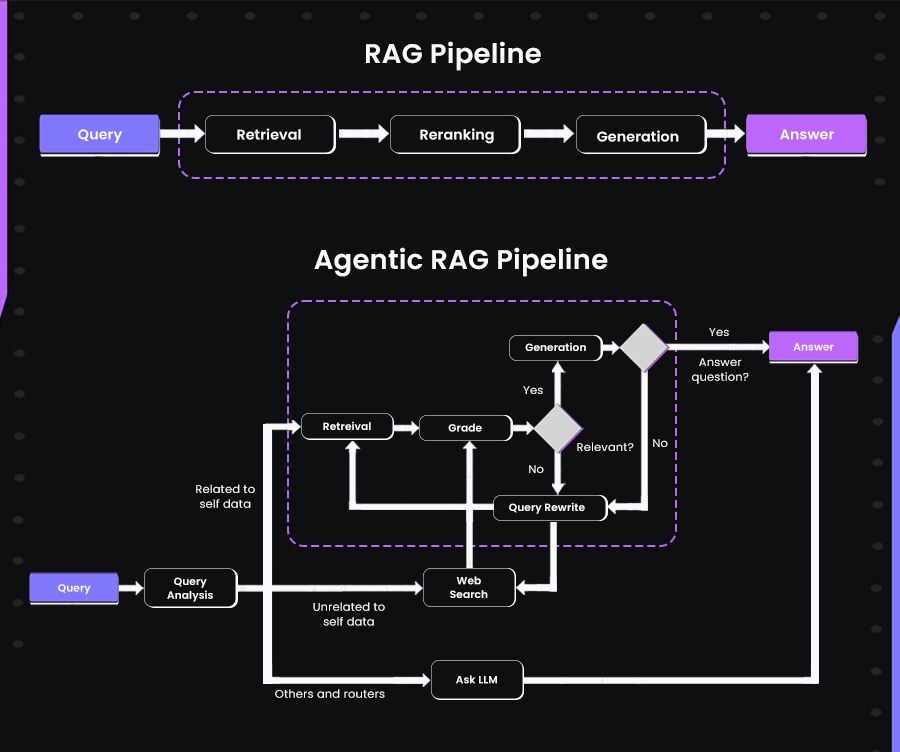
In the RAG pipeline (top), the process is linear: a query goes through retrieval, re-ranking, and generation, leading directly to an answer. It’s a fixed, one-pass system, whereas the Agentic RAG pipeline takes a flexible, loop-based approach. It starts by analyzing the query and deciding whether to search internal data or external sources.
Retrieved results are graded for relevance, and if they fall short, the agent rewrites the query and tries again. This cycle continues until enough useful context is gathered to generate a reliable answer.
Types of Agentic RAG Architectures
Agentic RAG systems can range from simple to highly modular, depending on how retrieval and reasoning responsibilities are distributed. At their core, they shift away from fixed one-shot retrieval toward a more dynamic system, where agents make decisions based on task goals and available tools. Below are two foundational patterns commonly used to structure Agentic RAG workflows.
Single-Agent RAG (Routing Agent)
The simplest form of an Agentic RAG system uses one agent acting as a decision-maker. Single-Agent RAGs are like smart routers that work like this: when a question comes in, the agent evaluates where the best information might live; it could query a vector store, search a document database, or even hit a live API like a company’s Slack channel or a search engine. The point isn’t just choosing from databases and tools that provide real-time or specialized context.
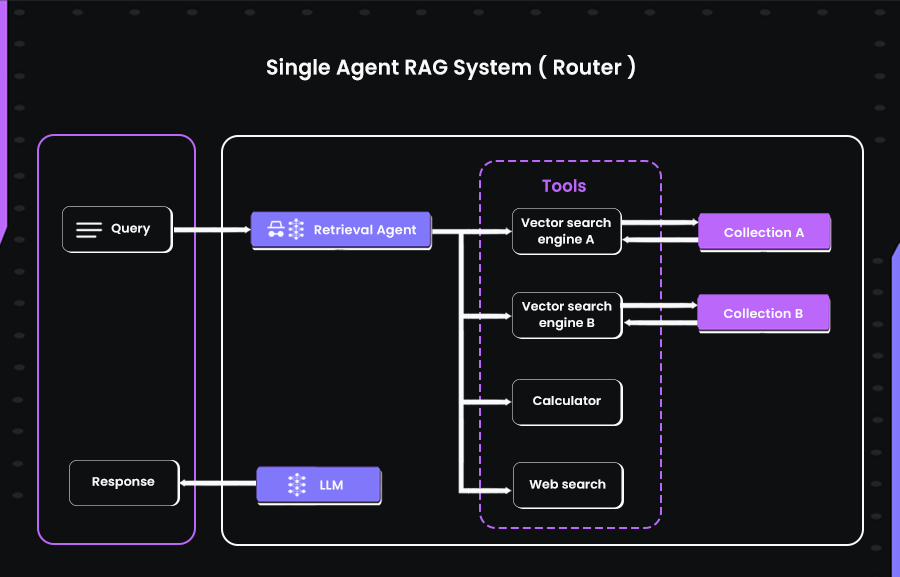
This model works well when there are just a few retrieval sources and lightweight coordination is enough. It’s still agentic because the agent makes the retrieval decision at runtime, not through hardcoded rules.
Multi-Agent RAG (Specialized Retrieval Agents)
In more complex setups, a single agent isn’t enough to handle the growing diversity of data and retrieval needs. Multi-agent systems solve this by distributing responsibilities. A lead agent handles the overall task and delegates subtasks to other agents, each specialized in accessing certain data or tools.
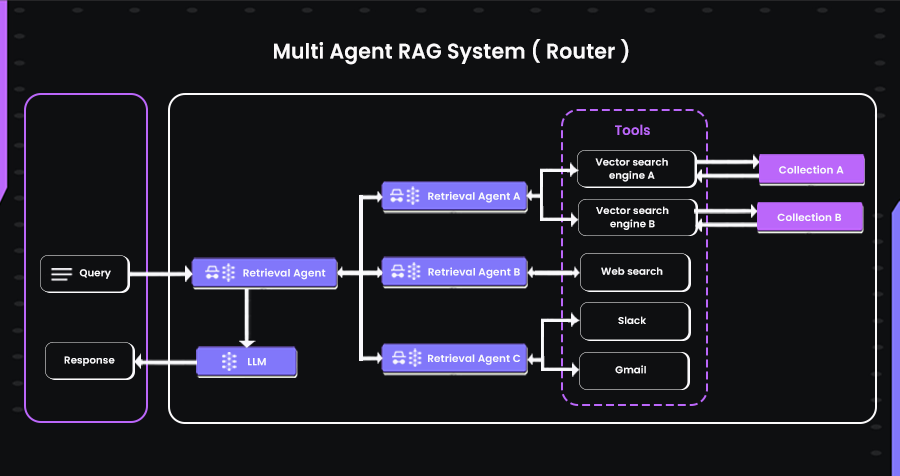
For example, one agent might focus on querying internal technical documentation, another might scan your email or chat history, and a third could pull relevant insights from the web. The primary agent coordinates the process, ensuring each sub-agent contributes context aligned with the original task.
This layered structure allows for modularity, flexibility, and better fault isolation. It’s especially useful when dealing with enterprise-scale systems or a mix of public, private, and semi-structured sources.
Agentic RAG vs Traditional RAG
As IBM notes, “Agentic RAG systems add AI agents to the RAG pipeline to increase adaptability and accuracy,” allowing LLMs to pull data from multiple sources and manage complex, multi-step workflows.
In other words, standard RAG is like a single-shot search against one dataset. In contrast, Agentic RAG treats the model as an active agent that can iteratively refine queries, consult different databases or tools, and revalidate information to solve harder tasks.
Below is a table for you so that you can understand the differences from different aspects:
| Aspect | Standard RAG | Agentic RAG |
| Data Sources | Single knowledge base (one vector store or DB) | Multiple sources and tools (vector DBs, web APIs, etc.) |
| Retrieval Process | One-shot: retrieve then generate | Iterative: agents decide when/how to retrieve and can re-query |
| External Tools | Typically none | Full tool usage (search, calculator, databases, APIs) |
| Planning & Logic | No query planning; static prompts | Agents plan, decompose tasks, and adapt strategy |
| Memory | Stateless (no shared memory between queries) | Short- and long-term memory to remember context and past results |
| Adaptability | Reactive (fixed retrieval logic) | Proactive and adaptive (can change approach mid-task) |
| Multimodal Capability | Usually text only | Can integrate text, images, audio via multimodal LLMs and tools |
| Complexity & Cost | Simpler, lower compute | More complex, higher cost (more tokens, compute) |
How Qodo Applies Agentic Retrieval to Code Review
Qodo is the AI code review platform with high-precision PR review, full codebase context, enforceable rules, and local review inside your coding agents. Its approach to retrieval is agentic: instead of passing a fixed slice of the diff to a model, review agents pull the context they need as they reason about a change.
- Context Engine: the Qodo Context Engine gathers context from across your repositories, pull requests, organizational rules, and workflows, and its deep research agents reason across that knowledge to answer questions and power review.
- Pull request review: Qodo Git reviews every pull request in GitHub, GitLab, Bitbucket, and Azure DevOps with that context, flagging critical issues, breaking changes, and duplicated logic.
- Rules: the rules system turns your team’s review norms into checks that run on every change.
- Local review and MCP: the Agentic Toolbox brings Qodo review into coding agents such as Claude Code and Codex, and exposes Qodo skills over MCP to custom agents and workflows.
This is where agentic RAG pays off for engineering teams: retrieval decisions follow the reasoning, so a review of a change to a shared module can pull in the services that consume it, past pull requests that touched it, and the rules that apply to it.
Conclusion
After experimenting with different retrieval strategies and hitting the limits of traditional RAG systems, I’ve come to believe that Agentic RAG isn’t just a new feature; it’s a fundamental shift in building context-aware AI systems. It bridges the gap between static retrieval and real-world problem solving, where data is messy, context is scattered, and goals aren’t always clearly defined in a single prompt.
The flexibility and reasoning capability offered by agentic workflows bring a new level of adaptability that enterprise environments demand. It’s no longer about retrieving information, but about understanding how and why to retrieve it, and then acting on it with autonomy.
With Qodo’s implementation, I’ve seen this shift play out in theory and practice, debugging multi-service issues, automating refactor workflows, and even generating complete PR guides with test integrity checks.
FAQs
Which AI code assistants offer deep context search and refactoring support for large enterprises?
Most AI coding assistant are limited to snippet-level completions, but Qodo is designed to review code with deep context across large, complex codebases. It pulls context from across repositories, applies organizational standards, and scales with teams of all sizes.
What are good alternatives for basic AI context handling systems?
While lightweight copilots work for single-file tasks, enterprises need deeper context awareness. Qodo is a strong alternative because it embeds cross-repo intelligence, integrates with GitHub and CI/CD workflows, and adapts to team-specific best practices, something basic systems cannot provide.
How does LangGraph MCP (Model Context Protocol) relate to context management in assistants?
Protocols like MCP are important for structuring how models exchange context, but on their own, they don’t provide enterprise-ready workflows. Qodo takes the concept further by bringing context into local review inside coding agents, Git workflows, and PR reviews, giving teams a practical layer of context engineering built for production environments.
What are the current approaches to deep cross-repo autocomplete?
Some assistants attempt token-level scaling, but this often leads to performance trade-offs. Qodo uses a shared knowledge model that dynamically refreshes repo context, allowing autocomplete to draw from the latest code across services without overwhelming the developer with irrelevant suggestions.
How do AI assistants like Qodo build and refresh code context at scale?
Qodo continuously indexes repositories, development history, and team-wide conventions. As code changes, it refreshes this context dynamically, ensuring that reviews reflect the most recent state of the project. This gives teams confidence that context-aware automation won’t fall out of sync with their codebase.
What are the best AI coding assistants for PHP that maintain context and consistency?
Many assistants lack a deep understanding of dynamic languages like PHP, especially in large frameworks. Qodo stands out by applying organization-wide context, handling dependencies across repos, and reviewing PHP changes consistently against your rules.
How does Retrieval-Augmented Generation (RAG) fit into context engineering?
RAG extends context engineering by combining repository indexing with on-demand retrieval from knowledge stores, documentation, and previous code history. For example, Qodo uses RAG-driven enrichment to surface relevant patterns and standards during code review or generation. We’ve explored this in more detail in our article on Context Engineering for Developers.
About the author