Best Graphite Alternatives for Developer Teams in 2026

84% of developers are now using or planning to use AI tools in their development process, according to the 2025 Stack Overflow Developer Survey. More code is arriving at review than review processes were built to absorb, which is the actual reason teams go looking for better pull request tooling.
In response, Graphite adopted the strategy of using stacked pull requests: it broke large changes into smaller ones, automated the rebasing, and ordered the merges. Then, in December 2025, Graphite entered into a definitive agreement to acquire Cursor and changed its position to that of an AI code-review platform. Any article written before that date refers to a product that no longer exists in the same form.
So the real question in 2026 isn’t what else does stacked PRs. It’s which review platform sits between AI-written code and production, and whether you want that platform owned by the company that also writes the code. Qodo publishes this blog and is one of three alternatives compared here, the methodology section states exactly how that was handled.
TL;DR
- Graphite is now part of Cursor. The acquisition was announced in December 2025, Graphite continues to operate as an independent product, and Cursor Cloud Agents shipped inside Graphite in March 2026. That changes the buying question from workflow tooling to vendor consolidation.
- Qodo is the best pick for organizations running many repositories, where the failure mode is a breaking change crossing a service boundary and standards that live in reviewers’ heads rather than anywhere enforceable.
- CodeRabbit is the strongest per-PR reviewer with a genuine IDE story, now raising at scale and repositioning around change management. It is priced per seat and starts at $24 per user per month.
- Greptile is the lightweight option, $30 per seat with 50 credits included, and it now runs your code through TREX rather than only reading it.
- Watch the pricing model, not the sticker. Two of these four tools changed pricing structure in the last year, and one of them moved in the opposite direction from what the previous version of this article reported.
No single tool covers all of it. Merge workflow, per-PR review, and cross-repo governance are three different jobs, and the tool that is excellent at one is usually average at the others.
What Changed When Graphite Joined Cursor
Right now, the category has been unified. In December 2025, Graphite joined Cursor, so the company took over the review and merging functions. Graphite is no longer known for having a backlog of pull requests, but is now called ‘the AI code review platform.
CodeRabbit announced a $143M raise to build what it calls the control layer for software change. Greptile shipped TREX, which executes code during review rather than reading diffs statically, and reworked its pricing around credits.
The second shift is what teams are buying for. Stacked pull requests solve a human-authorship problem: one engineer wrote too much at once. That problem still exists, but it’s no longer the expensive one. When agents open pull requests, the bottleneck is verification, and verification is a different capability from sequencing.
| Tool | Category | Setup time | Best for |
|---|---|---|---|
| Graphite (baseline) | Merge workflow plus AI review | 30 minutes (CLI plus workflow change) | Teams committed to stacked PRs and a merge queue |
| Qodo | Cross-repo review and governance | 10 minutes | Organizations with many repos and standards that need enforcing |
| CodeRabbit | Per-PR and in-IDE review | 10 minutes | Teams wanting fast feedback before and during the PR |
| Greptile | Lightweight PR review | 5 minutes | Small teams wanting quick, low-config review |
What counts as a Graphite alternative
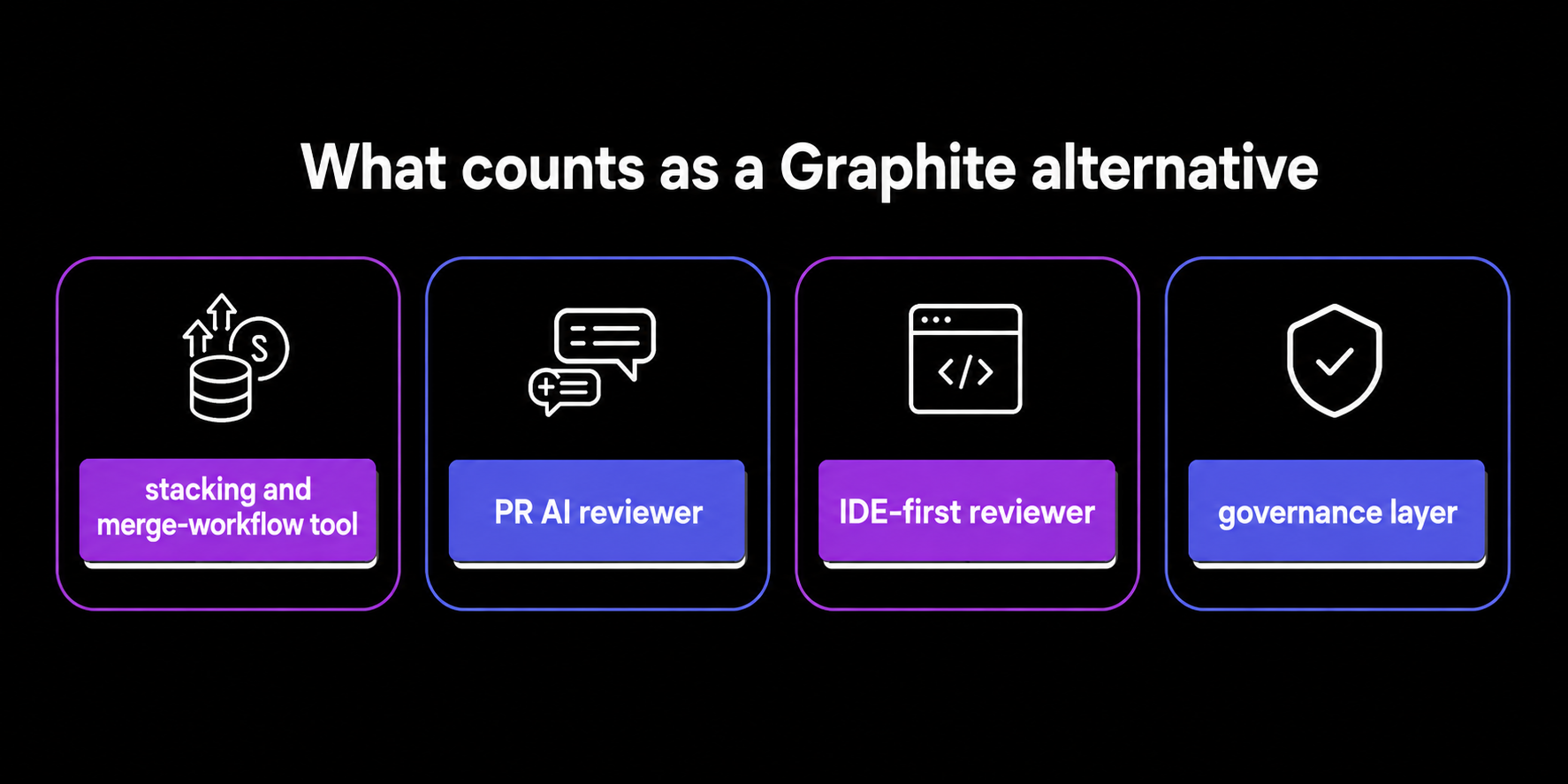
“Alternative to Graphite” means three different products depending on which part of Graphite you were actually using, and buying the wrong one is the common mistake here.
- Use a stacking and merge-workflow tool when the thing you liked about Graphite was splitting large changes and sequencing merges. If that is the requirement, the honest answer is that the alternatives are open-source workflow tools such as git-town, Sapling, and Gerrit rather than any of the AI reviewers below. None of the three tools in this comparison stack pull requests.
- Choose a per-PR AI reviewer if your main issue is slow review times, like when pull requests sit for days because no one has time to look at them. CodeRabbit and Greptile both address this problem, and now Graphite’s AI review does as well.
- Pick an IDE-first reviewer to catch issues before you even create a pull request. This approach helps shorten the review process instead of just making it faster.
- Go with a governance layer when your challenges are bigger than a single pull request. For example, if you have breaking changes across different repositories, inconsistent standards across the team, or no way to track if rules are working, a governance layer helps. Qodo is designed for this, and per-PR tools can’t handle these issues.
How we evaluated these Graphite alternatives
The tools were evaluated using six weighted dimensions, the weights being determined according to their effect on actual engineering work processes rather than on demo quality.
| # | Dimension | Weight | What we measured |
|---|---|---|---|
| 1 | Review depth and precision | 25% | Whether findings are real defects tied to business logic, not style noise |
| 2 | Context scope | 20% | Diff-only, whole-repo, or across repositories and PR history |
| 3 | Standards enforcement | 20% | Whether team conventions can be defined, applied automatically, and measured |
| 4 | Workflow fit | 15% | Git provider coverage, IDE support, setup friction |
| 5 | Enterprise controls | 10% | SSO/SAML, audit logs, self-hosting, data handling |
| 6 | Pricing predictability | 10% | Whether a team can forecast cost from the public pricing page |
Disclosure: Qodo publishes this blog and appears first in the list. To ensure honesty, three measures have been taken. Each tool is evaluated using the same six criteria, with stars given for each criterion, so you can see in which areas Qodo falls short. Qodo’s profile includes the same stated limitations as those of the other tools. Furthermore, the way the weights are determined is made clear from the start, rather than being worked out afterward; the weighting places greater emphasis on cross-repo scope and standards enforcement, since these are the aspects that large engineering organizations tend to prioritize. A team of five people focused on fast feedback would assign greater weight to dimensions 1 and 4 and therefore choose CodeRabbit; the ratings table clearly shows this.
The 3 Best Graphite Alternatives, Compared
1. Qodo
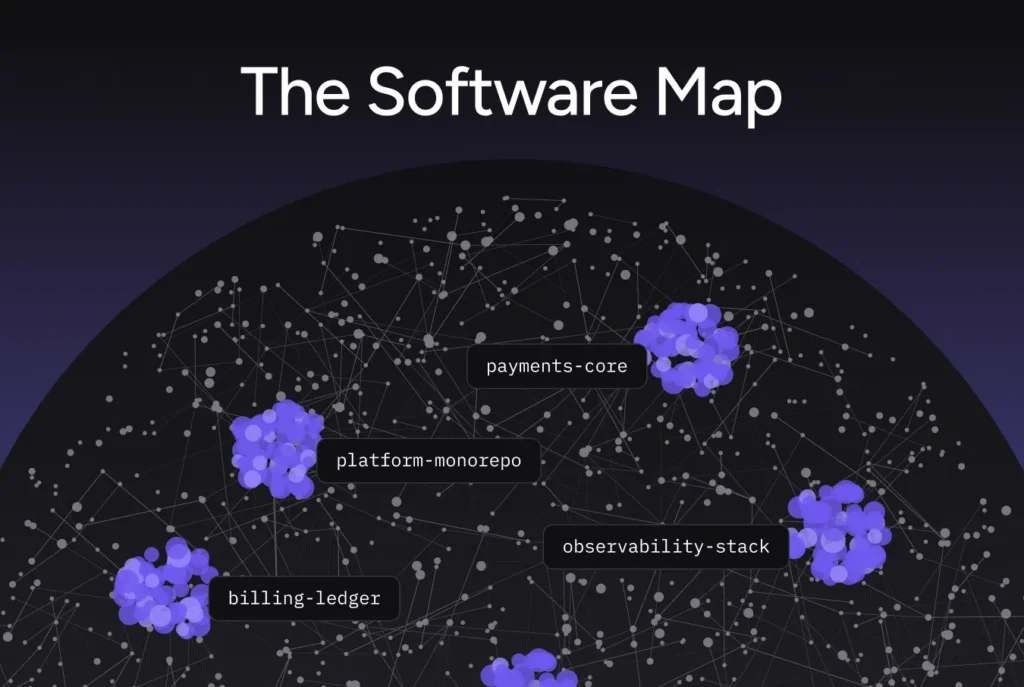
Qodo is an AI code review platform built around one argument: the expensive defects are the ones a single pull request cannot show you. A signature change in a shared SDK looks fine in its own diff and breaks three downstream services at deploy time. Qodo’s Context Engine indexes the codebase and PR history rather than the diff, and specialized agents run in parallel on every PR across bug detection, security, rule violations, and requirement gaps.
Four capabilities extend that from per-repo review to organization-level governance:
- Cross Repo Review maps dependencies between repositories and surfaces breaking changes during review, with the dependency graph laid out in the portal.
- Rule Miner automatically converts recurring comments from PR reviews and reviewer decisions into enforceable rules, meaning that when a new engineer submits a PR they will receive the feedback that used to take months of repeated comments to absorb.
- The Skills page in the Qodo portal transform the skill files that teams use to guide AI coding tools into a controlled and measurable system, including specific enforcement counts for each skill, enabling platform teams to discard the standards that only add noise.
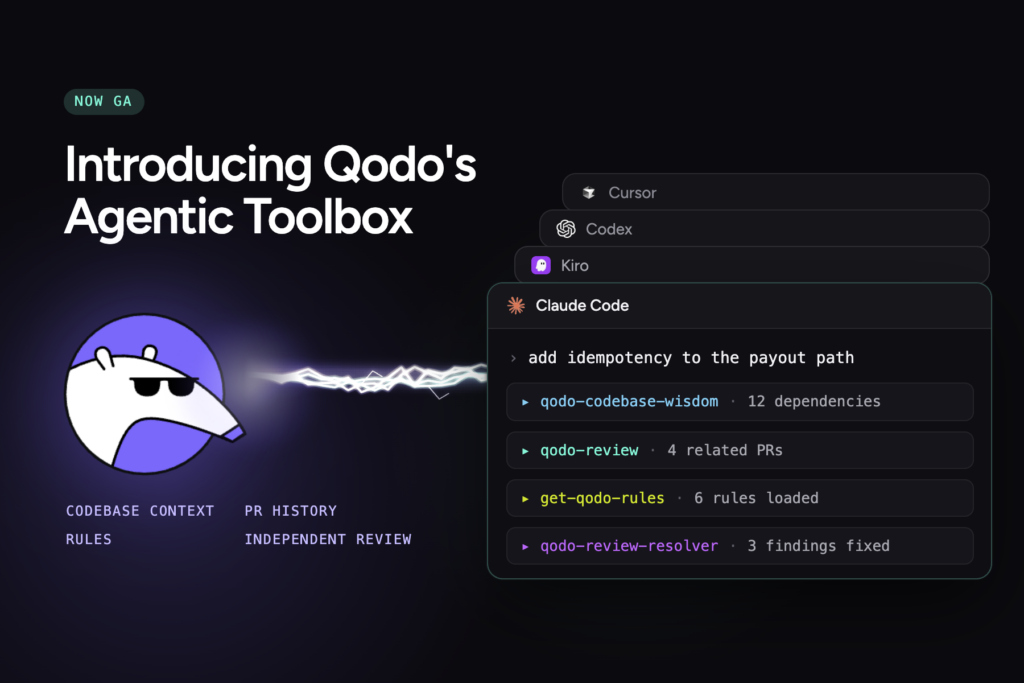
- A fourth capability, the Agentic Toolbox (launched September 9, 2026), extends that governance earlier still, bringing codebase context, applicable rules, and local-diff review directly into the coding agent a team already uses, before a PR exists.
First-hand example: reviewing a pharma sales tracker PR
I created a pull request for a pharma sales tracker that is used by regional managers, including an aggregation pipeline that calculated the total number of prescriptions, revenue, and the average number of monthly prescriptions.
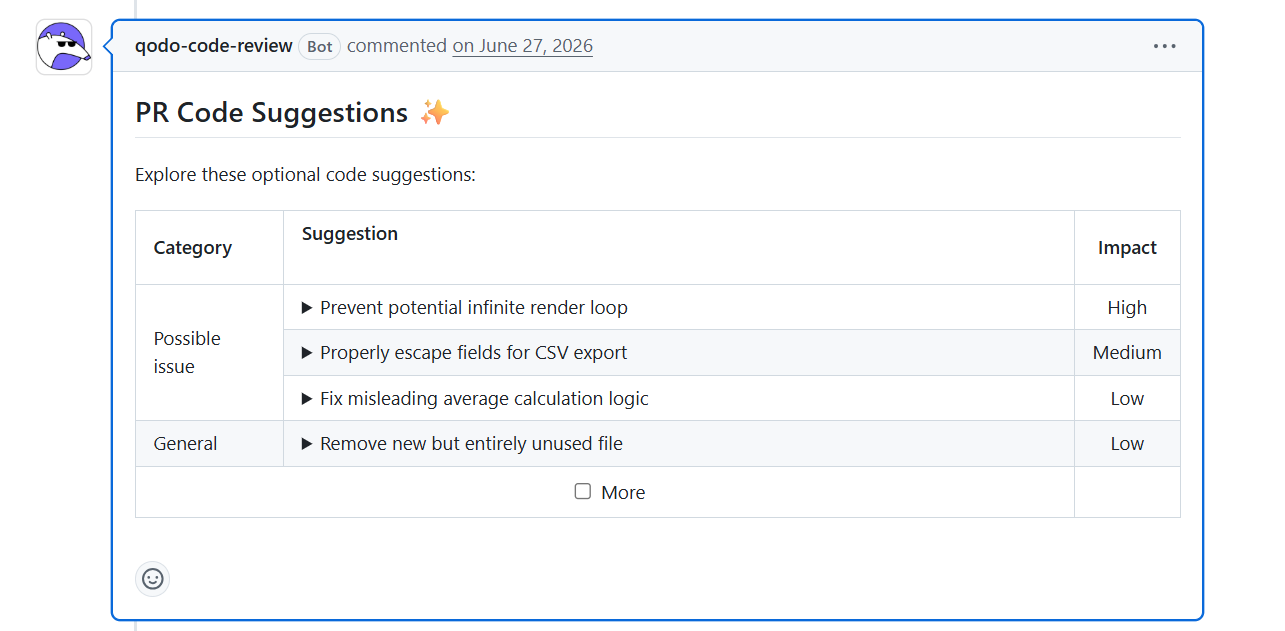
The review flagged a possible infinite render loop, missing CSV field escaping, an average calculation that could mislead users, and a file that had been added but never referenced anywhere in the codebase.
The review looked into the aggregation logic in detail, computing the average number of prescriptions on the basis of quantity while the monthly trends were calculated from the number of documents; this caused the dashboard to show two different figures without explaining the discrepancy to the sales team that viewed it. All full months with no data were excluded from the chart data, so the filtered results were misleading for any territory that had gaps in its reporting. The review also included value.toFixed(0) in the tooltip formatting, a method that strips the decimal places from the revenue figure and leads to a runtime error when encountering null values.
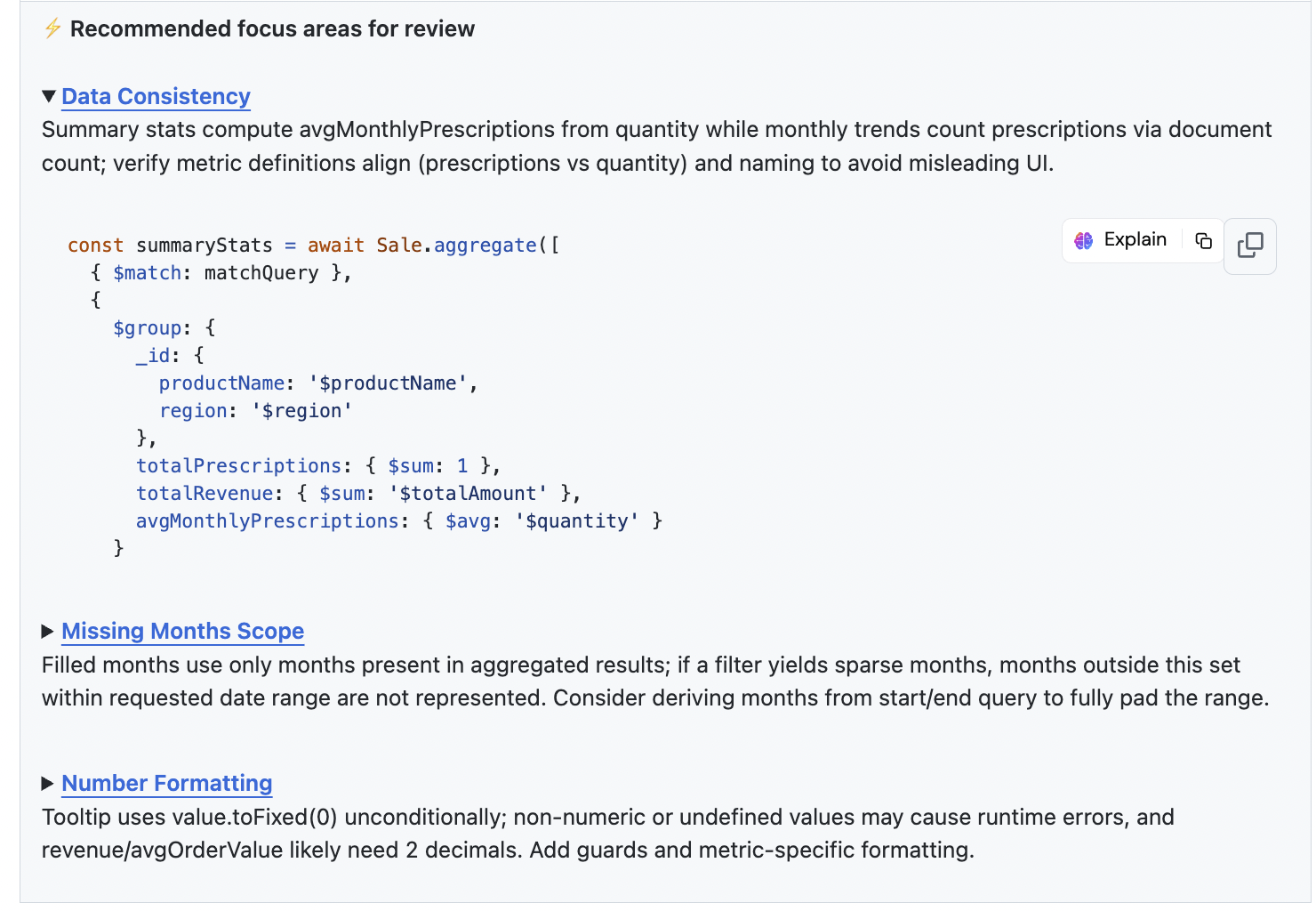
The measures taken were specific; they involved aligning the metric definitions, padding the missing months so that the charts show the full period, and enclosing the number formatting with null guards. The feedback was based on the business logic of the tracker, not on coding style; that being the difference between a review that improves the product and one that merely adds comments.
Best for: Engineering organizations running many interdependent repositories, with high PR volume and standards that currently depend on which reviewer happens to pick up the PR.
Not for: Teams whose actual requirement is stacked pull requests and a merge queue. Qodo does not stack PRs, and if that is why you adopted Graphite, this is not a replacement for it.
Key features:
- Cross Repo Review mapping dependencies and surfacing breaking changes before merge
- Rule Miner extracting enforceable standards from PR review history
- Context Engine with multi-repo indexing and PR history awareness
- Agentic Toolbox (launched September 9, 2026): brings codebase context, rules, and review into the coding agent via Agent Skills, before a PR exists
- One-click remediation with severity-ranked findings
- Git provider coverage across GitHub, GitLab, Bitbucket, and Azure DevOps
Limitations: Qodo does not take the place of Graphite’s merge workflow, meaning that teams that use stacked pull requests will need to continue using that tooling. Since the value provided depends on the history of the repository, Rule Miner will offer less benefit to a newly created codebase with no record of pull requests than to one that is more established. Pricing is based on credits, which is straightforward on a per-review basis but does require credit pack management when dealing with a high volume of reviews. Self-hosting, SSO/SAML, and BYOK are available only as Enterprise features, so a team of twenty people with strict deployment requirements will not be able to access them on the Pro Team plan.
Pricing: Usage-based rather than per-seat, with credits pooled across the team.
- A 14-day trial covers the full platform: unlimited reviews and credits, no credit card
- Pro Team: $30/month for roughly 18 reviews up to $240/month for roughly 143 reviews
- Unlimited users per workspace, monthly billing, a customer-set overage cap, no annual commitment
- Enterprise: custom-priced, adds SSO/SAML, audit logs, BYOK, governance analytics, single-tenant or on-prem, dedicated CSM
2. CodeRabbit
CodeRabbit reviews pull requests and, unlike most of this category, also runs inside the editor. It integrates with VS Code, Cursor, and Windsurf for feedback during active coding, then reviews the PR itself with agentic analysis, one-click fixes, and pre-merge checks. It has repositioned over the past year around what it calls agentic change management, backed by a $143M raise, and the product now includes MCP connections, loops with coding agents, and Jira and Linear integrations.
First-hand example: reviewing a scheduling feature
I was building a scheduling feature using react-big-calendar. To style events by priority, I overrode eventWrapper and returned a bare <div> with custom classes. It looked correct.
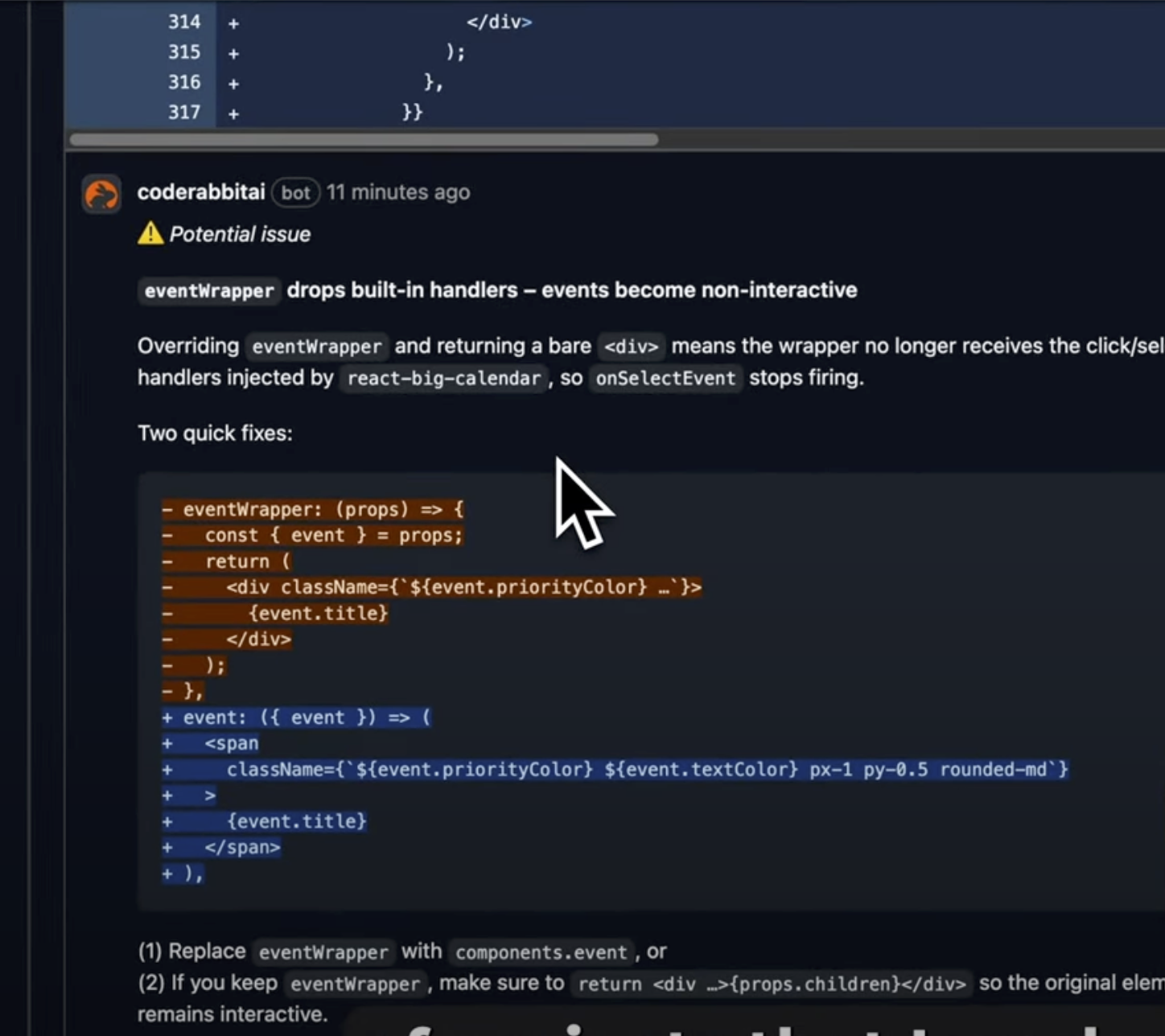
CodeRabbit noticed that when the wrapper was replaced with a simple <div>, the built-in handlers were stripped from react-big-calendar; as a result, onSelectEvent stopped working. The display of the UI was unproblematic, but the interactivity was quietly broken, which is precisely the type of bug that manual testing fails to detect. The recommended solution was to use components.event or to return {props.children} from the wrapper in order to keep the handlers, with a modified example using a <span>.
Best for: Teams that want review feedback before the PR exists, and teams already standardized on VS Code, Cursor, or Windsurf so the IDE layer is usable across the whole team.
Not for: Organizations whose main problem spans repositories. Multi-repo analysis sits on the Pro Plus tier, and the product’s center of gravity is the individual change.
Key features:
- Agentic AI review on pull requests and in the CLI
- Real-time in-IDE feedback across VS Code, Cursor, and Windsurf
- One-click fixes and built-in pre-merge checks
- Automatic PR summarization
- Linter and SAST tool integration, plus agentic chat
- Learnings that carry team preferences forward between reviews
Limitations: The IDE layer only pays off if the whole team uses a supported editor, so enterprise-wide consistency depends on editor standardization you may not have. Multi-repo analysis is gated to Pro Plus at $48 per user. Pricing is per seat, so cost scales with headcount whether or not those engineers open PRs. Security review is a separate $40 per user add-on rather than part of the core plans.
Pricing: All plans include a 14-day trial with no credit card. Pro is $24 per user per month billed annually, Pro Plus is $48 per user per month and adds multi-repo analysis, custom pre-merge checks, and post-merge actions, and Enterprise is custom-priced with self-hosting, RBAC, SSO, audit logging, and API access. CodeRabbit Security is a separate $40 per user per month product.
3. Greptile
Greptile is the most basic option: it’s an AI reviewer that reads the entire codebase to gain context, adds comments directly on pull requests, and produces PR summaries that include a file-by-file breakdown together with confidence scores. It is the quickest of the three to set up, and it allows the use of custom rules that can be applied on a per-repo or per-path basis, as well as offering self-hosting within your own VPC for teams that have compliance needs.
The notable change this year is TREX, which executes code during review rather than only analyzing it statically. Greptile states over 22,000 teams use the product.
First-hand example: reviewing a revenue analytics PR
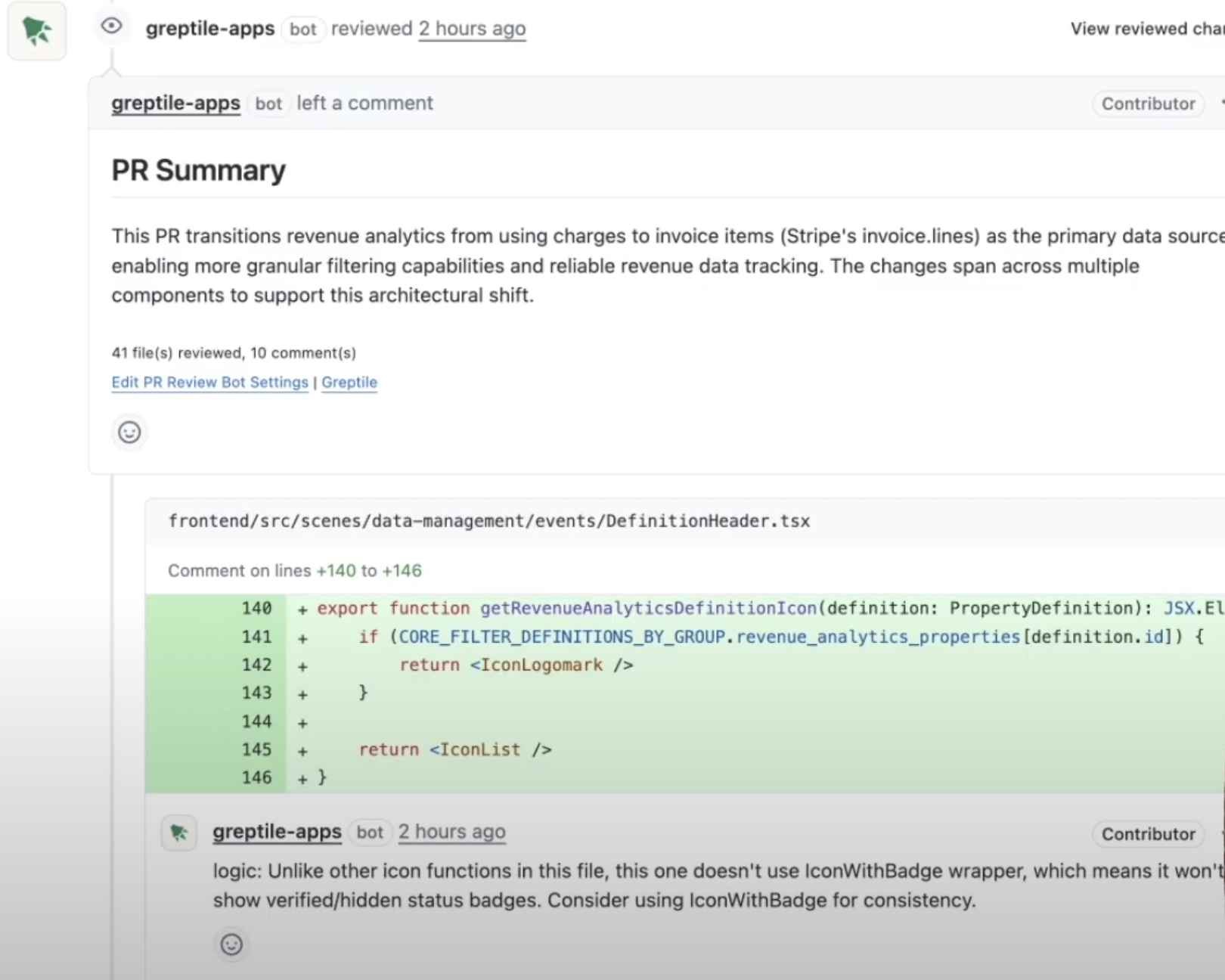
I pushed changes to an open PR that moved a revenue analytics flow from charges to invoice items as the primary data source. Greptile generated a summary covering the architectural impact across components.
It then left an inline comment on a new function returning an icon based on the revenue_analytics_properties definition, flagging that similar functions in the file wrapped the icon with IconWithBadge and this one did not, and suggesting the wrapper for consistency since the badge signals verified and hidden states.
That is a real inconsistency, correctly caught. It was also scoped to that PR alone. It would not tell me whether the same badge-wrapping pattern was being broken elsewhere in the codebase, because the review does not carry PR history or cross-repo context forward the way a persistent rules system does.
Best for: Small teams and startups wanting useful review in minutes, and teams that need self-hosting without an enterprise procurement cycle.
Not for: Organizations that need standards enforced consistently across many repos, or that need review decisions to persist across pull requests.
Key features:
- Full-codebase context on pull request review
- Inline comments plus PR summaries with file-by-file breakdowns and confidence scores
- Conversational follow-ups via comment commands
- Custom rules and style guides scoped per repo or path
- TREX reviews that execute code rather than reading it statically
- Self-hostable in your own VPC, including air-gapped environments
Limitations: the reviews are limited to the current pull request and do not retain any memory of previous reviews or take into account dependencies between different repositories. The output is non-deterministic, meaning that two runs on the same pull request may produce different results. Initial tuning is required in order to obtain useful signals rather than just noise. Moreover, the pricing model has changed; reviews are now charged for in terms of credits rather than being unlimited.
Pricing: Starter is free for one active developer with unlimited repositories and 50 credits per month. Pro is $30 per seat per month with 50 credits included per seat, unlimited users, and custom rules, where one standard review costs 1 credit and one TREX review costs 3, with additional credits at $1 each. Enterprise is custom-priced and adds self-hosting, SSO/SAML, and GitHub Enterprise support. Greptile is free for qualified non-commercial MIT and Apache projects, and pre-Series A startups under $2M revenue get 50% off.
How the 3 alternatives scored, by dimension
Ranked, because unlike a comparison spanning tool categories these three are competing for the same job: reviewing pull requests with AI. Read the per-dimension stars rather than the rank if your weighting differs from the methodology above.
| Rank | Tool | Review depth | Context scope | Standards | Workflow fit | Enterprise | Pricing clarity | Best for | Weakest at |
|---|---|---|---|---|---|---|---|---|---|
| 1 | Qodo | ★★★★★ | ★★★★★ | ★★★★★ | ★★★★☆ | ★★★★★ | ★★★★☆ | Cross-repo governance at scale | No stacked PR or merge queue |
| 2 | CodeRabbit | ★★★★★ | ★★★☆☆ | ★★★★☆ | ★★★★★ | ★★★★☆ | ★★★★☆ | Fast feedback in IDE and PR | Multi-repo gated to a higher tier |
| 3 | Greptile | ★★★★☆ | ★★★☆☆ | ★★★☆☆ | ★★★★★ | ★★★☆☆ | ★★★☆☆ | Fastest useful setup | No memory across PRs |
How to structure your review stack
These tools layer rather than compete outright, which is why the framing of “what replaces Graphite” tends to produce the wrong answer.
If you adopt Graphite for stacked pull requests, keep a stacking tool and add review on top of it. If you adopted it for AI review, you are choosing between four AI reviewers and the question is scope: per-PR, per-repo, or across repos. And if the pain is that quality now depends on which reviewer is available and what they happen to remember about your conventions, that is a governance problem, and no per-PR tool solves it regardless of how good its inline comments are.
For teams evaluating the enterprise end of that spectrum, you can book a walkthrough and run it against existing repositories without changing how the team currently ships.
FAQs
Is Graphite still independent after the Cursor acquisition?
Graphite agreed to join Cursor in December 2025 and says it remains an independent product, though Cursor Cloud Agents already shipped inside it by March 2026. That raises a real question for a multi-year commitment: do you want the company writing your code also reviewing it? Qodo isn’t tied to any code-generation vendor, so it avoids that conflict entirely.
What is Graphite used for in software development?
Originally, splitting large changes into stacked PRs and automating rebases and merge order. As of 2026 it also does AI code review and merge queuing, spanning more of the pipeline than some teams want from one vendor.
When should teams look for Graphite alternatives?
When CI costs scale with stack depth, reviewers approve mid-stack changes blind, late feedback forces cascading rebases, or the team applies stacking discipline inconsistently. These are workflow symptoms that call for a review layer with enough context to catch what stacking hides, which is what Qodo is built for.
How does Qodo differ from Graphite?
Graphite splits and merges changes, and now reviews them too, scoped to one PR at a time. Qodo skips the merge workflow entirely and goes deep on review instead: full codebase and PR history context, standards mined from your own history, and breaking changes flagged across repos. Many teams run both.
Which alternative is cheapest for a small team?
Greptile’s Starter tier is free for one developer. Beyond that, compare pricing models, not sticker prices: Greptile and CodeRabbit charge per seat, so cost rises with headcount. Qodo pools credits across the team instead, so cost tracks review volume, a model that scales more predictably.
Do these tools integrate with existing Git workflows?
Qodo covers GitHub, GitLab, Bitbucket, and Azure DevOps, the widest of the three. CodeRabbit and Greptile support GitHub and GitLab only. None require changing how your team branches or commits.
About the author