Qodo Now Supports Azure DevOps: Enterprise-Grade AI Code Review

Enterprise teams feel the strain of code review breakdowns acutely. Large codebases, multiple teams shipping in parallel, and strict governance requirements leave little room for error. As AI accelerates development, engineering organizations are producing more code than ever before, turning code review into the primary bottleneck. Bugs slip through. Security and compliance checks fall behind. Review quality becomes inconsistent.
Azure DevOps already sits at the center of these enterprise workflows. Today, Qodo is excited to announce native support for Azure DevOps, bringing enterprise-grade AI code review directly into ADO so teams can move at AI speed without compromising quality or control.
Why Azure DevOps, and Why Now
Azure DevOps is deeply embedded across enterprise engineering organizations. As AI expands across the development stack, teams using ADO need review tooling that can keep up with modern code velocity without compromising standards.
With Qodo’s new Azure DevOps integration, teams can now pair AI-powered code generation with AI-powered code review. Qodo acts as a universal review layer across the modern SDLC, working alongside platforms like GitHub, GitLab, Bitbucket and Azure DevOps to ensure consistent, high-quality reviews across an organization.
What Qodo Brings to Azure DevOps
Qodo’s Azure DevOps support is designed to be native, seamless, and built for enterprise development teams. Developers get:
- Native integration with Azure pull requests and Azure Boards to automate code review
- Industry-leading issue detection with high precision and recall
- Clear, actionable review feedback that developers can apply quickly
- AI that learns from best practices and adapts to team-specific coding patterns
The highest precision and recall issue findings
In enterprise environments, accuracy alone is not enough. Review needs both depth and control. Qodo goes beyond surface-level AI review by applying system-level reasoning to every pull request.
Qodo uses a multi-agent review architecture where specialized agents analyze pull requests in parallel, each focused on a different dimension of quality (bugs and security issues, rule violations, requirements gaps). This allows deeper analysis without sacrificing speed. Qodo’s review agents are grounded in deep code awareness. They reason across the full repository, cross-file dependencies, and established patterns, rather than reviewing changes in isolation.
Before results reach the reviewer, a judge agent evaluates and prioritizes findings across agents. It resolves conflicts, removes duplicates, and filters out low-signal feedback so that only the most relevant issues are surfaced.
This system-level design allows Qodo to achieve high recall by finding more real issues, while maintaining high precision through intelligent filtering. The result is review feedback that scales to large Azure DevOps environments without creating noise or friction.
How It Works in the Developer Workflow
Using Qodo in Azure DevOps fits naturally into existing workflows.
When a developer opens a pull request, Qodo can be triggered to run a review automatically directly from Azure DevOps. It generates a structured summary and walkthrough to help reviewers understand what changed, even in large or complex diffs.
Qodo then surfaces targeted suggestions across key categories:
- Bugs and logical issues
- Security risks and policy violations
- Compliance and rule enforcement
- Best practice improvements
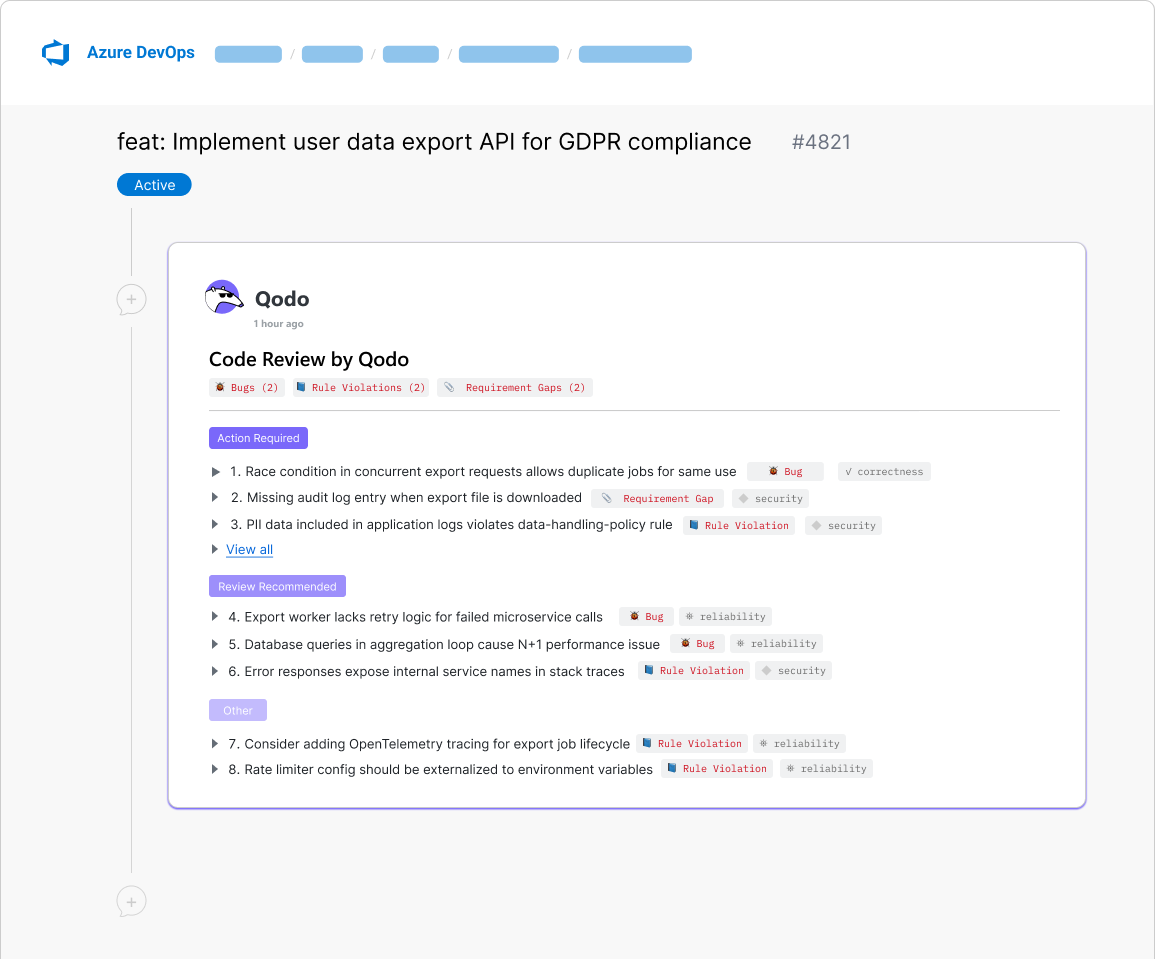
Qodo also checks ticket and process compliance, helping teams ensure pull requests meet organizational requirements before merging.
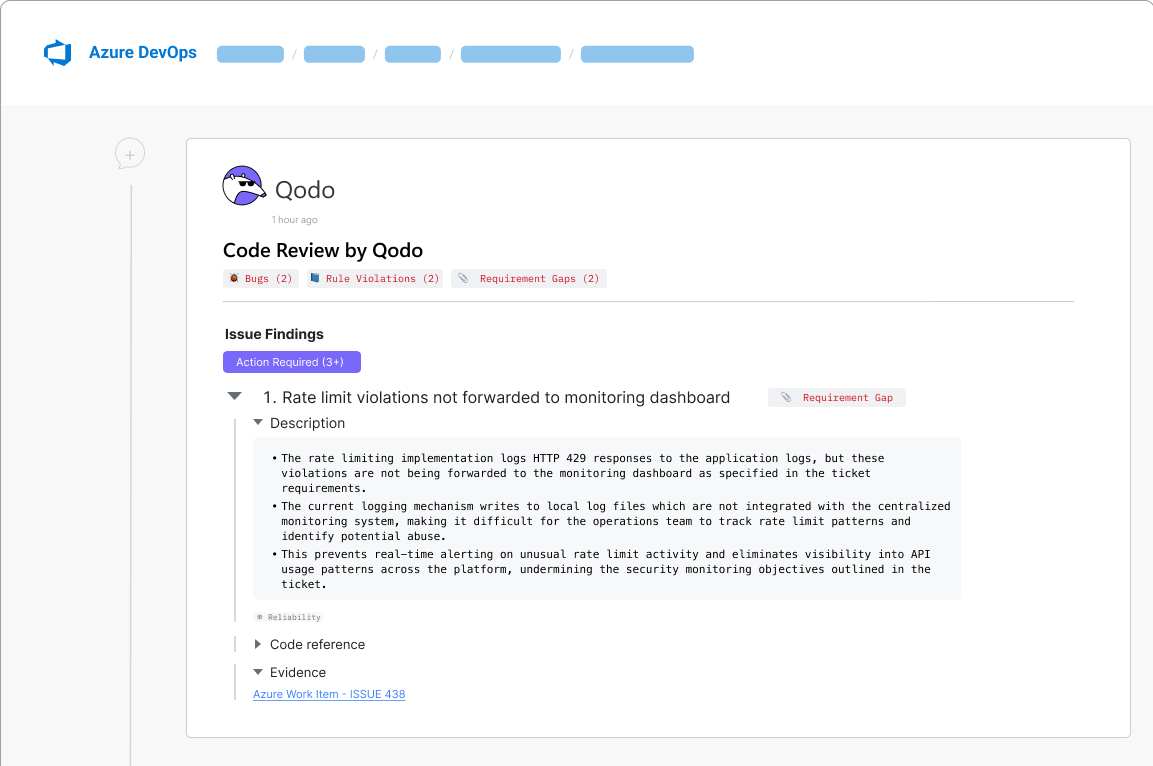
The result is faster reviews, fewer back-and-forth comments, and higher confidence in every change.
How Qodo Surfaces Actionable Issues
Qodo doesn’t just flag problems in pull requests. It presents issues in a way that is clear, contextual, and easy to act on. Instead of scattering comments across a diff, Qodo groups related findings into a structured review summary and prioritizes what matters most.
Each issue includes:
- A clear explanation of what is wrong and why it matters
- Relevant code context so developers know exactly where to look
- The reasoning behind the finding, making feedback easier to trust
- A quality category, such as reliability, security, or maintainability
This structured approach turns noisy AI feedback into focused insights that teams can resolve quickly and confidently.
Built for Enterprise Teams
Qodo’s Azure DevOps support was built with enterprise realities in mind. It scales across large codebases, adapts to evolving standards, and supports teams operating under strict governance and compliance constraints.
By bringing advanced AI code review directly into Azure DevOps, Qodo helps teams move at AI speed without sacrificing quality.
Azure DevOps support is available today. If your team is already building faster with AI, Qodo helps make sure you are reviewing just as efficiently.
See Qodo in Action
Want to see how Qodo works inside Azure DevOps for your team and codebase? Contact us to schedule a personalized demo and see how AI-powered code review can scale with your enterprise workflows.