The Future of Software Maintainability: Context-Aware AI for Enterprise Codebases

TLDR;
- Software maintenance is the most resource-intensive phase of the SDLC, acting as the primary enterprise bottleneck. It consumes a significant majority of project costs, with ∼30% of developer time and 41% of IT budgets diverted to managing technical debt. This cost is compounded by the high cognitive load required for humans to manage aging, massive-scale codebases.
- AI code generation speeds up development but actively compounds technical debt by lacking system context and architectural adherence. AI models often miss critical enterprise internal logic, naming rules, and architectural constraints, causing inconsistencies when integrated. Without deep, context-aware reviews, this quickly degrades long-term maintainability.
- The solution shifts from static analysis to Context-Aware Maintainability, which understands the codebase as an interconnected system. It interprets complex relationships across microservices and version histories, providing insight into how a local change affects the entire system. This approach moves beyond simple surface checks to enforce architectural soundness.
- Context-aware systems like Qodo enforce proactive “shift-left” practices through a continuous four-stage analysis and remediation loop. They move quality checks to the development stage, offering Early Detection & Remediation for complexity and anti-patterns. This immediate, pre-merge fixing is essential for managing the velocity of AI-assisted code.
- Platforms use contextual analysis to identify and remediate deep structural issues like cross-service code duplication and inconsistent logic. Tools like Qodo analyze relationships and history to flag problems such as code duplication across separate microservices. They offer immediate one click remediation to consolidate logic and keep the codebase consistent.
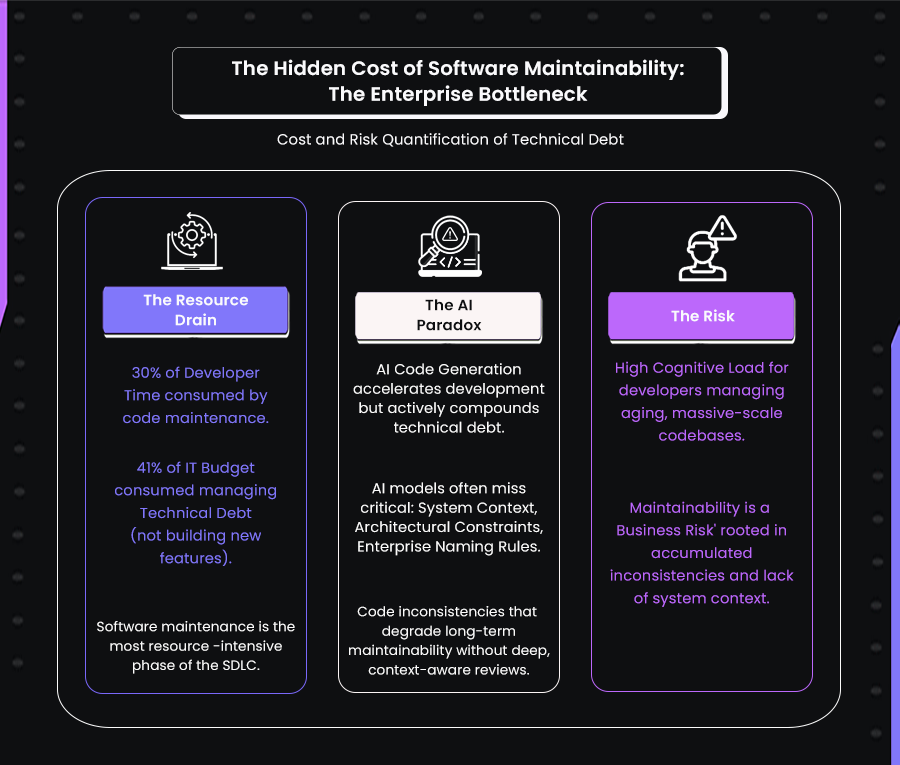
The task of software maintenance is the most resource-intensive and often the most challenging phase of the software development lifecycle, consuming a significant majority of total project costs.
As a Senior Engineer, I see that as enterprise codebases grow in size, complexity, and age, it becomes increasingly difficult for developers, including myself, to fully understand all dependencies, historical changes, and implicit knowledge. This cognitive overload slows down debugging, makes refactoring risky, and increases the chances of introducing new bugs, which in turn adds to technical debt and slows innovation.
I find this challenge to be highly quantifiable: I’ve seen industry surveys indicating developers spend approximately 30% of their time just on code maintenance. Furthermore, in large enterprises, I know up to 41% of the IT budget is consumed managing technical debt rather than building new features. To me, these numbers highlight that maintainability isn’t a secondary concern; I view it as a business risk rooted in the accumulation of inconsistencies and lack of system context.
What complicates this issue even further is the recent rise of AI code generation. While I appreciate that AI-generated code accelerates development, I’ve noticed the models often miss the system’s internal logic, architectural constraints, and naming rules essential for keeping an enterprise system consistent. Refer to a Reddit post shared by a senior developer that shares their experience:
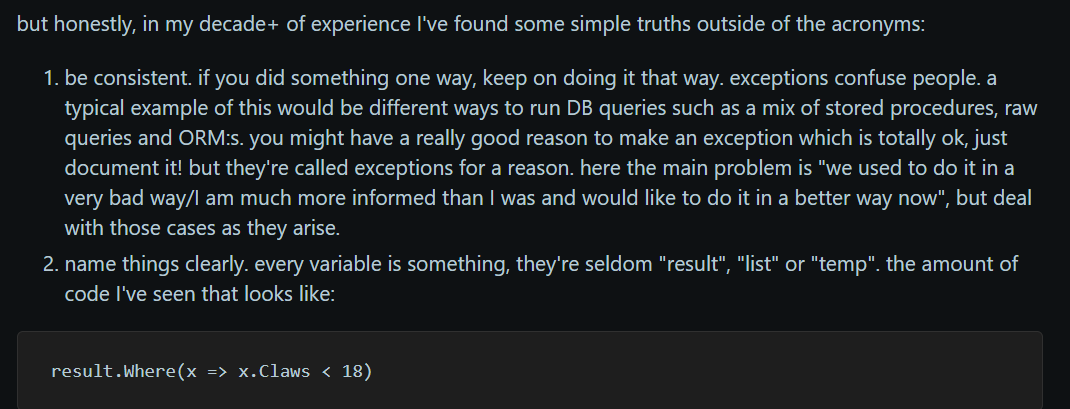
AI-generated code is changing how software is built, but it can make maintaining it harder. These models create code by learning patterns from large repositories, which helps write code quickly.
However, they often miss the system’s internal logic, naming rules, and dependencies that keep everything consistent. Code that appears correct on its own can cause problems when integrated into a larger system. Over time, these small issues add up, increasing technical debt and making future changes more difficult. Without careful code reviews, AI-assisted code can slowly decrease a system’s maintainability, turning updates into a time-consuming task.
In this blog, I’ll explore how enterprise teams can safeguard maintainability in the AI era, how deeper code understanding, shift-left practices, and one-click remediation inside platforms like Qodo can make systems evolve sustainably instead of degrading over time.
Why Software Maintainability Is the Real Enterprise Bottleneck
The hidden cost of poor maintainability is enormous. According to OutSystems, 41% of IT budgets are spent managing technical debt, and 69% of IT leaders see it as the top threat to innovation. In financial services, poor maintainability can translate into dozens of full-time equivalents per system per year in extra operational costs, according to the Software Improvement Group.
From my experience, these numbers don’t even capture the full story: scattered code knowledge and lack of architectural context multiply long-term maintenance costs in ways that are often invisible until a small change triggers cascading failures. I’ve seen a one-line configuration change in a billing microservice cease across multiple systems because dependencies weren’t properly tracked.
On top of that, enterprises are increasingly using AI to generate code, and while this can speed up development, it introduces a new layer of complexity for maintainability. AI models produce snippets by learning patterns from vast repositories, but they do not inherently understand your system’s architecture, coding conventions, or hidden dependencies.
Refer to this Reddit Post:
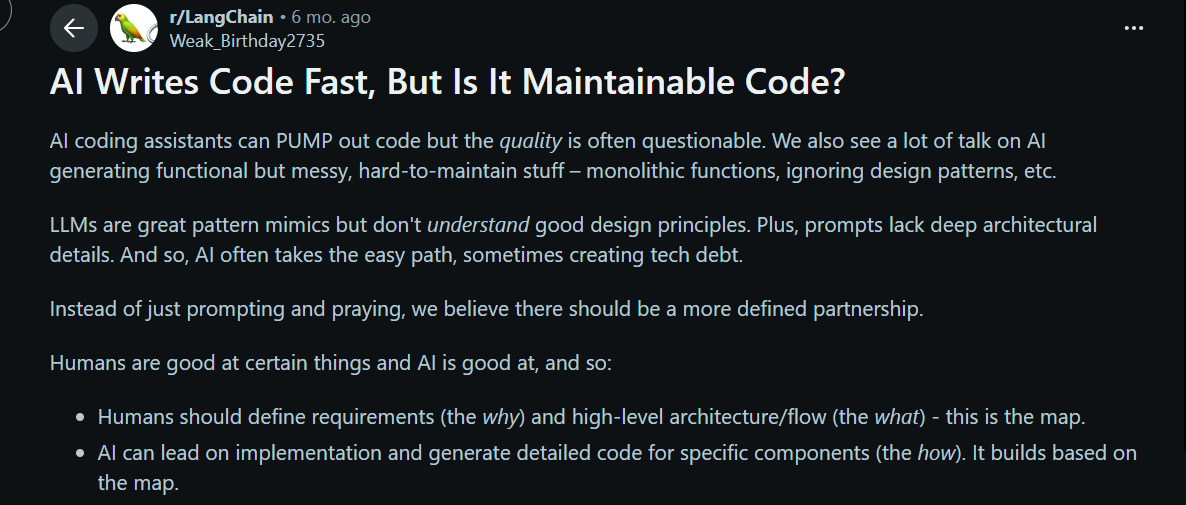
The Reddit post I came across above complements the points in this discussion about software maintainability by highlighting the real challenges of AI-generated code in enterprise environments. It raises a fundamental question that I’ve clashed with in my own work: speed versus long-term maintainability.
AI coding assistants can rapidly produce working code, but as the post notes, the quality and architectural soundness of that code are often inconsistent. Large Language Models (LLMs) mimic patterns effectively but do not inherently understand design principles, which can result in monolithic functions, overlooked design patterns, and ultimately, growing technical debt.
Enterprises have outgrown static analysis and rule-based quality checks. Today, what teams truly need is contextual maintainability, systems that understand how the entire codebase works together, not just individual lines or modules.
The Shift Toward Context-Aware Maintainability
For years, maintainability checks have relied on static rules and surface-level analysis. These tools can flag style issues or unused imports, but they rarely understand how a change affects the broader system. As software grows more interconnected, spanning microservices, APIs, and shared configurations, teams need maintainability systems that can reason in context.
Context-aware maintainability takes a deeper approach. Instead of treating files as isolated units, it interprets relationships across services, dependencies, and version histories. This allows teams to see how a single code change can influence performance, reliability, or readability elsewhere.
Refer to the diagram below:
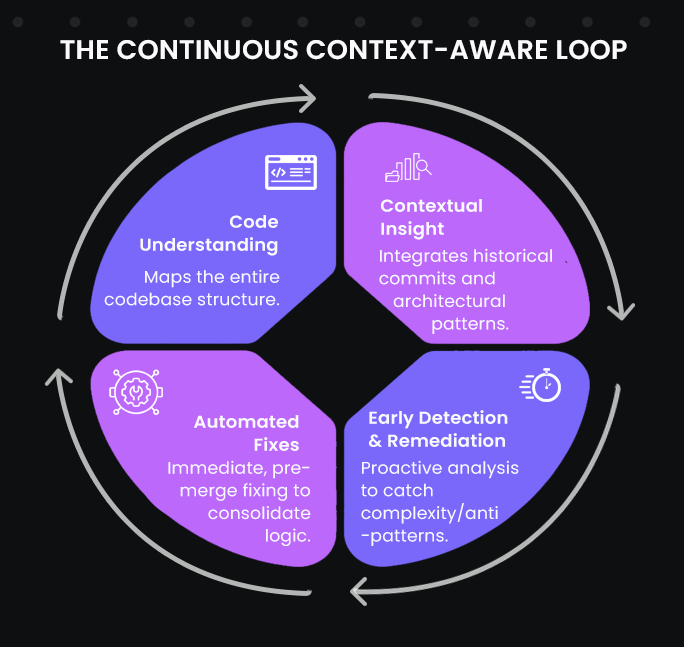
A context-aware system significantly boosts software maintainability by operating through a continuous, four-stage cycle. It starts with code understanding, mapping the entire codebase structure. This foundation is enriched by contextual insight, which integrates historical commits and architectural patterns to provide deep relevance for current changes.
The system then enters the proactive stage of Early Detection & Remediation, using “shift-left” analysis to identify and offer automated fixes for complexity and anti-patterns before they become defects.
For example, when a developer modifies a configuration in one service, a context-aware system can detect if that update breaks assumptions in another module or violates an established architectural pattern.
The beauty of a context-aware system lies in its circular, iterative nature. Each stage feeds into the next, creating a powerful feedback loop that consistently elevates the quality and maintainability of your software.
Hands-On: Improving Maintainability with Qodo
I have been using Qodo for a while, and I really wanted to show how it helps with software maintainability in a real project. To make this hands-on, I decided to fork the Google Cloud Microservices Demo repository, a multi-service e-commerce sample app. It’s a perfect playground because it includes multiple interconnected services, like frontend, payment, and shipping microservices, so any change can potentially ripple across the system. This setup allowed me to demonstrate how context-aware maintainability works in practice, beyond what static analysis or linting tools can catch.
After forking the repo, I cloned it locally to my machine. Once I had the project on my system, I logged into Qodo using the CLI and initialized it in the repository with qodo init. This setup created the configuration file and linked my local project with Qodo’s workspace. From here, I could start analyzing the code for maintainability in a meaningful, context-aware way.
The first thing I did was run a maintainability-focused review using the command /review focus=maintainability. Almost immediately, Qodo began analyzing the entire codebase, not just individual files, but the relationships between modules, the dependencies, and the historical commits.
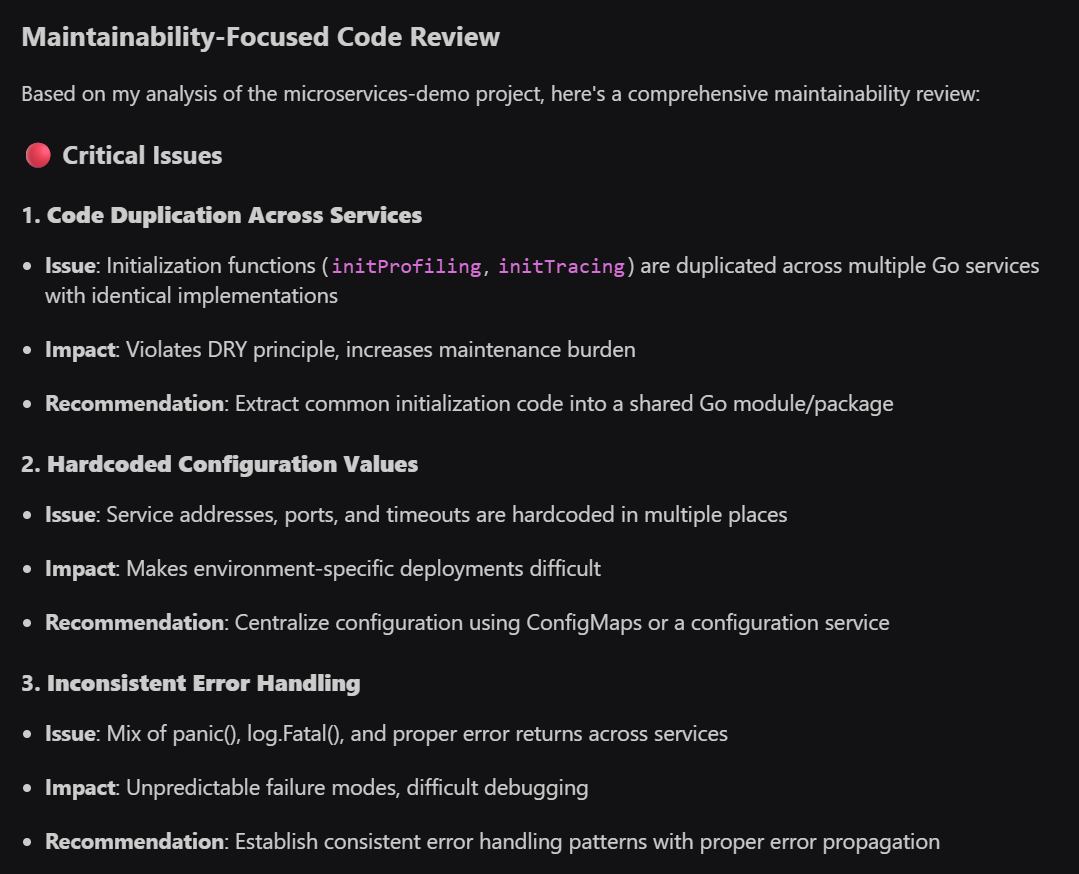
Qodo highlighted critical issues such as code duplication across multiple Go services, hardcoded configuration values, and inconsistent error handling. It also flagged major concerns like missing shared libraries, unresolved TODO comments, and inconsistent dependency management.
What I really liked was the level of detail in the specific recommendations. Qodo suggested creating shared modules for duplicated functionality, standardizing error handling with consistent patterns, and personalizing configuration into ConfigMaps for environment flexibility. It even provided medium- and long-term improvement guidance, including implementing service meshes, automated dependency updates, and API versioning strategies.
To make it even more concrete, I tried a scenario where I modified a configuration file in the billing microservice. Normally, such a small change could have cascading effects, but with Qodo, I could quickly ask /ask “Why does the payment service fail when I change order-config.yaml?”.
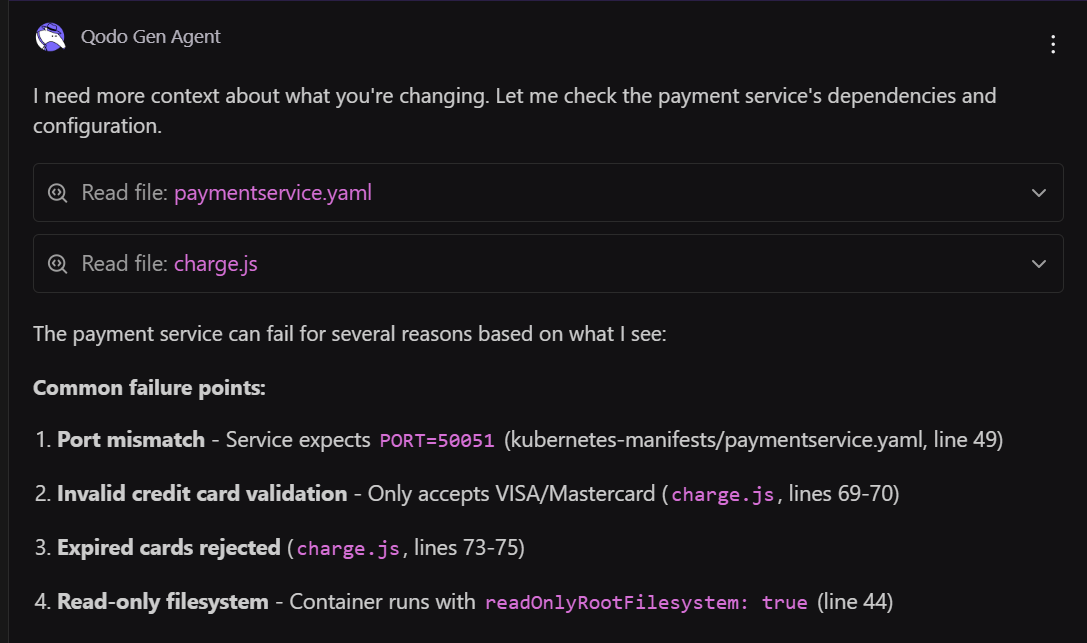
Qodo returned a detailed explanation, tracing the failure to prior changes in related services and highlighting which dependencies were affected. This was the perfect example of how context-aware maintainability goes beyond pointing out “where” a problem exists; it helps understand why it occurs.
To take this a step further, I wanted to test if Qodo could pick up context from previous commits and configurations, not just the current code snapshot. So, I reverted an earlier change I had made to the shippingservice module and introduced a new API route for order tracking. When I asked Qodo to review the update with /review focus=maintainability, it didn’t just look at the new code. Instead, it referenced the earlier commit where I had modified the service’s protobuf definition and reminded me that the change had introduced inconsistent data types across the shipping and checkout services.
I prompt Qodo with:
What software maintainability concerns can you see in this codebase?
Here’s a snapshot of the reply:
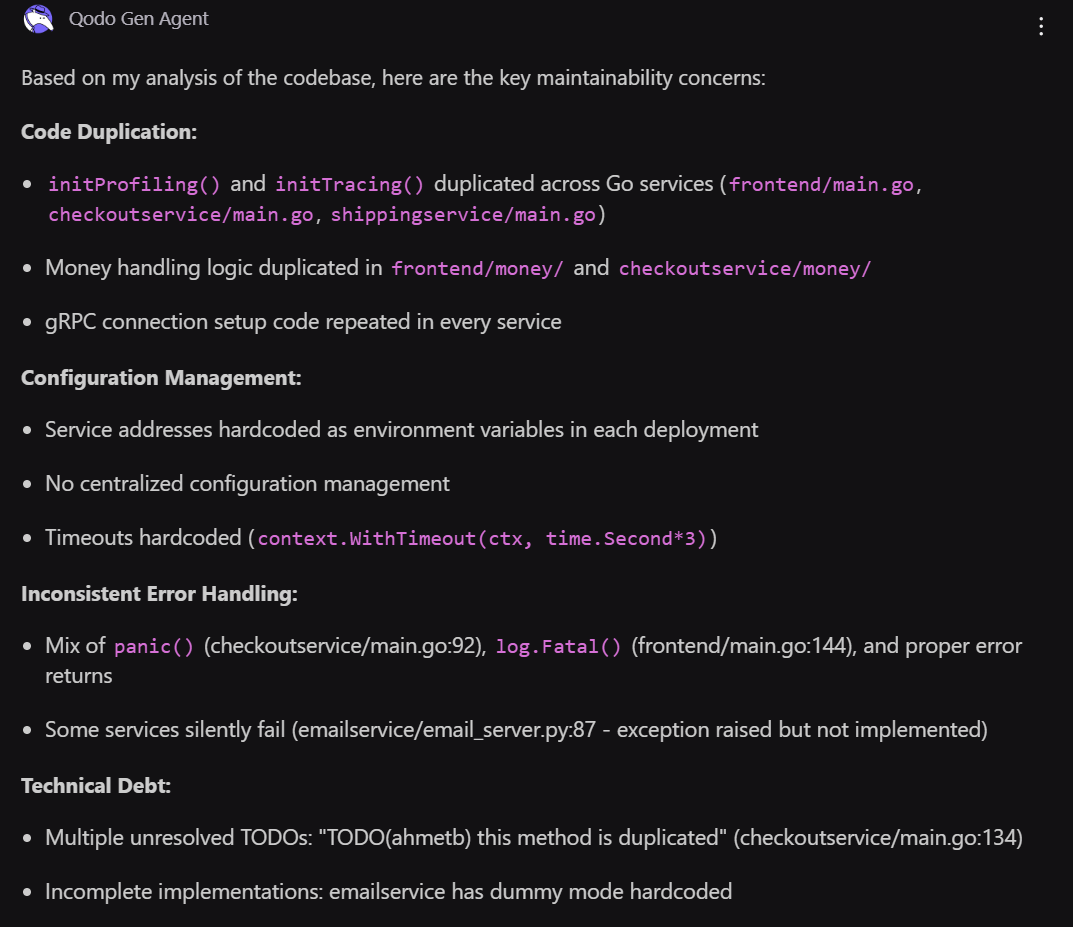
Qodo immediately pointed out several areas where the system’s long-term maintainability could degrade if left unaddressed. The first and most prominent issue was code duplication. Common initialization functions like initProfiling() and initTracing() appeared across multiple Go services, along with repetitive gRPC connection setup and money-handling logic. Qodo recommended consolidating these into a shared Go module to reduce redundancy and improve consistency across services.
On top of that, Qodo highlighted technical debt indicators such as unresolved TODOs and incomplete implementations, particularly in the email service. These small but persistent issues can quickly accumulate, reducing system reliability over time. By tracking these TODOs in an issue tracker and prioritizing them for future sprints, teams can prevent maintenance overhead from escalating.
Through this hands-on, it became clear that maintainability is not a single event; it’s a continuous discipline. Qodo’s contextual understanding, powered by Retrieval-Augmented Generation (RAG), allowed it to operate like a seasoned reviewer who knows the system’s history, dependencies, and design intent.
Conclusion
Maintaining large-scale software systems is one of the most significant challenges enterprises face. From scattered code knowledge to hidden dependencies, even small changes can trigger cascading failures if maintainability is not prioritized. My hands-on experience with Qodo demonstrates how context-aware, AI-powered code reviews can transform this process.
Features like one-click remediation and shift-left analysis allow teams to address issues proactively, keeping technical debt under control while improving code readability, structure, and testability. Integrating these practices into the development workflow ensures that software remains coherent, reliable, and easier to evolve.
FAQs
What are the main challenges enterprises face in maintaining large-scale software systems?
Enterprises often deal with fragmented knowledge across teams, tightly coupled services, outdated dependencies, and inconsistent coding practices. These factors make small changes risky and can multiply long-term maintenance costs if not addressed proactively.
How does Qodo improve long-term software maintainability for enterprise teams?
Qodo uses context-aware analysis to understand the entire codebase, track dependencies, and detect architectural or maintainability issues early. By combining historical code knowledge with AI reasoning, it highlights areas that require attention before they evolve into technical debt.
What role does one-click remediation play in reducing technical debt?
One-click remediation allows developers to apply AI-suggested improvements immediately, such as decoupling modules, resolving duplicate logic, or fixing configuration issues. This lowers manual effort, prevents recurring problems, and keeps the codebase consistent and maintainable over time.
How does shifting left with deeper code understanding impact developer productivity?
By detecting maintainability risks during development rather than after deployment, developers spend less time debugging, tracing dependencies, or undoing regressions. Context-aware insights allow teams to focus on meaningful work, improving velocity while ensuring long-term code health.
Can Qodo integrate with existing enterprise CI/CD and code review workflows?
Yes. Qodo works with standard Git repositories and integrates into code review and CI/CD pipelines. It analyzes diffs in real time, provides actionable suggestions, and can be incorporated effortlessly into existing workflows to maintain software quality without disrupting established processes.
About the author