Why Developers Are Sleepwalking Through the AI Revolution
Summary
Scott Hanselman has been writing code for money since 1992. Now he’s watching the industry tell him it’s all just vibes. In this episode, the Microsoft VP joins Itamar and Nnenna to talk about what actually changes when AI writes your code — and what doesn’t. From the uncanny valley of AI-assisted development to why a broken SDLC doesn’t get better with AI sprinkled on top, Scott doesn’t hold back. Plus: why voice dictation might be the most underrated developer productivity tool right now.
this episode’s guest

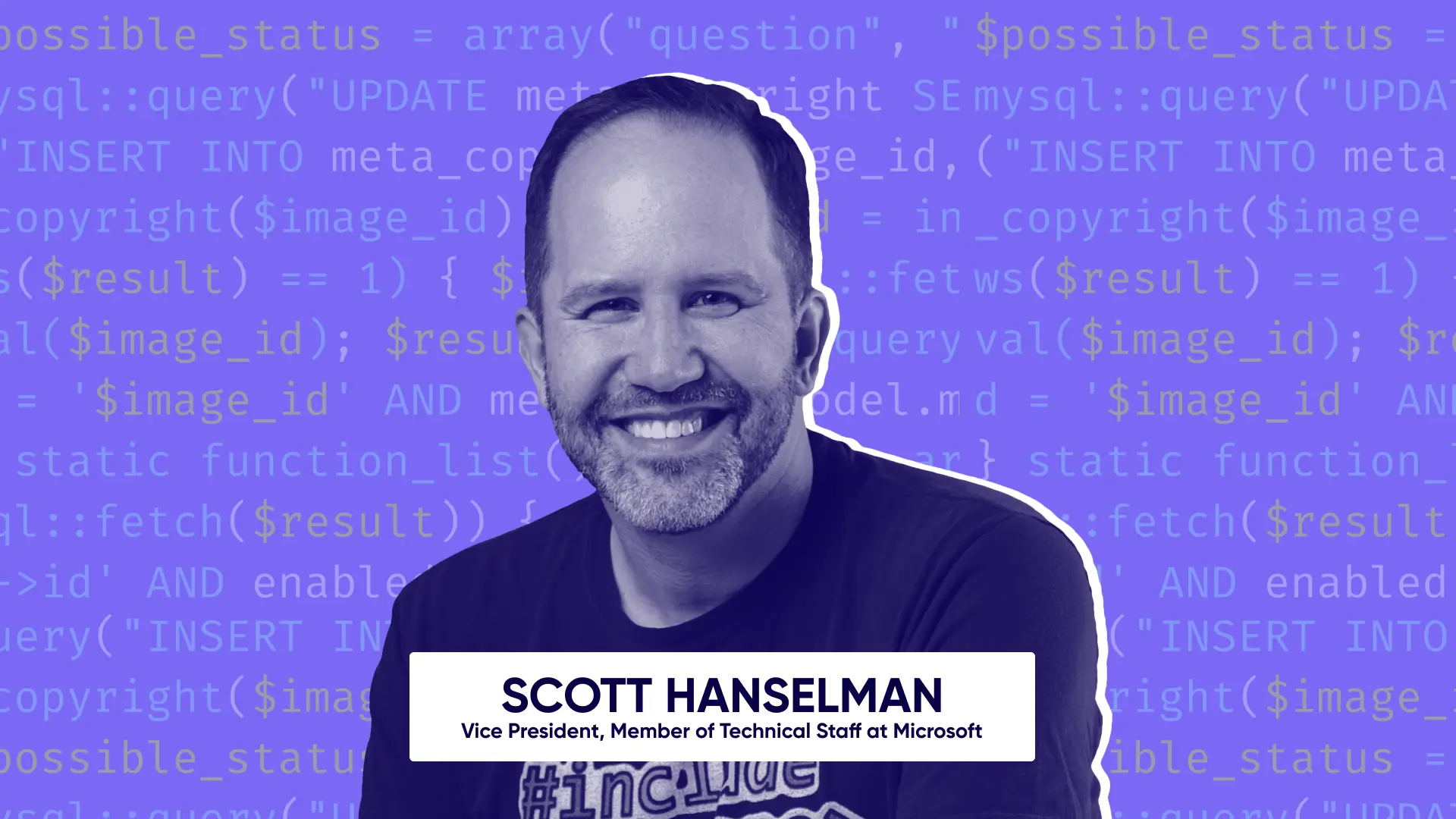
Scott Hanselman is a 30-year developer, prolific blogger, and 1,000+-episode podcaster serving as VP and Member of Technical Staff at Microsoft. He’s spent his career making complex ideas accessible and recently co-authored a paper warning that AI agents risk hollowing out the next generation of developers.
Key takeaways
- Typing code is fading, but the judgment required to build and maintain large systems isn’t — that’s still a human job
- AI reflects your SDLC back at you. Introducing it into a broken development process doesn’t fix the process, it exposes it
- Getting to a working prototype is the easy part. Code review, correctness, and regression prevention — the last 20% — is where the real engineering happens, and AI hasn’t replaced that yet
- Don’t outsource your thinking to AI. Use it to get sharper, not to think less — one day you’ll be coding in airplane mode
- Voice dictation changes how developers work with AI — clearer intent leads to better output, and it opens up coding to people who couldn’t participate before
- When one team cracks a best practice, Qodo can surface it across the org — turning what used to live in one person’s head into standards that scale
Chapters
- The Uber Analogy
- AI Coding Hits the Uncanny Valley
- “You're Sending a Forklift to the Gym”
- Don't Sprinkle AI on a Broken SDLC
Transcript
[00:00:00] Scott: I think that typing code manually is dying, and that makes me sad. But I don’t think that sculpting code and crafting large systems is dying yet.
[00:00:11] Itamar: Welcome to the Agentic Review, the podcast where we explore what good code really means in the age of AI software development.
[00:00:20] Nnenna: I’m Nnenna Ndukwe, developer relations lead.
[00:00:23] Itamar: And I’m Itamar Friedman, the cofounder and CEO of Qodo. Every episode, we sit down with engineering leaders and AI pioneers to talk about governance, accountability, and what it really takes to scale engineering velocity with AI.
[00:00:38] Nnenna: These days, writing code is easy.
[00:00:41] Itamar: But delivering trustworthy code, that’s harder.
[00:00:45] Nnenna: So let’s get into it.
[00:00:51] Itamar: Welcome to Agentic Review, the podcast where we explore what good code or good software development really means in the age of AI. I’m Itamar Friedman, the cofounder of Qodo.
[00:01:02] Nnenna: And I’m Nnenna Ndukwe, developer relations lead. And every episode, we sit down with engineering leaders and AI pioneers to talk about governance, accountability, and what it really takes to scale engineering velocity with AI.
[00:01:15] Itamar: And today, we’re joined by Scott Hanselman, VP and member of technical staff at Microsoft, longtime developer advocate, teacher, and one of the most influential voices in how developers actually build, learn, and ship software.
[00:01:31] Nnenna: Scott has spent decades at the intersection of developer tools, community, and large-scale systems, and now works closely on AI-augmented coding experiences across Microsoft, GitHub, and beyond.
[00:01:43] Itamar: So without further ado, Scott, welcome to the show.
[00:01:46] Scott: Thank you very much for that very flattering introduction. I’m happy to be here.
[00:01:50] Itamar: Our pleasure. We’d love to hear a little bit about yourself.
[00:01:54] Scott: I have been writing code since 1984, and I’ve been writing code for money since 1992. And I’m looking back on now 34 years of coding for cash, and now they’re telling me that it’s all just vibes, man. So I am exploring that and trying to understand what that feels like because I feel like someone just came out of college, and they’re thinking, why did I bother with that degree? And here I am at the end of, you know, 3Decades, almost four decades going, what am I even doing? And I’d love to talk about that because I don’t think the craft is dead.
[00:02:31] Nnenna: Really, really excited to get into this. I think, like, that actually moves perfectly into one of the things I wanted to ask you, which is in the current state for AI-assisted development, what do you think feels new to you, and what is just, like, repetition from the past?
[00:02:48] Scott: I think that typing code manually is dying, and that makes me sad. But I don’t think that sculpting code and crafting large systems is dying yet. I think that if something matches the statistical mean and you’re creating something that fits in the corpus, if I’m making React website or a Next. js site that’s text boxes over data, it wasn’t hard before, and it’s not hard now. And now it’s just vibes, man. But if you’re doing really interesting edge work on the other edges of the bell curve, then that’s where the magic lives. But I think that text boxes over data is pretty much dead. And I think I’m okay with that because it was never fun before, and now it’s just toil.
[00:03:38] Nnenna: And it’s kind of felt like there’s been this whole identity crisis that’s attached to this. So I wonder with what you just said, that I feel like that for some developers, uh, that would probably sting a little bit.
[00:03:52] Scott: Software engineering is the only engineering field where there’s no formal board that decides that you’re an engineer. There’s no required degree. And there’s, even within academia, a split between computer science and the engineering of software. So I have a software engineering degree. I do not have a computer science degree. So my expertise is in shipping, which is different than compiler theory and, you know, assembler and all that kind of stuff that you learn in computer science. And because we are in this weird place where there there’s no journeyman, there’s no apprentices, it’s not like plumbing or electricity where you have to, like, get certified. Then anybody can write software for the space shuttle or anybody can write. And we also pretend that writing software for the space shuttle is the same as me vibing my podcast website. And we which is the same as me working on an open source artificial pancreas because it’s just software engineering. It’s just code. I think that there’s a reckoning that’s going to kind of come where we have to understand that, like, writing kernel drivers is not the same as writing text boxes over data. It’s not the same. It’s not the same. And there needs to be a little bit more formality because, yes, maybe the typing part is either over or dying, but the life cycle, the correctness, the CI/CD, all of the stuff involved in preventing regressions and code coverage and cyclomatic complexity and and and has not yet been sucked in by the machine, and I don’t think that we’re replaced for that yet. The tension that you point out, I think, is is it art or is it science? And if it’s art, then is it stolen art, and is art over? Is coding over? Or was it always just toil, and now we’re just raising the water level and it’s a different level of toil? That’s a long, squishy, rambling answer, but I want to make sure Nnenna got what she agrees or disagrees. Sorry, sir.
[00:05:45] Itamar: So so you said, like, typing may be over for certain tasks. right? But do you believe that developers still need to read and understand those lines of code, or they can skip? Or maybe it’s their second layer here as well of
[00:06:03] Scott: I think I know this is awful. I’ve been saying it for forty years. It depends. As with all things in software, the number one answer that is a reasonable answer is, well, it depends. The analogy that I use a lot is the stack of transportation. If I want to get from point A to point B in the past, I would get a license, and I would learn how to drive, and I would get a stick shift, and I’d buy a car. My dad would teach me how to change my oil. My mom would teach me how to change a tire. I would get the skills that I would need, and all of those things were required before I could drive outside of my driveway. But now it’s Uber. And there’s young people in their thirties, and that’s great, that have never driven a car because they don’t need to. They got the subway. They got Uber. A stranger comes and gives them candy, and they get into a strange man’s car, and they drive away, and they’re cool with that. And the stack is deep, and they use a pocket supercomputer connected to the world to call that strange man to pick them up. But the reality is that they just wanted to go from point A to point B. So whether it’s a Lime scooter or an Uber, transportation was the point, not the mechanics of driving a stick shift. So for me to be old man shaking his fist at the cloud and say, well, you got to drive stick shift, young person. I’m I’m gatekeeping transportation itself. If you apply that extended analogy to something like software, what’s hard? What should be hard? Are we gatekeeping hardness? Like, shouldn’t everyone have a great portfolio website? Shouldn’t everyone be able to imagine how to do something? My friend Khadijah vibed a phone agent for her brother’s mechanic shop. He’s like a small business, and when you call, you get a voice agent. And they, like, they, like, can schedule stuff and make suggestions and, like and that’s completely revolutionized his business. And Khadijah’s never seen the code. She’s a great engineer, but she doesn’t need to see the code because it works. So then I’m like, I really want to see the code. What if it’s crap? What if it’s bad? It’s like she got from point A to point B. Who am I to say? Yeah. The problem got solved.
[00:08:03] Itamar: Roughly speaking, I’ll divide software into more simple software, simple usage, maybe more for, like, small and medium businesses or personal usage to real-world, heavy-duty software. I know it’s not like, you know, one or the other. It could be like a spectrum in between. But let’s focus a little bit on the real world software. So here’s what I hear when I, you know, think about when you’re talking about the Uber analogy, here is what I hear, that there should be, like, a team, an organization inside enterprise software development team that is focused on building Uber, and that’s a system that is well designed. And the they these people probably did look on Uber code while they enabled more people in the organization, junior developers or maybe technical business owners in the organization, to actually build more features on top and just, you know, use the transportation. I’m I’m kind of, like, pulling that into a question to you. Like, what do you think it’s a well-thought-out AI coding strategy for the, you know, the real heavy duty software, real-world, heavy-duty software?
[00:09:18] Scott: I hate to get overly philosophical again, but let me try to answer it. I’m a I apologize. I’m a very, um, analogies type person. The whole point of software is to solve problems for humans. And the only reason that we write it in code is that that was the best way for us to express our unambiguous intent to the machine. We set it in assembler, and that was hard. And that required an altitude shift between English, here’s the business problem, and assembler. And we’re slowly moving up c, c plus plus, and Java. And now, suddenly, we’ve leaped too fast, too far, and we’ve made the English-prose compiler, in arguably any language, and that hit the uncanny valley. Are you familiar with the concept of the uncanny valley?
[00:10:05] Itamar: Uh, but please do explain.
[00:10:06] Scott: So if you watch, like if you ever play Final Fantasy or any zombie games or any of, like, the, you know, zombie games, the 3D models always look like cartoons. And then somewhere around, like, Toy Story 2 or, like, the Polar Express, their eyes became dead, and it was like, whoa. Are you trying to make it look like a human, or are you trying to make like, that’s not right. It’s like a Final Fantasy cutscene where it’s like, this is gross. What happens is, oh, this is amazing. It’s and then falls into the uncanny valley where it’s like, oh, they’re dead eyes. Make it stop. And then it gets hyper realistic again. It’s that feeling of, like, something horrible has happened and it’s wrong. That’s the reaction that software engineering is happening right now to AI because it’s questionable where the corpus of material came from. We all had jobs, and now suddenly you’re telling me that the giant capitalist billionaire machine could just chew it all up. What am I for, man? I came in here to carve and craft, and now you’re 3D printing Rodin. That makes me feel gross. It it it fell right into the uncanny valley. And it’s like if you’ve ever seen the movie Office Space when they’re laying off people and the one guy, it’s not really clear where he sits between engineering and the customer, and he’s pounding his fist on the table saying, I’m a people person. I talk to the customers. Like, I’m supposed to exist. We all are feeling that, but no one’s saying it out loud. Yeah. No one’s talking about it.
[00:11:26] Itamar: So so what what I’m taking for right is, like, before the uncanny valley, like, uncanny valley. But, basically, when the image is not realistic, it’s okay. Like, it’s fine, entertaining. When you’re trying to make the photo, the video realistic, but it isn’t, you feel awkward that it’s trying to, but it’s not, then you feel bad about it. But then when it’s realistic, very realistic, you’re going to, oh my god. This is a game game changer. And Right. You’re if I could get it corrected, you’re saying we’re somewhere there where, like, it’s, like, feeling like it is as if it’s taking our job or as a senior developer, but it that’s where we’re being pushed to, like, with the coding agents that work for two hours and trying to complete tasks end to end. But in real world, heavy duty software, maybe it’s not not like that. And then my question is, like, if I still, like, insist a little bit, if you have any, like, strategy of how to exploit the moment for real-world, heavy-duty software. Because on the personal level, it doesn’t feel like it feel we have passed the uncanny valley. Like, right now, I can develop features for myself and for my family and with my kids, etcetera, and it’s already working. And I don’t care too much about security or reliability or maintainability. Okay. I don’t care about the code, but in real-world, heavy-duty software, I do care about it. right? So and that’s why in the uncanny valley, like, right now.
[00:12:46] Scott: Yeah. Yeah. Yeah. I’m like, should
[00:12:47] Itamar: I go back? And or or how do I move forward?
[00:12:51] Scott: So there’s 3Different things I want to unpack there, and please jump in because I know you have opinions as well. Because first, you said exploit, and I kind of winced because exploitation is not a good thing. And then people are starting to say that, well, software is free now. Inference is free. Tokens are free. They’re not free. right? Like, having a token leaderboard is just as stupid as having a lines of code leaderboard is just as stupid as giving a raise to the one who has the most commits. right? The only thing that matters are user stories. Did the work get done? I don’t care if it was one lines of code or a thousand did the work get done, and it was the thing that needed to happen. One lines of code can be as valuable as a thousand if it’s the right line at the right time. So an exploitation, not a good thing, and inference costs money. So, like, you know, don’t be proud of the team burning a billion tokens and spinning rough loops. But you also pointed out that you’re making apps for your family. And I think that’s really interesting because the cost of little applets is approaching 0. 4 or $5 in tokens, and I can make a family calendar. The question is, why wasn’t there an existing SaaS or product that you used? Why did you need to vibe your own? right? It’s fun to make little bespoke things, but you couldn’t find anything on the open market to solve that problem. And then, like you said, I don’t care about security. Well, until you do, until the neighbor gets on your open Wi Fi and steals the family calendar and does whatever whatever. You know? So, like, it’s fun to, like, do these little fun, cute hobby things. But to your point and to ultimately answer your question, to put it in production is a whole other thing. So it’s kind of the 80/20 rule. Yes. I can get a nice B or B-minus for 20% of the effort, and that’s okay, I guess. But that last 20% to go from a B to an A-plus and put it into production, that’s going to take 80% of the time. Uh, Mark Russinovich and I call it code sculpting. You got a big block. You hack at it with a chainsaw, and then you kind of get the shape. And a lot of people go, yeah. That’s fine. It’s abstract art. I just made a little vibe tool. I have a whole website called tinytooltown. com. It’s filled with vibe tools.
[00:15:01] Itamar: Nice.
[00:15:01] Scott: Hundreds of them. But if you want to be a you want to make it a Rodin, you want to make it a proper sculpted thing, you got to use finer and finer tools. You need code review. You need SDLC. You need craft. So the hacking and slashing part is easy. Yeah. But to get out of the uncanny valley, I think you still need talent.
[00:15:20] Itamar: By the way, like, I do admit that recently, I’ve been thinking about that idea that the more tokens developers are using, maybe they’re more efficient. And at first, I rejected it, like, just unequivocally, like like you said. But I’m actually wondering if it’s you like metaphor analogies. Like, what about, like, walking and health? Like, if I have more miles walked, it doesn’t necessarily mean that I’m I’m healthier. But you probably did do some some meaningful, you know, effort into being healthier by doing that. And the same thing with tokens, the more tools you use, the more you’re working hard, you’re probably using more tokens. So maybe there is some correlation. Maybe it’s a vanity metric like you were mentioning, but but actually I got, like, a little bit convinced that it it is a proxy, and it’s becoming more more of a proxy. Like, it’s it’s also about how you plan and how you etcetera. So eventually, I get it. Like, I want to be healthier. That’s my goal. But how do I get there? Then the more I walk, probably I’ll get there better.
[00:16:32] Scott: Um, the exercise thing is an analogy I’ve used a lot as well. Although the problem is that people are thinking that this is exercise, but they’re sending a forklift to the gym. And then you’ll say, hey, Nana. Did you did you lift the weights today? She’s like, oh, yeah. The weights were lifted. She didn’t lift them, but the forklift lifted the weights. So I don’t know what the problem is. They we’ve lifted the weights. They went up and down, up and down. They we worked against gravity, but then I continue to fall apart, and my muscles atrophy. We’re watching our brains atrophy because we’re going from system one thinking, which is intuitive, to system two thinking, which is, uh, deeper and focused, to system three thinking, which is the complete externalization of our brains. And the problem with that is we’re going to start paying people $100 a month forever just like we pay for water and power and Internet, and now we’re going to pay for inference. And that $100 a month is going to give you your brain back. Don’t let them steal your brain and then charge you $100 a month so you can get it back, or you can get the brain max back.
[00:17:30] Itamar: You can
[00:17:31] Scott: take $200 a month. Oh my god.
[00:17:33] Nnenna: That’s I think I feel like I needed to hear that, honestly. But, I mean, I guess that that ties in nicely with we follow each other on on, um, on Twitter, X, whichever one you want to call it.
[00:17:46] Scott: All the socials?
[00:17:47] Nnenna: Yeah. All the socials. And, you know, there have been different incidents that have come out and related to GenAI-assisted changes, related to agent permissions, like, the agents having the ability to make changes that have brought down systems for several hours or whatnot. And you’ve said things like read every line, or if you constantly talk about that or there’s always that underlying message. And do you think that’s difficult to actually get people to do in practice? In theory, that sounds great. But the way in which we are being pulled in all of these directions, and it’s it’s enticing. It feels like, well, this is there’s a huge temptation here, and there are actually some very valuable seemingly valuable incentives to lean into the temptation for career and, you know, feeling like, you know, we’re going to get ahead in this competitive market. Yeah. I just I’d love to hear your thoughts on that.
[00:18:52] Scott: Candy tastes good, and it’s easier than cooking at night. Eating out is easier. Instacart is easier. right? I mean, you’re a gym rat. How often do you go?
[00:19:03] Nnenna: Every day at, like, 5AM.
[00:19:05] Scott: Okay. Now here’s the part that’s tricky, though. That’s because you’re addicted to it, and it feeds your spirit, is my guess, not because you’re doing it because it’s good for you. You tell yourself that, but it’s giving you the dopamine that you need.
[00:19:17] Nnenna: 100%.
[00:19:19] Scott: I don’t get the dopamine from the gym and I hate the gym. For me, it’s Netflix. It’s sitting on my ass. So the challenge is you’re lucky in that staying healthy in a healthy behavior feeds your spirit and gives you the dopamine that you need. What we’re chasing is dopamine. We’re chasing it on the infinite scrolling machine, the infinite scrolling machines that tells you that everyone is better than you and that you’re less than, and then everyone’s in economy plus or business class and you’re in 35K. This machine is algorithmically designed to make us feel bad about ourselves. And now we’re being told that we need to be not 20% more productive, but 20 times more productive. But my wife came here from another country, and she told me that when she came, she came only with her brain. And I said, why? Because she had a very oppressive regime that she came from. And she said they can they can take away everything, but they can’t take away your brain. So she filled her brain with knowledge, and she ran away. right? She got out of that country. And that has always stuck with me for we’ve been married for twenty five years. They can’t take away your brain, and here we are giving it away. So when I use an AI, I’m always using it to make my brain better because one of these days, I’m going to be coding in airplane mode. right? And you yeah. You need you need to work out. You need to push back against it. Now you’re blessed, Nina, to have found a thing that feeds your dopamine. I would be interested in a thing that you do that doesn’t, that you do it just because it’s the right thing to do. And that’s hard. Humans are not good at that.
[00:20:50] Itamar: So so you mentioned this idea about dopamine and actually I connected to the is the craft dead? I’m I’m kind of thinking, like, what do you think how how do developers what should they do daily or weekly or so Mm-hmm. That they will keep exercising that craft and how it’s evolving while keeping that dopamine. right? Like, any any recommendation about that?
[00:21:14] Scott: Well so I I look at this. My life is colored through, you know, my generation, my age, and my situation. So I have two young men, 18 and 20, my sons. And I see them on the TikTok machine, which I love. I love TikTok. And I kind of just I’ll walk by them, whether it’s on the couch or, you know, just say, hey. Don’t forget to wake up. And I don’t mean don’t forget to wake up, like, stay woke, but I just mean, like, don’t lose time. Wake up. You know how you ever, like, drive, and then you are driving, and then you realize, oh, crap. I’m driving. You know what I’m talking about? Yes. Right. You’re like, you weren’t asleep. You just weren’t there, and then you kind of, like, kind of go and what’ll happen is you’re you’ll kind of go, uh, and then you’d like, oh, and then and you’ll tell yourself, oh my god. I’m never going to do that again till next week when it happens again. So I said at the beginning of the show how I’ve been doing this for, like, 34 years. I think probably seven of those years, I was probably just just driving, just asleep. So what we can do is be intentional and be present. You can call it meditation. You can call it whatever. What is your wake-the-up moment? Is it like, alright. It’s Monday. It’s 02:00. What am I working on? What are the three things that I can do today? What are the things that need to be worked on? Like, am I awake, or am I just a busy, busy bee? Those little things. I try to reflect on what my week’s going to look like on Monday mornings. And then on Fridays, I look back on the week, and I give myself forgiveness for the things that didn’t work out. But I try to be present. So I’m always trying to wake up. And if you can wake up two or three times a day, that’s 10 times more than the average person. And it’s hard. It’s hard to wake up. But the AI just wrote some code, and you just got some dopamine. Okay. Am I solving the problem? Did I did I do it right? Let me read the code for a little bit. Let me ask the AI what I could do better. You can actually ask it about yourself. How could I be a better prompter? How could I have handled this code review more? Because here’s the funny thing. When you’re talking to an AI, you’re talking 50% to yourself and 50% basically to everyone else in the entire world. It’s just talking to yourself and a little bit of everybody else, but it’s mostly yourself in the mirror. So if you’re not right with yourself in the mirror, then the AI is going to lead you down a path that you don’t want to you don’t want to go down. But if you’re cool with yourself and you like yourself and you’re okay listening to yourself, you can learn a lot from talking to yourself in the mirror, but you’re not talking to another person. You’re talking to yourself.
[00:23:38] Itamar: I love the practical suggestion. Elaborate, like, a couple from my own experience, my own experience. So although I’m the CEO of Qodo, I do try to write code daily, like, on a streak of fourteen days of, like, a PR a day. And, of course, I’m trying not to touch the core mission-critical code. Uh, that’s not the right thing, but I do quite a lot of coding. And one or two things that I really love doing is, like, Control+E or explain it to me. And I want to make sure that before I click that, I kind of, like, predict what it’s going to tell me and see the gap. And if we agree, great. I hope because it could be, like, a selection bias or so. But if not, like, do I don’t immediately, like, believe. Like, I’m going to check, etcetera. And, actually, these days, one really, like, neat thing to spend more tokens is to use, uh, by-the-way options. Like, while the coding agent is working, I’m going to ask myself. Like, did I plan correctly? Am I agreeing with what I’m seeing on front end? Like, teach me a little bit about that. Like, let’s be reflective. So and then, like, that’s how I try to wake up. And that’s something I really, like, take your suggestion about, like, especially challenging the why are we doing it and why this architecture. Like, I do admit that sometimes, like, I was so excited. Like, it finished this feature’s 07/2002 lines of code, and then, like, can you think about an implementation that has 20 lines of code? You know? And it it does happen. Yeah. So that’s definitely, like, a really good call.
[00:25:09] Scott: Do you both type your code, or do you do dictation?
[00:25:12] Nnenna: I do both. So but yeah. So it’s both at this point.
[00:25:17] Scott: Okay. And which one do you enjoy more and why? Dictation.
[00:25:20] Nnenna: I think I mean, I could just move faster. Mm-hmm. And it’s more of an authentic expression of myself in real time, less edited. Yeah. And so that means, like, I get to put more of my thoughts and more be more specific, I guess, in a shorter amount of time, which I think impacts the context that AI gets.
[00:25:47] Scott: Exactly. Yappers do better with AI than non-yappers because you are typically I/O-bound. This is your CPU, and this is your I/O, and you’re bound. Your brain has already had the idea. And now I got to type 55 words a minute or whatever I type, and I lose track. And I’ll be like, oh, squirrel, and I get confused. But if you can just talk, it works really well. But then if you have to listen to the AI talk back, you can read a lot faster than it can talk. So there’s a new asymmetry that’s developing where we talk at the computer, and then we read what it says. And that’s extremely effective, and it also exercises all the senses. So I wander around, and I’ve got a three-button keyboard that is basically three hot keys. And I kind of wander around the house and talk to my keyboard, or I’ll use GitHub Copilot, and I’ll switch to my phone so I’ll have a remote developer tunnel, you know, like kind of an ngrok tunnel, and I’ll talk to the AI or go for a walk. So I really feel like being able to speak extemporaneously, clearly, and make your intent well understood is, as you said, Nina, a truer expression of oneself and hopefully of the solution.
[00:26:59] Itamar: I’ll take it as a homework. I admit that I do that a lot when everything unrelated to code, but I think zero times, like, when related to good and I’ll I’ll try to report back. For me, there’s yeah.
[00:27:12] Scott: It’s a rubber duck, right? If you know about rubber ducking, right? You talk to the duck, right, or you call your friend and you brainstorm with your friend. If you’re talking to yourself in the mirror, like, that’s just a great analogy. Bounce ideas off of that weirdo in the mirror. Yeah. And that’s you know? And under and understand that they are goal seeking also. Like, don’t get gaslit by the AI.
[00:27:33] Itamar: I have, like, a little side reason for not doing it probably because, usually, I need to warm up my English. You probably noticed that my I hope that my English is getting better as we go into the show, but in the beginning, it takes me time to warm up. And when I’m doing coding, I kind of try to be accurate. And the second thing is, like, it’s still weird for me not to for example, like, I don’t know, like, quote a certain class or, you know, like, forces a certain direction, but it might I might be not harnessing it. And often, by the way, like, I did reflect a little bit what you said about exploit. And I do believe that harness actually is a really good word and self self exploit in many ways. So, yeah, you definitely both of you convinced me that I’m going to try to code with with voice dictation, like, looking forward to it.
[00:28:20] Scott: Well, certainly, there are some basic voice features now in Claude Code where you can just hold the space bar. The voice stuff is built in. But the tool that I use is called Handy, and it’s handy. computer. So the top level domain is not. com. It’s. computer, and it runs Mac, Windows, and Linux. It has all open source models, and it runs entirely locally, and it works with different accents and different languages. So I changed it comes with a push to talk. I switch that to a hot key that is push and then just talk, talk, talk, talk, talk, and then push to end. And then it takes the dictation, does it all locally, and then paste it into whatever text box it’s in front end of. So I push. I have my yap, and I push again, and it has been extraordinary. And I and I’m not just a new dictation person. My hands don’t work anymore. I’ve had hand surgeries, and I’ve got all kinds of issues. So I have been dictating since, like, Dragon NaturallySpeaking days, and it’s so good now. Like, we are in a we are in a Nice. For accessibility, I have a good friend who has got his wheelchair bound, and he has got cerebral palsy. And he says he’s got a rocket ship strapped to his back because he just has to push a button and talk, and his intent he’s he’s writing code. He’s doing PowerPoints. He’s just going nuts, and he freaking loves it. And it’s because dictation plus agentic loops is taken off.
[00:29:44] Nnenna: That’s incredible. Like, I’m I’m really glad that you shared that story. I’ve I feel like I’ve been in a certain type of bubble where I only hear from certain types of people and the things that they care about and their needs, which might be, of course, very similar to mine. And so it’s great to hear other types of stories.
[00:30:02] Scott: Well, remember remember, you probably have heard this before that, right, we all may be able-bodied now, but everyone will at some point be disabled in some way.
[00:30:11] Nnenna: Yeah. That’s a that’s a good point. So I think one thing we’ve spoken a lot about, like, the individual experience for and what developers are going through, how we are experiencing AI and for AI coding. And I’m wondering, there’s another type of person, not just developers, but leaders in this space. They’re the type of pressures that they might have, engineering leaders, at companies, like, what are the pressures that you feel like they’re dealing with when it comes to the AI promises that are being made?
[00:30:45] Scott: Well, I think first, the 20x or 10x, all the BS numbers. right? Like, five, ten years ago, it was like the rockstar programmer. We only hire rock stars. I wrote a whole blog post about the myth of the rockstar programmer. Like, we know that they exist, but, like, there’s five or 10 of them. There’s not, like, one in 100. The other thing was the squeezing optimization, the hyper optimization of software. Like, we’ve been trying to improve things three to 5% for a hundred years. That’s just going to asymptotically approach zero. So we’re kind of fooling ourselves to think that nine women can have a baby in a month. It’s just not how it’s done. There is a minimum amount of time that babies bake, so that’s how long it takes. And the idea that, like, oh, I can just Vibe it, and we’ll have a new company in a week and a half, leadership needs to push back against senior leadership and tell them, hey. There’s a lot of great things about AI, but it it’s you can have a good, fast, or cheap. right? pick two.
[00:31:43] Itamar: Would you say that that’s your suggestion for the mindset shift? Mm-hmm. Hey. Let’s harness AI, but you need to have, like, an AI strategy where you’re not you do not fool yourself and align across the board on what are we trying to achieve? Like, would you like to add on that?
[00:31:58] Scott: 100% agree. And simply saying, we need more productivity. More PRs is probably that’s just that’s just blind optimization. We need we can have less people now. Like, what are we doing, man? What is it that we’re doing? And the part that’s ironic, and I’m curious what you think about this because you both have, like, a lot of customers and, like, small business, large business, lots of different, is so many of them have poor software development life cycles now, and they’re just going to sprinkle AI on it, and that’s going to make their build server not suck. Or the fact that they have an old they don’t use branching correctly, or they’re not using GitFlow, or, like, there’s 50 other things that they could improve that aren’t AI. So if you introduce AI into an immature SDLC, then that’s going to cause you problems, and it’s it’s you’re putting a Band-Aid on cancer.
[00:32:43] Itamar: Yeah. Actually, I think, like, it resonates with me, and I actually connected back to using AI also as a rubber ducky and etcetera, and to help even with education and the craft and not the other way around. And as a Qodo, we do see ourselves, like, as as a product with an opportunity to educate back with being humble. But for example, if we notice a certain behavior, Qodo might surface automatically. Hey. Here’s a suggested rule. You accept it. You decide if you want or not, but here’s, like, a best practice that you can consider. And, of course, it needs to, like, have, let’s say, high precision on on this suggestion. Otherwise, people will just, you know, dismiss it too too often. But but if it if it does make sense to the other side and the easy to easy to implement, I actually think you can raise the bar among different companies and within a company. Like, let let me give you a concrete example. If if there’s some best practice in one team, actually, AI could be a really good tool to pass that information and pass that best practice to the second team, to the other team, uh, which otherwise nobody would actually do that.
[00:33:56] Scott: I think a challenge with tools like Qodo and tools in general is that they speak to an individual, and it’s hard to speak to an organization. You’re still ultimately a bottom-up tool or at least at the very least, an engineering leaders tool. How does that get into the brain of the boss? Like, you’re going to make a suggestion to me, and I’m going to go, yeah. That’s a totally valid suggestion. Then I need to carry the message uphill. Yeah. That’s the challenge.
[00:34:20] Itamar: Oh, and I don’t want to make it this too much of a commercial for Qodo. So in in general, I think that’s opportunity for AI tools. Like, I think that what I said as an example before is that if one tech lead, for example, like, worked hard to put a certain rules into their dev team, and then, like, an AI tool like Qodo, but could be others that are learning that and and realizing that and seeing that there is a very similar, like, uh, tech stack and situation that for another team that can benefit to surface that rule, for example. And then surfacing to the to the manager, notice how this rule actually impacted things for the better on that team and how now it actually impacts for the better for this team. So you want me to add more for your organization.
[00:35:06] Scott: How would they consume that? Would they consume it as a manager dashboard? Their the manager may never look at the code review.
[00:35:13] Itamar: Amazing question. So I think, like, we’re going into a world where there is an interface to the developer that is evolving really quickly, and there is an interface to the managers, and they’re and they’re engaging, uh, really well. With full respect, like, I see not too many managers going and doing code review. I’m not talking about tech leads. I’m talking about managers because they can go by code review one by another. But the opportunity with AI is to accumulate the last 80 reviews into a dashboard
[00:35:43] Scott: There it is.
[00:35:44] Itamar: With links. With And
[00:35:45] Scott: that’s stuff that we couldn’t do before.
[00:35:47] Itamar: Yeah. Exactly. With linking. Like, hey. In the last 80 PRs, there are five rules that were violated and etcetera. And let’s think together, like, why that other team actually didn’t violate it, and what can we, like, import from one team to another, things like that. That was so hard to do, and, like, you wouldn’t put effort to do that before an AI could help with.
[00:36:12] Scott: Exactly. So any and you just brought up a great point, which I think is is the meta point here. If it can do things that we couldn’t do before, that’s interesting. If it can do things that were extremely tedious and boring and awful, and I don’t want to do that thing, that’s toil, then that’s a good thing. Those are all positives.
[00:36:32] Itamar: Awesome. I think it’s a good opportunity to wrap up. So maybe you can share a little bit of how you would like people to find you, where where to start.
[00:36:42] Scott: You can go out there and you can Google with Bing, and you’ll have no trouble finding me on TikTok, on YouTube, at hanselman. com. My podcast, I am I have been on the Internet since its inception. So if you want to find me on the internet, you can feel free to find me on the internet.
[00:36:58] Itamar: Love it. More than 1,000 episodes that that you have Yeah.
[00:37:02] Scott: We’re coming up on a thousand. I’ve got 840 of Hanselminutes, 750 of Azure Friday, and, uh, almost 30 or 40 of Mark and Scott Learn To. So if there’s if somebody needs to have a tariff on dudes with podcasts, then I will have to pay the tariff.
[00:37:21] Itamar: Amazing. Thank you so much, Scott. Anything you’d like to add? Or
[00:37:25] Scott: No. Thank you for having me. And I’ve been in very much enjoying Nnenna’s video content, and her improved camera and microphone have been have been noticed by the people.
[00:37:38] Nnenna: I appreciate it. It was good feedback that you gave me.
[00:37:42] Scott: No. I think you’re a star, and I’ve enjoyed Qodo, and I’ve I loved having you on the podcast as well.
[00:37:47] Nnenna: Oh, yeah. It was a wonderful time, and thank you for coming to join us and have this awesome conversation.
[00:37:53] Scott: My pleasure.
[00:37:55] Itamar: If today’s conversation challenged how you think about AI and code quality, That’s the point.
[00:38:01] Nnenna: At Qodo, we believe that independent, context-aware code review with rules as guardrails is how engineering teams maintain standards at scale.
[00:38:11] Itamar: If you’re leading an enterprise team and want to see how intelligent AI code review can reinforce governance, visibility, and accountability in your workflow, visit qodo. ai to learn how we help teams turn AI productivity into production-ready quality.
[00:38:29] Nnenna: And if you enjoyed this episode, subscribe, share it with your engineering leadership circle, and leave us a review.
[00:38:35] Itamar: Until next time, keep humans in the loop.
[00:38:38] Nnenna: And keep shipping.
About the hosts