Greptile vs Qodo: Which AI Code Review Platform Is Right for Your Team?

TL;DR:
Greptile reviews code in the pull request. It rebuilds a repository graph for each review, scores every PR from 0-5, and implicitly learns its standards from how your team reacts to past reviews. It supports GitHub and GitLab.
Qodo runs the same persistent knowledge layer and the same Rules, Skills, and Rule Miner across the IDE, Agent Skills, and the pull request, so a standard enforced in the editor doesn’t get missed at merge time. Cross Repo Review extends that reasoning across dependent repositories, including across different Git providers, catching breaking changes before they ship rather than after. Qodo supports GitHub, GitLab, Bitbucket, and Azure DevOps, with SaaS, on-premises, and air-gapped deployment.
The real difference is that Greptile catches problems after the code is written. Qodo enforces the same standards earlier, consistently, and across every repo that depends on the one being changed.
This guide compares both across review workflow, context window, review output, coding standards, deployment, and developer experience, with real pull request examples from each.
A developer opens a PR generated by an AI coding agent. It’s 400 lines across six files, syntactically clean, and nothing in it looks obviously wrong on a first pass. That’s the actual problem: syntax was never what code review was built to catch. As AI coding assistants push pull request volume higher, the question of which system validates that code, and at what point in the pipeline, has become a real engineering decision.
An industry report tracking telemetry from 2026 of 22,000 developers across more than 4,000 teams found incidents per pull request up 242% and median review time up over 400% as AI adoption climbed, the same degradation showing up even at organizations with strong review practices already in place. Qodo breaks down what that shift means for review infrastructure in its own analysis of the report.
This comparison covers each of those dimensions: review workflow, codebase context, review output, coding standards enforcement, enterprise deployment, and developer experience, with real pull request examples from each tool. For a broader look at how these platforms fit into the AI code review market as a whole, see Qodo’s Academy chapter on AI code review.
Greptile and Qodo: What Each Platform Is Built
To Do
Review Workflow: Pull Request Gate vs Full
Development Lifecycle
Where a review tool enters the development workflow shapes almost everything about how teams use it. A tool that reviews only at the pull request enforces quality at merge time; issues are caught before code ships, but after the developer has already committed to an implementation. A tool that reviews earlier shifts the feedback loop: developers encounter the same issues while the context is fresh and the cost of changing course is lower.
Greptile: Review at the Pull Request Gate
Greptile enters the workflow at the pull request. When a developer opens a PR on GitHub or GitLab, Greptile automatically indexes the repository, retrieves context relevant to the change, and generates a review. The review appears in the PR interface alongside human reviewers and requires no changes to how code is written, committed, or pushed. Greptile also provides a CLI for reviewing a local branch before opening a PR, though the pull request is the platform’s primary focus, where most of its features are concentrated.
Qodo: Review Across the Full Development Lifecycle
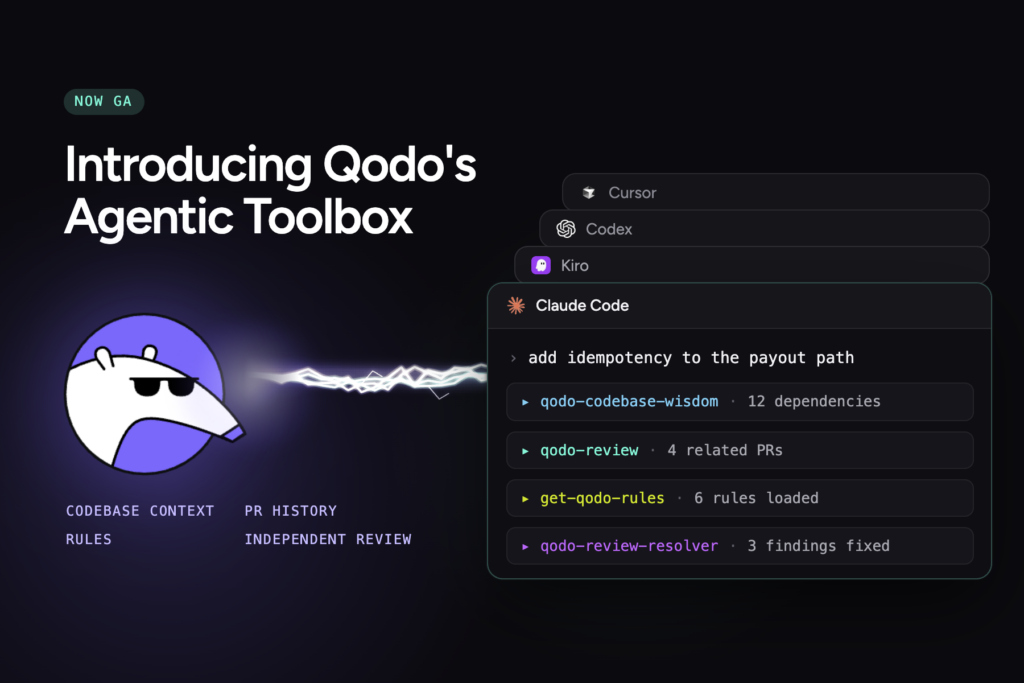
Qodo enters at three points: the IDE, Agent Skills, and the pull request. Developers can receive inline AI feedback while writing code without leaving their editor. Before pushing a branch, Agent Skills apply the same standards that will be run during the PR review. When the pull request opens, those standards are applied again, using the same repository knowledge, Rules and Skills across all three surfaces.
An issue caught in the IDE does not resurface during the PR review because the same rules govern both. Skill Review Standards, also part of the June 2026 release, extends that same governance to the skills themselves. As teams accumulate more Agent Skills across repositories, this gives engineering leaders a managed way to see which skills are actually enforced, monitor their impact, and retire ones that have gone stale, rather than losing track of a growing library nobody owns.
Codebase Understanding: Per-Review Repository Graph vs Persistent Knowledge Layer
AI code review tools read the diff. Understanding whether a change is correct requires more: knowing what the modified function calls, which services depend on it, and how the change propagates through the rest of the system. Both Greptile and Qodo build repository context beyond the diff, but they maintain it differently.
Greptile: A Per-Review Repository Graph
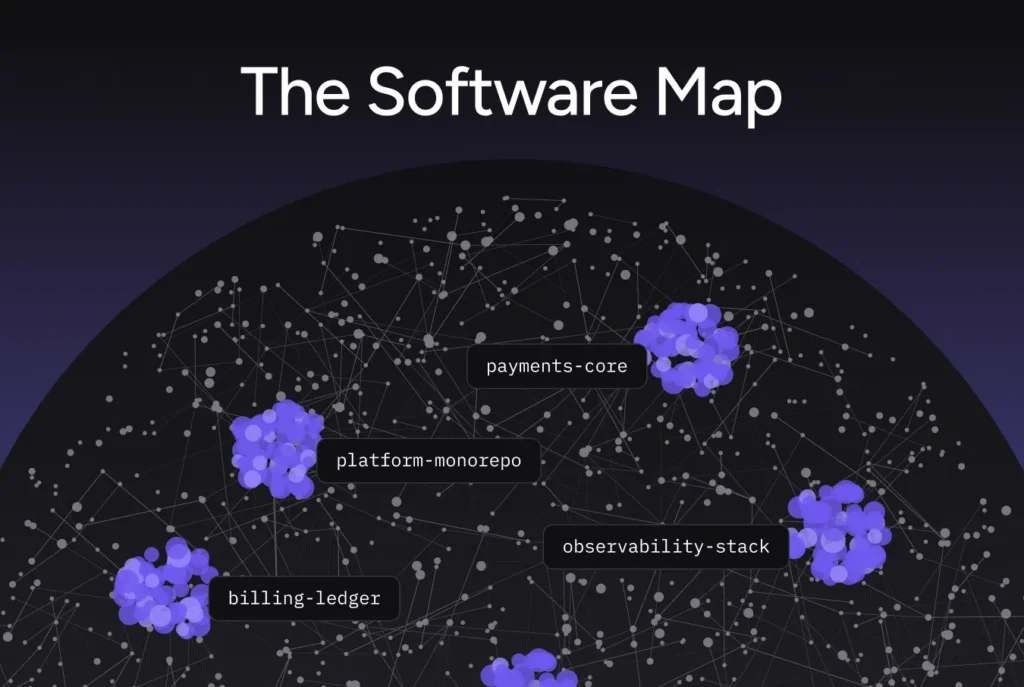
Greptile constructs a repository graph each time a pull request is reviewed. The graph captures relationships between files, functions, classes, dependencies, and call paths. When a PR opens, Greptile retrieves only the portions of the graph relevant to the current change, not the entire codebase, and reasons through how the modified code affects surrounding systems.
If a developer removes a required parameter from a shared authentication function, Greptile traces that call into the implementation, confirms the parameter is mandatory, and reports the resulting runtime bug even if the validation logic lives in a completely different file.

Qodo: A Persistent Knowledge Layer
Qodo maintains a persistent knowledge layer that is built once and reused across all review surfaces. The layer combines AST-parsed source code divided into logical units such as functions and classes, a graph database for call graphs and component relationships, a vector database for semantic similarity search, and commit history capturing how the codebase has changed.
Cross Repo Review, added in June 2026, extends that same knowledge layer past the repository being changed. If a shared authentication library ships a breaking change, Qodo reads the registered consumer repositories and flags the impact directly in the originating PR, function signature violations, broken API contracts, and schema drift, before the change merges and before a downstream team discovers it in production.
Review Output: Unified PR Analysis vs Specialized
Agent Pipeline
Both platforms generate inline review comments inside the pull request. The difference is in how those comments are organized, what supporting information accompanies them, and how the underlying review process is structured.
Greptile: A Unified PR Analysis
A Greptile review produces a single, consolidated output. After indexing the repository context, Greptile posts a PR summary explaining what changed and which parts of the system are affected. A confidence score from 0 to 5 summarizes the severity of detected issues, the complexity of changes, and how closely the implementation matches existing codebase patterns.
A score of 4 or 5 shows no critical findings; a score below 3 signals unresolved bugs or architectural deviations that a human reviewer should look for. Inline comments appear on the affected lines with severity levels and suggested code fixes that can be applied directly.
Greptile’s review of a version update PR for tauri-macos-sign, which bundled CHANGELOG updates and patch version bumps, revealed two critical bugs introduced in crates/tauri-macos-sign/src/lib.rs. The first finding identifies a reversed argument order in the ditto command that would silently create the zip archive at the wrong path.
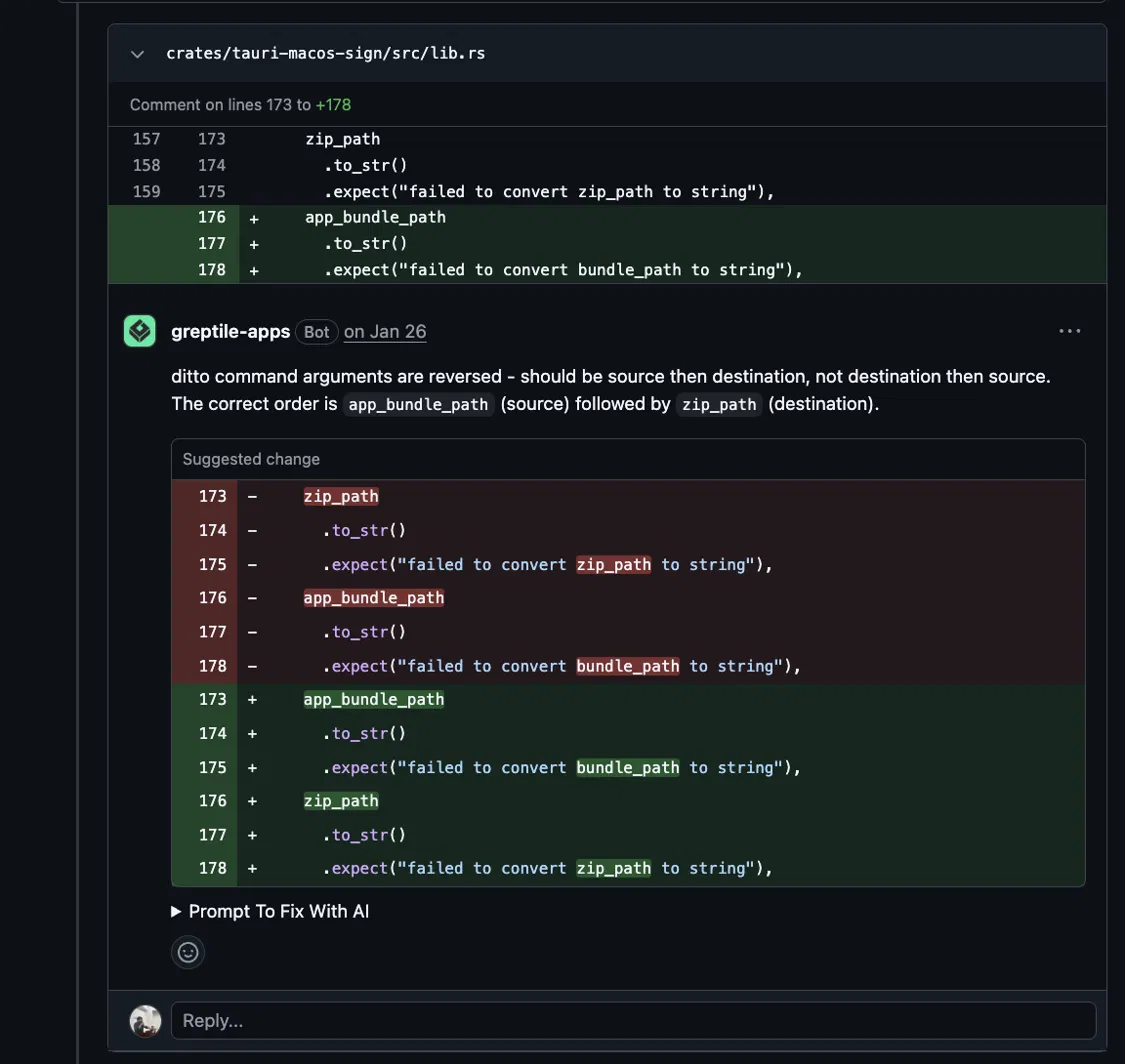
The diff shows zip_path in the source position and app_bundle_path in the destination position, reversed from the Unix convention that ditto requires. Greptile supplies the corrected argument order as an apply-ready change that the reviewer can accept with a single click.
A second finding on the same file catches a logic inversion in the notarization wait condition.
Greptile flags that !wait was changed to wait in the map_or fallback, inverting the logic that determines whether to proceed when the notarization status is empty, and provides the corrected one-line expression inline alongside the explanation. For changes spanning multiple services or data models, Greptile auto-generates sequence, ER, or flow diagrams so reviewers can follow the execution flow without manually tracing through multiple files.
Qodo: A Specialized Agent Pipeline
Qodo routes reviews through a pipeline of specialized agents rather than producing one unified output. A critical-issue agent detects logic bugs, incorrect conditionals, missing null checks, and invalid state transitions and posts findings with severity labels directly on the affected lines. A breaking changes agent checks for API or interface regressions. A rules agent enforces organizational coding standards.
Research agents retrieve the most relevant repository knowledge before any of these review agents run, so each agent works with the same repository knowledge while focusing on its assigned responsibility: correctness, breaking changes, standards compliance, duplication, or ticket alignment.
When a change reaches a dependent repository, the breaking changes agent draws on Cross Repo Review to check that impact too, so a consumer-repo violation shows up in the same card as every other finding, not as a separate report a reviewer has to go looking for.
Qodo’s review summary posts as a single prioritized card before a reviewer opens any inline comment.
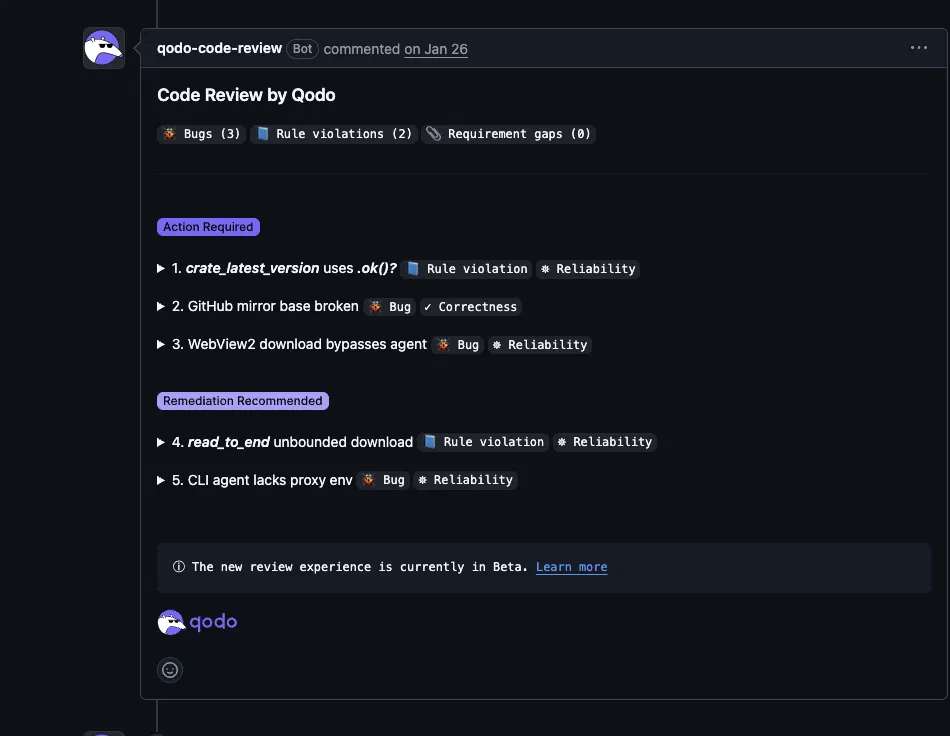
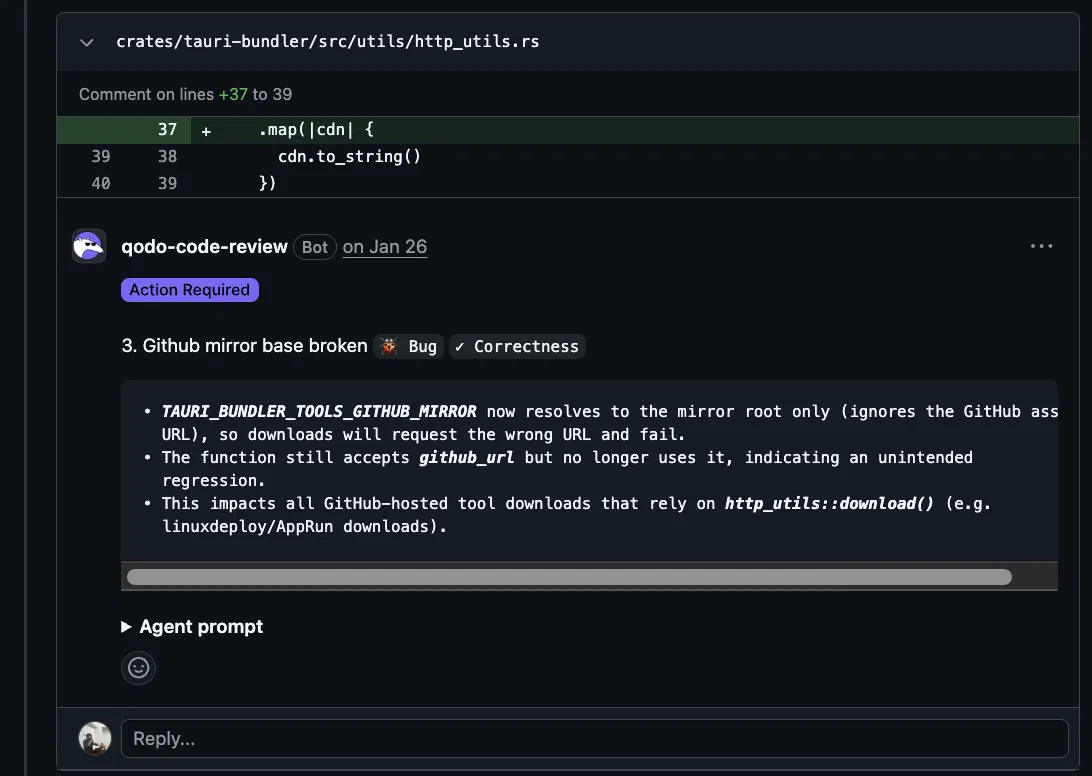
Findings from every specialized agent, critical issues, breaking changes, rules, duplication, and ticket compliance are grouped under two headers: Action Required and Remediation Recommended. The Action Required group lists findings that must be resolved before merging; the Remediation Recommended group lists advisory items that a reviewer can choose to act on. Each item is tagged by type and by attribute, so the reviewer scanning the card knows both what is wrong and why it matters before reading a single inline thread.
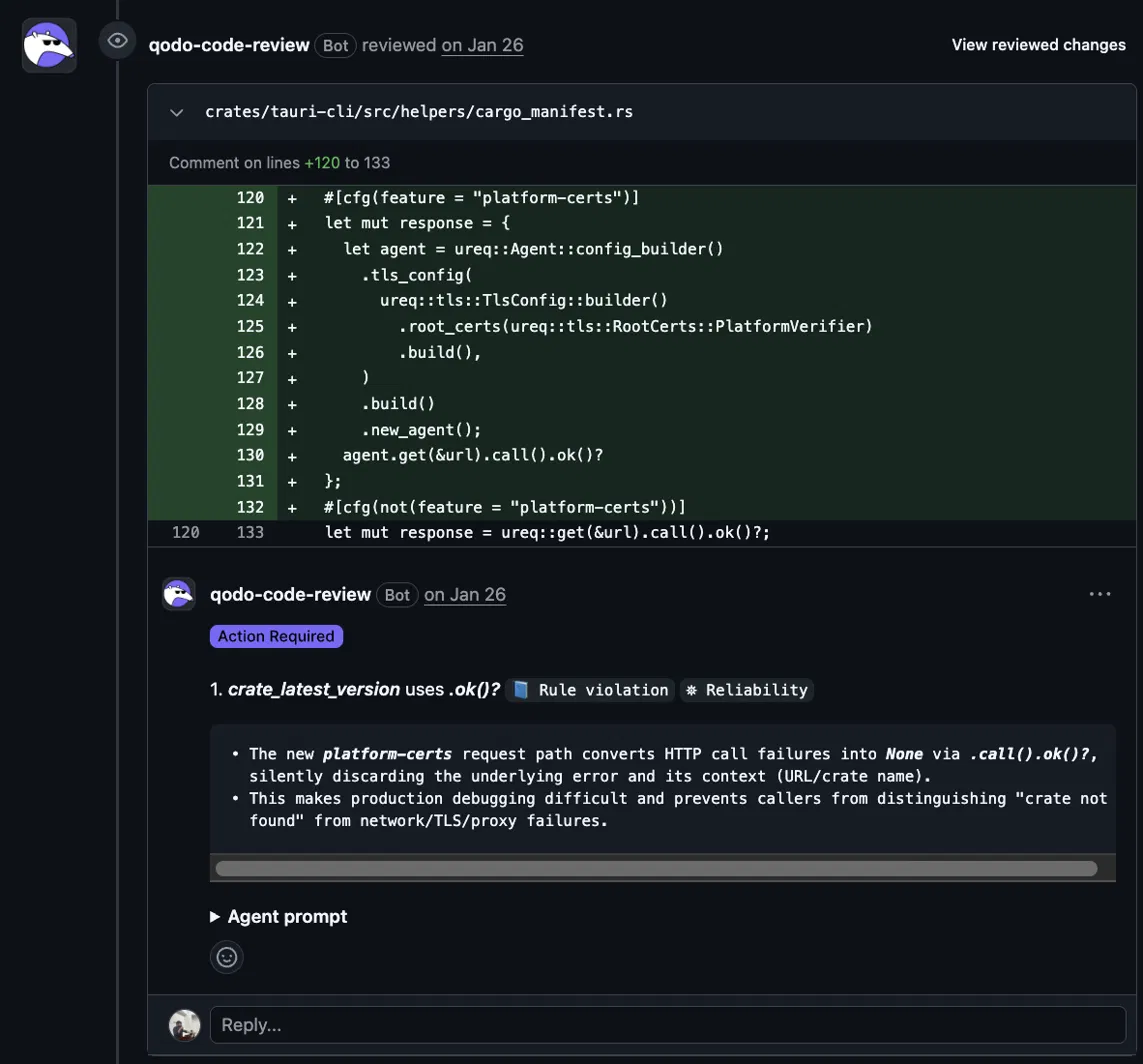
Each summary item links to a specific inline finding posted on the flagged code. Qodo’s inline finding for crate_latest_version in crates/tauri-cli/src/helpers/cargo_manifest.rs flags a new platform-certs agent path that converts every HTTP failure into None via .call().ok()?. This collapses every failure mode, such as network error, TLS rejection, and proxy block, into a single None, stripping all context from the caller and making production failures harder to diagnose than the non-platform-certs path.
A second inline finding appears in crates/tauri-bundler/src/bundle/windows/util.rs, where the WebView2 offline installer download reads the full HTTP response body into memory without a size cap.
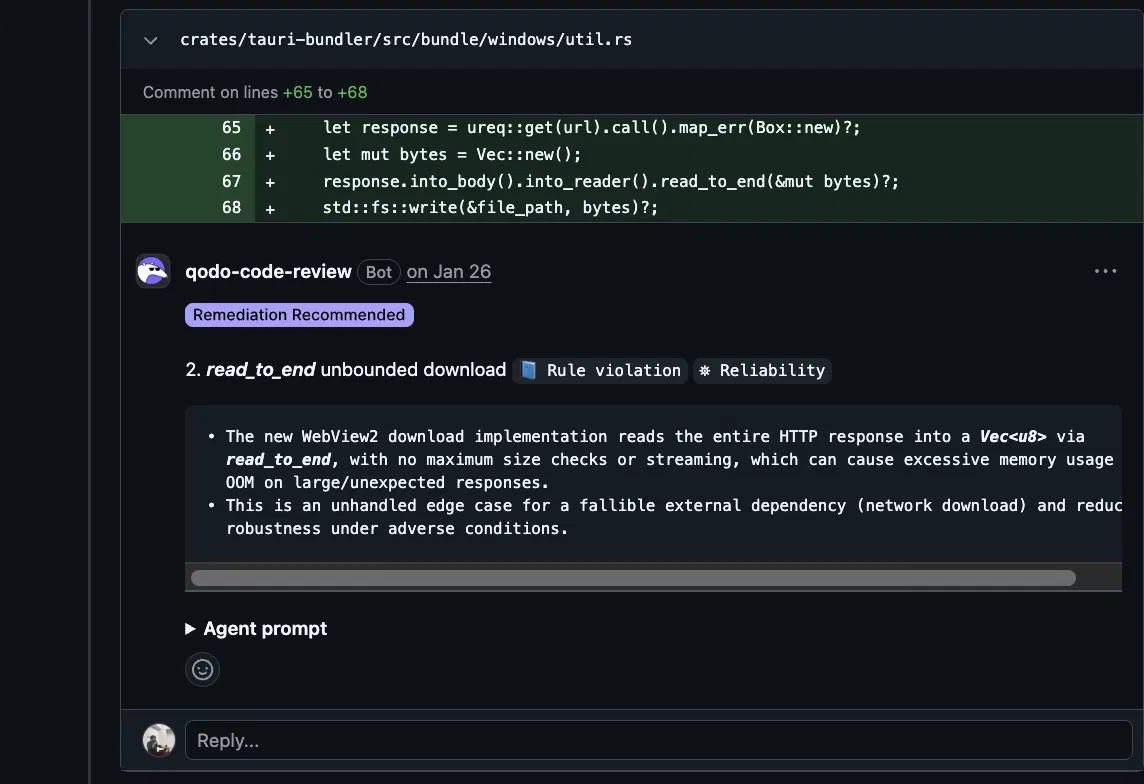
read_to_end on an unbounded network response means a malformed or oversized installer payload can exhaust available memory, a failure mode the original streaming implementation didn’t have.
Coding Standards: Implicit Team Learning vs Centralized
Rule Governance
Greptile and Qodo take opposite approaches to coding standards: Greptile infers them from how teams review code over time, while Qodo enforces them through explicit Rules and Skills that can be assigned, monitored, and tracked across repositories.
Both eventually generate consistent findings; the difference lies in how much upfront configuration is required and how auditable the coding standards are.
Greptile: Implicit Team Learning
Greptile learns coding standards implicitly from how teams review code. The platform observes which review comments developers accept, which they ignore, which ones receive a thumbs-up or thumbs-down reaction, and how the final merged version of a PR differs from the version first submitted.
If reviewers consistently flag missing error handling in a particular service, Greptile incorporates that pattern into future reviews. Two teams using Greptile can receive noticeably different reviews because the system calibrates to each team’s actual preferences rather than a shared, centrally defined rule library.
Qodo: Centralized Rule Governance
Qodo manages coding standards through an explicit governance model. Rules define engineering requirements that run during every review. They can be created manually, imported from files like AGENTS.md or CLAUDE.md, or discovered using Rule Miner, which analyzes historical PR discussions to flag recurring review patterns and suggest converting them into formal Rules. Skills are reusable knowledge packages stored in the repository as SKILL.md files, carrying standards, architectural constraints, and review checklists relevant to that codebase.
Rules and Skills can be assigned to specific repositories, activated or deactivated, monitored for how often they trigger, and tracked for how often violations are merged without being resolved.
Enterprise Deployment: Self-Hosted vs SaaS,
On-Premises, and Air-Gapped
For engineering organizations operating at scale, deployment flexibility and administrative control carry as much weight as review accuracy. Teams managing many repositories need consistent standards applied across all repositories, and organizations with compliance requirements need deployment options that keep source code within private infrastructure.
Greptile: Cloud and Self-Hosted Deployment
Greptile supports cloud and self-hosted deployment. Self-hosted deployment keeps repositories and review data inside the organization’s own infrastructure rather than being processed through a shared cloud service. Configuration is handled through repository-level files, and teams can import existing instruction files, such as AGENTS.md and CLAUDE.md, into the review workflow.
The adaptive learning system improves reviews over time without requiring a centrally managed rule library, keeping Greptile’s operational footprint light for teams with mature engineering processes.
Qodo: SaaS, On-Premises, and Air-Gapped Deployment
Qodo supports three deployment models: SaaS, on-premises, and air-gapped. Air-gapped deployment is designed for organizations in which source code cannot leave the private infrastructure under any circumstances.
Engineering managers can assign Rules and Skills to specific repositories, monitor how often those standards are triggered during reviews, track detected violations across the organization, and measure how many violations are merged despite being flagged. Because Qodo’s knowledge layer is persistent, the same codebase understanding runs across IDE integration, Agent Skills, and PR reviews without being rebuilt per session.
Developer Experience: PR-Focused Feedback vs
Cross-Stage Consistency
A review tool can generate accurate findings and still go unused if it disrupts the workflow, produces noisy comments, or provides reviewers with too little context to act quickly. The experience each platform provides reflects whether it reviews at one stage or across all three.
Greptile: PR-Focused Feedback
Greptile is built to make the pull request review moment faster and more informative. Every review starts with a summary explaining what changed, which parts of the system are affected, and whether any significant issues were found, giving reviewers enough orientation before reading individual comments.
The confidence score helps engineers triage a review queue: a high score means the PR is likely clean; a low score flags that the PR needs closer examination before merging. Auto-generated diagrams accompany complex changes spanning multiple services or APIs, giving reviewers a high-level view of execution flow without tracing through the code file by file.
Qodo: Cross-Stage Consistency
Qodo distributes the review experience across the development workflow rather than concentrating it on the pull request. Developers catch issues in the IDE while writing code, run Agent Skills inside their coding agent before pushing a branch, and see the same standards enforced again during the pull request review.
Because Rules and Skills are shared across all three surfaces, the feedback is consistent, and engineers working across multiple repositories encounter the same baseline guidance on every project without needing to re-learn each codebase’s conventions. Engineering managers access a centralized portal with rule analytics, violation tracking, and repository-level assignment of standards, providing visibility into how engineering practices are being applied across teams.
Greptile vs Qodo: Feature Comparison
| Capability | Greptile | Qodo |
| Review surfaces | Pull request, CLI | IDE, Agent Skills, pull request |
| Git provider support | GitHub, GitLab | GitHub, GitLab, Bitbucket, Azure DevOps |
| Codebase context model | Repository graph built per review | Persistent layer: graph DB, vector DB, AST parsing, commit history |
| Review output | PR summary, confidence score (0–5), inline comments, auto-generated diagrams, suggested fixes | Specialized agents: critical issues, breaking changes, rules enforcement, duplicate logic, ticket compliance |
| Standards management | Learned implicitly from review behavior and PR diffs | Centralized Rules, Skills, Rule Miner |
| Rule lifecycle management | Repository configuration files | Activate, assign to repos, monitor with analytics |
| Adaptive learning | Learns from PR diffs, reactions, accepted, and ignored suggestions | Rule Miner surfaces patterns from PR history |
| Violation tracking | Not available | Tracks violations and merge rates |
| Enterprise deployment | Cloud, self-hosted | SaaS, on-premises, air-gapped |
| Analytics | Limited | Rule analytics, Skill analytics, and violation tracking |
| IDE integration | Not available | Available |
| Cross Repo Review | Pattern repositories and shared context | Cross Repo Review across dependent repositories, including across Git providers |
Which Team Should Choose Greptile, and Which
Should Choose Qodo?
The difference in scope is the clearest way to frame the decision: Greptile solves one problem well. Qodo covers more of the development lifecycle, and the value of that wider coverage grows with team size, repository count, and the complexity of standards being enforced.
- A pull request is your only quality gate. Greptile fits here with its confidence score, diagrams, and adaptive learning, sharpening the signal without asking engineers to configure or maintain a rule library first.
- You need standards enforced consistently across every team. Qodo’s Rules, Skills, and violation analytics show engineering managers how standards actually hold up across the org, not just what’s flagged on one PR.
- Your Git provider is Bitbucket or Azure DevOps. Only Qodo supports them; Greptile is GitHub and GitLab only.
- Source code can’t leave your infrastructure. Qodo documents air-gapped deployment explicitly. Greptile supports self-hosted, but nothing air-gapped.
- You’d rather standards emerge from behavior than be configured up front. Greptile’s adaptive model tracks what your team accepts, ignores, and changes between submitted and merged PRs, then calibrates future reviews accordingly, no rule-writing required.
Conclusion
The decision comes down to where the quality bottleneck actually sits. If the pull request is where most problems are caught and resolved, Greptile’s merge-gate validation fits that workflow directly, and it gets more accurate the longer a team uses it, since the system keeps calibrating to what reviewers accept, ignore, and change between submission and merge.
Qodo is the better fit when the bottleneck sits earlier or spans more than one repo: issues surfacing too late in the review cycle, standards drifting across teams, or engineering managers needing compliance visibility across the org. That fit strengthens as the repository count and team size grow. Cross Repo Review and Rule Miner exist specifically for organizations managing dozens of interconnected repos, not a handful.
Greptile helps with this PR. Qodo improves the next hundred.
FAQs
What is the difference between Greptile and Qodo?
Greptile is a pull request validator that uses the full repository context to catch bugs before code is merged. Qodo is an AI code quality and governance platform that brings AI review into the IDE, Agent Skills, and pull requests, while centrally managing coding standards across repositories.
Is Greptile better than Qodo for small teams?
Greptile requires less setup and fits naturally into an existing PR workflow, which typically makes Greptile the faster starting point for smaller teams. Qodo’s governance features, centralized rules, analytics, and violation tracking add more value as team size and repository count increase.
Does Greptile review code in the IDE?
Greptile does not integrate with the IDE. Greptile’s primary coverage is the pull request. Greptile also provides a CLI to review a local branch before opening a PR.
Does Qodo support Bitbucket and Azure DevOps?
Yes. Qodo supports GitHub (including Enterprise Server), GitLab (including self-managed), Bitbucket, and Azure DevOps, as well as Gerrit for enterprise on-premises setups. Greptile supports GitHub and GitLab only.
How do Greptile and Qodo handle coding standards
differently?
Say a reviewer keeps flagging missing null checks on payment endpoints. With Greptile, that pattern is gradually picked up after enough repetition for the system to calibrate to it. With Qodo, Rule Miner can convert that same recurring comment into a formal rule the first time the pattern shows up often enough to be mined, and from then on, it’s enforced consistently rather than depending on a human catching it in review each time.
Can either tool be deployed in air-gapped environments?
Qodo supports SaaS, on-premises, and air-gapped deployments. Greptile supports cloud and self-hosted deployment but does not document air-gapped environments. The distinction matters for regulated teams: self-hosted typically still means the tool runs on infrastructure you control, but air-gapped specifically means the deployment can operate with zero outbound network dependencies, which is the requirement in industries like defense, finance, or healthcare where nothing can call out to an external service, ever.
What is Rule Miner in Qodo?
It’s the mechanism that turns a pattern reviewers keep flagging manually into something enforced automatically. Every rule it surfaces links back to the specific PR comment it came from, and teams choose whether new rules go live immediately or sit in a suggested state until someone approves them, so nothing gets enforced org-wide without a sign-off.
What does Greptile’s confidence score mean?
The confidence score is a 0–5 rating assigned to each pull request based on detected issue severity, change complexity, and how closely the implementation matches existing codebase patterns. Teams use the score to prioritize which pull requests in a review queue need close attention.
Do Greptile and Qodo replace human code review?
Neither platform replaces human code review. Both tools generate findings that appear alongside human reviewer comments in the pull request. The goal is to reduce the time human reviewers spend on routine issues so reviewers can focus on higher-judgment decisions.
What is the difference between Rules and Skills in Qodo?
Rules define explicit engineering requirements that run during every review and can be activated, deactivated, and assigned to specific repositories. Skills are reusable knowledge packages stored in the repository as SKILL.md files that carry architectural constraints, ownership information, and review checklists. Rules enforce requirements; Skills provide the context needed to apply them correctly.
About the author