

AI Code Review Tools: Benchmarks & Comparison
The AI code review market is crowded and every vendor claims the same outcomes. In this chapter you’ll learn the five evaluation criteria that actually determine fit at enterprise scale, how to read benchmark claims and tell credible data from marketing, and what current benchmarks show across major tools. You’ll get a buyer mapping table showing which tool fits which team, plus deep-dives on each major tool.

Key Takeaway
The AI code review market is crowded and every vendor claims the same outcomes. The differences that matter show up in three places:
- How much of your codebase a tool actually understands
- Whether it enforces standards or just suggests them
- How its performance holds up on independent benchmarks run on real production code
What You’ll Learn
- The five evaluation criteria that actually determine fit at enterprise scale
- How to read benchmark claims and tell credible data from marketing
- What current benchmarks show across major tools
- A buyer mapping table: which tool fits which team
- Deep-dives on each major tool — what it does well, where it falls short, who it’s for
Why Choosing the Right AI Code Review Tool Is Hard
The AI code review market has expanded fast. Every vendor uses the same language — “context-aware,” “AI-powered,” “automated review.” Every vendor claims to catch bugs, reduce review time, and enforce standards.
The claims converge. The capabilities don’t.
The real differences show up in places vendor marketing rarely addresses directly: how deep the context actually goes, whether standards are enforced or just suggested, what independent benchmarks run on real production code show, and how well the tool scales when you have multiple repos, multiple teams, and enterprise deployment requirements.
How to Evaluate AI Code Review Tools
The five criteria that determine fit at enterprise scale
1. Context depth — diff-only vs. full codebase
The single most important dividing line in the category. A diff-only tool sees what changed. A full-context tool understands what that change means across your entire system — dependencies, PR history, architectural patterns, team standards.Ask any vendor: “What does your context include? Do you index our full codebase, or just the files in the PR?” The answer tells you more than any feature list.
2. Standards enforcement — suggestions vs. policy
Most tools let you describe your coding standards in natural language and ask the AI to follow them. That’s suggestions — the model tries to comply, but there’s no enforcement, no consistency, no lifecycle management, and no way to measure whether standards are actually being applied.
True enforcement means rules are codified, versioned, applied automatically on every PR, measured for adoption and violations, and updated as your codebase evolves. The difference between hint and policy is the difference between a standard that depends on who reviewed the PR and one that applies regardless
3. Review architecture — single-pass vs. multi-agent
A single-pass review asks one model to catch everything — bugs, security issues, style violations, breaking changes — in one pass. That model has to compete for attention across all of those concerns simultaneously.
A multi-agent architecture deploys specialized agents for distinct concerns. Each agent focuses on one domain, uses its own context, and doesn’t trade off depth against breadth. The result is higher recall on the issues that matter most — without the noise that comes from a generalist model trying to cover everything.
4. SDLC coverage — PR-only vs. IDE + Git + CLI
A PR-only tool catches issues after code is written and committed. A platform that covers the full SDLC catches issues at the IDE stage (before commit), at the PR stage (before merge), and in the CLI (as part of automated pipelines). Earlier detection means lower cost to fix — and continuous enforcement regardless of which interface a developer is using.
5. Enterprise readiness — deployment, platform coverage, governance
For enterprise teams, this includes: deployment options (cloud, on-prem, air-gapped), Git platform coverage (GitHub-only vs. GitHub + GitLab + Bitbucket + Azure DevOps), centralized rules management across repos and teams, and analyst validation. A tool that only works on GitHub creates a governance gap the moment your organization uses anything else.
How Qodo maps to each criterion
Criteria
How Qodo answers it
Context depth
Qodo’s Context Engine indexes your full codebase across repositories, learns from PR history, and reasons about dependencies. Reviews read the system, not the diff.
Standards enforcement
Qodo codifies standards as living policy through the Rules System — discovered from your codebase, applied automatically, updated as the codebase evolves. Enforcement stops depending on the reviewer.
Review architecture
Qodo’s Review Agent Suite runs specialized agents in parallel — Critical Issues, Duplicated Logic, Ticket Compliance, Rules Enforcement, Breaking Changes. High signal instead of generalist noise.
SDLC coverage
Qodo runs the same review across the IDE, Git, and agentic workflows. Same rules, same context, same quality bar at every stage.
Benchmarks: How to Verify What Vendors Claim
Every vendor publishes benchmark results. Most of those results are incomparable. Here is how to tell the difference.
Online vs. offline benchmarks
The first question is where the benchmark ran.
Offline benchmarks evaluate tools against a fixed dataset of PRs after the fact — clean, reproducible, but distant from how the tool behaves on live code. Online benchmarks evaluate tools as they run on real PRs in real repositories — closer to production behavior, but harder to standardize across vendors.
Benchmarks measure the model or the system — not both
A benchmark that tests an LLM on an isolated dataset is measuring the model.
A benchmark that tests an AI code review platform on production PRs in real codebases is measuring the system — the model, the context engine, the rules layer, the review agents, and how they work together. Those are different measurements, and only the second tells you how the tool will behave on your code.
The gap between them is large. A 2025 study from Raman Shihab tested the same model two ways: against an isolated benchmark in the human-eval style with no real codebase, and against a real coding task inside a real codebase with dependencies and conventions. The model scored 84–89% on the first test and 25–34% on the second. A 50-point cliff between benchmark and reality.
When comparing benchmarks, ask which one the vendor is reporting.
What makes a benchmark credible
Real-world dataset. Synthetic benchmarks use toy codebases. Real-world benchmarks use production PRs — the kind of code that actually breaks in production. Tools that perform well on synthetic data frequently underperform on real codebases.
Consistent, default evaluation conditions. Every tool should be evaluated at default configuration, with no manual tuning, under the same LLM-as-judge system. Benchmarks that allow vendor-tuned configurations are measuring optimization effort, not tool quality.
Open methodology. Can you reproduce it independently? Is the dataset, defect injection approach, and evaluation script publicly available? Closed benchmarks are marketing.
Precision and recall as the primary metrics — not “issues found” or “comments generated.” Precision tells you how much of what the tool flags is real. Recall tells you how much of what’s real the tool actually finds. F1-score — the harmonic mean of both — is the right single number to compare.
What current benchmarks show
Benchmark
What it measures
Limitation
HumanEval / MBPP
Code generation fluency — can the model write a correct function from a prompt?
Measures writing ability, not review quality. High scores here say nothing about a tool’s ability to catch issues in someone else’s code.
SWE-bench
Agentic task completion — can the model resolve a GitHub issue end-to-end?
Tests autonomous coding, not verification. A strong SWE-bench result doesn’t predict PR review performance.
PR-level review quality — precision, recall, and F1 across 100 real production PRs with 580 verified injected defects, 8 repositories, 7 languages. Open methodology, default configs, LLM-as-judge against human-validated ground truth.
Point-in-time evaluation — doesn’t measure long-term learning or rules enforcement improvements over time.
Independent F1-score evaluation across tools. Third-party run, not vendor-controlled.
Focuses on review output quality; doesn’t evaluate depth of codebase understanding behind it.
What the results show: In the Qodo Code Review Benchmark — the only benchmark designed specifically for PR-level review with an open, reproducible methodology — Qodo leads on F1-score across all tools evaluated.
When NVIDIA needed to validate Nemotron 3 Super for enterprise code review, this is the benchmark they used. In the most recent head-to-head, Qodo leads Claude Code Review by 12 F1 points — identical precision, significantly higher recall. Qodo also ranks #1 on the hardest reviews in the Martian benchmark, leading on nuanced logic bugs most likely to cause production failures.
Neither CodeRabbit nor GitHub Copilot has published benchmark results on a standardized, open-methodology evaluation.
Buyer Mapping: Which AI Code Review Tool Fits Which Team
Mid-market to enterprise, 50-10,000+ developers, multi-repo, compliance requirements
IDE + PR + CLI
Full codebase + multi-repo + PR history
Codified rules system + auto-discovery, lifecycle, analytics
GitHub, GitLab, Bitbucket, Azure DevOps
Cloud, on-prem, air-gapped
Startups and SMBs, single or small repo setup, lightweight setup
PR
Diff + PR context
Custom instructions only – not enforced
GitHub, GitLab
Cloud only
Teams standardized on GitHub, already using Copilot for generation
PR (GitHub only)
PR-level context within GitHub
Advisory — no centralized standards layer
GitHub only
GitHub cloud
Small teams, developer-first workflows, already using Cursor for generation
PR
Diff-level
Advisory suggestions
GitHub
Cloud only
Small teams, lightweight PR feedback, informal reviews
PR
PR-scoped
Advisory — no governance layer
GitHub, GitLab
Cloud only
Teams wanting deep reasoning on individual PRs, GitHub workflows
PR
PR-level
Advisory — no centralized enforcement
GitHub only
Cloud only
Tool
Qodo
Mid-market to enterprise, 50-10,000+ developers, multi-repo, compliance requirements
IDE + PR + CLI
Full codebase + multi-repo + PR history
Codified rules system + auto-discovery, lifecycle, analytics
GitHub, GitLab, Bitbucket, Azure DevOps
Cloud, on-prem, air-gapped
Tool
CodeRabbit
Startups and SMBs, single or small repo setup, lightweight setup
PR
Diff + PR context
Custom instructions only – not enforced
GitHub, GitLab
Cloud only
Tool
GitHub Copilot Code Review
Teams standardized on GitHub, already using Copilot for generation
PR (GitHub only)
PR-level context within GitHub
Advisory — no centralized standards layer
GitHub only
GitHub cloud
Tool
Cursor (Bugbot)
Small teams, developer-first workflows, already using Cursor for generation
PR
Diff-level
Advisory suggestions
GitHub
Cloud only
Tool
Greptile
Small teams, lightweight PR feedback, informal reviews
PR
PR-scoped
Advisory — no governance layer
GitHub, GitLab
Cloud only
Tool
Claude Code Review
Teams wanting deep reasoning on individual PRs, GitHub workflows
PR
PR-level
Advisory — no centralized enforcement
GitHub only
Cloud only
Tool Deep-Dives
Qodo
What it is: A dedicated AI code review platform built for enterprise engineering teams. Code review and code quality are the core product — not a feature added to a generation tool.
Architecture: Qodo’s Review Agent Suite runs specialized agents in parallel — each with a single job: critical issues, duplicated logic, breaking changes, ticket compliance, rules enforcement. A prioritization layer filters findings before they surface, which is why 73.8% of suggestions are accepted by developers — they aren’t dismissing the feedback as noise. Behind the agents sit two further layers:
- Context Engine indexes multi-repo codebases, incorporates PR history, and applies organizational rules — so reviews read the system, not the diff.
- Rules System manages the full lifecycle of engineering standards: auto-discovery, enforcement, analytics, and health monitoring.
Most tools ask you to write down your coding standards in plain language and hope the model follows them. Qodo’s rules are codified — it auto-discovers standards already present in your codebase, versions them, enforces them on every PR, and tracks whether they’re holding over time. That’s rules with a lifecycle, not a sticky note.
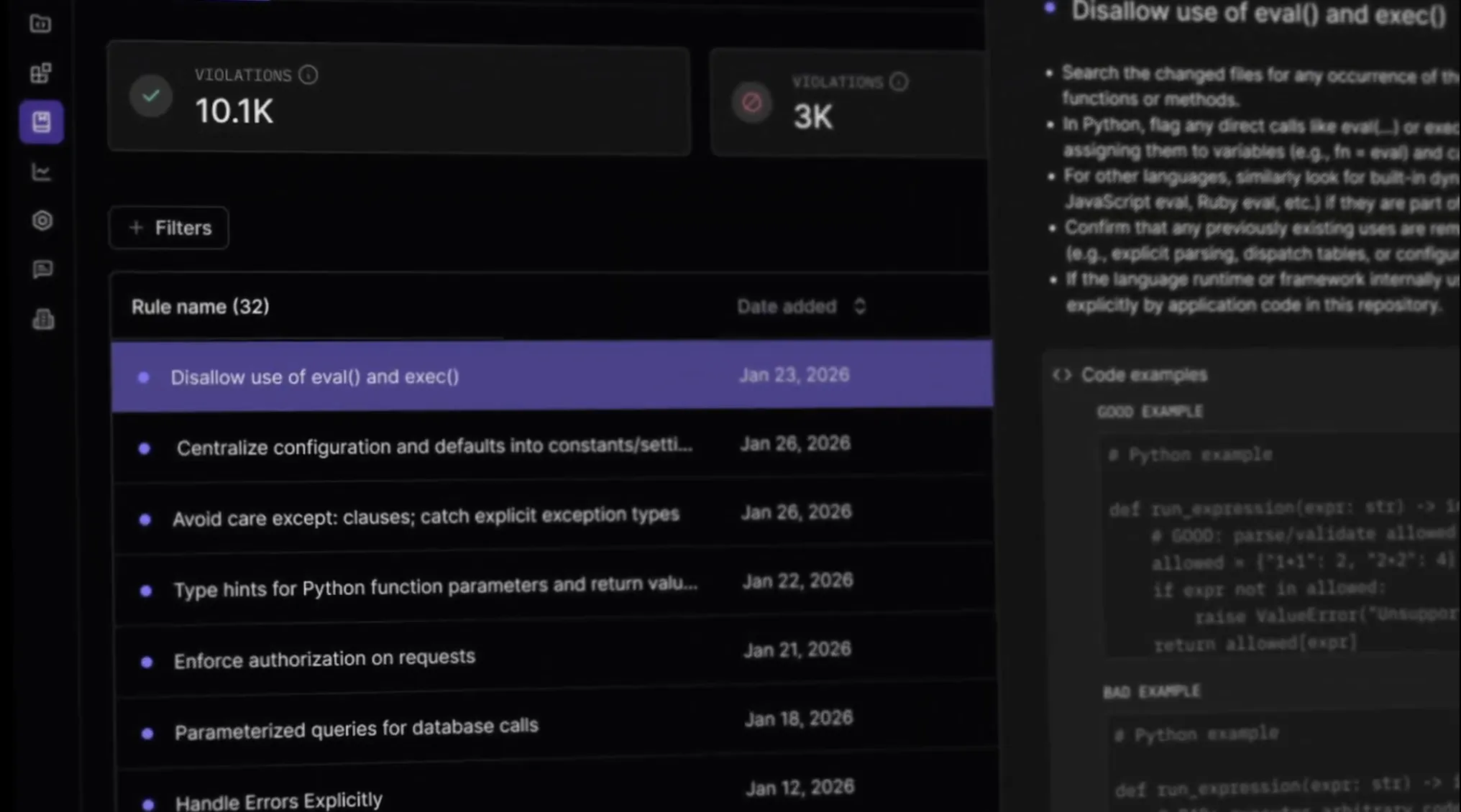
SDLC coverage: IDE Plugin (VS Code, JetBrains), Git Plugin (GitHub, GitLab, Bitbucket, Azure DevOps), CLI for agentic quality workflows.
What it does well:
- Full codebase context across 10 repos or 1,000 — not diff-only review
- Enforceable rules system with auto-discovery and lifecycle management — rules that learn from your codebase, not just rules you write manually
- Independent verification layer, separate from the generation tools in your stack
- Benchmark-proven precision and recall — highest F1-score in the Qodo Code Review Benchmark and #1 on hardest reviews in Martian’s benchmark
- Enterprise deployment flexibility — cloud, on-prem, air-gapped
- 15+ automated PR workflows including breaking change detection, code duplication, ticket compliance
- Gartner #1 for Code Understanding (Critical Capabilities for AI Code Assistants, 2025)
Where to evaluate carefully:
- Setup and configuration is more involved than lightweight tools — the depth of context and rules enforcement requires onboarding. This is a governance platform, not a one-click install.
- Best value is realized at scale — for very small teams with informal standards, lighter tools may be sufficient.
Benchmark performance: Highest F1-score in the Qodo Code Review Benchmark across all tools evaluated. #1 on hardest reviews in Martian’s independent benchmark. 73.8% of code suggestions accepted by developers.Bottom line: The right choice when review quality, consistent standards enforcement, and enterprise-scale governance are requirements — not nice-to-haves.
CodeRabbit
What it is: An AI-powered PR review tool focused on speed and simplicity. Positioned as fast, lightweight review automation for development teams.
Architecture: Single-agent PR review. Integrates with GitHub and GitLab. Supports custom instructions in natural language — the reviewer tries to follow them, but there’s no codified enforcement layer.
SDLC coverage: PR-level only. No IDE integration, no CLI.
What it does well:
- Fast to set up — low friction for teams that want automated PR comments quickly
- Learns from PR comments to adjust review behavior over time
- Good fit for startups and small teams that want automated coverage without a governance requirement
Where it falls short:
- Diff-level context — reviews are PR-scoped and don’t reflect full codebase understanding
- Standards are advisory, not enforced — consistency depends on the model following instructions, not on a codified rules system
- No centralized rules management or analytics — no way to measure whether standards are being applied
- No independent benchmark performance data on standardized, open-methodology evaluations
- Cloud-only deployment — not suitable for regulated or air-gapped environments
Bottom line: A reasonable starting point for small teams that need lightweight PR automation. Not built for organizations where consistency, governance, and measurable quality are requirements.
GitHub Copilot Code Review
What it is: Code review as an extension of GitHub Copilot — an AI coding assistant that added review capability when it became GA in April 2025. Review is an assistive layer inside a generation-first product.
Architecture: Single-model review assistant within GitHub. Suggestions are advisory. Standards management requires manually maintaining files in individual repos — there’s no centralized enforcement layer.
SDLC coverage: GitHub PRs only. No cross-platform Git support, no CLI.
What it does well:
- Native GitHub integration — no additional tooling for teams already standardized on GitHub
- Familiar interface for teams already using Copilot for generation
- Reasonable for individual developer productivity in GitHub-centric workflows
Where it falls short:
- GitHub-only — organizations using GitLab, Bitbucket, or Azure DevOps alongside GitHub have no governance coverage outside GitHub
- The same system that generates code also reviews it — shared architecture means shared blind spots. There’s no independent verification layer
- No centralized rules enforcement across repos — standards drift when teams or repos manage their own configurations
- No published benchmark results on standardized, open-methodology evaluations
- No deep cross-repo context or PR history awareness
Bottom line: Works for teams fully standardized on GitHub that want convenient, assistant-level review. Not suitable as a primary governance layer for organizations with multi-platform Git environments, compliance requirements, or a need for independent verification.
Cursor (Bugbot)
What it is: Bugbot is Cursor’s automated PR review feature — review feedback from within the same product used for AI code generation. Review is integrated into the Cursor coding workflow.
Architecture: Single-pass automated review at the PR level. Flags issues and can suggest or attempt fixes. No multi-agent architecture, no benchmarked validation of review quality.
SDLC coverage: PR-level within GitHub. Integrated into Cursor’s IDE workflow for teams using Cursor for generation.
What it does well:
- Convenient for teams already using Cursor — review in the same environment as generation
- Low friction for developer-first, small team workflows
- Can flag issues and suggest fixes at the PR stage without additional tooling
Where it falls short:
- Review happens within the same product that generates the code — no independent verification. The same system that wrote the code is reviewing it
- Diff-level context — no full codebase awareness, no cross-repo understanding
- No centralized governance or standards enforcement layer
- No enterprise deployment options — no on-prem, no air-gapped, no multi-platform Git coverage beyond GitHub
- No published benchmark data
Bottom line: Adequate for small teams that want lightweight review feedback within their existing Cursor workflow. Not positioned as a governance or verification platform for teams where production risk and consistency matter.
Greptile
What it is: A lightweight AI PR review tool that offers codebase-aware feedback on pull requests.
Architecture: PR-scoped review with some codebase indexing capability. Reviews are interaction-based — feedback is generated per PR without persistent organizational memory or rules enforcement.
SDLC coverage: PR-level. GitHub and GitLab.
What it does well:
- Indexes the codebase to provide some context beyond the immediate diff — more aware than pure diff-only tools
- Quick feedback on pull requests with relatively low setup friction
- Suitable for teams that want lightweight, automated PR comments
Where it falls short:
- Context is PR-scoped — reviews don’t improve over time, don’t incorporate org-wide standards, and don’t reflect cross-repo dependencies
- No standards enforcement — feedback is advisory and inconsistent across PRs
- No centralized rules management, no lifecycle management of standards
- No multi-agent architecture — single-pass review optimized for speed over depth
- No published benchmark data on standardized evaluations
- No enterprise deployment options
Bottom line: A lightweight option for teams that want faster PR feedback without governance requirements. Reviews are isolated — useful for quick feedback, not for teams that need consistent, enforceable standards at scale.
Claude Code Review
What it is: Code review capability within Anthropic’s Claude Code — a multi-agent system that dispatches parallel agents to review pull requests and post inline comments on GitHub.
Architecture: Multi-agent PR analysis within GitHub. Deep reasoning on individual PRs. No persistent organizational memory, no rules system, no cross-repo context.
SDLC coverage: GitHub PRs only. No IDE integration, no CLI, no cross-platform Git support.
What it does well:
- Strong reasoning quality on individual PRs — particularly useful for deep architectural feedback on complex changes
- Good fit for teams that want thoughtful, conversational-style review on individual PRs
- Useful for engineers who want AI feedback on specific changes without a full governance platform
Where it falls short:
- GitHub-only — no coverage for GitLab, Bitbucket, or Azure DevOps
- No persistent organizational memory — each PR reviewed in isolation, without context from prior review decisions
- No centralized standards enforcement or rules system
- Benchmark performance: in the Qodo Code Review Benchmark run under identical conditions, Claude Code Review trails Qodo by 12 F1 points — precision is equivalent, but recall is significantly lower, meaning Claude misses more real issues
- Cost model is significantly higher per PR than dedicated review platforms — typically $15–25 per PR vs. under $1 for Qodo
Bottom line: Strong for teams that want deep AI reasoning on individual PRs within a GitHub workflow. Not built for organizations that need enforceable standards, cross-platform Git coverage, or measurable, consistent review quality at scale.
What to Do Next
If you’re evaluating tools, the single most useful thing you can do is run each tool against the same 10–20 real PRs from your own codebase — not synthetic examples, not vendor demos. Look at what each tool flags, what it misses, and whether the feedback your developers actually act on.
The benchmark data gives you a starting point. Your own codebase gives you the answer.
Let’s see what you’ve learned!
What’s the right metric for comparing AI code review tools?
Select the correct answer
Which AI code review tool supports GitHub, GitLab, Bitbucket, and Azure DevOps?
Select the correct answer
What’s the difference between standards as suggestions and standards as enforced policy?
Select the correct answer
See what a verified AI code review workflow looks like in practice.
Questions?
Yes. AI code review runs on every PR automatically, regardless of where the team is or what time it is. Qodo reviews PRs within minutes of being opened — so a developer in Singapore doesn’t wait until their colleague in San Francisco wakes up to get feedback. Human reviewers still review where judgment is needed, but the first pass — catching breaking changes, standards violations, duplicated logic — happens immediately, not on the next reviewer’s schedule.
Move the first review pass to AI and reserve human reviewers for the calls that need judgment. When AI code review handles the volume, human reviewers stop catching issues a system should catch and start focusing on architecture and edge cases. With Qodo running on every PR, 80% require no human review comments — not because review is being skipped, but because it’s happening at the right layer. The backlog clears because the bottleneck moves.
A dedicated AI code review platform — independent from the tool that generated the code. Qodo sits between AI code generation and merge as a verification layer: it reviews every PR against the full codebase, validates against your rules, detects breaking changes across dependencies, and surfaces structured findings before merge. Independence matters — the system that generates code shares its own blind spots, which is why review needs to be a separate layer with adversarial reasoning, not a feature of the generation tool.
Not as a full replacement for human approval — and that isn’t the goal. AI code review handles the volume, context, and consistency at the system level so human reviewers stop spending time on issues a system should catch. Approval still belongs with humans for architectural decisions, design tradeoffs, and edge cases that require judgment. With Qodo, 80% of PRs require no human review comments — which means human reviewers focus their attention where it actually matters, not on everything.
Catch issues earlier and enforce standards consistently — so engineers stop spending their time fixing what a system should have caught. Qodo runs review in the IDE before code reaches a PR, applies codified rules on every PR before merge, and reviews against the full codebase to catch architectural drift and duplicated logic before they accumulate. Engineers spend less time on rework and tech debt because less of it reaches main in the first place.
Qodo is SOC 2 Type II certified. Additional compliance certifications and enterprise deployment options — including on-prem and air-gapped — are available for regulated industries. For specifics on FedRAMP status or other compliance requirements, contact Qodo’s enterprise team during your security review.