

Best AI Code Review Tools for GitHub (2026)
More AI code review tools support GitHub than any other Git provider. That sounds like a buyer’s market, and on the surface it is — every shortlist looks reasonable, every tool posts inline PR comments, every vendor page promises context-aware analysis. The real evaluation work starts when you ask harder questions: does the tool fit alongside CODEOWNERS and branch protection, does it actually reason about other repositories, and what happens when you move from GitHub to GitHub Enterprise Server?

Key Takeaway
On GitHub, the gap between the cheapest tool and the most capable one isn’t obvious from feature tables. Almost every tool can post PR comments. Far fewer respect CODEOWNERS and branch protection, reason across repository boundaries, learn from prior review decisions, or run inside GitHub Enterprise Server. Picking well means looking past the GitHub badge on the vendor’s homepage and into how the tool actually behaves inside the workflow your team already uses.
What You’ll Learn
- Which AI code review tools have real GitHub integration in 2026
- How GitHub Copilot Code Review fits into the picture for teams already paying for Copilot
- What changes when your team runs GitHub Enterprise Server or an air-gapped environment
- How a good AI review tool fits alongside CODEOWNERS, branch protection, and status checks
- A clear set of next steps for choosing the right tool for your team
The GitHub AI code review tools shortlist
The tools worth evaluating for GitHub split naturally into three groups.
- GitHub’s own AI offering: GitHub Copilot Code Review, included with Copilot Business and Copilot Enterprise.
- Dedicated AI code review platforms: Qodo, CodeRabbit, Greptile, Graphite Diamond.
- Static analysis and security tools that pair with AI review: GitHub Advanced Security and SonarQube. Both belong in the stack alongside AI review, not as substitutes.
Most of these check the same boxes for basic PR review on GitHub. The differences worth paying attention to show up further down the requirements list: cross-repo reasoning, a rules system that grows with your codebase, and deployment flexibility for teams that can’t put source code on external SaaS.
What “GitHub support” actually means in 2026
Every vendor in this category claims GitHub integration. What’s behind the claim varies from a webhook posting a comment to a tool that runs as a GitHub Action, respects CODEOWNERS, posts as a required status check, and works inside GitHub Enterprise Server. Before you book demos, get specific about which layers your team actually needs.
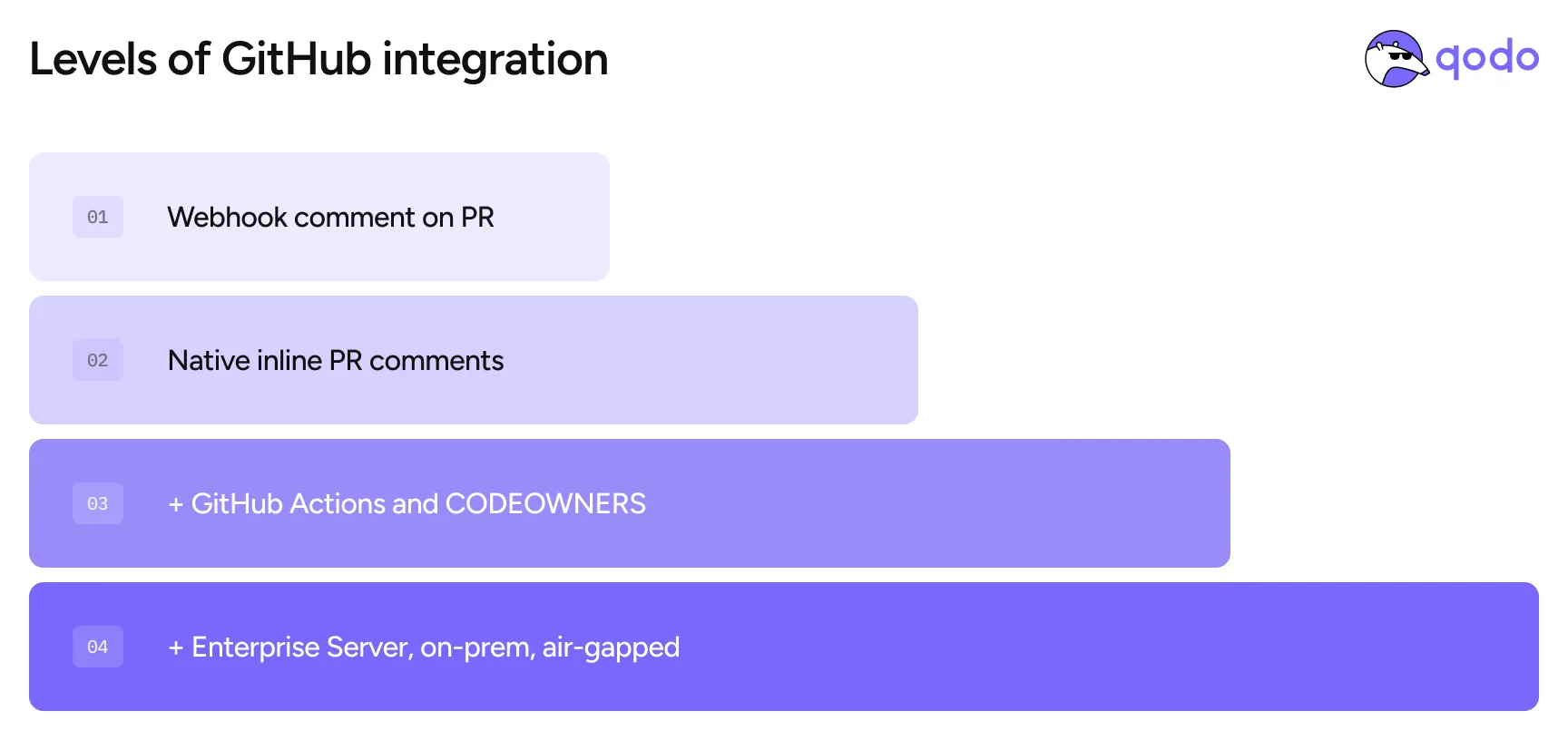
GitHub integration capabilities worth verifying
Use this as your checklist when reading vendor docs. Each row shows up differently in different tools.
Capability
Why it matters for your team
Native inline PR comments
Findings appear inside the PR thread, where your team already reviews
GitHub Actions integration
Review runs as a workflow, with results posted back automatically
CODEOWNERS and branch protection awareness
The tool plugs into your existing approval workflow rather than fighting it
Status check integration
Review can be a required check on merge, or kept advisory
GitHub Enterprise Server support
Required if your team runs self-hosted GitHub on internal infrastructure
Air-gapped and sovereign deployment
Required for regulated environments and government work
Cross-repository context
Review evaluates PRs against shared modules and rules across multiple repositories
How the leading tools compare on GitHub
Most tools cover basic PR review. The decision narrows once Enterprise Server, cross-repo context, and rules enforcement come into play.
GitHub / Enterprise Cloud
Enterprise Server
Air-gapped
Cross-repo context
Rules system
On the SaaS side, nearly every tool can post inline comments and run as a GitHub Action. The shortlist thins out the moment you ask about Enterprise Server, air-gapped deployment, reasoning across repositories, or a rules layer that learns from your codebase — capabilities most tools either skip or treat as roadmap items.
What actually matters when choosing
Across benchmarks and developer feedback, the biggest differences between AI code review tools on GitHub aren’t about which one is “smarter.” They’re about four practical dimensions — and how a tool scores on these is what your engineers will actually feel every day.
- Signal-to-noise ratio. How many of a tool’s findings are worth acting on, versus how many get muted as noise? A tool that flags thirty things per PR and never learns from your team’s overrides gets ignored within a quarter. The tools that hold up over time are the ones that learn from prior decisions and prune their own noise.
- Context depth. Does the tool reason about a single file, the whole PR diff, the surrounding repository, or the rest of the system the change connects to? This is the single biggest spread in the category. Most tools stop at the diff. A few reach into the rest of the repo. Fewer still reason across repository boundaries — which is where the production-breaking bugs actually live.
- GitHub integration quality. “Supports GitHub” ranges from a webhook posting a comment to a tool that runs as a GitHub Action, respects CODEOWNERS, posts as a required status check, and works on GitHub Enterprise Server. The difference is whether the tool plugs into the workflow your team already uses, or fights it.
- What the tool is optimized for. Some tools are built around developer productivity — faster, lighter reviews to keep PRs moving. Others are built around security — vulnerability detection, SAST, secret scanning. A third group is built around code quality and governance — architecture rules, cross-repo consistency, standards that scale with the team. These aren’t opposites, and most enterprise teams end up with one tool from more than one category. But knowing which job you’re hiring the tool to do is what keeps the evaluation honest.
The rest of this article looks at each tool through this lens — starting with what GitHub already gives you out of the box.
Where GitHub Copilot Code Review fits
Copilot Code Review is GitHub’s own AI review feature, bundled into Copilot Business and Copilot Enterprise. If your team already pays for Copilot, turning it on is a one-click decision — and for many single-repo teams, what it does is plenty. It reads the diff, posts suggestions inline, and stays inside the GitHub UI.
It’s worth being clear about what Copilot Code Review is designed for and where the design stops.
- It looks at one PR at a time. It doesn’t reason across repositories, doesn’t check a change against shared API contracts in other services, and doesn’t reference organization-wide architecture rules.
- It doesn’t carry a rules layer. There’s no concept of a discoverable, lifecycle-managed rules system that learns from your team’s prior decisions and evolves with your codebase. That’s a different product category.
- It runs as a single reviewer. Dedicated platforms typically run a suite of specialized agents — critical issues, duplicated logic, ticket compliance, breaking changes — with each agent surfacing a different kind of finding.
- Its scope is tied to Copilot pricing. If your team isn’t on Copilot Business or Enterprise already, the calculation is different than for teams who get Copilot Code Review as part of an existing license.
None of this makes Copilot Code Review wrong for the teams it fits. It just means that once you need cross-repo reasoning, a rules layer, or deployment options Copilot doesn’t cover, you’re looking at a different category of tool, not a feature upgrade.
Qodo on GitHub: built for the full enterprise footprint
Qodo runs across GitHub, GitHub Enterprise Cloud, GitHub Enterprise Server, and air-gapped on-premise deployments. That covers the full GitHub spectrum — from a small team reviewing PRs on a public repo to a regulated enterprise running GitHub Enterprise Server inside a sovereign cloud.
Inside the PR itself, Qodo’s Review Agent Suite slots into the workflow your team already uses: findings appear as inline comments inside the PR thread, organized by severity and by agent, and tied back to rules defined in Qodo’s Rules System. Qodo runs as a GitHub Action with results posted back automatically. Your team resolves findings before merge, while your existing branch protection and required reviews decide what merges. Merge blocking based on findings is in limited preview.
What that looks like in practice on a typical PR: a concise summary at the top of the change, line-by-line findings with suggested fixes, automatic detection of hard-coded secrets and security issues, and visual aids like sequence and architecture diagrams generated for larger changes. The PR thread reads like a thorough review from a senior engineer who already knows your codebase — not a wall of generic suggestions.
How Qodo fits alongside GitHub’s native review surface
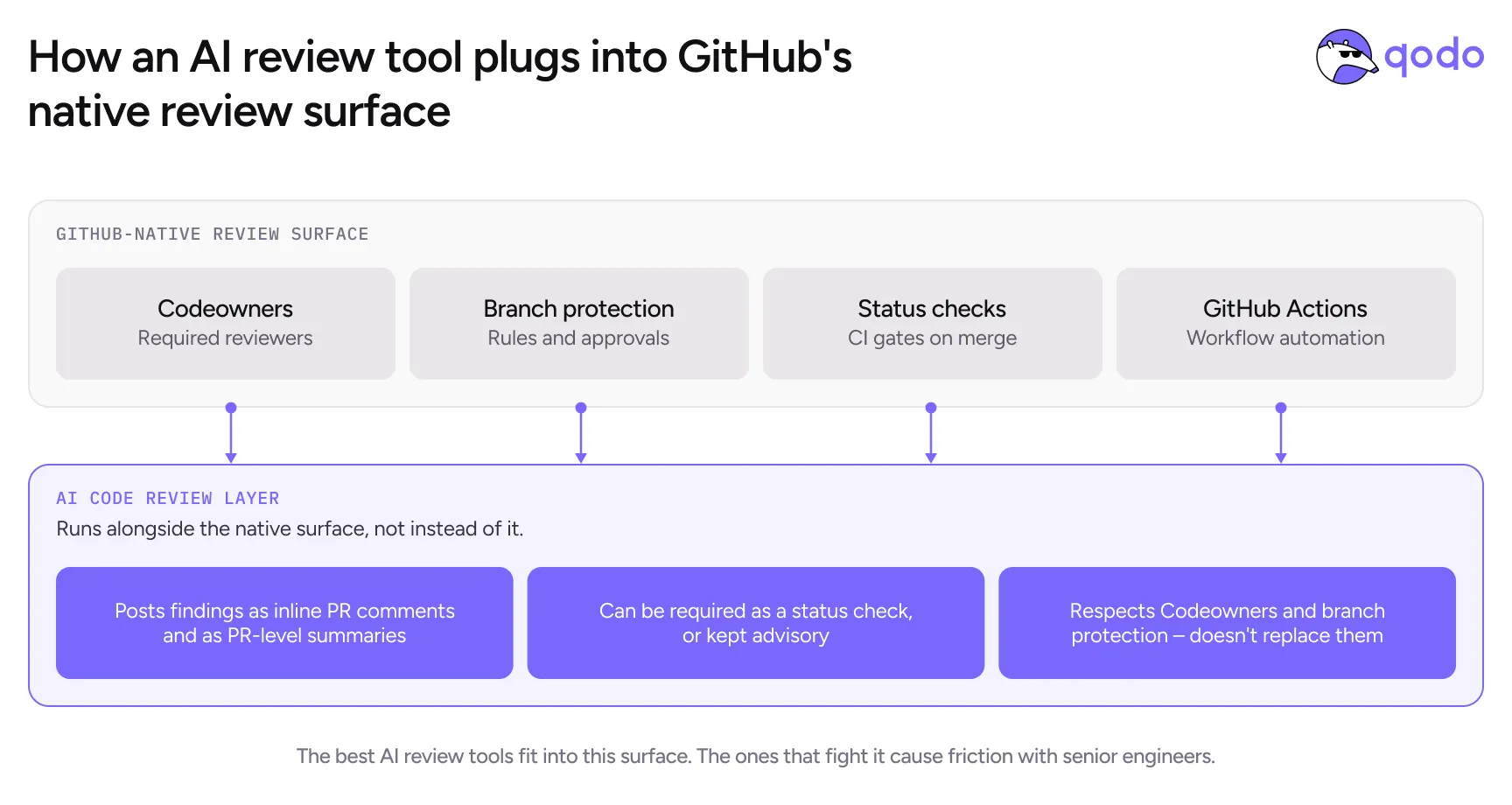
Cross-repository context is where Qodo earns its place on GitHub specifically. The Context Engine evaluates PRs against shared modules, API contracts, and organization-level rules that live in other repositories — not just the one being reviewed.
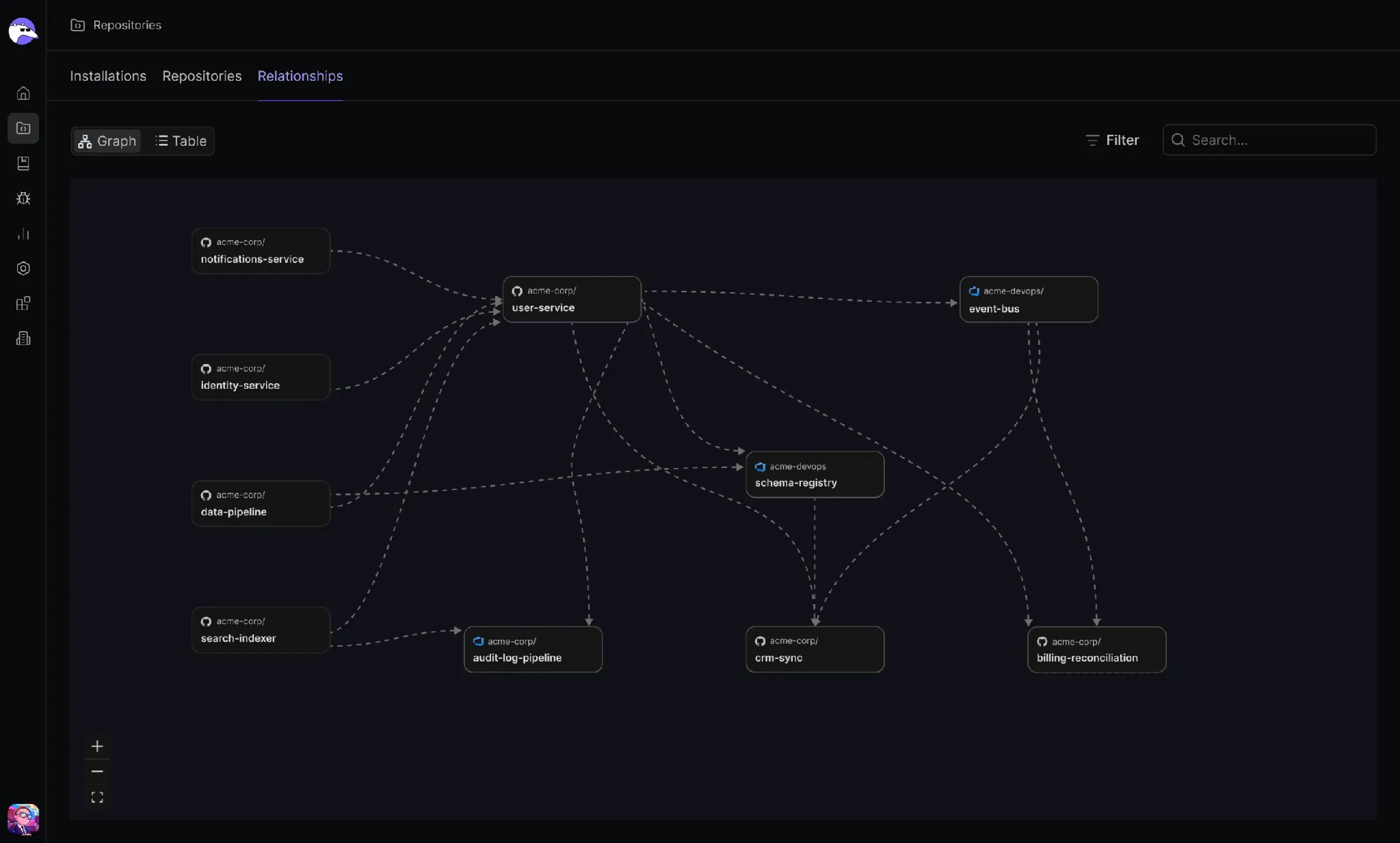
Take a realistic scenario: a developer removes an optional parameter from a function in backend-api. The change is clean, the tests pass, the PR ships. What nobody saw at review time is that frontend-app, payments-service, and auth-service all call that function. Two services break in production the next morning. Qodo’s Cross Repo Review catches this at PR time — it maps how repositories depend on each other, identifies downstream consumers of the changed code, and posts a cross-repo conflict finding on the PR with direct links to the affected lines in the consumer repos.
The relationship map behind cross-repo review
Qodo builds and maintains a map of how repositories depend on each other. The map stays in your control — teams choose which relationships Qodo reasons over — and feeds the Cross Repo Agent at PR time.
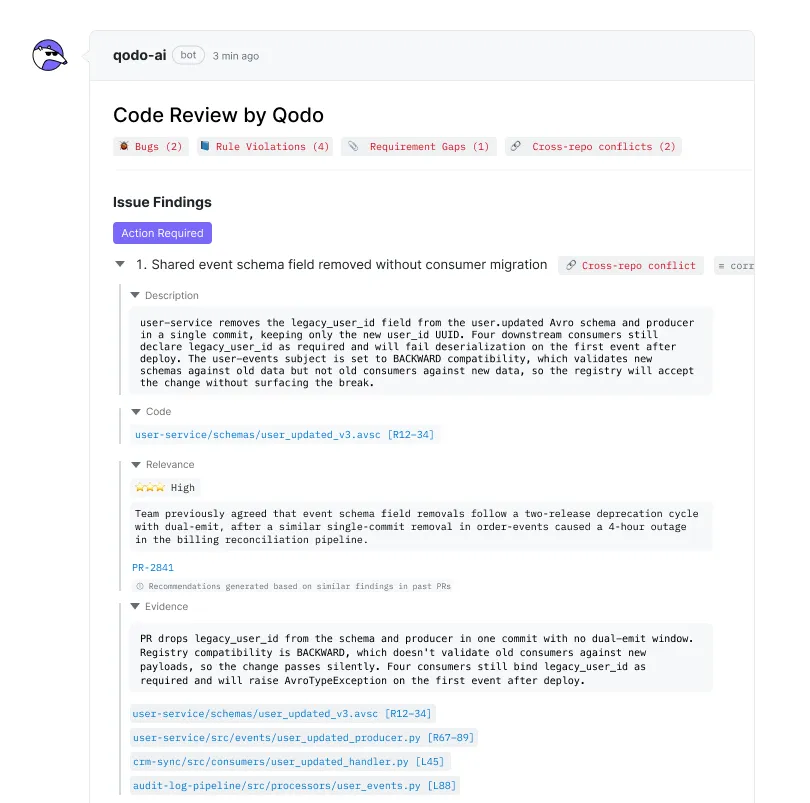
What a cross-repo finding looks like in a PR
Cross-repo conflicts appear as a new category of finding in the PR review, alongside bugs, rule violations, and requirement gaps. Each finding includes the affected files in consumer repos, an evidence trail, and a relevance score.
See it in action
Walkthrough: cross-repo review catching a breaking change in a real microservices project. The PR looks safe inside one repo, but Qodo follows the dependency graph to the consumer services and surfaces the downstream impact before merge.
Walkthrough: cross-repo review catching a breaking change in a real microservices project. The PR looks safe inside one repo, but Qodo follows the dependency graph to the consumer services and surfaces the downstream impact before merge.
This capability shipped in Qodo v2.4 alongside Rules Miner (which mines coding standards from your team’s PR review history) and Skill Review Standards (which governs the skill libraries that shape how AI tools write code in your codebase). The anatomy of a breaking change walks through why this class of bug clears single-repo review, and the cross-repository code review docs cover the Context Engine wiring.
What this looks like at scale
Monday.com runs Qodo across their engineering organization on GitHub and reports that Qodo prevents an average of 800 potential issues from reaching production every month while saving developers approximately one hour per pull request. A leading global retailer with 14,000+ developers deployed Qodo into an air-gapped environment and recorded over 450,000 developer hours saved in the first year, with more than 2,000 repositories onboarded. Both deployments show what AI code review looks like when it’s actually trusted by the team using it.
GitHub edition determines the shortlist
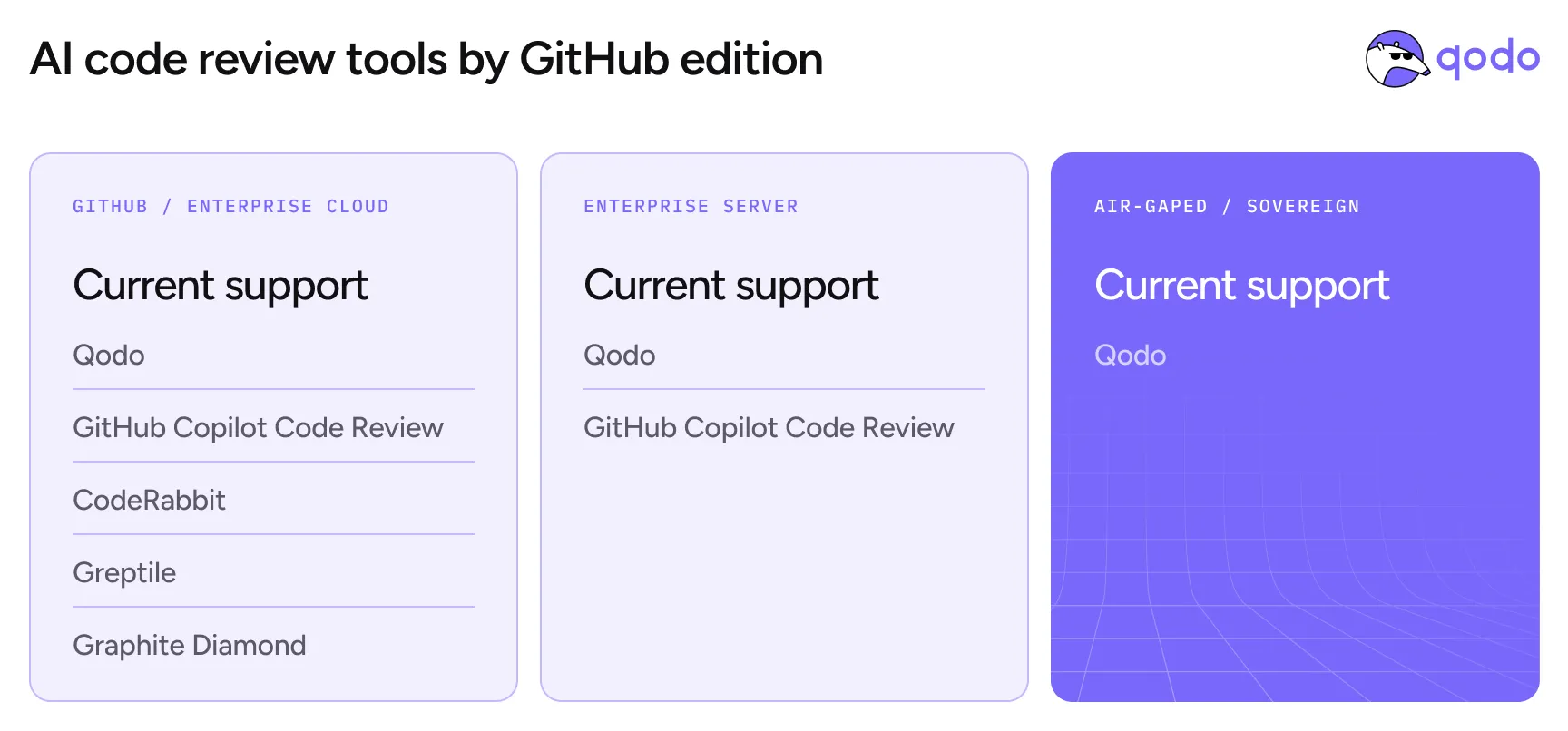
For teams running multiple Git providers — GitHub in one division, GitLab or Bitbucket in another — Qodo works across all four major providers from the same platform. A single review and governance layer across providers avoids the drift that comes from running different review tools per provider. Deployment models by Git provider has the specifics.
Where the other tools fit
- CodeRabbit is a GitHub integration with inline PR comments. Enterprise Server support is limited and air-gapped deployment isn’t covered. Review stays inside the current repository.
- Greptile is built around codebase indexing and natural-language search. GitHub works, Enterprise Server isn’t supported, and cross-repo coverage is limited to indexed repositories.
- Graphite Diamond is the AI review layer on top of Graphite’s stacked PR workflow. It works for teams already on Graphite. Enterprise Server, air-gapped deployment, cross-repository context, and a rules layer aren’t part of the product.
A few tools come up in AI code review conversations on GitHub but sit in adjacent categories rather than the AI code review category itself. Tabnine is built around AI code completion with some review capabilities layered on. Sweep is closer to an AI coding agent that handles small PR-sized tasks. Both can be useful, but neither is built as a dedicated review and governance layer — worth knowing about, not worth comparing line-by-line in a review-tool shortlist.
For head-to-head context, see CodeRabbit alternatives, Greptile alternatives, and Graphite alternatives.
Which tool fits which GitHub team
The right answer depends on where your team actually sits — not the textbook version of your setup, but what your PRs actually touch and what your engineering org actually needs to enforce.
If your team looks like this…
Start here
Why
Small team or open-source project on GitHub, single repo, no enterprise compliance requirements
Qodo free for open source projects, free trial or Pro team
Copilot Code Review requires Copilot Business. Free tiers from Qodo and CodeRabbit get you inline PR review without the licensing conversation.
Team already on GitHub Copilot Business or Enterprise, single repo, no cross-service dependencies
Start with Copilot Code Review
It’s already included. Turn it on, run it for a sprint, and evaluate honestly whether the signal quality is enough before adding another tool.
Mid-size team on GitHub with multiple services and shared libraries, but no Enterprise Server requirement
Copilot Code Review + Qodo
Keep Copilot for lightweight in-PR suggestions. Bring Qodo in for the cross-repo context and rules enforcement Copilot wasn’t built for.
Enterprise team on GitHub Enterprise Server or Enterprise Cloud with compliance requirements
Qodo + GitHub Advanced Security
Qodo covers AI review, cross-repo context, and the rules governance layer. Advanced Security covers secrets, vulnerability scanning, and SAST. Neither replaces the other.
Regulated enterprise on GitHub Enterprise Server, air-gapped or sovereign cloud deployment
Qodo
The only AI code review tool in this comparison with verified air-gapped and on-premise deployment support. Copilot Code Review covers Enterprise Server but not air-gapped environments.
The pattern across every profile: Copilot Code Review is the right starting point when it’s already paid for and the team’s review needs stay inside a single repository. Once the architecture has more than one service that depends on another, or once standards need to be enforced consistently rather than suggested, the team needs something built for that job.
When you’re ready to set up Qodo on GitHub, the installation docs walk through it in a few minutes.
Quick quiz: test your GitHub tool evaluation thinking
A team is already on GitHub Copilot Enterprise and asks whether Copilot Code Review is enough. What is the most accurate framing?
Select the correct answer
What does cross-repository context add for AI code review on GitHub?
Select the correct answer
Which capability narrows the GitHub AI code review shortlist the most?
Select the correct answer
Frequently Asked Questions
It can be, for single-repository teams already on Copilot Business or Enterprise who want lightweight in-PR suggestions. It doesn’t cover cross-repository context, a lifecycle-managed rules system, or multi-agent review. Many GitHub teams use it alongside a dedicated AI code review platform rather than as a complete solution.
Qodo and GitHub Copilot Code Review both support Enterprise Server. Qodo also supports air-gapped and sovereign cloud deployments, which makes it the broadest fit for regulated environments. CodeRabbit, Greptile, and Graphite Diamond don’t fully cover Enterprise Server.
Yes. Qodo runs as a GitHub Action and posts review findings back to the PR thread automatically. The Review Agent Suite triggers on PR open without additional CI configuration.
Yes. Qodo plugs into GitHub’s native review surface rather than replacing it. CODEOWNERS, branch protection, required reviewers, and status checks continue to work the way your team has them configured. Qodo’s review is advisory: findings appear in the PR for your team to resolve, or dismiss with a recorded reason, and your existing GitHub rules decide what merges.
Yes. Many teams already on Copilot keep Copilot Code Review for in-PR suggestions and use Qodo for cross-repository review, rules enforcement, and multi-agent analysis. The two cover different layers and don’t conflict.
Open-source projects are eligible for free tiers across most tools in this comparison. Qodo offers a free tier for open-source repos and individual developers.
No. GitHub Advanced Security handles secret scanning, dependency review, and code scanning through static analysis. AI code review tools handle context-aware PR analysis, architecture rule enforcement, and reasoning about why a change matters. Most enterprise teams run both — Advanced Security as the security layer, an AI code review tool as the review and governance layer.