

Rolling Out AI Code Review at Enterprise Scale
Rolling out AI code review across an enterprise means accounting for different teams, repositories, deployment models, and engineering environments. This chapter shows how to structure that rollout without losing consistency in how review is configured, governed, and measured.

Key Takeaway
There is no single right way to roll out AI code review across an enterprise. A legacy monolith, a 300-repo microservices estate, an on-prem regulated environment, a multi-provider Git landscape, and an AI-native engineering org each break in a different place first. Each needs a different rollout sequence. This chapter walks through five enterprise scenarios drawn from real deployments: what the organization looks like, what fails if you roll out naively, and the path that works. Find your organization, then follow its path.
What You’ll Learn
- The five enterprise scenarios, and how to identify which one you are
- What breaks first in each scenario if you roll out without a plan
- The rollout sequence that works for each: legacy codebases, multi-repo estates, on-prem, multi-provider, AI-native
- How to run rollout waves, and the configuration hierarchy that keeps them consistent
- Who owns rules when forty teams can write them
- What to measure at each wave, and when to declare the rollout done
Find Your Organization: Five AI Code Review Rollout Scenarios
This chapter assumes the evaluation phase is behind you. If you are still choosing a tool or scoping a trial, start with How to Run an AI Code Review POC and the tool comparison and benchmarks chapter, then come back here to plan the rollout.
Most enterprises are a blend, but one scenario usually dominates, and that scenario should set your rollout sequence. Identify yours before planning anything:
Scenario
You are this if…
What breaks first in a naive rollout
1. The legacy codebase enterprise
A 10–20-year-old codebase, thin test coverage, conventions living in senior engineers’ heads, review as mentoring
First contact with old code produces noisy findings, and the team reads the noise as a verdict instead of a starting point
2. The multi-repo estate
Hundreds of repositories, microservices, breaking changes that cross service boundaries
Rollout sequenced by org chart instead of dependency clusters, so cross-repo detection never gets a fair test
3. The regulated on-prem enterprise
Self-hosted or air-gapped requirement, model access approval-gated, every external URL needs a ticket
The rollout stalls on people with permissions – DNS, OAuth apps, model approvals – not on the technology
4. The multi-provider Git estate
GitHub in one division, GitLab or Bitbucket in another, often from acquisitions
Each division gets configured separately from scratch, standards drift between providers, and nobody owns parity
5. The AI-native organization
Coding agents opening PRs at volume, review demand growing faster than reviewer headcount
The PR gate becomes the bottleneck it was supposed to remove, because review was never integrated into the agent workflows generating the code
Scenario 1: The Legacy Codebase Enterprise
The profile: a decade-old codebase, standards living in senior engineers’ heads
A platform that has shipped for a decade or more. Java or C# at the core, a React layer added later, test coverage that arrived after the fact. The real engineering standards are undocumented. They live in the review comments of three or four senior engineers, and code review doubles as the mentoring system. AI adoption is early: the team is “dabbling” with an assistant like Copilot, and review is already the bottleneck on at least one team.
What breaks first: week-one noise gets read as the verdict
First contact between an AI reviewer and a legacy codebase happens through the PRs touching it, not a scan of the whole thing. But those new diffs land on years of undocumented convention the reviewer has no context for, and the findings pile up fast: a lot of them, and many are technically true but irrelevant to code nobody plans to touch. If the rollout treats week-one volume as the verdict, the team concludes the tool is noisy and disengages. The noise is not the result; it is the raw material.
The rollout path: start where PRs flow, mine rules from history
- Start where the code is alive. Not the oldest, most haunted part of the monolith, but the services where PRs actually flow today. Review only produces signal where changes are moving – and legacy systems often see a handful of PRs a month, so pointing wave one at them stalls the rollout before it starts. Begin with real PR traffic; the monolith’s turn comes once the rules are tuned.
- Mine the rules out of your PR history. PR history analysis learns from how your senior engineers have reviewed for years: what they flag, what they wave through. That converts the mentoring knowledge in their heads into rules the whole org inherits. This is knowledge retention as much as review automation..
- Scope review to changes, not the archive. For legacy code, findings on untouched files should be deferred by scoping review to changed code and its blast radius. Confirm this is how your tool behaves by default, since it’s what keeps legacy rollouts from opening with an archaeology report instead of a PR review.
- Protect the mentoring function explicitly. In a legacy org, review is how juniors learn. Position the AI layer as the first-pass reviewer that frees seniors for the architectural feedback only they can give, not as the replacement for the conversation.
If you’re rolling out on a legacy codebase: learn from the incumbents before replacing anything
The situation (from a real Qodo deployment): an industrial automation enterprise with a decade-old Java/React platform. The real standards lived in a few senior reviewers’ heads.
The move: they pointed Qodo’s PR-history learning at how those seniors actually review, and (as a global automaker did in the same position) interviewed the incumbent static analyzer’s power users before mapping any replacement.
What it won them: knowledge retention instead of knowledge loss. The most influential skeptics became the source of the system’s rules.
Apply it to your own rollout: inventory both incumbents: the static analysis stack and the reviewers whose comments are the de facto standard. Then run the rule miner after two to three weeks of PR flow; suggestions pass a human gate, so early weeks are for evidence, not enforcement.
In Qodo: turn on Rule Miner at the org level in suggested mode, so mined rules queue for human approval instead of going live automatically – that’s the human gate this scenario depends on. PR history indexing is what it learns from.
Scenario 2: The Multi-Repo Estate
The profile: hundreds of repositories, breaking changes that cross service boundaries
Hundreds of repositories. Frontend, backend, and shared libraries live apart; a change to a shared component can break services three repos away; the incident postmortem says “nothing in the PR showed who depended on it.” Teams own services, but nobody owns the seams between them.
What breaks first: org-chart sequencing leaves the seams dark
The instinct is to roll out team by team, following the org chart. But cross-repo detection – the reason a multi-repo estate buys AI code review – only proves itself when connected repositories that actually depend on each other are covered together. Roll out by org chart and every wave tests single-repo review; the seams stay dark.
The rollout path: sequence by dependency cluster, map the relationships first
- Sequence by dependency cluster, not org chart. Pick a frontend, its backend, and the shared library between them, a cluster where changes demonstrably cross boundaries. That cluster is wave one, regardless of which teams own the pieces
- Define the repository relationships explicitly. Cross-repo review starts from a map of which repositories relate to which. In practice this is generated: a provided skill scans and produces the relationship file, which the platform then uses to run impact analysis on every PR
- Expect bugs across repos, rules within them. Cross-repo findings target breaking changes and real bugs across boundaries: the blast radius of a change. Standards enforcement stays per-repo. Expecting rules written in one repo to police another is the most common misconfiguration expectation
- Mind the branch logic. By default, impact is checked against the main branch of adjacent repos; teams with long-lived release branches should specify the comparison branch per PR where it differs
If you run hundreds of repositories: map the relationships before expecting cross-repo findings
The situation (from a real Qodo deployment): a vertical SaaS company onboarding onto Qodo’s cross-repository review.
The move: the kickoff went to data, not agents: a Qodo-provided skill generated the repository relationship map, and every PR in a connected repo got impact analysis against its neighbors from then on.
What it won them: findings badged as cross-repo, next to a gallery showing exactly which adjacent repositories were checked. That gallery answers reviewers’ first trust question.
Apply it to your own rollout: spend the first hour mapping which repos interconnect; that map is what makes every later finding possible. Teach reviewers to read the context gallery in week one.
In Qodo: define the repository relationships for your wave-one dependency cluster before the first PR – cross-repo impact analysis runs off that map, and traces impact in both directions.
Scenario 3: The Regulated On-Prem Enterprise
The profile: code cannot leave the environment, and every resource has an approver
Healthcare, finance, defense, government. Code cannot leave the environment; the deployment is self-hosted or air-gapped; model access runs through an internal AI gateway with its own approval chain. Every DNS entry, OAuth app, and cloud resource has an owner, and that owner has a queue.
What breaks first: the rollout stalls on approvers, not architecture
Nothing technical. On-prem architecture is well-trodden: a handful of services (review backend, metadata, indexer, context retriever) plus supporting infrastructure – a Redis instance, two DNS entries, a Git OAuth app registered at the organization level, and approved model capacity. What actually stalls rollouts is that each of those five items belongs to a different person: the architect who can register the OAuth app, the infra engineer who provisions DNS and Redis, the platform owner who approves the model, procurement for the billing project. One unavailable approver can idle the whole deployment for days.
The rollout path: name every dependency owner and schedule the people
- Name the owner of every dependency. Before the first deployment call, list every dependency with a named owner: DNS entries, Redis, the Git OAuth app (org-level, needs client ID, secret, and callback URLs), model/gateway access, and the billing project behind it. The rollout plan is that list with dates.
- Provision model capacity like production infrastructure. If the AI gateway is metered, size the rate limits for review traffic before wave one; a limit set for chat-scale usage will crash review runs at PR-scale volume. In one deployment, raising throughput on the gateway from 100 to several thousand requests per minute was the difference between reviews failing silently and running reliably.
- Engineer the model mix for cost. Model economics compound at rollout scale: default to cost-efficient models for indexing and high-volume paths, reserve premium models for the review reasoning itself, and revisit the mix after wave one with real usage data.
- Sequence installs around approvers’ calendars. Deployment moves in dependency order (infrastructure, then platform, then integrations), and each handoff is a meeting where the right approver must be in the room. Schedule those people, not just the milestones.
If you’re deploying on-prem: assign a named owner to every prerequisite
The situation (from a real Qodo deployment): a large healthcare enterprise deploying Qodo fully on-prem.
The move: Qodo provided the complete prerequisites in writing (DNS entries, Redis, an org-level Git OAuth app, approved model capacity, gateway auth headers), and each item got a named owner on the customer side.
What it protected them from: idle days waiting on the one person who could approve each item. The install moved in dependency order with the right approver in each session.
Apply it to your own rollout: get the prerequisites list in writing before the first deployment session, and schedule the approvers, not just the milestones.
In Qodo: the deployment prerequisites in this scenario – DNS, Redis, the org-level Git OAuth app, model capacity – are the documented install sequence; get the list in writing and assign each item its owner.
Scenario 4: The Multi-Provider Git Estate
The profile: GitHub in one division, GitLab in another – usually from acquisitions
GitHub in the product division, GitLab in a business unit that was acquired, Bitbucket or Gerrit in an older engineering group. Sometimes cloud Git with on-prem infrastructure, sometimes the reverse. Each division has its own admins, its own conventions, and its own opinion about tooling.
What breaks first: configuration drift between providers
Parity. Each provider integration gets configured independently, by different admins, at different times, and six weeks in, the GitLab division’s review behaves differently from the GitHub division’s, standards have drifted, and nobody can say which configuration is canonical.
The rollout path: template the simplest provider, appoint a parity owner
- Lead with the simplest provider, template the rest. Start with the division whose Git setup is most standard (usually cloud GitHub or GitLab), prove the configuration there. Teat it as the template the other providers inherit, adapted only where the provider genuinely differs.
- Decide cloud-to-cloud vs. on-prem backend per provider, deliberately. For a cloud Git provider, a cloud-to-cloud connection validates the tool in days; an on-prem backend adds networking, webhook routing to a backend URL, and database provisioning. One real team facing this choice went cloud-first explicitly to validate long-term viability quickly, keeping on-prem as the later step if the tool earned it.
- Stage the context depth. Full codebase indexing can follow the rollout rather than lead it: for a division that mainly needs PR review validated, deferring the context engine to a later wave reduces install friction without blocking the evaluation.
- Appoint a parity owner. One person owns cross-provider parity: the same rules, the same feedback behavior, the same thresholds on GitHub and GitLab alike. Without that owner, drift is not a risk, it is a schedule.
If you’re weighing cloud vs. self-hosted integration: start light, deepen when the rollout earns it
The situation (from a real Qodo deployment): a media company’s engineering group planning its GitLab integration with Qodo.
The move: with both paths available (self-managed backend or cloud-to-cloud), they went cloud-to-cloud first, staged full codebase indexing for a later wave, and ran the security questionnaire in parallel.
What it won them: reviews on live PRs within days instead of an infrastructure project, with the deeper deployment held ready for when the rollout needs it.
Apply it to your own rollout: match integration weight to adoption stage, and keep a one-page “provider deltas” doc so later divisions inherit answers instead of rediscovering problems.
In Qodo: put your standards in the portal at the organization level and reserve .pr_agent.toml for genuine per-repo exceptions – the configuration precedence (repo > Git org > portal) is what makes the template inheritable across providers.
Scenario 5: The AI-Native Organization
The profile: coding agents open PRs faster than reviewers can cover
Coding agents – Claude Code, Cursor, internal agents – open a meaningful share of PRs. Engineers interact with agents in the IDE and terminal all day. PR volume grows faster than reviewer headcount, review time climbs, and the engineering leadership question has shifted from “should we adopt AI review” to “how do we keep quality attached to this volume.”
What breaks first: the PR gate becomes the new bottleneck
The gate. If review exists only at the PR, agent-generated code arrives there in volumes the gate was never sized for and the review layer becomes the new bottleneck. In an AI-native org, review has to move to where the code is generated, not just where it is merged.
The rollout path: anchor at the PR, then shift review into the IDE and agents
- Anchor at the PR first. PR review is still the anchor: it is where quality is provable and measurable. Wave one looks like any other rollout: connected repos, rules, dashboards.
- Then shift left into the IDE and agent workflows. Developers should see findings in the IDE and resolve them with their coding agent before a PR exists. In practice that means review skills the agents can invoke: pulling org rules into the agent’s context, fetching PR comments for local resolution, and pre-PR review of committed and uncommitted changes.
- Feed the rules to the agents. The same rules the PR gate enforces should be exported into the coding agents’ context, so the agent writes compliant code in the first place and the gate confirms rather than corrects.
- Close the loop from production. AI-native teams ask for learning loops: production incidents, regression bugs, and Jira tickets feeding back into review context so the reviewer gets smarter about what actually breaks. Treat that as a wave-three capability with a named owner, not a demo-day wish.
If your organization is AI-native: plan for the trial to outgrow the PR gate
The situation (from a real Qodo evaluation): a semiconductor enterprise, three weeks in, with coding agents already part of daily development.
The move: by week three the asks had shifted from “does it work” to “how deep can it go”: findings in IntelliJ, resolution through terminal agents, cross-repo awareness, learning loops from incidents.
What it won them: proof the evaluation question was answered. A trial that generates integration requests instead of objections has already made the decision.
Apply it to your own rollout: plan wave two around that trajectory from day one, and sequence shift-left after rules mature; agents amplify whatever the rules say.
In Qodo: enable the Per commit trigger so agent-driven PRs get re-reviewed on every push, and install Agent Skills so coding agents pull org rules into their context pre-PR.
AI Code Review Rollout Waves: The Sequence That Works in Every Scenario
Whatever your scenario, the wave structure is the same; only the contents of each wave change:
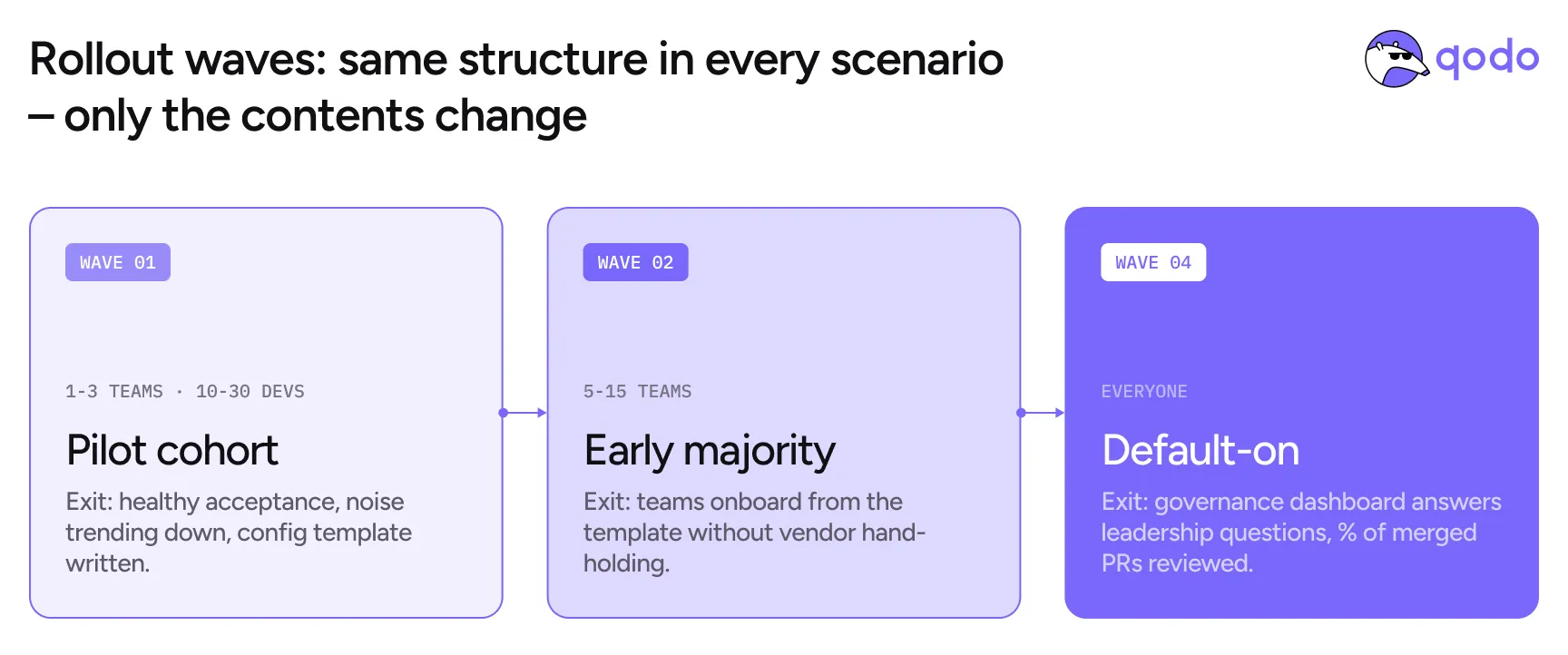
Wave
What happens
Scale
Exit criteria
Wave 1: Pilot cohort
The scenario-specific starting point from this chapter: the alive repos, the dependency cluster, the simplest provider. Rules mined, configuration templated, champions identified
1–3 teams, 10–30 developers
Acceptance rate healthy; noise trending down; a documented configuration template
Wave 2: Early majority
Teams that opted in after seeing wave 1. Org-level configuration applied; per-repo overrides only where justified; champions from wave 1 support onboarding
5–15 teams
New teams onboard from the template without vendor hand-holding
Wave 3: Default-on
Review becomes the default for every new repository; exceptions require a reason. Shift-left, cross-repo, and learning-loop capabilities land here
Everyone
Coverage measured as % of merged PRs reviewed; leadership reads the governance dashboard, not anecdotes
The configuration hierarchy is what keeps waves consistent
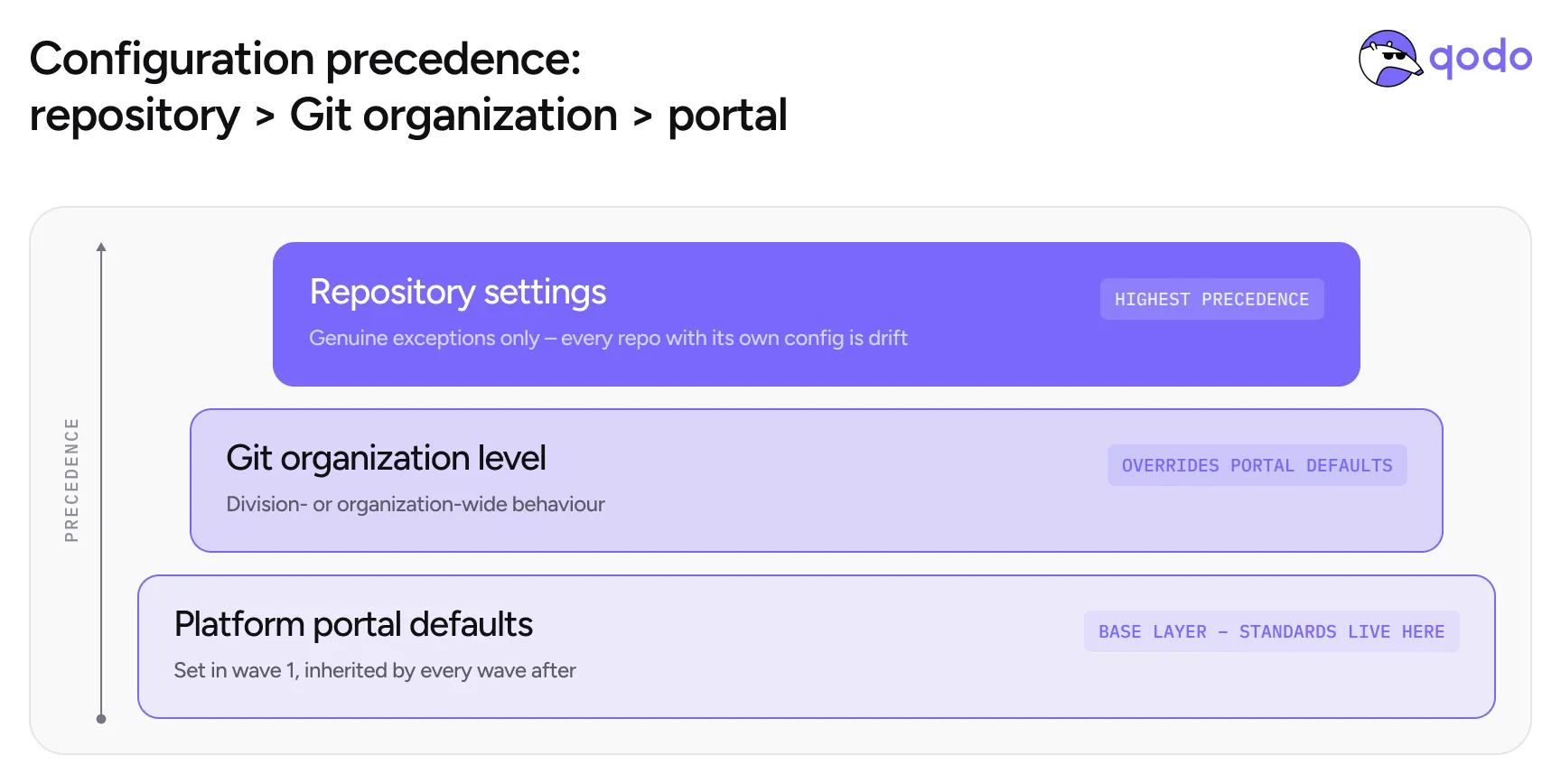
Configuration resolves in a strict order of precedence: individual repository settings override Git-organization-level settings, which override platform-portal defaults. Use that deliberately – put your standards at the org and portal level in wave one, and reserve repo-level settings for genuine exceptions. A rollout where every repo carries its own configuration is a rollout that has already drifted.
Practical tip: connect Okta/SSO and document config precedence before wave two
One enterprise platform team required exactly these two things before scaling past the pilot: identity-provider integration, so users and teams sync automatically instead of being added by hand, and the configuration precedence (repository > Git org > portal) in writing. Neither matters at pilot scale; both hurt at org scale.
Rules Governance at Rollout Scale: Who Owns the Rules When Forty Teams Can Write Them
Rules need an owner the same way code does
At pilot scale, one champion writes the rules. At org scale, rules become a governed asset: a platform or DevEx team owns the global set, individual teams own their scoped additions, and everything lives in one portal as the single source of truth.
The mechanics that make it governable
- Two scopes, two owners. Rules apply globally (organization-wide standards: naming, security patterns, review conventions) or scoped to specific repositories (a team’s domain rules). Global rules are the platform team’s; scoped rules are the owning team’s.
- Mined suggestions, human gate. Rule suggestions are generated from code patterns and recurring PR discussions, but a human reviews and approves each suggestion before it activates. Treat that approval queue as a weekly platform-team ritual, not an inbox.
- Prune with data. Analytics show which rules fire, which get implemented, and which are ignored as noise. A rule that fires constantly and is never acted on is not a standard. It is spam with a badge. Retire it.
For the mechanics as implemented in Qodo, global and repository scopes, mined suggestions, rule analytics, see rules in Qodo and the documentation.
Practical tip: run a 30-minute rule review every two weeks from wave two
Platform team plus one rotating champion: approve mined rule suggestions, retire rules that fire without being acted on, and publish the changelog to engineering. Rules that change silently lose trust.
What to Measure at Each Rollout Wave
Wave
The numbers that matter
The trap to avoid
Wave 1
Acceptance/implementation rate (with the definition agreed in writing), false-positive trajectory after tuning, time to first review feedback
Judging raw finding volume – especially on legacy code, volume is raw material, not a verdict
Wave 2
Teams onboarded per month from the template, % of configuration inherited vs. overridden, champion-to-team ratio
Counting repos connected – connection without engagement is the vanity metric from the POC chapter at 10x scale
Wave 3
% of merged PRs reviewed, rule coverage on governed standards, issues caught pre-merge vs. escaped to production, cost per developer at full scale
Declaring done at “installed everywhere”. Ddone is when the governance dashboard answers leadership’s questions without anyone pulling a manual report
Running your AI code review rollout on Qodo
Scenario coverage: cross-repo capabilities, custom agentic workflows, and Gerrit support are Enterprise-plan features; GitHub, GitLab, Bitbucket, and Azure DevOps are supported across plans, and deployment options span multi-tenant SaaS, single-tenant SaaS, and on-prem / air-gapped with BYOK for gateway-routed model traffic.
The governance layer: rules in Qodo live in one portal with global and repository scopes, mined rule suggestions pass a human approval gate before activating, and the governance analytics dashboard is what wave-three leadership reporting runs on.
Shift-left for AI-native teams: review skills let coding agents pull org rules into their context, fetch PR comments for local resolution, and run pre-PR review on committed and uncommitted changes – the wave-three capabilities in Scenario 5.
Enterprise rollouts run with a dedicated onboarding engineer and a CSM, the deployment sequencing in Scenario 3 is a standard motion, not a special request.
Where to go deeper: plans and pricing · enterprise overview · Context Engine · Git integration · documentation · Trust Center
Let’s see what you’ve learned!
What breaks first in a multi-repo rollout?
Select the correct answer
Week one on a legacy codebase produces a flood of findings. What does that mean?
Select the correct answer
What most often stalls a regulated on-prem rollout?
Select the correct answer
Planning a rollout across one of these scenarios?
Questions?
Wave one (pilot cohort) typically runs three to six weeks including tuning. Wave two scales with your onboarding capacity, teams should be joining from a configuration template, not from scratch. Most enterprises reach default-on within one to two quarters; regulated on-prem environments add time up front for infrastructure and approvals, not at the end. Qodo enterprise rollouts run with a dedicated onboarding engineer and CSM, which is what keeps wave one inside that window.
Sequence by scenario, not org chart. In a multi-repo estate, wave one is a dependency cluster, a frontend, its backend, and the shared library between them, so cross-repo detection gets a real test. In a legacy enterprise, wave one is the repos where PRs actively flow. The org chart tells you who to invite; the codebase tells you where to start. In Qodo, cross-repo review runs on a defined repository relationship map, which is exactly why wave one should be a dependency cluster rather than a department.
Scope review to changed code and its blast radius rather than the archive, mine rules from your PR history so the tool learns how your senior engineers actually review, and judge the false-positive trajectory after tuning – not the week-one volume. Legacy first contact always produces noise; the rollout plan is what converts it into standards. Qodo scopes review to changed code and its blast radius by default, and its Rule Miner turns your PR history into rule suggestions a human approves before anything activates.
Yes. Qodo deploys on-prem and fully air-gapped on Enterprise plans, an established pattern for regulated enterprises: a small set of services plus Redis, DNS entries, an org-level Git OAuth app, and approved model capacity (including BYOK through an internal AI gateway). The critical path is the approval owners for each item, so map those people before the first deployment session
A platform or DevEx team owns the global rule set and the approval queue for mined rule suggestions; individual teams own rules scoped to their repositories. Keep everything in one portal as the single source of truth, review the rule set on a standing cadence, and retire rules that fire without being acted on. In Qodo, rules carry global and repository scopes and mined suggestions pass a human approval gate, which is what makes the governance model workable at forty teams.
Use the configuration precedence deliberately: standards live at the organization and portal level, repo-level settings are reserved for genuine exceptions, and one named owner is accountable for parity across providers. Lead the rollout with the simplest provider, turn its configuration into a template, and keep a one-page “provider deltas” document so later divisions inherit answers. Qodo’s configuration precedence (repository > Git organization > portal) is built for exactly this: standards live low in the stack once, and every division inherits them.