

Best AI Code Review Tools for Azure DevOps (2026)
Azure DevOps is a different kind of platform from GitHub. It ships with Boards, Repos, Pipelines, and Test Plans as one integrated product — and many teams running it are on the full Microsoft stack. That shapes the AI code review question differently: the integration bar isn’t just whether a tool supports Azure Repos pull requests, it’s whether it runs as a Pipelines task, links to Azure Boards work items, and handles on-premise deployment for the large share of enterprise Azure DevOps teams that can’t route source code through external SaaS.

Key Takeaway
The Azure DevOps AI code review shortlist is shorter than GitHub’s and shaped by different constraints. The Microsoft ecosystem covers security scanning and static analysis naturally. What it doesn’t provide is a review layer that reasons across repositories, enforces architectural standards from your team’s own PR history, or runs inside Azure DevOps Server for teams that can’t route source code through external SaaS.
What You’ll Learn
- Which AI code review tools natively support Azure DevOps in 2026
- How Azure DevOps Services and Azure DevOps Server create different shortlists
- Why mined rules and cross-project review matter for enterprise Azure DevOps teams
- How the Microsoft security and static analysis layer fits alongside AI code review
- Which tool fits which Azure DevOps team
Azure DevOps and GitHub are not the same platform
Microsoft owns both, but they’re built for different buyers. GitHub is built around the open-source developer experience and has the widest AI code review ecosystem of any Git provider. Azure DevOps is built for enterprise software delivery — project tracking, test management, release pipelines, and source control as one integrated platform.
The practical difference for AI code review: fewer tools support Azure DevOps, the CI integration runs through Azure Pipelines rather than GitHub Actions, and a significant share of enterprise Azure DevOps customers run Azure DevOps Server on-premise. That on-premise share rules out most AI code review tools before the evaluation starts. See what AI code review actually does for a grounding overview of the category before comparing tools.
The Azure DevOps AI code review tools shortlist
The shortlist for Azure DevOps is narrower than GitHub’s or GitLab’s. The tools worth evaluating fall into three groups.
- Dedicated AI code review platforms: Qodo
- GitHub’s AI offering extended to Azure DevOps: GitHub Copilot Code Review — available for Azure DevOps Services via a GitHub integration, with limitations compared to its native GitHub experience.
- Security and static analysis that pairs with AI review: GitHub Advanced Security for Azure DevOps (GHAS for ADO), Snyk, SonarQube. These cover security scanning and quality gates — a different layer from AI-driven PR review.
Greptile, Graphite Diamond, and most other tools in the broader AI code review category do not support Azure DevOps. The shortlist here is genuinely shorter than most comparisons suggest.
What “Azure DevOps support” actually means in 2026
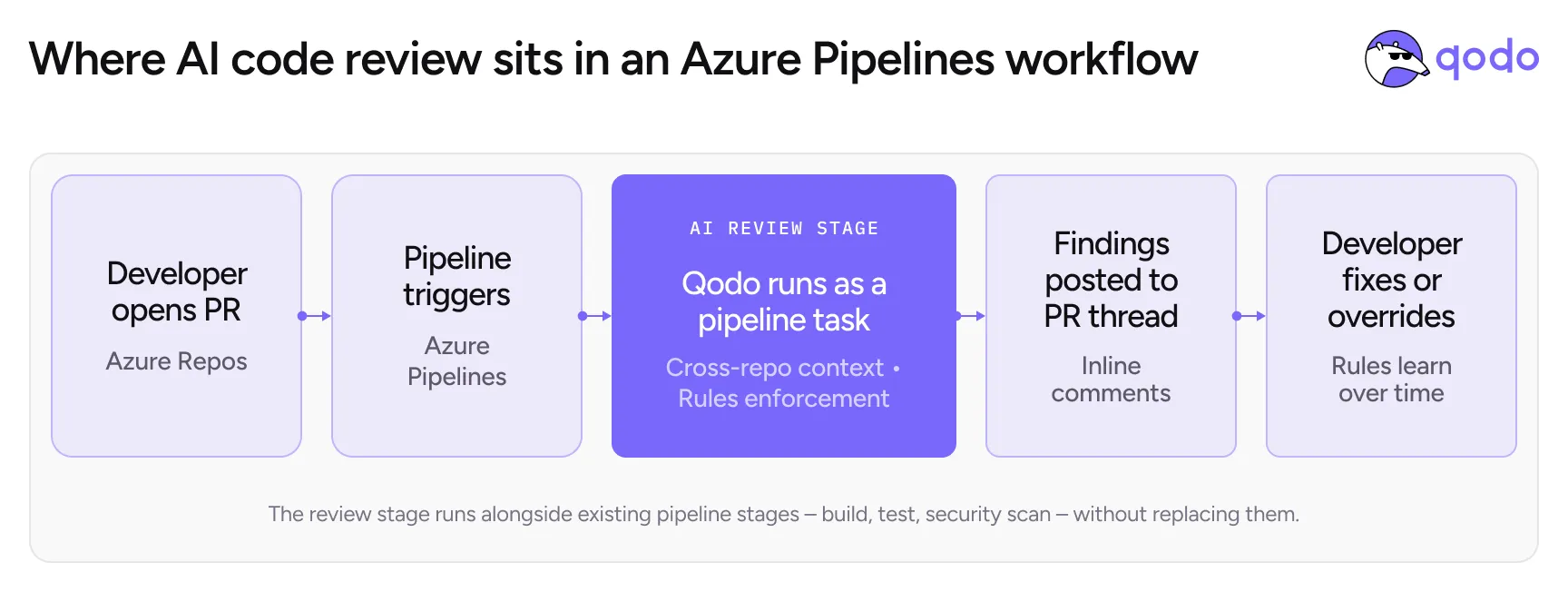
“Supports Azure DevOps” can mean a webhook posting a comment on a pull request, or it can mean native integration with Azure Pipelines, Azure Boards work items, Azure DevOps Server, and air-gapped deployment. Get specific before you start evaluating.
Azure DevOps integration capabilities worth verifying
Use this as your checklist when reading vendor docs. The gap between tools is widest at rows 4 and 5.
Capability
Why it matters for your team
Native inline PR comments in Azure Repos
Findings appear inside the pull request thread, not in a separate dashboard
Azure Pipelines integration
Review runs as a pipeline task and posts results back to the PR automatically
Azure Boards work item linking
Findings link to existing work items, reducing context switching for teams tracking work in Boards
Azure DevOps Server support
Required for teams running self-hosted Azure DevOps on internal infrastructure
Air-gapped and on-premise deployment
Required for regulated environments and sovereign deployments
Cross-repository context
Review evaluates PRs against shared modules and rules across multiple repositories
How the leading tools compare on Azure DevOps
Most tools cover basic PR review on Azure DevOps Services. The shortlist narrows sharply for Server, air-gapped deployment, and cross-repo context.
ADO Services
ADO Server
Air-gapped
Azure Pipelines
Cross-repo context
GitHub Copilot Code Review’s Azure DevOps support requires connecting through a GitHub integration and is more limited than its native GitHub experience. For teams whose primary environment is Azure DevOps, this creates meaningful friction.
The governance gap in enterprise Azure DevOps
Enterprise Azure DevOps teams share a problem that affects most large engineering organizations: coding standards are real and consistently applied by senior reviewers, but they live in people’s heads and PR comment threads rather than formal documentation.
The onboarding engineer learns the hard way. The reviewer leaves the same comment for the third time. This is the category problem that code review best practices literature addresses in principle but tools rarely solve in practice.
Two capabilities close this gap specifically on Azure DevOps:
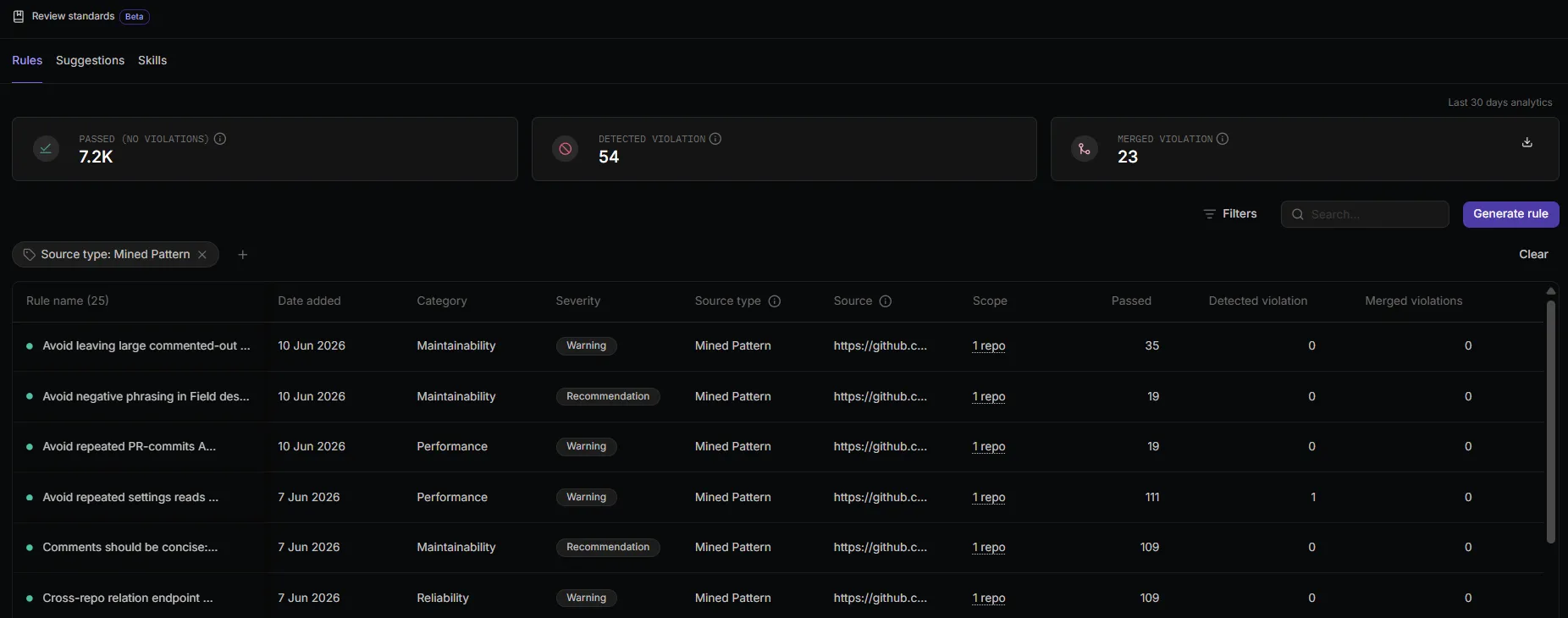
- The first is mined rules: rather than requiring manual rule creation, the tool analyzes your organization’s Azure DevOps pull request history, surfaces recurring review patterns, and generates enforceable coding standards from them automatically. Comments that were accepted by developers and led to code changes become rules. The rule set maintains itself — if a generated rule consistently gets overridden, its signal fades and it drops out naturally.
- The second is cross-project context. A PR that looks clean inside one Azure DevOps project can still break a shared contract that other projects depend on. Cross-project review maps how your repositories depend on each other and surfaces those conflicts as findings on the PR before the code merges. The anatomy of a breaking change walks through exactly why this class of bug clears single-repo review.
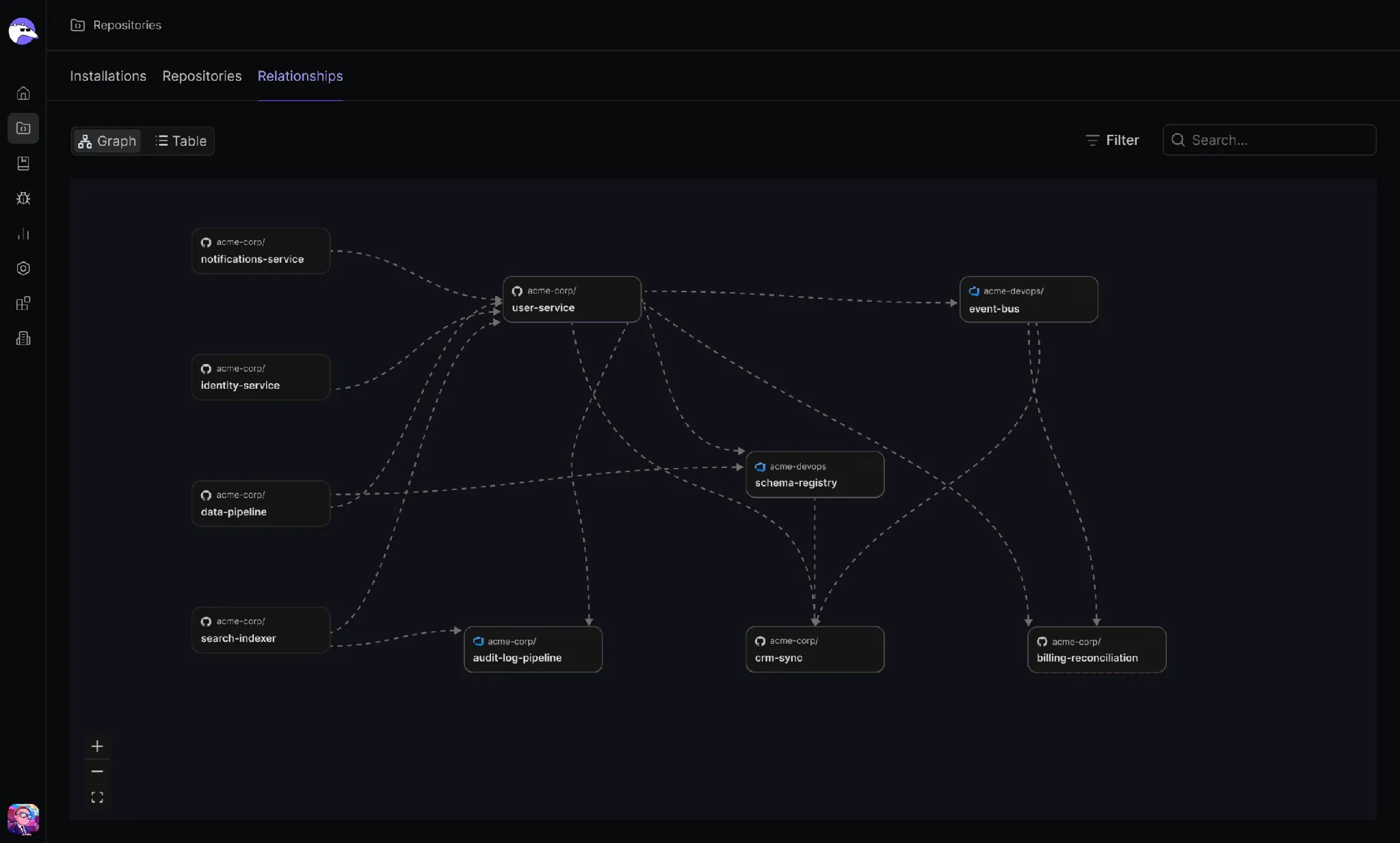
Both capabilities are part of Qodo v2.4, available in Beta on Azure DevOps now. See the Rules Miner docs and cross-repository code review docs for setup details.
What this looks like at scale
A leading global retailer with 14,000+ developers deployed Qodo into an air-gapped environment and recorded over 450,000 developer hours saved in the first year, with more than 2,000 repositories onboarded. A major financial software company with 9,000+ developers runs Qodo on-premise across 2,500+ repositories and reports over 100,000 hours saved per year. Both are the kind of regulated, self-hosted deployments where most AI code review tools can’t be used.
AI code review for Azure DevOps Server and regulated environments
Azure DevOps Server is the self-hosted edition of Azure DevOps, used by enterprises that run their own infrastructure for compliance, security, or data residency reasons. The same reasons those teams chose self-hosted Azure DevOps are the reasons they can’t use cloud-only AI code review tools.
If your team is on Azure DevOps Server, every row in this table applies before any other evaluation criterion.
Requirement
Why it’s needed
On-premise or single-tenant deployment
Source code can’t be sent to external multi-tenant APIs
Air-gapped environment support
Tool must run without outbound internet access
FedRAMP, SOC 2, or equivalent compliance
Required for regulated industries and government work
Audit logging
Review decisions need to be traceable for compliance
SSO and SAML integration
Required for enterprise identity infrastructure
On Azure DevOps Server, the AI code review shortlist narrows to Qodo. CodeRabbit and GitHub Copilot Code Review are cloud-only. See Qodo on-prem and deployment models by Git provider for deployment details.
The Azure DevOps code quality stack
The three layers in the Azure DevOps stack solve different problems. Most enterprise teams run tools from more than one layer.
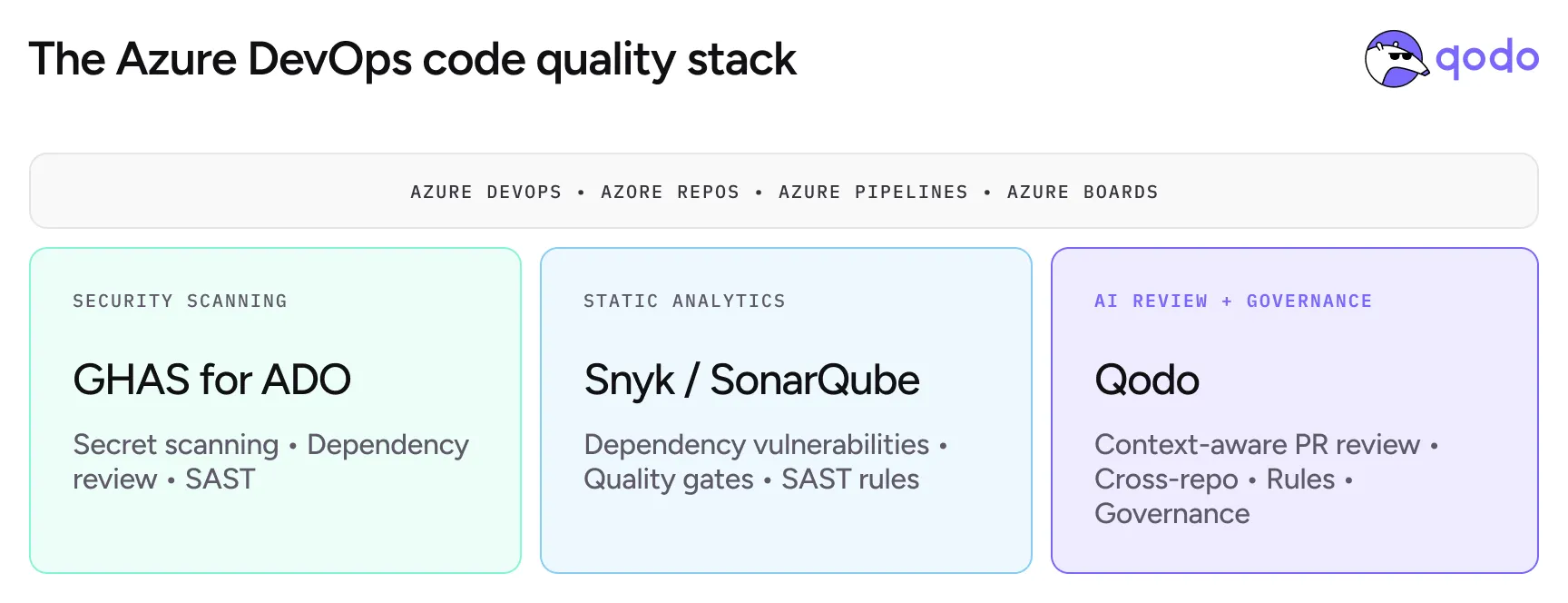
GitHub Advanced Security for Azure DevOps covers secret scanning, dependency review, and code scanning. Snyk and SonarQube handle static analysis, dependency vulnerabilities, and quality gates. The AI review and governance layer handles context-aware PR review, cross-repo reasoning, and the rules system that learns from your team’s PR history. None of these replaces the others.
AI code review tools by Azure DevOps edition
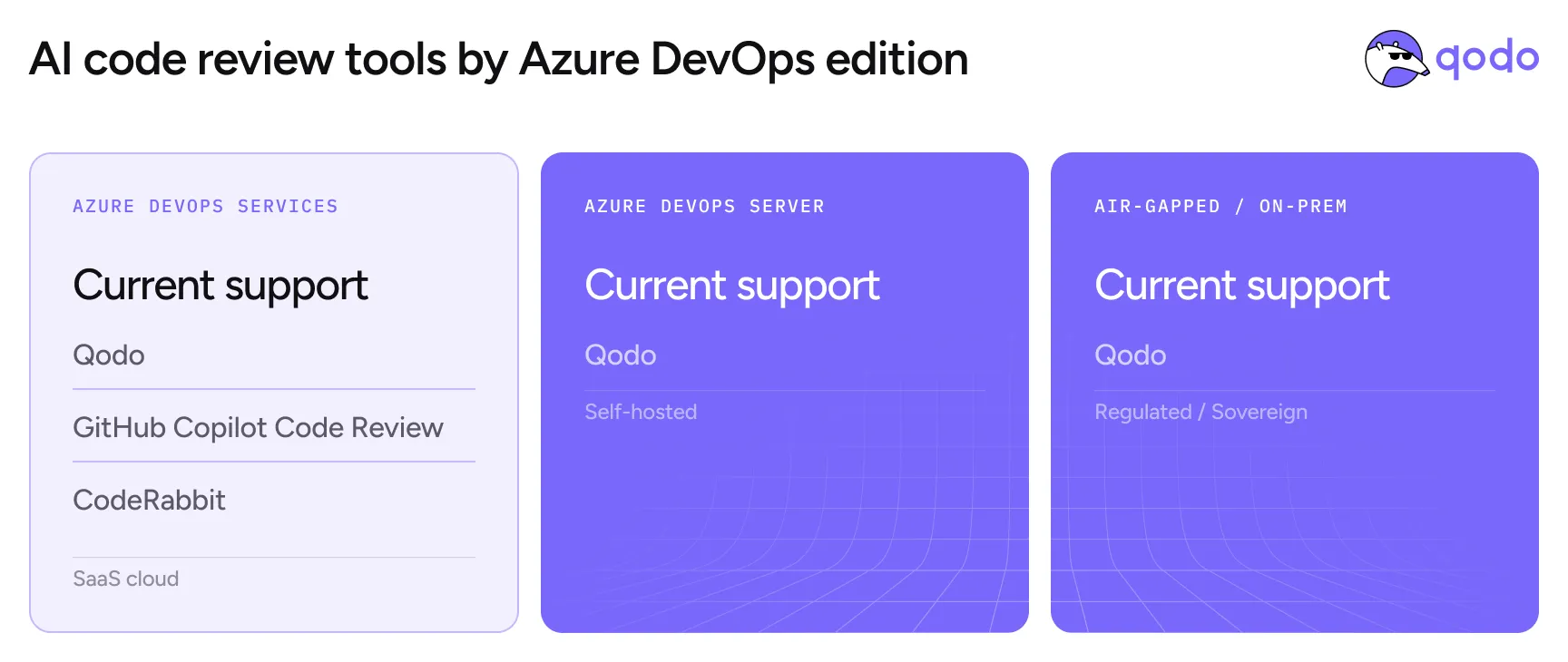
Which tool fits which Azure DevOps team
The right answer depends on where your team actually sits in the Azure DevOps ecosystem.
If your team looks like this…
Recommended stack
Why
Small to mid-size team on Azure DevOps Services, single repository
Qodo (Pro team)
Both support Azure DevOps Services natively with inline PR comments and Pipelines integration.
Team on Azure DevOps Services tracking work in Azure Boards
Qodo
Qodo links review findings to Azure Boards work items, keeping the review-to-resolution flow inside the Azure DevOps surface.
Enterprise team with multiple projects and shared libraries
Qodo
Cross-project review evaluates PRs against shared modules and API contracts. CodeRabbit reviews within the current repository only.
Enterprise team where standards live in reviewer memory and PR comments
Qodo with Rules Miner
Rules Miner mines your Azure DevOps PR history to generate enforceable standards automatically. Available in Beta.
Enterprise needing security scanning and quality gates alongside AI review
Qodo + GHAS for ADO + Snyk or SonarQube
Three layers, each covering what the others don’t.
Regulated enterprise on Azure DevOps Server, air-gapped or sovereign cloud
Qodo
The only tool with verified Azure DevOps Server and air-gapped deployment support.
For a broader comparison across all AI code review tools, see the full AI code review tools comparison. When you’re ready to set up on Azure DevOps, the installation docs walk through it in a few minutes.
What does Azure DevOps Server require that most AI code review tools can’t support?
Select the correct answer
Your team leaves the same PR comment repeatedly. What does that signal?
Select the correct answer
A PR looks clean inside one repository but breaks a service that depends on it. What kind of review would have caught it?
Select the correct answer
Frequently asked questions
No. Microsoft owns both but they’re different products. Azure DevOps ships Boards, Repos, Pipelines, and Test Plans as an integrated enterprise platform. GitHub is a developer platform built around Git hosting and the GitHub Actions ecosystem. AI code review tools that support GitHub don’t automatically support Azure DevOps.
Qodo is the only AI code review tool in this comparison with verified Azure DevOps Server and on-premise deployment support. CodeRabbit and GitHub Copilot Code Review are cloud-only for this use case.
Yes. Qodo runs as an Azure Pipelines task and posts review findings back to the Azure Repos pull request thread automatically on PR open.
Rules Miner analyzes your organization’s Azure DevOps pull request history to surface recurring review patterns and generate enforceable coding standards automatically. For enterprise teams where standards live in reviewer memory, this turns tribal knowledge into a managed rule system. Available in Beta on Azure DevOps.
Cross Repo Review maps how your Azure DevOps projects depend on each other and surfaces cross-project conflicts as findings on pull requests before code merges. It also works across Git providers — an Azure DevOps project that depends on a GitHub library is part of the same dependency map.
Yes. Qodo can link review findings to Azure Boards work items, keeping the review-to-resolution workflow inside the Azure DevOps surface
No. GHAS for ADO handles secret scanning, dependency review, and code scanning through static analysis. AI code review handles context-aware PR analysis, architecture rule enforcement, and cross-project reasoning. Most enterprise Azure DevOps teams run both layers.