

Best AI Code Review Tools for Bitbucket (2026)
The shortlist for Bitbucket is shorter than most comparisons suggest. Several well-known AI code review tools — including GitHub Copilot Review and Graphite — are GitHub-only and don’t support Bitbucket at all. Among the tools that do integrate, the meaningful differences come down to three things: whether review findings appear natively inside Bitbucket PRs, whether the tool connects to Bitbucket Pipelines, and whether it supports Bitbucket Data Center for teams running self-hosted infrastructure.

For teams in the Atlassian stack in 2026, Qodo and CodeRabbit are the primary options with native Bitbucket support. SonarQube covers security and quality gates but doesn’t perform AI-driven PR review. Sourcery works for Python-heavy teams but has limited enterprise features.
Key Takeaway
Most AI code review tools claim Bitbucket support, but the meaningful filters are narrower than they look: whether findings appear natively inside Bitbucket PRs, whether the tool connects to Pipelines and Jira, and whether it supports Bitbucket Data Center. Teams on Cloud have several options. Teams on Data Center, or in regulated industries, have one.
What You’ll Learn
- Which AI code review tools actually integrate with Bitbucket — and which are GitHub-only
- What “supports Bitbucket” really means, and the four levels of integration depth that matter
- Why Bitbucket Data Center shortens the tool shortlist to one
- How Qodo and CodeRabbit compare on Bitbucket Cloud, Pipelines, and Jira workflows
- Where SonarQube fits alongside AI code review in the Atlassian stack
- How to evaluate AI code review tools against your specific Bitbucket setup
What Bitbucket Integration Actually Requires
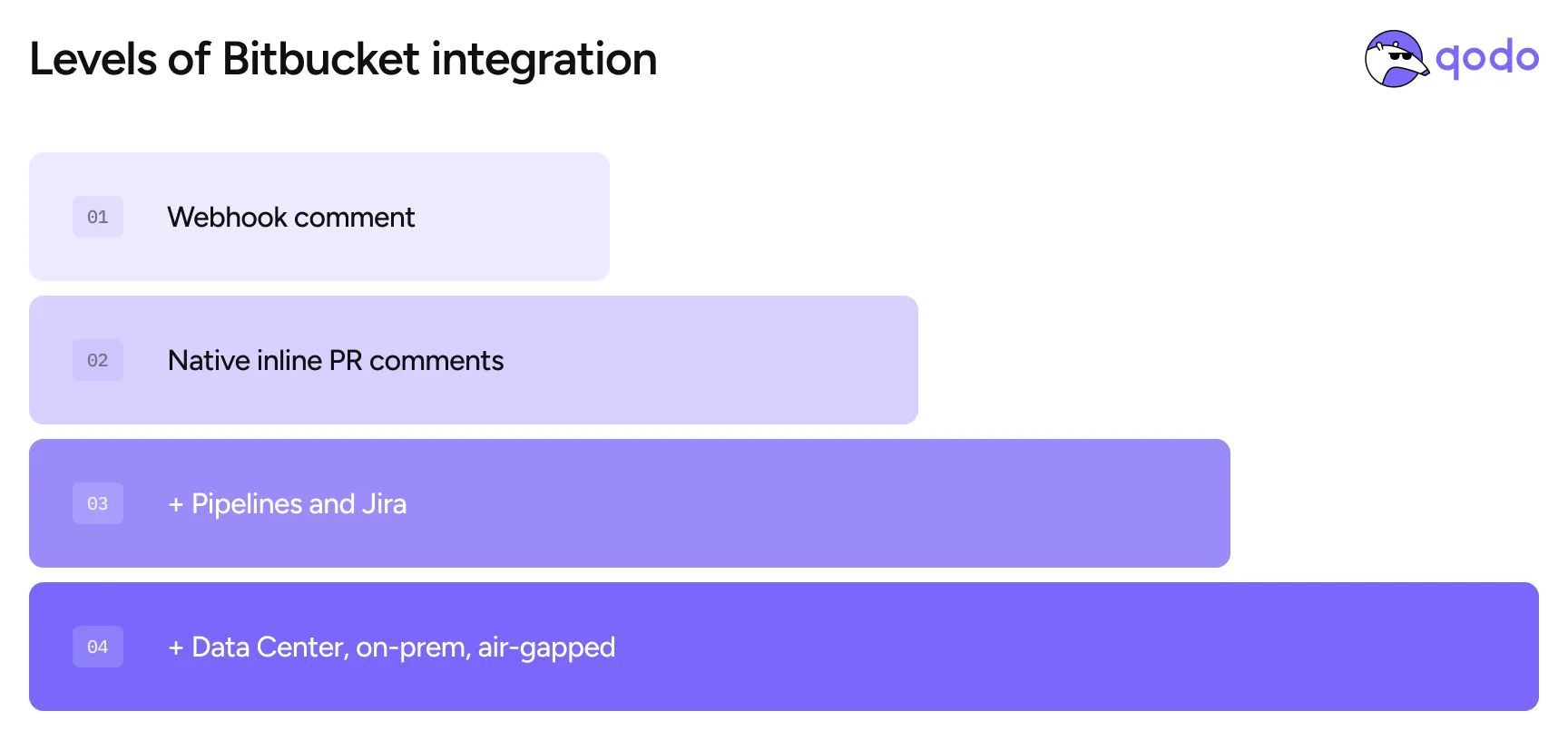
“Supports Bitbucket” can mean anything from a webhook that posts a comment to a full native integration with inline review, pipeline triggers, and Jira issue linking. Before evaluating tools, clarify which of these your team actually needs:
Capability
Why it matters
Native inline PR comments
Findings appear inside the Bitbucket PR UI, not in a separate dashboard
Bitbucket Pipelines support
Review runs automatically on PR open, without separate CI configuration
Jira integration
Violations can be linked to Jira issues or tracked in existing workflows
Bitbucket Data Center support
Required for self-hosted, air-gapped, or regulated environments
On-premise deployment
Required when code cannot leave internal infrastructure
Teams that only need inline PR comments can use several tools. Teams that need Data Center support or on-premise deployment have a much shorter list.
How the Leading Tools Compare on Bitbucket
Bitbucket Cloud
Bitbucket Data Center
Inline PR comments
Pipelines
Jira integration
SonarQube is a strong complement to AI code review — particularly for security and compliance — but it doesn’t replace AI-driven PR analysis. It belongs in the stack alongside one of the other tools, not instead of them.
Qodo on Bitbucket: Native Integration Across Cloud and Data Center
Qodo supports both Bitbucket Cloud and Bitbucket Data Center, making it the only AI code review tool in this comparison that covers the full Atlassian enterprise footprint.
On Bitbucket Cloud, Qodo’s Review Agent Suite integrates directly with the PR workflow:
- Review findings appear as inline comments inside the Bitbucket PR UI, organized by severity
- Findings are tied to rules defined in Qodo’s Rules System — not just model inferences
- Qodo connects to Bitbucket Pipelines, so reviews trigger automatically on PR open
- Jira integration links findings to existing issue tracking workflows without leaving Bitbucket
On Bitbucket Data Center, Qodo supports on-premise deployment including air-gapped environments:
- Source code stays inside internal infrastructure — nothing is routed through external SaaS
- Required for regulated industries, government contractors, and organizations with strict data residency policies
- The only AI code review tool in this comparison with verified Data Center support
Qodo’s cross-repository context works the same way on Bitbucket as it does on GitHub. The Context Engine evaluates PRs against API contracts, shared modules, and organization-level rules that may live in other repositories — not just the one being reviewed.
CodeRabbit on Bitbucket: Good for Cloud, No Data Center Support
CodeRabbit offers Bitbucket Cloud integration with native inline PR comments and Pipelines support. For small to mid-size teams on Bitbucket Cloud who need faster, more thorough individual reviews, it’s a capable option.
Where it falls short for enterprise teams:
- No Bitbucket Data Center support — teams on self-hosted infrastructure can’t use it
- No on-premise deployment option — rules out air-gapped environments entirely
- Jira integration is limited compared to Qodo — findings don’t link naturally into Jira workflows without additional configuration
- Review scope is bounded to the current repository — no cross-repo contract or shared module awareness
Bitbucket Data Center: Why the Tool Shortlist Gets Much Shorter
Bitbucket Data Center is the self-hosted edition of Bitbucket, used by enterprises that manage their own infrastructure for compliance, security, or data residency reasons. The same reasons those organizations choose self-hosted Bitbucket are the reasons they can’t use cloud-only AI code review tools.
Requirements for Bitbucket Data Center environments:
Requirement
Why it's needed
On-premise or private cloud deployment
Source code cannot be sent to external APIs
Air-gapped environment support
Tool must run without outbound internet access
Audit logging
Review decisions need to be traceable for compliance
SSO and access control
Integration with existing identity infrastructure
Qodo meets all four requirements for Bitbucket Data Center. SonarQube covers quality gates and security scanning but not AI-driven PR review. Every other AI code review tool in this category is cloud-only.
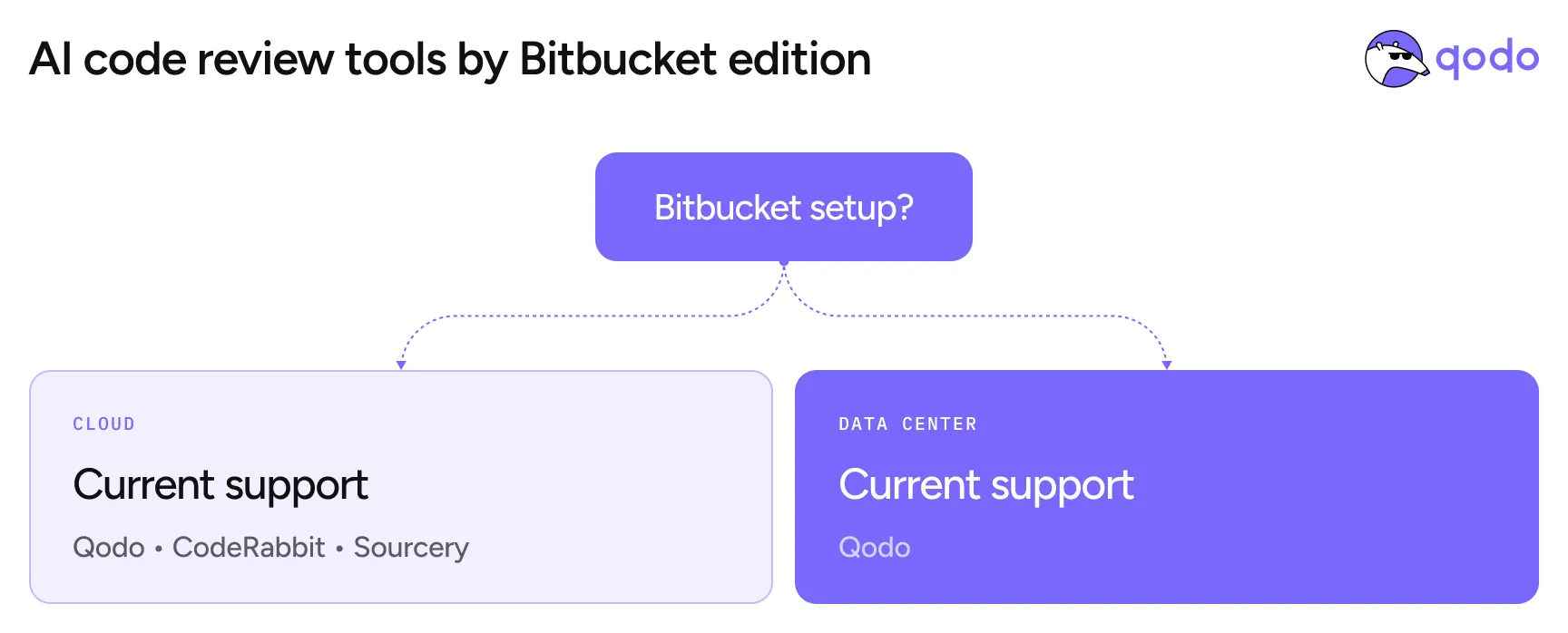
For regulated industries — financial services, healthcare, defense, government — Bitbucket Data Center support isn’t a nice-to-have. It’s the deciding factor.
Which tool fits which Bitbucket team
The right answer depends less on which tool scores highest on a feature list and more on where your team actually sits in the Atlassian ecosystem.
If your team looks like this…
Recommended stack
Why
Small team on Bitbucket Cloud, single repo, Python-heavy codebase
Qodo + Sourcery
Sourcery adds Python-specific linting and refactoring suggestions. Qodo handles the broader review and governance layer. The two cover different concerns and work alongside each other without overlap.
Team on Bitbucket Cloud running Jira for issue tracking
Qodo
Qodo’s Jira integration links findings to existing issues in both directions — finding severity mapped to Jira priority, violations creating tickets automatically. No additional configuration needed.
Team with multiple services or shared libraries on Bitbucket Cloud
Qodo
Cross-repository context evaluates PRs against shared modules and API contracts across repositories. Most tools review within the current repository only.
Enterprise team needing security scanning and quality gates alongside AI review
Qodo + a static analysis or SAST tool
SonarQube is the most common pairing for Atlassian-stack teams. Snyk is a strong fit for cloud-native teams focused on dependency and open-source vulnerability scanning. Semgrep suits security-minded teams who want to write and own their own rules. Checkmarx and Veracode are common in regulated industries with enterprise SAST requirements. Qodo handles the AI review and governance layer; any of these handles the static analysis layer.
Enterprise team on Bitbucket Data Center, regulated environment, or strict data residency
Qodo + a static analysis or SAST tool
Qodo is the only AI code review tool with verified Data Center and on-premise deployment support, including air-gapped environments. SonarQube and Checkmarx both have Data Center-compatible editions for the static analysis layer.
The pattern across every profile: Qodo is the AI review and governance layer regardless of which Bitbucket edition your team runs. The static analysis and security layer — SonarQube, Snyk, Semgrep, Checkmarx, or Veracode — sits alongside it and serves a different purpose. No profile in this table is a one-tool answer, which reflects how real Atlassian-stack engineering teams actually operate.
Quiz
Why does cross-repository context matter for AI code review on Bitbucket?
Select the correct answer
Which capability is the strongest filter when shortlisting AI code review tools for Bitbucket Data Center?
Select the correct answer
What does Jira integration add to an AI code review workflow on Bitbucket?
Select the correct answer
Frequently Asked Questions
No. GitHub Copilot Code Review is GitHub-only and does not integrate with Bitbucket Cloud or Bitbucket Data Center. Teams on Bitbucket looking for AI code review should evaluate Qodo or CodeRabbit instead.
Qodo is the only AI code review tool with verified Bitbucket Data Center support and on-premise deployment options. SonarQube supports Data Center but focuses on static analysis and quality gates rather than AI-driven PR review — most teams use both Qodo and SonarQube together.
Yes. Qodo integrates with Bitbucket Pipelines and triggers automatic reviews on PR open without additional CI configuration. Reviews appear as inline comments inside the Bitbucket PR UI.
No. CodeRabbit supports Bitbucket Cloud only and has no on-premise deployment option. For self-hosted Bitbucket environments, Qodo is the only AI code review tool that supports Data Center and air-gapped deployments.
Yes. Qodo integrates with Jira, allowing teams to link review findings to Jira issues and track violations within existing Atlassian workflows. This makes Qodo a natural fit for teams already running Bitbucket, Jira, and Confluence together.
No — they serve different purposes. SonarQube handles static analysis, security scanning, and quality gates. Qodo handles AI-driven PR review, architecture rule enforcement, and cross-repository context. Most enterprise Bitbucket teams run both: SonarQube as the quality gate layer, Qodo as the review and governance layer.