Best Graphite Alternatives for Developer Teams in 2025
TLDR
- Graphite helps teams manage large pull requests by breaking them into stacked PRs, automating rebases, and visualizing dependencies. This reduces the effort of massive merges and lost context. However, it can significantly increase CI costs and reviewer workload when stacks grow long.
- When base PRs receive late feedback, all dependent PRs must be rebased and retested, creating cascading work. Teams may notice delays in iteration speed and reviewer fatigue, especially in fast-moving frontend or small teams. These are common signals to evaluate graphite alternative tools.
- Teams look for graphite alternatives like Qodo, CodeRabbit, and Greptile when Graphite’s stacked workflows introduce overhead, slow iteration, or increase costs. These AI-based code review tools provide AI-backed, context-rich feedback while keeping development and review processes efficient.
- I prefer using Qodo because it integrates into pull requests and IDEs to deliver context-aware code reviews. It uses retrieval-augmented generation (RAG) to fetch relevant documentation, coding standards, and similar past reviews, helping developers identify logic, formatting, and business rule inconsistencies before merge time.
- CodeRabbit integrates with IDEs like VS Code and Cursor to deliver real-time code feedback, pull request summaries, and actionable suggestions. It combines static analysis with AI insights, helping reviewers understand potential issues without switching contexts, lowering cognitive load.
- Greptile delivers lightweight, context-aware PR analysis and automated summaries for GitHub or GitLab. It highlights inconsistencies, enforces coding patterns, and flags architectural issues quickly, acting like a fast second pair of eyes for developers during reviews.
When you’ve spent years building software teams, nothing tests patience like a pull request (PR) that sits idle for days, weeks, or even months before seeing feedback. As your team grows and your application adds more features, open PRs start drifting from the main branch. Merge conflicts pile up, and the mental context of the work gets lost.
Developers today love to work with Graphite in the above scenario. Instead of forcing developers to juggle massive PRs or deal with endless rebases, Graphite introduces stacked pull requests, breaking large changes into smaller, linked PRs that can be reviewed and merged in order. On top of that, it automates painful tasks like rebasing when the parent branch changes, gives a clear view of dependencies between PRs, and smooths out merge sequencing so teams can keep shipping without constant disruption.
But as developers often point out on Reddit and developer forums, stacked workflows bring their own challenges like dealing with cascading rebases when a base PR changes, managing review fatigue across multiple dependent PRs, and sustaining context when reviewing mid-stack changes. If a base PR gets heavy feedback late in the cycle, every dependent PR above it needs to be rebased. Reviewers sometimes feel swamped when asked to review mid-stack changes without the full context. And for frontend teams doing rapid UI iterations, the overhead of stacks sometimes slowed things down more than it helped.
That’s why, in 2025, many engineering leaders are not just assessing Graphite, but also looking at alternatives for an AI code reviewer that address the same pain points in different ways. In this article, I’ll dig into those options, starting with Qodo, and explain where each tool fits depending on team structure, delivery model, and workflow discipline.
When to start considering Graphite alternatives
Even though Graphite brings structure and automation to pull requests, there are situations where the workflow creates new challenges. These aren’t flaws in the product, but signs that your team’s priorities, like cost control, review speed, or iteration pace, might be better served with a different approach.
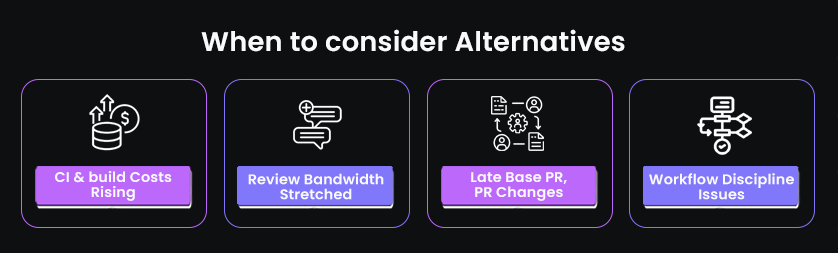
Here are some of the most common signals I’ve seen developers experience in real life:
1. CI (Continuous Integration) and build costs are growing faster than expected
The first sign is when your compute time (the amount of time your continuous integration (CI) service spends running builds, tests, and checks for your code) or build infrastructure costs start climbing out of proportion to your team size. With Graphite’s stacked PR model, every PR in the stack often kicks off its own CI run. If you have a stack of 7 changes, that could mean 7 full pipelines running in parallel.
For teams with long builds or large test suites, this quickly adds up in both cost and waiting time. One developer explained it bluntly: “Since Graphite creates a new branch for each change … you end up with 10 CI processes running in parallel, rather than the 1 you’d get if pushing to a single branch.”
2. Review bandwidth stretched thin
The second sign shows up when reviewers are swamped. Stacked workflows mean feedback can come mid-stack, and reviewers are asked to approve changes without the full context of what came before. This creates overhead and context switching fatigue. On Reddit, some reviewers noted they had to “jump between a ton of PRs just to review a single commit,” which slows everyone down. If your team’s review load is already heavy, the stacked model can stretch that even further.
3. Base PRs changing late in the cycle
The third common challenge is when feedback arrives late on a base PR. Imagine you have six stacked PRs, and the very first one needs big changes. Everything above it now needs to be rebased, tested again, and sometimes rewritten. Even a small adjustment in the foundation can ripple through the entire stack. Developers often say this feels like “dominoes falling”, one nudge at the bottom forces a cascade of work at the top.
4. Workflow discipline is becoming a bottleneck
The fourth signal is when the workflow itself starts feeling heavier than the work it’s supposed to streamline. Graphite assumes everyone on the team follows the stacked PR discipline consistently. But in reality, if only half the team adopts it properly, stacks can break down: merge order gets messy, branches drift, and reviewers lose trust in the process. Smaller teams or fast-moving projects often find that the coordination overhead outweighs the benefits.



Top 3 Graphite Alternatives for Developer Teams in 2025
To help teams evaluate options beyond Graphite, the table below compares the top three AI coding assistant alternatives. It highlights their focus, context-awareness, shift-left capabilities, and integration, enabling teams to quickly determine which tool best aligns with their workflow and scale.
| Feature / Tool | Qodo | CodeRabbit | Greptile |
| Focus | Context-aware AI code reviews in PRs & IDEs | Real-time IDE code feedback & PR summaries | Lightweight PR analysis & automated summaries |
| Best For | Enterprises needing shift-left reviews, policy enforcement, and deep code understanding | Fast feedback in IDEs, lowering context switching | Quick PR checks and coding pattern enforcement |
| AI / Context | RAG-powered, considers codebase, dependencies, and historical PRs | Static + generative AI with code graph analysis | Inline AI suggestions with PR context |
| Shift-Left & Remediation | Early feedback, one-click fixes | IDE feedback only, manual fixes | Post-push review, manual fixes |
| Pros | Reduces reviewer load, consistent standards, and actionable suggestions | Speeds review, lowers cognitive load | Fast, lightweight, highlights inconsistencies |
| Cons | Initial setup required | IDE dependency, learning curve | Limited deep context understanding |
| Integration | IDE + PRs, GitHub/GitLab/Bitbucket | VS Code, Cursor, Windsurf | GitHub, GitLab |
Top 3 Graphite Alternatives: Detailed Tool Reviews
1. Qodo (Top Pick)
Qodo is my top pick when it comes to automated code review. It is built for engineering teams that want AI support directly in their development lifecycle, not just as a post-review tool. What I really like about Qodo is its deep understanding of your codebase: it doesn’t give generic suggestions. Instead, it reviews changes in context, taking into account existing code, architecture, and project best practices.
Below is a diagram that I have shared to illustrate how Qodo Merge integrates effortlessly into the Software Development Lifecycle (SDLC) to increase code quality at every stage:
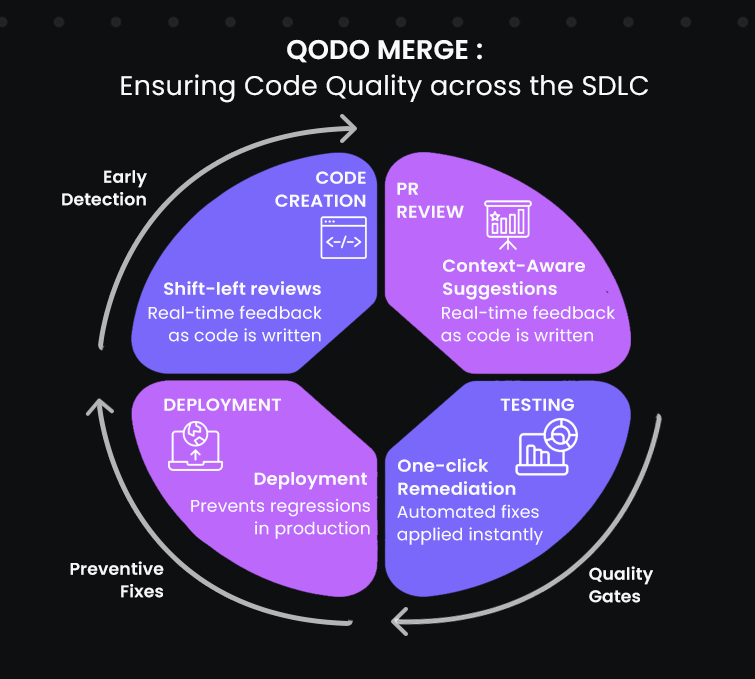
In the image above, we can see that starting from Code Creation, Qodo Merge encourages developers with Shift-Left Reviews, providing real-time feedback as code is written, effectively catching issues at their earliest point. As development moves into the PR Review phase, Context-Aware Suggestions uses AI to give intelligent recommendations, simplifying the review process and initiating collaborative improvement.
During Testing, Qodo Merge speeds up remediation with One-Click Fixes, allowing automated corrections to be applied instantly, saving time and resources. Finally, as code progresses to deployment, constant quality enforcement acts as a strong gate, ensuring that only high-quality, validated code makes it to production, halting regressions.
Best For
Teams that want to shift left on quality and security, automate repetitive review tasks, and keep context-rich code feedback directly where work happens, in the IDE and in pull requests.
First Hand Example: Reviewing a Pharma Sales Tracker PR
I was working on a pharma sales tracker used by regional managers to monitor drug sales across territories. The app already supported uploading sales data and filtering by rep or product, but it lacked a clear way to visualize monthly performance trends. So I had created a PR including an aggregation pipeline to compute total prescriptions, revenue, and average monthly prescriptions.
Here’s a snapshot of Qodo Merge PR code suggestions showcasing the suggestion and the impact severity, ensuring which one is to be fixed first:
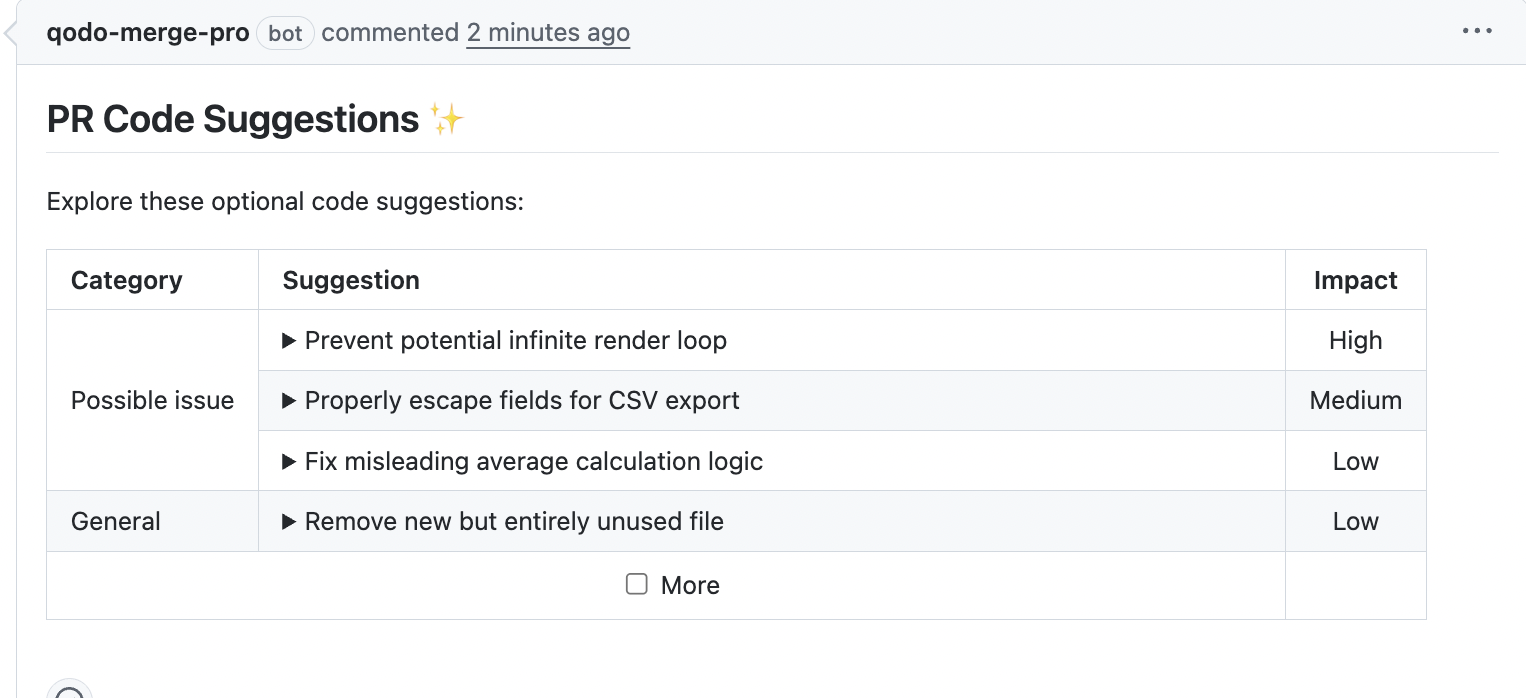
The review flagged a possible infinite render loop, missing CSV field escaping, and an average calculation that could mislead users. It also suggested removing a file that had been added but was never used. Each of these would have caused issues later, from broken exports to inaccurate reports.
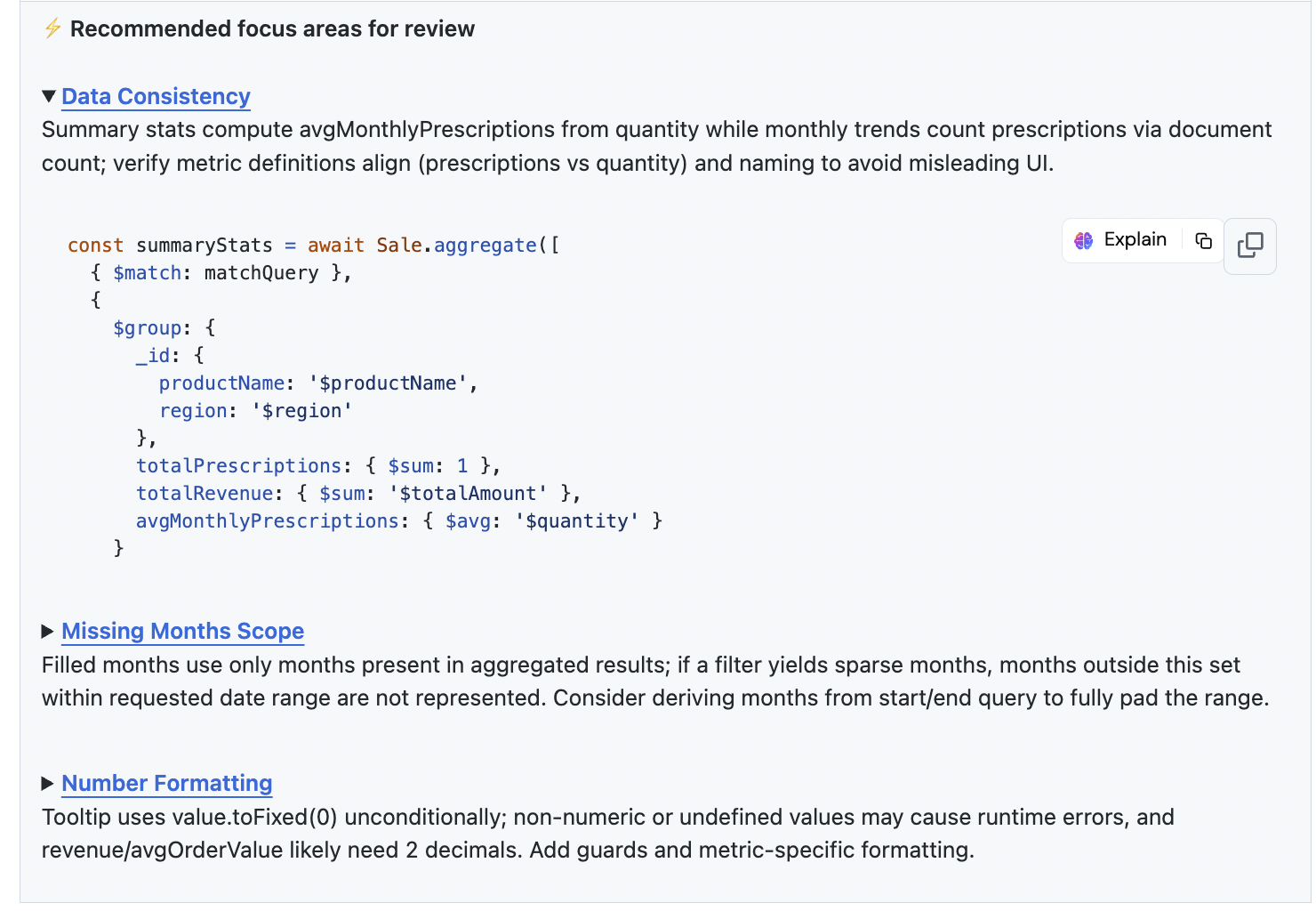
In the detailed review as shown in the image above, Qodo Merge went deeper into the aggregation logic. It highlighted that average prescriptions were calculated from quantity, while monthly trends were based on document counts, which would have shown inconsistent numbers to sales teams. It also caught that the empty months weren’t being represented in the charts, making the filtered results misleading.
On top of that, it pointed out that I was using value.toFixed(0) for tooltips, which risked runtime errors and cut off important decimal values for revenue and averages.
The feedback was tied directly to the business logic of the tracker. Fixes were clear: align the metric definitions, add padding for missing months, and improve number formatting with guards. By applying these suggestions in one pass, the PR moved from draft to production-ready without waiting on human reviewers to parse through the details.
Features
- Shift-left reviews: AI identifies code quality, architecture, and security issues at the PR stage, before merge.
- One-click remediation: Inline fixes developers can implement instantly, cutting down review cycles.
- Deep context analysis: Reviews code with full project awareness, considering dependencies, historical patterns, and best practices.
- RAG-enriched suggestions: Pull relevant documentation, previous PRs, and coding standards to generate precise, actionable guidance.
- Lifecycle coverage: Gen for code creation, Cover for unit test generation, Merge for AI-backed PR collaboration.
- Configurable policies: Let teams enforce review standards and coding guidelines consistently across repos.
Pros
- Delivers context-aware feedback, lowering false positives and low-value suggestions.
- Supports enterprise Git workflows (GitHub, GitLab, Bitbucket).
- Balances individual productivity with team-level review governance.
- Makes AI suggestions explainable and actionable.
Cons
- Requires some initial setup effort to align review rules, workflows, and policies.
- Best value is realized only when teams consistently adopt it within their existing Git workflows.
Pricing
Developer: $0 / 75 PRs per month
- Open Source edition, limited to 75 PRs/month
- Basic code review, automated issue detection, and IDE integration
- Community support
Teams: $30 / user per month, 2,500 PRs
- All Developer features
- Automated PR descriptions, ticket compliance checks
- Custom best practices, private support, optional SSO
Enterprise: Contact for pricing for full platform access with advanced review, security, and compliance features
2. CodeRabbit

CodeRabbit is an AI-driven code review tool designed to enhance developer productivity by providing context-aware feedback directly within the development environment. It integrates with popular IDEs like VS Code, Cursor, and Windsurf, offering real-time code analysis and suggestions. By combining static analysis with generative AI, CodeRabbit delivers insights that are both actionable and aligned with the project’s coding standards.
Best For
Best for development teams seeking to streamline their code review process without compromising on quality. It’s useful for teams working in fast-paced environments where quick feedback is important, and for those looking to reduce the cognitive load on reviewers.
First-hand Example: Reviewing a Scheduling Feature
I was working on a scheduling feature that used react-big-calendar to display events. To style the events differently based on priority, I overrode the eventWrapper and returned a bare <div> with custom classes. The implementation worked visually, but CodeRabbit flagged it as a potential issue.
Refer to this snapshot:
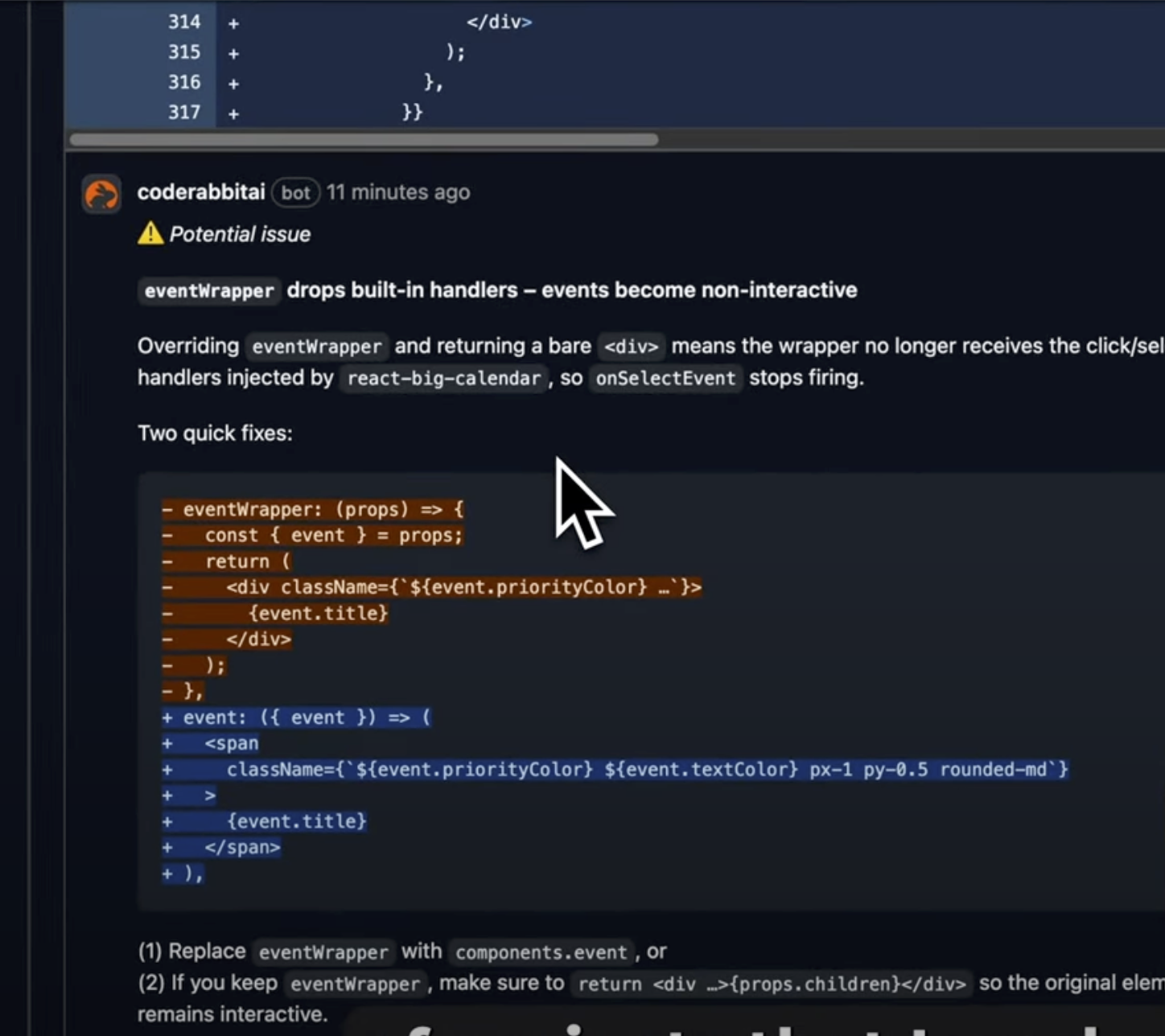
The review explained that by replacing the wrapper with a plain <div>, the event lost built-in handlers from react-big-calendar, which meant that clicks and selection logic (onSelectEvent) stopped firing. This was something easy to miss in manual testing because the UI looked fine, but event interactivity was broken under the hood.
The suggestions were simple: either replace eventWrapper with components.event, which keeps the handlers intact, or ensure the wrapper still returns {props.children} to preserve interactivity. It also showed a revised code snippet using a <span> that styled the event while sustaining handler functionality.
Features
- IDE Integration: Provides real-time feedback within the developer’s preferred IDE, keeping workflow continuity.
- Context-Aware Analysis: Uses code graph analysis to understand the broader context of changes, enhancing the relevance of suggestions.
- Pull Request Summarization: Automatically generates concise summaries of pull requests, highlighting key changes and potential issues.
- Security and Linting Support: Integrates with popular static analyzers and security tools to identify vulnerabilities and code quality issues.
- Agentic Chat: Gives an interactive chat feature for developers to discuss code changes and receive explanations for suggestions.
Pros
- Enhanced Productivity: Speeds up the code review process, enabling faster delivery of features.
- Improved Code Quality: Identifies potential issues early, leading to cleaner codebases.
- Seamless Integration: Works within existing development environments, minimizing disruption.
- Scalable: Suitable for teams of many sizes, from small startups to large enterprises.
Cons
- Learning Curve: New users may require some time to familiarize themselves with the tool’s features and capabilities.
- Dependency on IDE: Relies on specific IDEs, which may not align with all team members’ preferences.
Pricing
CodeRabbit has a tiered pricing model:
- Free: Basic features with limited functionality.
- Lite: $12/month per developer, includes important pull request reviews and code graph analysis.
- Pro: $24/month per developer, adds advanced features like linters, SAST tools support, and agentic chat.
- Enterprise: Custom pricing with additional features tailored to organizational needs.
3. Greptile
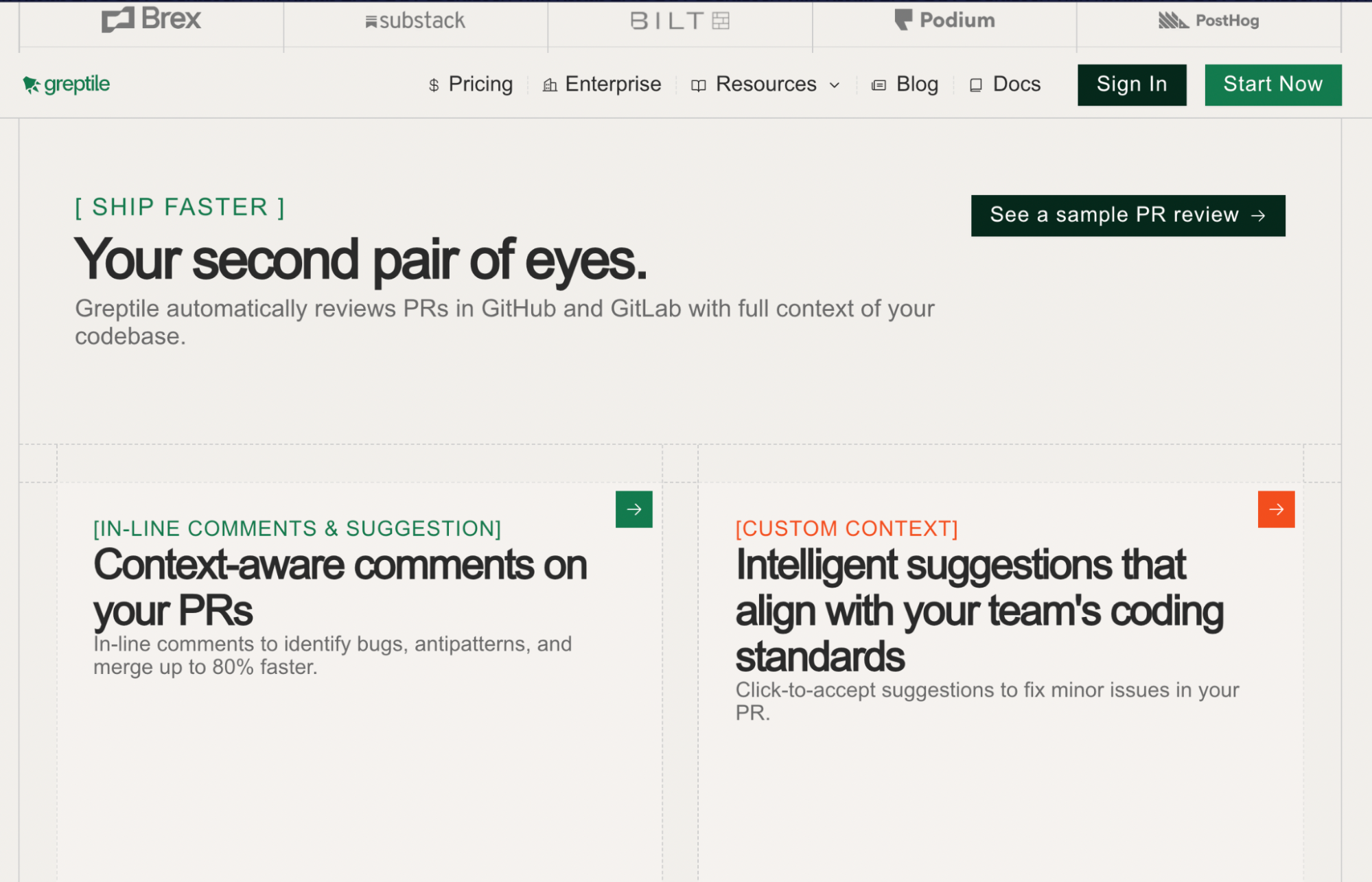
Greptile is an AI-driven code review tool that improves developer productivity by providing context-aware feedback directly within the development environment. It integrates with popular platforms like GitHub and GitLab, offering real-time code analysis and suggestions. With the integration of static analysis with generative AI, Greptile delivers insights that are both actionable and aligned with the project’s coding standards.
Best For
Development teams seek to streamline their code review process without compromising on quality. It’s great for teams working in fast-paced environments where quick feedback is important, and for those looking to reduce the cognitive load on reviewers.
First Hand Example: Reviewing a Revenue Analytics PR
I tested Greptile by checking in on one of my open PRs. After pushing my changes, Greptile automatically generated a summary of the PR. In this case, it explained that the update introduced a new revenue analytics flow by transitioning from charges to invoice items as the main data source. The summary was clear and covered the architectural impact across multiple components.
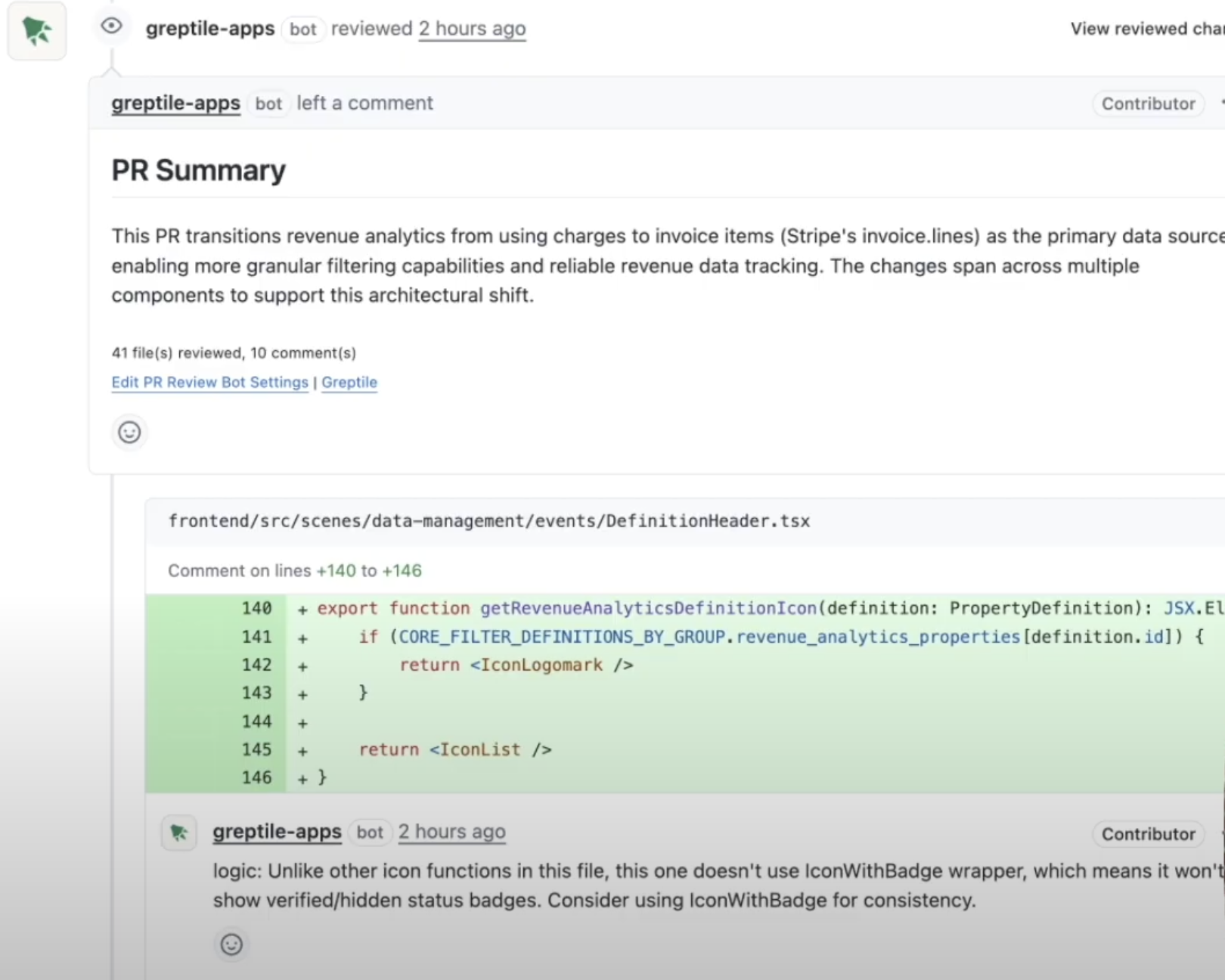
Along with the summary, Greptile also left inline comments on the code. For example, I added a new function to return an icon based on the revenue_analytics_properties definition. Greptile flagged that, with distinct similar functions in the file, this one didn’t wrap the icon with IconWithBadge. It suggested using the wrapper for consistency, since the badge is used to show verified or hidden states.
The feedback was simple, contextual, and helped me notice a detail I might have missed. Overall, the review felt similar to having another developer double-check the code, but much faster.
Features
- Reviews pull requests with full codebase context (i.e., understands how files, functions, and modules connect).
- In-line comments, suggestions, and PR summaries (with diagrams, file-by-file breakdowns, confidence scores).
- Conversational interface: you can ask follow-ups, request clarification via comment commands (e.g., @greptileai <question>).
- Customizable rules & style guides, scoped rules per repo or path.
- Self-hostable / deployable in VPC (air-gapped environment) for security/compliance needs.
Pros
- More accurate reviews: context awareness helps catch bugs and cross-file issues that simple diff-based tools miss.
- Reduced review cycle times: many teams report much faster merges with automated review feedback in place.
- Enforced consistency: coding standards and conventions get applied uniformly across PRs via custom rules.
- Adaptability: the learning/feedback mechanism refines results over time to suit team style and preferences.
Cons
- Non-determinism: reviews may differ between runs due to model sampling or context variation.
- Learning curve/setup: You need initial configuration, tuning, and feedback to get useful results rather than spammy ones.
Pricing
Greptile has a tiered pricing model:
- Flat rate: $30 / active developer/month for cloud plan (includes unlimited repos, reviews, apps).
- Enterprise / self-hosted: Custom pricing (includes SSO, dedicated support, deployment options, compliance features).
- Historical note: They moved from a usage-capped pricing model to this simplified flat rate model in 2025 to make costs more predictable
Why Qodo is Better for Enterprise
Enterprises face unique challenges in code review: multiple teams working across hundreds of repositories, inconsistent adherence to coding standards, and bottlenecks in PR approvals that slow down delivery. Qodo addresses these challenges by bringing context-aware AI directly into the review process.
In my experience, Qodo has been one of the best AI code review tools because of its deep code understanding, reviewing changes with full awareness of the codebase. Using RAG, it pulls in historical PRs, coding guidelines, and documentation so every suggestion is grounded in the team’s context. This ensures feedback is precise, actionable, and aligned with the organization’s standards.
Qodo also emphasizes shift-left practices, catching issues early in the development lifecycle before they reach production. Features like one-click remediation allow developers to implement fixes instantly, lowering manual back-and-forth and keeping teams productive.
Conclusion
I’ve seen firsthand how PRs that sit idle block teams, create merge conflicts, and sap morale. Graphite helps by breaking changes into stacked PRs and automating rebases, but real-world workflows can still feel heavy when base PRs change or reviewers are swamped.
In 2025, many teams are exploring alternatives like Qodo, CodeRabbit, and Greptile. From my experience, Qodo is the best for enterprises: its deep code understanding, RAG-powered suggestions, and shift-left reviews make feedback precise, actionable, and scalable. One-click remediation and configurable policies keep teams productive while keeping high code quality.
The goal is clear: ship reliable code faster with less friction, and picking the right tool for your team’s workflow makes all the difference.
FAQs
1. What is Graphite used for in software development?
Graphite is primarily used to manage large pull requests by breaking them into stacked PRs. It automates rebases, sequences merges, and provides dependency visualization so developers can work on smaller, linked changes without juggling massive feature branches.
2. When should teams look for Graphite alternatives?
Teams often look for alternatives when stacked PRs increase CI costs, slow down iteration speed, or create a heavy reviewer workload. This is especially common in fast-moving frontend projects or small teams where late changes in base PRs cause cascading rework across the entire stack.
3. How does Qodo differ from Graphite?
In contrast to Graphite’s stacked workflow model, Qodo uses AI to deliver context-aware code reviews directly in PRs and IDEs. It leverages Retrieval-Augmented Generation (RAG) to incorporate documentation, coding standards, and past PRs, providing actionable, grounded suggestions without adding stack complexity.
4. Can Qodo help reduce review bottlenecks for enterprise teams?
Yes, Qodo is designed for enterprises dealing with hundreds of repositories and inconsistent review standards. It enables shift-left reviews, one-click fixes, and policy enforcement, which reduces manual reviewer load and ensures consistent quality across distributed teams.
5. Does Qodo integrate with existing Git workflows?
Qodo integrates effortlessly with enterprise Git platforms like GitHub, GitLab, and Bitbucket. This allows teams to adopt AI-backed review processes without disrupting their current development workflows, making it easier to scale across projects and teams.
About the author