Qodo vs CodeRabbit: Full Codebase Enforcement vs. Diff-Level Review (2026)

TL;DR:
CodeRabbit reviews the diff and adds comments to help reviewers understand what changed in the pull request. CodeRabbit stays focused on the current repository.
Qodo reviews the pull request against codebase context window and defines rules to catch bugs, breaking API responses, invalid data assumptions, and standard violations before merge. Qodo references contracts, shared modules, and rules across repositories, not just the files in the current diff.
The difference shows up when a pull request touches a service contract, violates a policy rule, or duplicates logic that lives in a shared module in another repository. CodeRabbit surfaces the issue as feedback. Qodo ties it to a defined rule and can block the merge until it is resolved.
The longer I’ve worked in large engineering teams, the less code review feels like “does this run” and the more it becomes a question of what was actually validated before merge.When something breaks in production, the questions are always same:
- Who approved this?
- Did anyone check the service contract?
- Was the auth boundary evaluated?
AI code review tools have made it easy to comment on a diff. The harder problem is consistency. Can a tool enforce the same checks across repositories without relying on the right person reviewing the right PR? That’s what I wanted to understand when I evaluated Qodo and CodeRabbit.
Both sit inside the PR workflow. Both analyze code changes and flag issues before merge. But they’re built on different assumptions about what code review is actually for. CodeRabbit is built to make individual reviews faster and more thorough.
Qodo is built to enforce rules defined across repositories, such as API contracts, shared utilities, and security policies, during pull request review. This difference shows up when a PR touches a service contract, violates a rule, or duplicates logic that already exists in another repository.
Qodo vs CodeRabbit: Key Differences in Pull Request Review
Let’s start the comparison by looking at how each tool structures and presents review feedback inside the pull request. The way findings are organized and prioritized directly affects how reviewers allocate attention and manage risk.
The difference becomes clear when you look at how each tool handles a pull request when the PR touches a service contract, violates a policy rule, or duplicates logic that lives in a shared module three repositories away. Now let’s go through a side-by-side comparison making the distinction more clear:
| Dimension | CodeRabbit | Qodo |
| Scope | Single repository | Across repositories |
| Focus | Explaining changes in a PR | Identifying risk and enforcing rules |
| Output style | Diff summary and walkthrough | Prioritized risk signals and review guidance |
| Decision support | Helps reviewer understand changes | Helps reviewer decide what must be addressed |
| Policy alignment | Advisory recommendations | Tied to defined rules and policies |
| Cross-repo awareness | Limited to current repository | References contracts, shared modules, and rules |
| Role in workflow | Review assistant | Review and rule enforcement layer |
Now, let’s look at how this difference shows up in how each tool structures feedback inside the pull request.
1. How Qodo and CodeRabbit Structure PR Review Feedback
The difference is not in whether issues are identified, but in how feedback is organized and how reviewer attention is guided.
How CodeRabbit Walks You Through a Pull Request
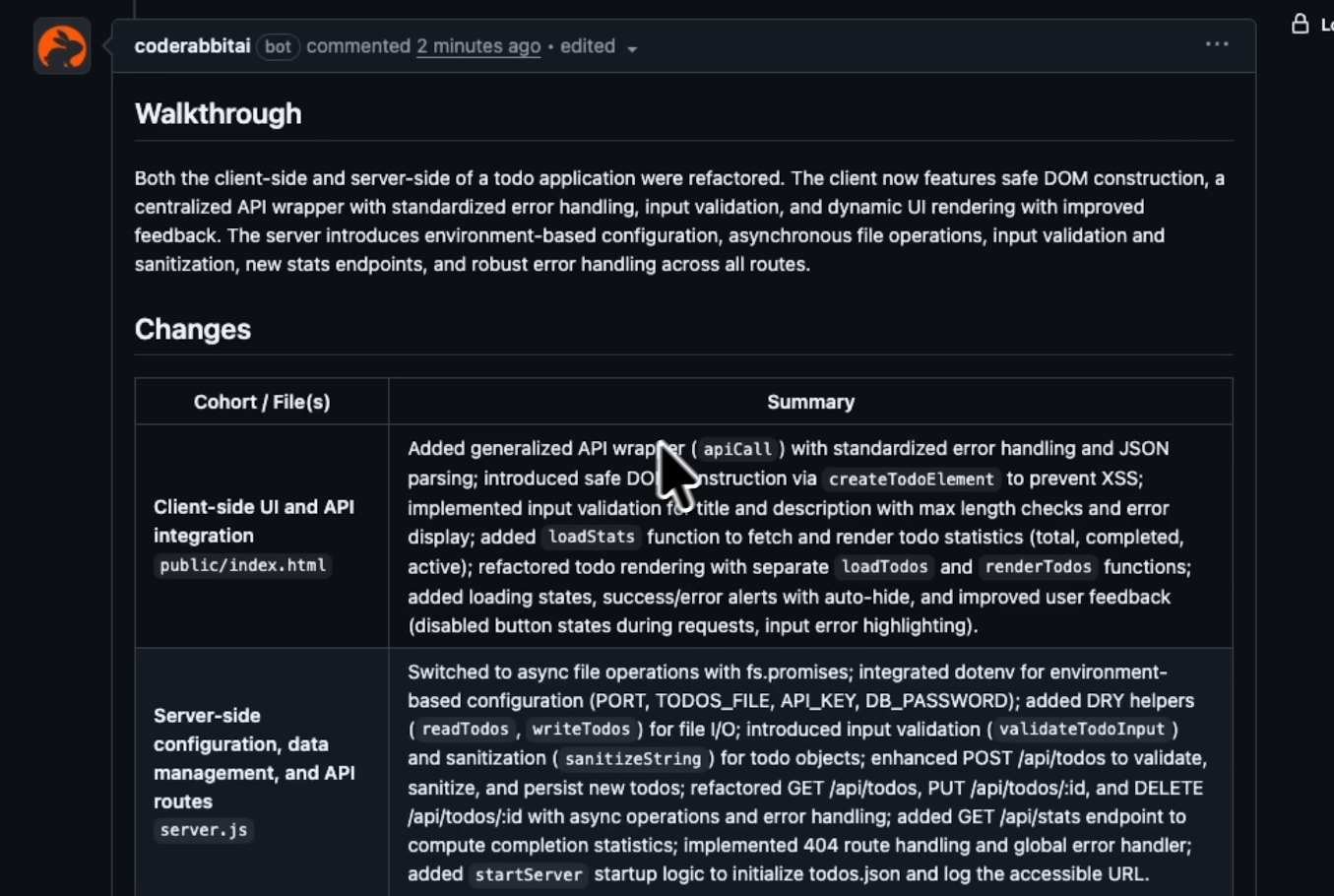
In the CodeRabbit screenshot, the review is presented as a structured walkthrough:
- A high-level summary of refactoring across client and server
- A breakdown by file cohort
- Detailed explanations of changes introduced
- Inline references to functions and code elements
This format is useful for understanding what changed and provides helpful narrative context around the diff. It reads almost like an annotated change log, which can be valuable when onboarding reviewers to larger PRs. However, the emphasis remains primarily descriptive. The output focuses on summarizing modifications rather than explicitly ranking risk, highlighting enforcement priorities, or separating critical concerns from general improvements.
How Qodo Shows You What Needs Fixing First
Now the Qodo screenshot added below presents the review as a structured reviewer framework rather than a simple summary of changes.
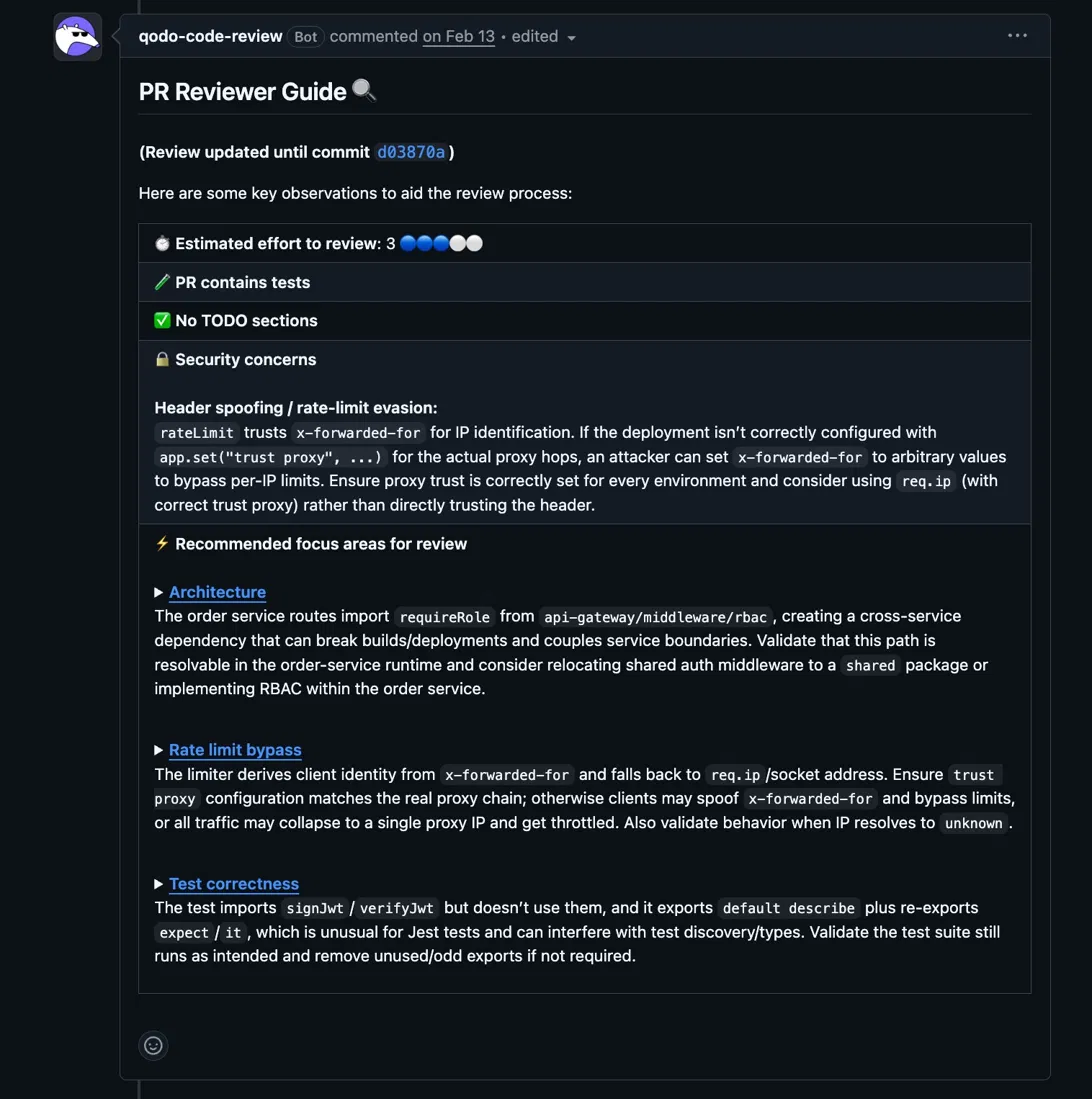
The code review is presented as a structured reviewer framework. Instead of walking through what changed, it ranks what deserves attention first:
- Estimated review effort
- Test coverage presence, explicitly confirmed
- Security concerns labeled and isolated (e.g., header spoofing / rate-limit evasion via x-forwarded-for trust misconfiguration)
- Focus areas grouped by category (Architecture, Rate Limit Bypass, Test Correctness)
- Risk explanations tied to runtime behavior, service coupling, or test integrity impact
Instead of primarily summarizing changes, the output guides the reviewer’s attention toward risk concentration points. Security issues are isolated and surfaced early, in this case, flagging that rateLimit trusts x-forwarded-for for IP identification, which can be spoofed if proxy trust isn’t correctly configured. Review focus areas are segmented (Architecture dependency, Rate Limit Bypass, Test Correctness), which helps triage the review in a structured way.
How PR Review Needs Change as Codebase Complexity Grows
In smaller teams, descriptive walkthroughs can be sufficient. Reviewers often have full context and can manually assess risk prioritization.
In larger organizations, however, structured prioritization reduces cognitive load and standardizes review behavior. When the tool itself categorizes security concerns, highlights missing tests, and estimates review effort, it effectively acts as a triage layer rather than a commentary layer.
From this specific comparison, Qodo demonstrates a stronger emphasis on risk signaling and review prioritization, while CodeRabbit provides a comprehensive narrative overview of changes. The difference is small but important: one organizes information around what changed, the other organizes it around what deserves attention first.
2. Policy Enforcement and Quality Gates: Advisory vs Governance
The biggest difference between CodeRabbit and Qodo isn’t whether they can identify potential issues. It’s what happens after those issues are found.
Some AI code review tools act as advisors, surfacing recommendations that reviewers can accept or ignore. Others act as governance platforms, enforcing engineering and security standards that every pull request must satisfy before it can be merged.
That’s the distinction between CodeRabbit and Qodo.
| Aspect | Advisory Model (CodeRabbit) | Governance Model (Qodo) |
| Review outcome | Suggestions for reviewers | Enforced engineering standards |
| Merge decision | Reviewer discretion | Can enforce organization-defined quality gates |
| Standards | Applied per review | Applied consistently across repositories |
| Knowledge source | Code diff and reviewer judgment | Organization-wide review standards and historical review patterns |
| Goal | Improve individual reviews | Standardize quality across engineering teams |
Policy enforcement transforms code review from a discussion into an organizational control. Instead of relying on every reviewer to remember internal standards, those standards become part of the review process itself.
CodeRabbit: It Flags Problems, But Your Team Decides What to Do
In the first screenshot, CodeRabbit flags a potential issue with Date.now() being used for ID generation, noting the risk of collisions under concurrent requests. It categorizes the issue (“Potential issue, Major”) and proposes a fix (crypto.randomUUID).
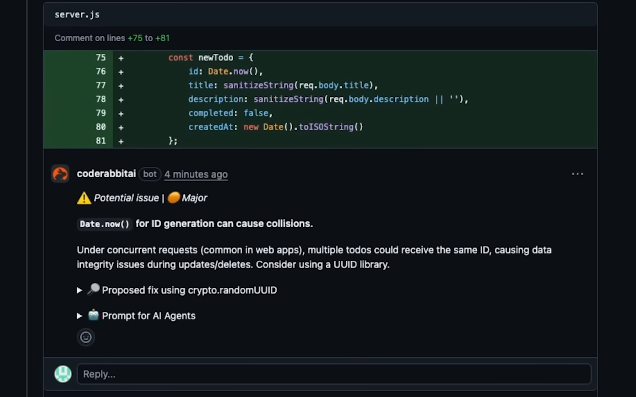
The tool identifies an integrity concern and proposes a remediation path. The interaction remains advisory:
- The issue is raised as a recommendation.
- There is no visible indication of enforceable gating.
- Merge control appears to remain entirely manual.
In this model, quality depends on whether the reviewer or author chooses to act on the recommendation.
Qodo: Governance Beyond Individual Reviews
To evaluate Qodo, I reviewed a pull request containing changes across multiple files without adding corresponding tests. Instead of only analyzing the modified code, Qodo identified critical application paths affected by the changes and highlighted potential regression risks.
In my test, it flagged that making the region field mandatory could break existing sales workflows, API clients, and older frontends that still submit payloads without the new field. It also identified a new reporting endpoint with no associated tests and warned that changes to the CSV export format could silently impact downstream consumers relying on the existing schema.
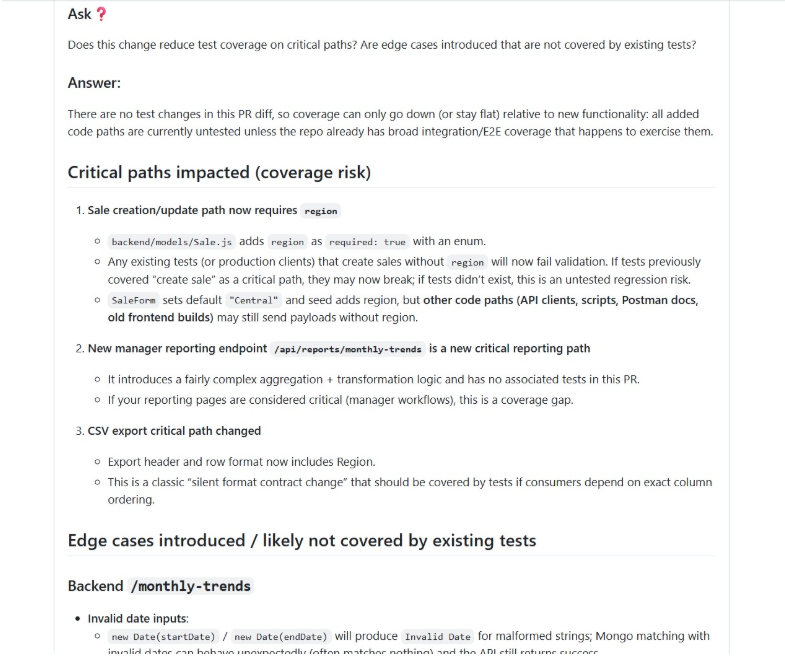
What impressed me was that the feedback went beyond generic code quality suggestions. Rather than simply recommending more tests, Qodo pinpointed which business-critical workflows and edge cases were now at risk, giving reviewers clear guidance on what should be validated before merging.
This becomes even more valuable when combined with Qodo’s governance capabilities. Teams can define their own Rules and Skills, allowing reviews to enforce organization-specific architecture, testing, and security standards instead of relying on generic best practices. As those standards evolve, Qodo applies them consistently across future reviews.
For enterprise engineering teams, Rules Miner further strengthens this workflow by learning review patterns from historical pull requests and automatically applying them to new ones. Skill Review Standards complement this with enforcement metrics and analytics, helping platform teams understand which review standards improve code quality and ensuring they are consistently applied across repositories and teams.
Suggestions vs. Standards: Which Code Review Model Does Your Team Need?
The practical difference emerges in how organizations operationalize review output:
- Advisory model: AI highlights risks; humans decide whether to act.
- Governance model: AI identifies policy violations; workflows can be configured to enforce standards.
In smaller teams, advisory feedback may be sufficient. In enterprise settings, especially where compliance, SOC 2, ISO, or internal security standards apply, policy violations cannot remain discretionary.
From the screenshots, CodeRabbit demonstrates contextual detection within individual PRs. Qodo’s Review Agent Suite, however, presents findings in a way that aligns more closely with enforceable quality gates and structured security policy adherence.
The distinction is not about the accuracy of analysis, but about the role the platform plays in the SDLC: one assists reviewers; the other functions as an embedded compliance control within the merge lifecycle.
Gartner Peer Insights puts a number on it: 94% of Qodo users are willing to recommend it, compared to 56% for CodeRabbit. CodeRabbit was not selected to participate in Gartner Critical Capabilities or Magic Quadrant. CodeRabbit is transactional. Qodo is strategic.
3. Cross-Repository Context: Qodo’s Context Engine vs CodeRabbit’s Scope
This is one of the first dimensions I look at. Most production issues I’ve dealt with did not originate from a syntax error inside a single file; they emerged at service boundaries. A missing auth header. A contract assumption. A configuration hardcoded in one repo but abstracted in another.
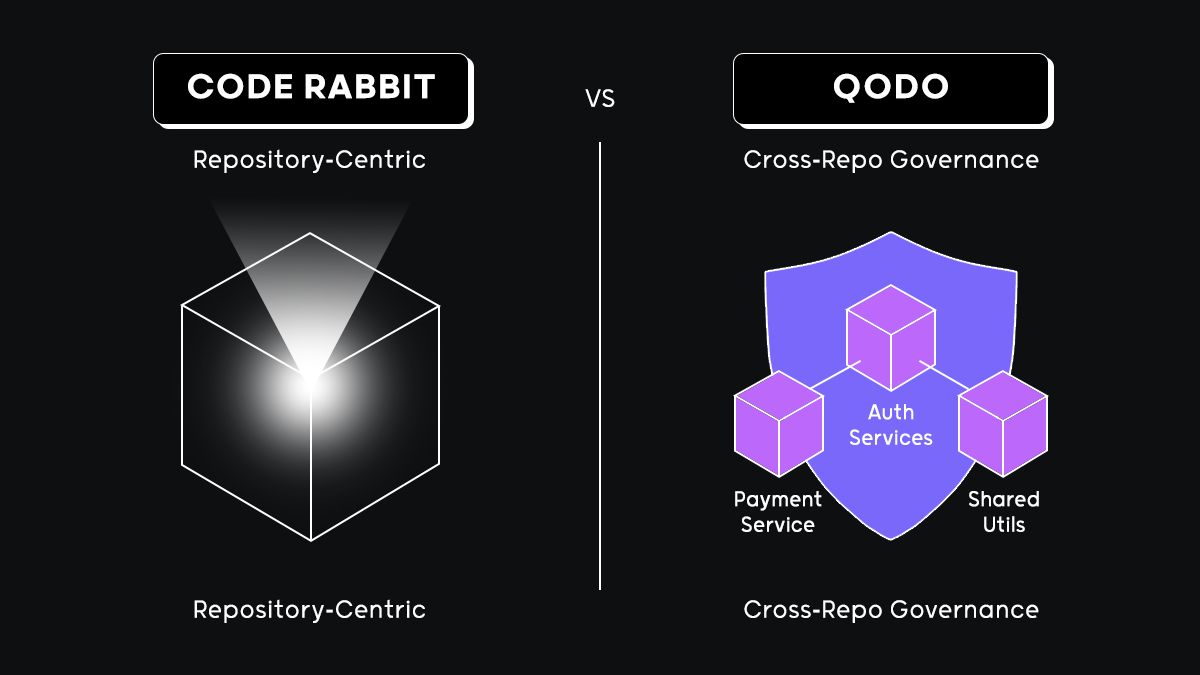
It is worth asking if a review tool understandsmy repository, and does it account for API contracts, shared modules, and service dependencies across repositories? Some of the most surprising issues I faced were often issues that happened inbetween repositories, whether it was an incompatibility or a broken contract.
How CodeRabbit Handles Repository-Level Review Scope
From the screenshot, CodeRabbit provides a well-reasoned comment about adding URL validation before redirecting. The feedback is technically sound and grounded in the current file’s behavior. It identifies a potential open redirect issue and suggests validation as a safeguard.
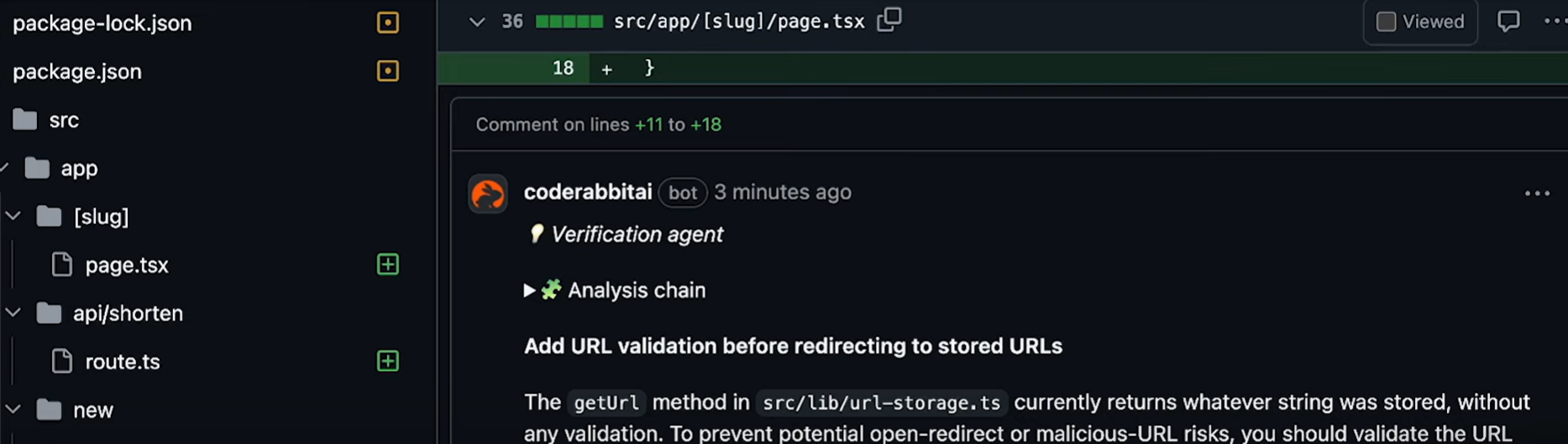
However, the analysis remains bounded by the repository in which the PR exists. Here, the reasoning is strong, but it is local.
It does not appear to:
- Reference external contracts
- Validate assumptions against another service’s expectations
- Check whether shared utilities exist in adjacent repositories
- Evaluate policy definitions outside the current codebase
In reality, this means the tool functions as an intelligent repository-level reviewer. For teams working primarily within a single service, that may be sufficient.

How Qodo’s Context Engine Expands Review Beyond a Single Repo
Well, the case in the Qodo screenshot shows the review reaching beyond the immediate repository. It references:
- The payments-service contract
- A contract definition file (contracts/payments-charge.json)
- Organization-level policy rules (.qodo.yaml)
- Cross-repo duplication concerns
- Service-to-service authentication expectations
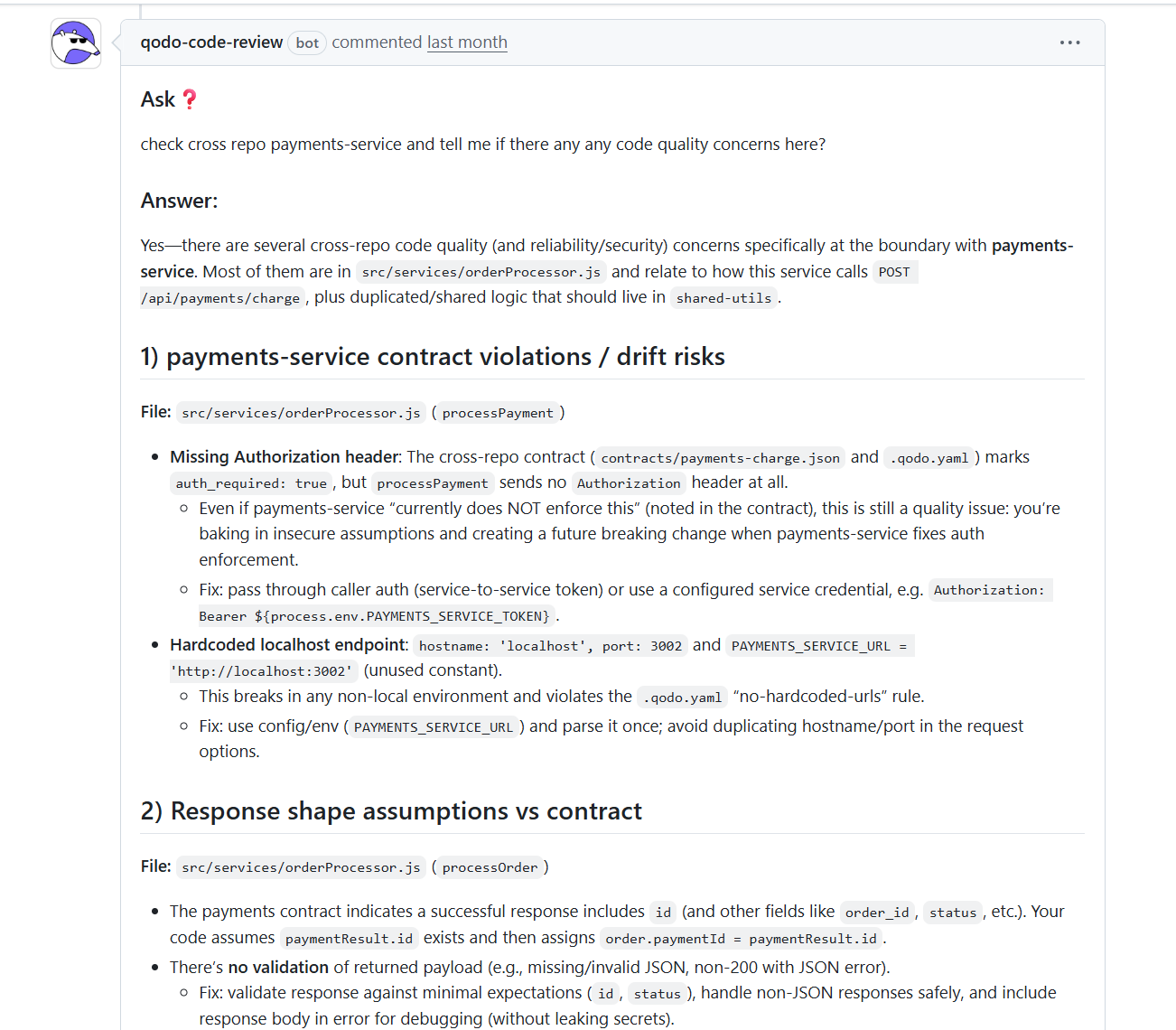
From my perspective, that changes the nature of the review. Instead of asking whether this code works in isolation, the review is asking whether this code behaves correctly within the broader system.
For example, say a contract defines an Authorization header but the downstream service doesn’t enforce it yet. Flagging that gap anyway shows that the AI code review tool is thinking about how the system will evolve and where contracts and reality drift apart. That kind of feedback prevents hidden inconsistencies that often come up much later, during integration testing or after a downstream service tightens enforcement.
The ability to tie review feedback to rules in Qodo’s Rules System is also significant. Many organizations maintain centralized configuration or rule definitions, but they rarely come up during PR reviews unless someone explicitly remembers to check them. If a tool can automatically evaluate changes against centrally managed rules in Qodo’s Rules System, it reduces reliance on individual memory and tribal knowledge. Over time, that leads to more consistent adherence to architectural standards.
Why Single-Repo Review Breaks Down in a Multi-Service Architecture
In smaller teams, senior engineers often carry cross-repo knowledge in their heads. In larger organizations, that does not scale. Shared utilities live in one repo. Platform lives in another. Reviewers cannot realistically cross-reference all of this on every PR.
- A repository-scoped reviewer improves code quality locally.
- A cross-repository-aware reviewer helps maintain architectural consistency across the system.
Qodo’s Context Engine demonstrates broader system awareness by incorporating contract definitions, policy rules, and shared component considerations directly into its analysis.
Gartner ranked Qodo #1 for Code Understanding, the only tool in this comparison to appear in Gartner Critical Capabilities for AI Code Assistants. That wider contextual scope reduces the risk of service drift and enforces alignment with organizational standards without relying entirely on human memory.
In enterprise environments with multiple teams and services, that difference becomes structural rather than cosmetic. For teams operating multiple services with shared contracts and centralized standards, Qodo better supports system-level consistency rather than just local code correctness.
4. Security, Compliance, and Rule-Based Enforcement in Code Review
Security review inside pull requests serves different purposes depending on the organization’s maturity. In some teams, it reinforces secure coding habits. In others, it functions as a formal compliance checkpoint.
CodeRabbit identifies security concerns within the context of the current pull request and explains the associated risks. The feedback operates at the code level and remains part of the PR discussion flow. Enforcement, however, depends on team processes rather than built-in policy structures.
Qodo presents security findings within a more structured framework. Issues such as hardcoded credentials are labeled with severity and tied to rules defined in Qodo’s Rules System. This framing positions security findings as policy violations rather than optional improvements, which aligns more closely with compliance-driven workflows.
How Qodo Standardizes Security Across Repositories
For organizations where security must be standardized and auditable across repositories, Qodo demonstrates stronger alignment with governance requirements. CodeRabbit provides in-PR visibility into risks, but Qodo embeds security into enforceable, organization-level standards through its Rules System, with deployment options including on-premise and air-gapped environments for regulated industries.
5. Which Tool Fits Which Team?
| Team Profile | Best Fit | Primary Reason |
|---|---|---|
| Small team, single repository, faster individual reviews | CodeRabbit | Low setup, immediate PR feedback, descriptive walkthrough |
| Enterprise org, multiple repositories, compliance requirements | Qodo | Cross-repo context, rule enforcement, merge gating, enterprise deployment |
| Multi-service architecture with shared contracts | Qodo | Contract validation, shared module detection, service boundary analysis |
| Team needing SOC 2, ISO 27001, or internal security policy enforcement | Qodo | Severity-classified findings tied to defined rules, on-premises deployment |
| Team wanting PR summary and review speed improvement | CodeRabbit | Structured diff walkthrough, inline suggestions, quick setup |
Why Enterprise Engineering Teams Choose Qodo Over CodeRabbit
After evaluating both tools across governance, cross-repository visibility, and organization-wide quality enforcement, I found that Qodo stands apart because it functions as engineering governance infrastructure rather than just an AI code review assistant. It fills the missing quality layer in the AI development stack by ensuring engineering standards are consistently applied across teams, repositories, and services.
Qodo extends review beyond the pull request itself. Instead of focusing only on the code diff, Cross Repo Review analyzes how changes affect dependent repositories and shared services, surfacing downstream impact before code is merged.
At the same time, Rules Miner automatically applies standards learned from historical pull request reviews, while Skill Review Standards provides engineering leaders with measurable governance through enforcement counts and analytics. Rather than relying on repository-specific configuration files or individual reviewer knowledge, review standards are managed centrally through the Qodo platform, ensuring every team follows the same engineering expectations at scale.
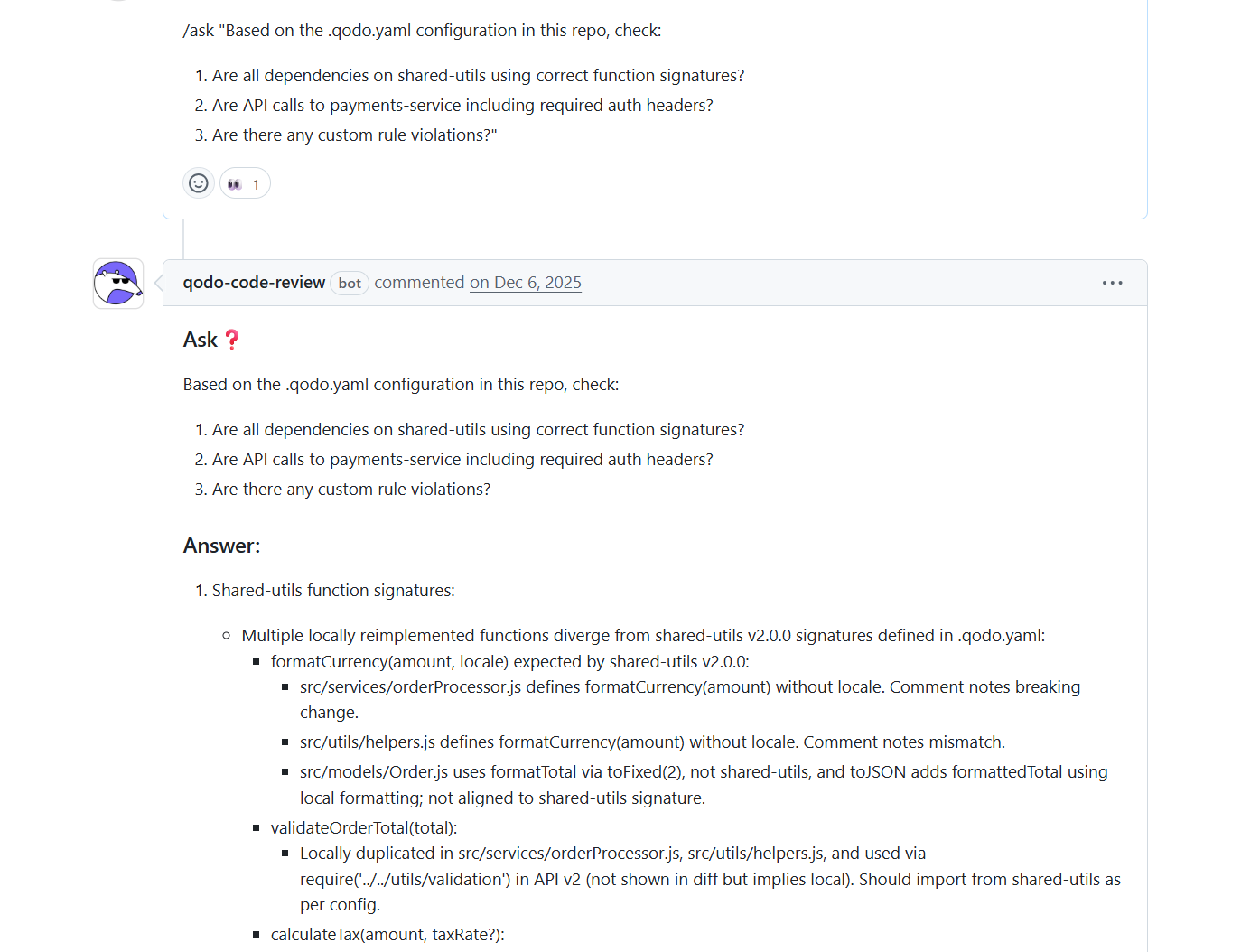
When I review pull requests in a multi-service system, I’m not only asking whether the code works. I’m asking:
- Does this violate any platform-level rules?
- Are we drifting from shared libraries?
- Are we duplicating logic that should live in a common module?
- Are we honoring service contracts and authentication requirements?
Qodo flags those concerns directly inside the PR, tied to configuration files and declared policies. That reduces reliance on memory, Slack threads, or tribal knowledge. It makes architectural expectations executable.
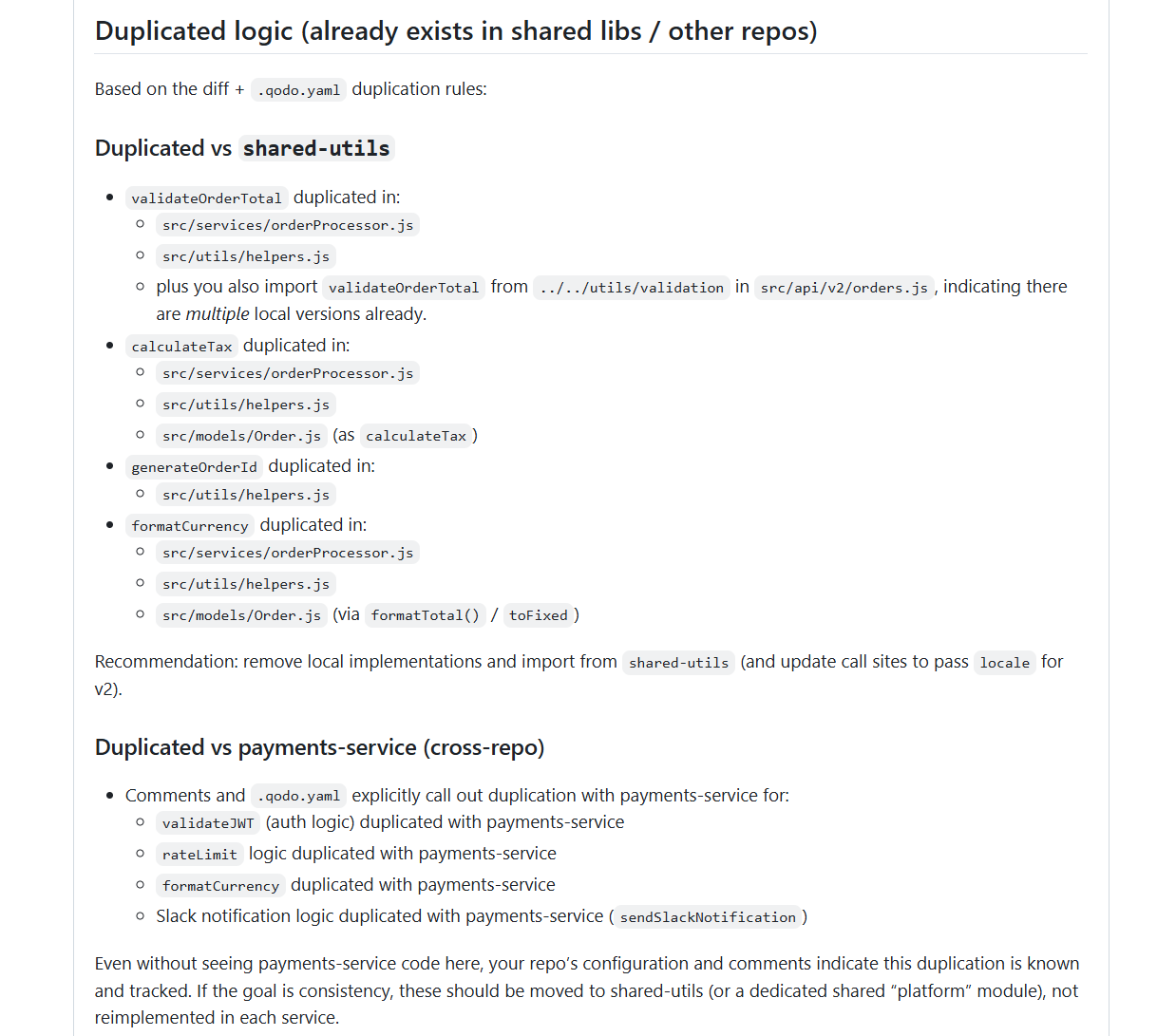
The duplication detection shown in the screenshots is a good example. It doesn’t just say, “You have repeated the code.” It identifies specific functions (validateOrderTotal, calculateTax, formatCurrency) that diverge from shared-utils and calls out cross-repo duplication with payments-service. That is exactly the kind of drift that accumulates silently in growing organizations.
Similarly, the contract validation behavior signals something important: Qodo is aware of external definitions. It doesn’t treat repositories as isolated units. It evaluates them in the context of declared interfaces and org-level rules.
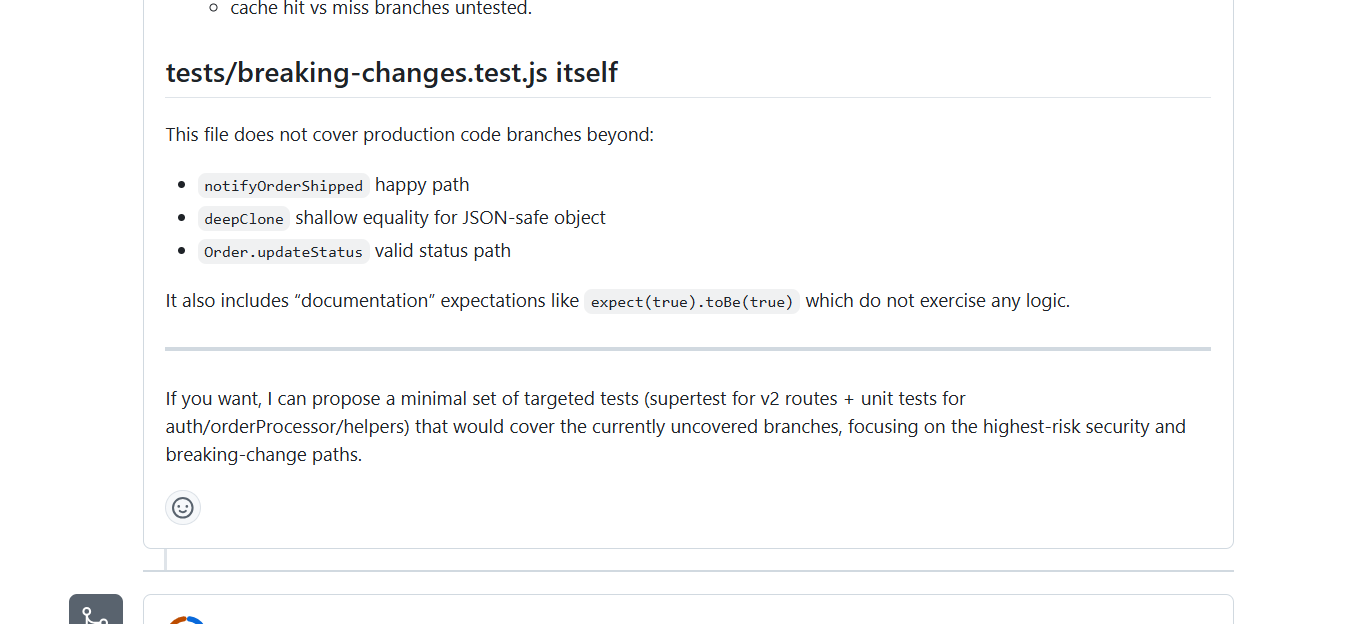
In enterprise settings, especially those with platform teams or AppSec oversight, systemic awareness is more valuable than isolated suggestions. The goal is not just better pull requests, it’s consistent enforcement of standards across dozens or hundreds of repositories. At monday.com, Qodo prevents an average of 800 potential issues from reaching production every month while saving developers approximately one hour per pull request.
From a scalability standpoint, I would choose Qodo because it reduces variance between teams. It translates policy into something reviewable and enforceable. It shifts quality control from individual reviewer judgment to structured governance embedded in the workflow.
For small teams optimizing purely for developer convenience, either tool could improve review quality. But for enterprises concerned with architectural consistency, compliance alignment, and cross-repo control, Qodo better fits the operating model.
Conclusion
CodeRabbit and Qodo both sit inside the PR workflow and flag issues before merge. For small teams focused on faster individual reviews within a single repository, CodeRabbit does that well.
Where the differentiation becomes clear is at enterprise scale. As repositories multiply and services grow more distributed, consistency becomes harder to maintain through human review alone. Standards drift, contracts evolve, and policy enforcement becomes uneven across teams.
In that context, the review tool must do more than comment on code; it must operationalize governance. Qodo’s Context Engine, Review Agent Suite, and Rules System work together as a closed loop: review findings feed the rules, and rules shape the next review. That’s what makes it the missing quality layer in your AI stack, not a faster way to comment on diffs, but a system that enforces standards consistently across every repo, every team, every PR. Gartner ranked Qodo #1 for Code Understanding and named it a Visionary in the 2025 Magic Quadrant for AI Code Assistants. CodeRabbit was not selected to participate in either.
Ultimately, the decision depends on what problem you are trying to solve. If the goal is smarter PR assistance, a repository-scoped AI reviewer may be sufficient. If the goal is sustained architectural consistency, enforceable quality gates, and system-level oversight across teams, Qodo better fits the needs of enterprise engineering organizations.
FAQs
What is the main difference between Qodo and CodeRabbit?
CodeRabbit focuses on helping reviewers understand changes within a single repository. Qodo analyzes changes against API contracts, shared modules, and defined rules across repositories, and can treat certain findings as rule violations rather than suggestions.
How do Qodo and CodeRabbit differ in pull request review?
CodeRabbit presents a structured walkthrough of what changed in a pull request, helping reviewers follow the diff. Qodo organizes findings around risk, highlighting issues such as breaking API changes, schema incompatibilities, or unsafe configuration so reviewers can prioritize what needs to be addressed before merge.
What does “advisory vs enforcement” mean in code review tools?
In an advisory model, the tool flags issues and leaves the decision to the reviewer. In an enforcement model, findings can be tied to defined rules so that certain issues must be resolved before a pull request can be merged.
Why is repository-level review not always enough for enterprise teams?
In multi-repo environments, services, APIs, and shared modules are maintained separately. A change in one repository can affect others. Repository-level review does not always capture these dependencies, which can lead to issues surfacing during integration or after deployment.
How does Qodo handle cross-repository dependencies?
Qodo references API contracts, shared modules, and rules defined across repositories. It can identify issues such as missing authentication headers, contract mismatches, or duplicated logic that exists in another repository.
What types of issues are typically missed in pull request reviews?
Issues that appear correct within a single repository but affect other components. This includes API response changes that break consumers, schema updates that do not account for existing data, configuration values that only work in one environment, and infrastructure changes that introduce deployment dependencies.
Can CodeRabbit enforce quality gates before merge?
CodeRabbit primarily provides feedback within the pull request. Whether a change is blocked or allowed typically depends on reviewer decisions or external CI/CD rules rather than built-in rule enforcement.
How does Qodo enforce standards during code review?
Qodo connects findings to rules defined in configuration files such as .qodo.yaml. Issues can be categorized by severity and linked to expected practices, which allows teams to apply consistent checks across repositories and influence merge decisions.
Which tool is better for multi-repository or microservices architectures?
Qodo is better suited for environments where services, APIs, and shared modules span multiple repositories and need to be validated against common rules and contracts.
When should a team choose CodeRabbit over Qodo?
CodeRabbit is a good fit for teams focused on improving pull request clarity and review speed within a single repository, where cross-repository dependencies and rule enforcement are less critical. Qodo is better suited for multi-repo environments where service contracts, shared utilities, and centralized rules need to be validated across repositories.
About the author